Friday, 22 July 2022


Monday, 25 April 2022
Monday, 4 April 2022
Monday, 3 February 2020
Sunday, 21 October 2018
The Real and the Fake 700 year old Great Mosque of Xi'an, China

We know that Internet is full of fake stuff. One such email doing rounds is the "700 year old Mosque in Xian Shanxi, China from the time of the Ming dynasty. The entire Quran is written on the walls of the mosque." An example of this tweet is here:
700 year old #Mosque in #Xian Shanxi, China from the time of the Ming dynasty.— Sabena Siddiqi (@sabena_siddiqi) March 11, 2018
The entire Quran is written on the walls of the mosque. pic.twitter.com/wSbGp0FQ9L
This mosque is Tiban Turen Mosque in Malang, Indonesia. Tiban Mosque is called because it is said that the mosque is in the village, with a narrow road, and with its grandeur was built without the knowledge of the local people. According to the myths circulating in this area the mosque building was built by a genie in just one night.
However, when this was confirmed to the secretariat, it was said that the construction of the mosque which was actually a complex of the Salafiyah Bihaaru Bahri Islamic Boarding School 'Asali Fadlaailir Rahmah was purely built by the students and worshipers.
In fact it is actually an Islamic boarding school. It has 10 levels, where each level has a different theme. On the 1st floor there are several large aquarium displays and souvenirs. Floors 2-6 You will be spoiled with various calligraphy carvings and ornaments that spoil your eyes. On floors 7-8 you can buy some of the mosque's special souvenirs. And at the end of the 9-10th floor you will be spoiled with views of the green and comfortable village from a height.
Some of the above info is Google translated from IloveMalang.
You can also watch this video for more info.

Now coming back to the Great Mosque of Xi'an, China, there is a recent article from The News, Pakistan.
The Great Mosque of Xi'an has charmed the Muslim dynasty with honor as much as any other religious heritage -- with one being epic calligraphy of entire verses from the holy book - Quran.
This largest mosque across the province of Shanxi, China has breathed seven hundred years since its birth during the Hongwu reign of the Ming dynasty, with further additions during the Qing dynasty, still stands gracefully -- portraying all the elegance in its wall calligraphy.

The architecture excellence takes its mantra from a fusion of Arabic and Nastaliq script brought on to the walls with no voids for imperfection and is indeed a blissful gift, which after construction was next taken in responsibility and renovation under impact of Qing dynasty.
What adds to its perfection is the scripting brilliance yet in its fine prominence and gathers as much believers as any other would.
In 1956, the mosque was declared a ‘historical and cultural site protected at the Shaanxi province level, and was later promoted to a ‘major historical and cultural site protected at the national level in 1988. The mosque is still used as a place of worship by Chinese Muslims, primarily Hui people, today.
Friday, 25 August 2017
The First Female Commander in the Modern World Was Muslim – Meet Aceh Malahayati

Thursday, 23 March 2017
When the Netherlands Had a Muslim-Majority Empire
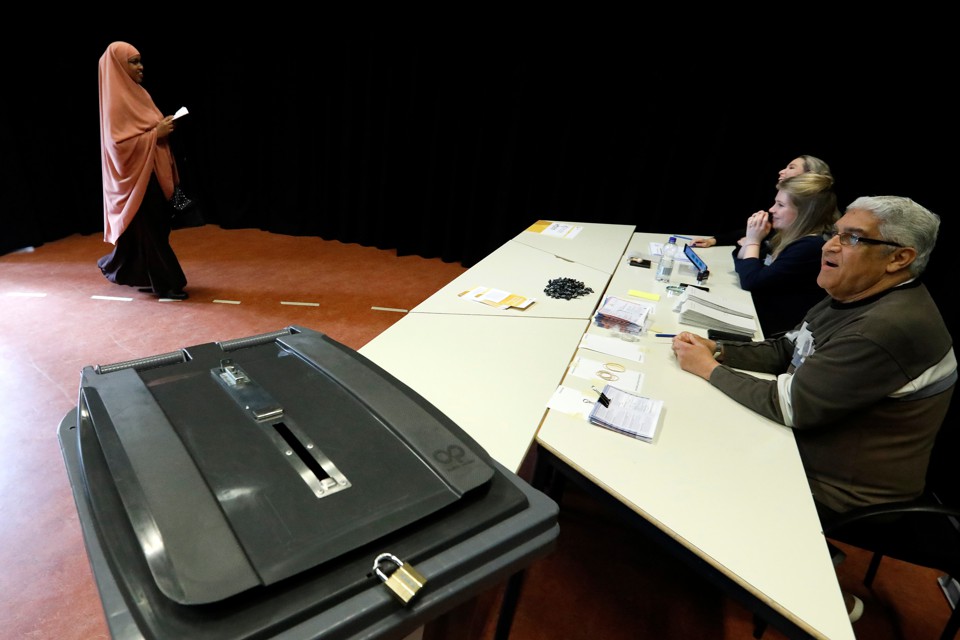 A woman arrives at a poll station to cast her vote in the Dutch general election in The Hague, Netherlands on March 15, 2017
Tuesday, 27 August 2013
Female students in Indonesia may be forced to undergo 'virginity tests'

Tuesday, 16 March 2010
Pious But Moderate

Back in his boyhood home of Indonesia, Obama will find a conservative state that has fought off radical Islam
When Barack Obama arrives in Indonesia this month he will find a country far different from the one he lived in. When he moved there at the age of 6, in 1967, the country's economy was verging toward bankruptcy; strongman Suharto had just started his 32-year-long, iron-fisted reign; and millions of people embraced a type of Islam tinted with animism and a belief that the volcanoes that dot the land housed powerful spirits. Today Indonesia is a thriving democracy, an emerging economic powerhouse, and far more rigorously Muslim in character. More than 40 percent of the books published annually are now dedicated to Islamic teachings or Muslim pop culture, and in the past 10 years, sales of Muslim books have surpassed those of schoolbooks. A 2007 poll showed that Indonesians were more likely to consider religion the most important factor in defining their identity than nationality or ethnicity.
After Suharto's fall, in 1998, new ideas burst forth. Dozens of Muslim-based political parties began competing, and in the mayhem created by the fall of the dictatorship, combined with the Asian economic crisis of the late '90s, many predicted a turn toward fundamentalist Islam. Even secular politicians started to jump on the religion bandwagon. In the 2000s, about 50 of the 450 districts and municipalities in Indonesia passed a string of Sharia-inspired regulations. New Islamic movements prospered, including the Party for Justice and Prosperity, or PKS, a party rooted in the Muslim Brotherhood, an organization that now rejects violence but whose political wing is banned in its birthplace, Egypt, for its advocacy of Sharia. In last year's Indonesian parliamentary elections, the PKS won 7.8 percent of the vote and became the fourth-largest group in Parliament, with four ministers in government. So sensitive is religion that authorities never officially banned the homegrown terrorist group Jemaah Islamiah. In fact, it was not before militants attacked a peaceful demonstration in Jakarta in June 2008 that President Susilo Bambang Yudhoyono's government pushed back against the Islamic Defender Front, an organization that had led violent actions to uphold its agenda, such as attacking bars open during Ramadan.
Indeed, the president's conciliatory style is often blamed for a long tolerance of intolerance. Yet the most virulent Islamists never managed to get a real foothold in politics. Indonesia is among the most observant of Muslim countries. A 2008 Pew poll showed that 80 percent of Indonesian Muslims say they pray five times a day, compared with 59 percent in Egypt, 46 percent in Pakistan, and 34 percent in Turkey. But most of them belong to one of two moderate organizations: Nahdlatul Ulama and Muhammadiyah, which focus on social work and preach an inclusive view of Islam. Overall, Islamist parties have experienced drops in support at the ballot box, from 24 percent in 2004 to 16 percent last year. At the local level, most of the leaders who adopted Sharia-based laws have not been reelected. PKS has held on only by deemphasizing religion in favor of clean governance. And the consolidation of democracy in Indonesia has resulted in a growing feeling that terrorists are enemies of the nation. When the terrorists responsible for the 2002 Bali attacks were executed in 2008, hundreds of radicals gathered in the terrorists' home villages to give them martyrs' burials. But after the terror attacks that shook Jakarta last July, villagers refused to bury the suicide bombers who died in the attacks.
Old-line Muslim groups still worry that they are losing control of many of the nation's thousands of mosques and schools to a more radical Islam. They fear that militant groups may seem more inviting to the young, and that the tradition of dialogue favored by moderates does not work well in a chaotic young democracy, where those who shout the loudest get the most attention. But moderates are starting to fight back and, for now, winning the battle, helping to maintain a different kind of Muslim country: one that bridges Western-inspired ideals with an increasingly conservative population.
Sunday, 22 November 2009
Indonesia Civil Service Discriminates against Hijabis
 Photo Source.
A hijab-clad Indonesian woman was denied the right to conduct civil service for wearing the Islamic headscarf, raising eyebrows in the world’s most populous country.
"I was surprised at the requirement," Siti Aisyah, 34, told The Jakarta Post on Saturday, November 21.
The religion teacher has applied to the Karo education administration in North Sumatra for a civil service job.
But to her surprise, she received a “no” answer, with the administration arguing that the Muslim teacher was rejected over her veiled photos.
"I don't know if there is a different requirement in other regions, but we follow national regulations," Daud Sembiring, a member of the Karo civil service recruitment committee, said.
But the hijab-clad woman ridiculed the argument.
"Headscarves are compulsory for Muslim women," Siti said.
Hijab is a code of dress for Muslim women, not a symbol showing ones affiliation.
The Muslim woman is not disappointed by the rejection.
She only hopes the requirement would be removed to help hijab-clad women apply for the civil service.
"I prefer to keep my aurat safe rather than successfully enter the civil service but have to expose it."
Discriminatory
The move drew immediate fire in the Muslim country.
"This is a very discriminative and counterproductive requirement," Chaidir Ritonga, deputy speaker of the North Sumatra provincial legislative council, said.
"Such a requirement must not be used in the selection process."
He said the requirement necessitating women to provide photos without wearing hijab violates the basic principles of freedom for all people.
The lawmaker called for abolishing the requirement to avoid doing injustice to Muslim women.
"How can we ban Muslim women from wearing headscarves?
“It is a religious obligation for them."
Muslims make up some 86.1 percent of Indonesia’s 235 million population, according to the CIA World Fact Book.
Saturday, 10 October 2009
1/4th of the world's population is now Muslim

Islam may be most closely associated with the Middle East, where it emerged in Arabia in the seventh century, but today the region is home to only one in five of the world's Muslims, according to a study of the religion's global distribution.
The world's Muslim population stands at 1.57 billion, meaning that nearly one in four people practise Islam, according to the US Pew Forum on Religion and Public Life, which published the survey. This compares to 2.25 billion Christians.
The top five Muslim countries in the world include only one in the Middle East ‑ Egypt ‑ behind Indonesia, Pakistan, India and Bangladesh, in that order. Russia, the survey shows, has more Muslims than the populations of Libya and Jordan combined. Germany has more Muslims than Lebanon. China has a bigger Muslim population than Syria.
The work, the largest of its kind, was the result of three years of research examining data from 232 countries and territories.
The reality, as described by Mapping the Global Muslim Population, is that two out of three Muslims are Asians, while the 38 million Muslims in Europe, if treated as a separate group, would be the ninth largest in the world, behind Turkey, with a population of 71 million, and ahead of Algeria, with 34 million.
Pew Forum, in consultation with nearly 50 demographers and social scientists at universities and research centres around the world, analysed about 1,500 sources, including census reports, demographic studies and general population surveys, to arrive at their figures.
The research is the first step in projecting growth trends in the world's Muslim population, and a similar survey is planned by the Pew Forum on the distribution of Christians.
"This whole idea that Muslims are Arabs and Arabs are Muslims is really just obliterated by this report," said Amaney Jamal, an assistant professor of politics at Princeton University.
"There are these countries that we don't think of as Muslim at all, and yet they have very sizeable numbers of Muslims," said Alan Cooperman, associate director of research for the Pew Forum, naming India, Russia and China.
Islam had a huge geographic reach ‑ from the Atlantic coast to central Asia ‑ within a century of the prophet Muhammad's death, but until now its modern global profile was based on rough estimates.
The Pew Forum study depicts the world's second largest religion as complex and nuanced, challenging the notion that its trajectory is defined by a minority of Islamists.
Significantly, one in five of Muslims now lives in a country where they are represented as a religious minority, with three-quarters of that number concentrated in five countries: India (161 million), Ethiopia (28 million), China (22 million), Russia (16 million) and Tanzania (13 million).
The survey also attempted to quantify the relative sizes of the two main branches of Islam - Sunni and Shia - but came up against the difficulty that many national demographers did not distinguish between the two. It ended up suggesting that Shias, concentrated largely in four countries including Iran and Pakistan, probably made up between 10 and 13% of Muslims.
- India, a majority-Hindu country, has more Muslims than any country except for Indonesia and Pakistan, and more than twice as many as Egypt.
- China has more Muslims than Syria.
- Germany has more Muslims than Lebanon.
And Russia has more Muslims than Jordan and Libya put together.
Nearly two out of three of the world's Muslims are in Asia, stretching from Turkey to Indonesia.
The Middle East and north Africa, which together are home to about one in five of the world's Muslims, trail a very distant second.
- There are about 1.57 billion Muslims in the world
- One in five of the world's Muslims lives in a country where Muslims are a minority.
- Russia, Albania, Kosovo, those places -- Muslims are an indigenous population
- Roughly nine out of 10 Muslims worldwide are Sunni, and about one in 10 is Shiite
One in three of the world's Shiite Muslims lives in Iran, which is one of only four countries with a Shiite majority, he said. The others are Iraq, Azerbaijan, and Bahrain.
Sunday, 4 October 2009
Dua and Donation for Indonesia Earthquake Victims

In rural areas of Indonesia, weddings are communal, open-air affairs. Some 400 people attended the nuptials of a couple in Pulau Aiya, a village outside Padang, last Wednesday. Then the ground shook and swallowed everyone up.
"They were sucked 30m deep into the earth," Rustam Pakaya, head of the Indonesian Health Ministry's crisis centre, said yesterday. "Even the mosque's minaret, more than 20m tall, disappeared."
Three days after a 7.6-magnitude earthquake devastated Padang and surrounding areas on the west coast of Sumatra, the full impact of the tragedy is starting to become clear. Whole villages were found obliterated yesterday by rescuers pushing deeper into the disaster zone, where roads remain cut off and survivors – still desperately awaiting aid – are subsisting on coconut milk.
The official death toll from Wednesday's quake stood at 809 last night, but the Indonesian Red Cross believes up to 4,000 people are lying beneath the rubble of collapsed buildings. The chances of finding more survivors are receding by the hour. Rescuers, boosted by teams from Britain, Australia and Japan, among other countries, are pulling out body after body. The morgues are overflowing.
Still, extraordinary stories of survival are continuing to emerge. "Please help, I'm trapped, my position is in the house by the stairs." That brief text message, sent to his father in Jakarta nearly 600 miles away, saved Johnson Chandra's life after a four-storey building in Padang toppled, trapping him and his wife.
Mr Chandra tried without success to call relatives and friends on his mobile phone. "I was desperate," he said. "But I suddenly thought about texting, so I texted my dad to let him know where I was. Later I heard people coming, so I tried to make a sound. I found a small nail and started banging it. They finally found me. Slowly they broke concrete around me, and I was rescued 10 hours after the quake."
Another text was sent from the bowels of the Ambacang Hotel in Padang, but with a less happy outcome. Rescuers tunnelled through the ruins of the Dutch colonial-era hotel yesterday after the message alerted them to eight people alive inside. But sniffer dogs found no signs of life.

Rescue workers reported yesterday that entire villages had been sucked under the earth after the the devastating earthquake that hammered western Sumatra, estimating that at last 600 people had lost their lives in the countryside surrounding Pandang.
The dead included those attending a large wedding party numbering several hundreds. If the figure is confirmed, it would bring the total death toll to above 1,300. More than 3,000 people were listed as missing before the news about the villages emerged.
In Pandang itself, a colonial-era hotel became the national focus for hopes that survivors might still be found .
In dramatic scenes, rescuers dug for eight guests and staff rumoured to be alive in the wreckage of the city's Ambacang hotel.
At the hotel, a prominent landmark in the university town of 900,000, the rescue efforts were inspired by a text message sent by a victim to his family on Friday. The message, delivered as rescue workers attempted to burrow their way through rubble and masonry, said simply: "Be careful that the excavator doesn't cause the building to collapse on us."
The once grand, 140-room hotel complex was destroyed by the earthquake, but relatives and locals gathered outside as rescuers searched among the rubble for the survivors they believed could be trapped between the fifth and sixth floors. Jul, who worked as a waiter in the hotel's restaurant downstairs, said he did not believe anyone could still be alive in the wreckage. "I think seven people I know are inside. Inside somewhere. Alive? I don't think so," he said.
The cavity of the KFC restaurant on the ground floor remained largely untouched. Tables still stood and food, abandoned in panic, still sat on them. "We estimate there are still eight people trapped alive under Ambacang Hotel," Colonel Boy Rafli Amar told reporters. "We are still trying hard to evacuate them," Private Harmen told the Observer. He believed the operation had moved from rescue to recovery. "The last text message was at 5pm yesterday. I do not think they are alive any more."
In the countryside, as rescuers finally reached remoter areas, they discovered that at least three villages had disappeared.
Friday, 6 February 2009
There are so many problems but all we are concerned with is Smoking Ban

A fatwa by Indonesia's top Islamic body banning smoking in public places is dividing the world's most populous Muslim state amid a conflict of interests between health and business.
"We will submit the fatwa to the Supreme Court as a basis of upgrading it to become apart of additive essence," Aries Merdeka Sirait, secretary general the National Human Rights for Children Protection, told IslamOnline.net on Saturday, January 31.
He said if the court considered tobacco an additive essence, then smoking will be banned in the Muslim country.
"So, the fatwa would be in effect not only for children and pregnant women," said Aries.
Nearly 700 scholars of the Ulemas Council on Sunday, January 25, banned smoking in public places and for children and pregnant women.
The scholars, however, failed to agree an outright ban on smoking, fearing it could harm the country's economy.
The fatwa is not legally binding for Muslims, who make up some 86.1 percent of Indonesia's 235 million population, but can influence government policy.
"I am happy and glad about the fatwa," Health Minister Siti Fadilah Supari said.
When asked about the impact of the fatwa on the country's tobacco industry, Supari said the issue is beyond her authority.
"That is not the concern of the health minister, but rather the trade and industry minister."
Indonesia is the world's third biggest cigarette consumers after China and India.
At around $1 a pack, cigarettes in Indonesia are among the cheapest in the world.
More than 60 million Indonesians are active-smokers.
Smoking is Haram regardless of what some people say or try and justify it. I have earlier posted articles about Egyptian Mufti declaring it Haram.
There are many instances where the Qur'an gives us general guidelines, and calls upon us to use our reason and intelligence, and seek guidance from Allah about what is right and wrong. In the Qur'an, Allah says, ...he [the Prophet] commands them what is just, and forbids them what is evil; he allows them as lawful what is good, and prohibits them from what is bad..." (Surah al-Araf 7:157).
Allah says, "...make not your own hands contribute to your destruction..." (Surah al-Baqarah 2:195); "...nor kill yourselves..." (Surah al-Nisaa 4:29). It is universally understood that cigarette smoking causes a
number of health problems that often ultimately result in death. Men who smoke contract lung cancer at 22 times the rate of non-smokers. Smokers are also highly at risk for heart disease, emphysema, oral cancer, stroke, etc. There are hundreds of poisonous and toxic ingredients in the cigarette itself that the smoker inhales straight into the lungs. In an authentic hadith, the Prophet Muhammad (peace be upon him) said that "Whomsoever drinks poison, thereby killing himself, will sip this poison forever and ever in the fire of Jahannum (Hell)." Over 3 million people worldwide die from smoking-related causes each year.
In the Qur'an, Allah says: "Those who annoy believing men and women undeservedly bear on themselves a glaring sin" (Surat al-Ahzaab 33:58). And the Prophet (peace be upon him) said that "there should be neither harming, nor reciprocating harm. In another hadith, the Prophet (peace be upon him) said: "Anyone who believes in Allah and the Last Day should not hurt his neighbor." Those around the smoker inhale what is known as "second-hand smoke" - the unfiltered, poisonous waste that goes in the air around the smoker. There are over 4,000 chemicals in cigarette smoke, over 40 of which are known to cause cancer. Second-hand smoke causes or aggravates asthma, bronchitis, and other respiratory problems, especially in children.
Allah says, "...But spend not wastefully (your wealth) in the manner of a spendthrift. Verily spendthrifts are brothers of the devils... {Surah al-Israa 17:26-27} And in an authentic hadith the Prophet (peace be upon him) said that: "Allah hates for you three things: gossiping, begging, and wasting money." In the U.S. and other countries, cigarettes are taxed heavily in order to discourage this habit and reimburse the government for the overwhelming health care costs to care for those afflicted with diseases caused by smoking. Smokers often spend thousands of dollars a year that literally just go up in smoke.
More info can be obtained here.
Wednesday, 28 January 2009
Rohingyas: Nowhere to go, no place to call home
 Indonesia has refused to grant political asylum to 193 migrants from Myanmar and Bangladesh who are being held at a navy base after they were found stranded off the country's western coast. Most of the group identified themselves as the Rohingya - a Muslim ethnic group from Myanmar.
The migrants were found floating in an 11-metre wooden boat without food or water, officials said. Hassan Wirajuda, the foreign minister, said on Friday that the people are economic migrants and not political asylum seekers. But according to Human Rights Watch, more than 250,000 Rohingyas fled Myanmar to Bangladesh in 1992 amid a campaign of persecution and what many have labelled "ethnic cleansing" on the part of the government in Naypyidaw.
 Shortly after their arrival on Sabang, Imam Husen, one of the migrants, told the Reuters news agency from his hospital bed that he and about 580 other people had set off from Mundu in Myanmar in four boats on December 9 to flee the country. He said some members of the group had been beaten after landing in Thailand.
They were then towed out to sea and set adrift, he said.
According to Wirajuda, citing accounts by the navy, many died on the trip to Indonesia during which they had to stand because the boat was so full.
Imam Husen's testimony corroborates reports from a Rohingya human-rights group and Indian police reports from other Rohingyas found adrift near the Andaman Islands that Thai security forces towed 992 people out to sea and abandoned them in engine-less boats.
The Arakan Project, a Rohingya non-governmental organisation, estimates that 550 of the 992 are missing, feared drowned.
Colonel Manas Kongpan of the Internal Security Operations Command (Isoc) denied on Tuesday any abuse, saying that all the migrants who arrived in Thailand were sent out to sea with food and water.
 About 28,000 Rohingyas recognised as refugees are living in UNHCR camps in Bangladesh.
 I have been following these poor people for many years now and there seems to be no light at the end of their trouble.
 I quote the following from Washington Report article from last year:
Among those most fervently hoping for an end to the military regime are a Muslim minority known as the Rohingyas, whose home territory is on the western coast of Burma. Their language is similar to that of the people of the neighboring Chittagong area of Bangladesh—which the military regime has used to support its claim that they were Bengali immigrants with no right to Burmese citizenship. In fact, when the British occupied the area in 1825, they found that half the population of the Arakan area were Muslims.
In 1992, the Burmese army combed the Rohingya areas of the Arakan region, driving the alleged “foreigners” from their homes. Some fled to other parts of Burma, but 250,000 crossed the border into Bangladesh. They were officially regarded as “undocumented people” rather than refugees. Poor, densely populated Bangladesh took a helpful attitude at first, but soon wearied of the Rohingyas’ presence. It mounted pressure on Burma to allow their return and on the refugees to leave. The majority were readmitted to Burma, but a smaller wave arrived in Bangladesh in 1996-97.
Those who remained in Burma or returned there are still denied citizenship, refused the right to own property and discriminated against. During military campaigns, they have been forced to labor on projects for the army. Rohingyas are at the bottom of the economic pile in a country that, in 2006, had a per capita GDP of $1,800, compared to $2,300 in Bangladesh. No wonder they supported the movement of protest against the military authorities.
May Allah help them in their struggle.