Showing posts with label Islam in the UK. Show all posts

Monday, 1 August 2022

UK’s first-ever survey details attacks on mosques, Islamic bodies


About 42 percent of mosques or Islamic institutions in a  newly released UK report have experienced religiously motivated attacks in the last three years.

The survey, the first of its kind, was jointly carried out by two British Muslim organisations – Muslim Engagement and Development (MEND) and Muslim Census.


It said that the most common form of attack experienced by mosques and other Islamic institutions was vandalism, followed by burglary or theft (34 percent), with 83 percent being attacked at least once a year.

It also suggested that nearly 17 percent of mosques have faced physical abuse directed at staff or worshippers, with one mosque reporting that a religious cleric was stabbed outside the front entrance.

Mosques officials described receiving threats of physical violence on popular social media platforms and general abuse. In the report, they have expressed their frustrations and how increased Islamophobia hate crimes are taking toll on their wellbeing.

“We have witnessed individuals breaking windows, vandalising worshipers’ vehicles, and spraying racist graffiti on the mosque building,” an unidentified mosque official was quoted by the report as saying.


Nearly two-thirds of the 113 mosques who participated in the survey reported that the attacks harmed the wider community, with 9 percent reporting that their mosques or Islamic institutions were targeted frequently, at least every three months.


The report indicated that 15 percent of mosques saw an increase in attacks during the COVID-19 pandemic.

Toufik Kacimi, the imam of Sainsbury Park mosque in north London, told Al Jazeera that religiously motivated attacks have increased over the years, with the latest incident happening weeks ago when a member of the public hurled dog faeces into the mosque.

“Just last Ramadan, one man punctured six cars belonging to worshipers; we also received threats phone calls and hatred letters,” he said.

Kacimi also said that some of the attackers pretend to be Muslim to gain access to the mosque and steal money and mobile phones from the donation box and people’s jackets.

“We can say that hate crimes against Muslims have sharply increased in the last three years, and it’s costing us more money; we have hired four security guards and deployed more CCTV cameras in the mosque premise and it’s a huge financial burden to us,” he said.

Police response
The survey also investigated the UK police response to such attacks. It said 85 percent of the mosques that have been attacked or threatened reported these incidents to the police.


About 55 percent of the mosques were satisfied with the police response, while 38 percent said that no police action was taken when they reported the incident, according to the report.

In addition, 28 percent of the respondents said that the police provided extra surveillance to the mosques due to their reports; however, 15 percent of those deemed it unnecessary to contact the police and report the attack, supposing the police would not take any action.

However, the UK national police chiefs’ council lead for hate crime, Deputy Chief Constable Mark Hamilton, refuted the allegations, saying that they take all hate crime reports seriously since they have a devastating impact on individual victims and the communities involved.

“We work hard to build confidence by engaging with affected communities at a local and national level. We are in regular contact with our partners at the charity who support Muslim communities, and I would encourage anyone who suffers hate crime to report it to the police,” he told Al Jazeera.

“Everyone has a right to live their lives and practice their religion, without the fear of targeted abuse for who they are, either physically or verbally; and we will always seek to protect that right.”

Azhar Qayum, the director of MEND told Al Jazeera that though they have documented their concerns, they have also made recommendations to the police to address Islamophobic hate crimes in the UK.

“We haven’t had a response from the government yet; but we have made some recommendations, including the police to improve links with their local Muslim community and mosques and implement swift action when such attacks occur, and a full explanation when no action is taken and we will monitor to see if they have been implemented,” he said.

Some mosques mentioned in the report also stated that they kept quiet about these attacks for a variety of reasons.

About 64 percent of mosques reported that they feared these attacks would have a negative impact on Muslim communities, with responses ranging from worshippers being discouraged from attending mosques, to causing rifts in the community to Muslims losing faith in the police.

The UK Home Office statistics record 6,377 religious hate crimes between March 2020 and 2121 with almost half of them aimed at the Muslim community in Britain, which is estimated to be about 2.8 million or 4.4 percent of the British population.

Source

Thursday, 17 September 2020

Muslim Medics Taunted About Bacon And Alcohol – By Their Own NHS Colleagues


 Being “visibly Muslim”, such as wearing a hijab or having a long beard, made it more likely for Muslim NHS workers to face Islamophobia. One woman said she stopped wearing the hijab as it was “like wearing a sign saying ‘kick me’.”

Meanwhile, alcohol – forbidden in Islam – has been described as a “social glue” in the NHS, with many Muslims believing they have missed out on career and bonding opportunities because socialising outside work revolves around drink.

And while there are many incidents of outright bullying and harassment, it is the subtle, more difficult to prove Islamophobia within the NHS that is the “most dangerous discrimination”, say Muslim healthcare workers.

A staggering 43% admitted they had considered leaving the NHS because of Islamophobia.

Our survey conducted in conjunction with BIMA had 133 respondents from all over the country working in various NHS roles including consultants, surgeons, GPs, pharmacists and medical students.

One Muslim NHS worker said: “I think Islamophobia has increased in society at large and this is reflected in the NHS.”

Dr Salman Waqar, general secretary at BIMA, told HuffPost UK: “It reflects a wider societal unease about religion and the way spirituality and belief is seen as a problem.

“Some Muslims will not make a fuss because of fear of retribution. But making small compromises causes turbulence and unease internally.

“This creates a sense of not belonging for Muslims in the NHS and biological weathering. They feel they have to put on their uniform, turn up for work and justify their existence to colleagues.”

Dr Hina J Shahid, chair of the Muslim Doctors Association, said: “We see people celebrating diversity in all its forms in the NHS – but people generally don’t want to talk about religion. It is like a taboo subject.

“Belonging to a religious group is almost seen as going against the scientific nature of being a doctor.”

“In the NHS, you realise there’s something about the hijab that really riles people,” says Kiran Rahim, a paediatric registrar in London. “People make assumptions about you. When people first see me, they presume I don’t speak English, or I have an accent.”

She says judgements are made about women in hijabs and she is asked questions by colleagues like: “Does your husband make you wear that?” and “Do you wear your hijab when you shower?”

“I would expect people I work with to be more clued up. I am as British as they come, but my religion is part of my identity.”

Muslim women told HuffPost UK they were often perceived to be less educated due to wearing headscarves, and received backhanded compliments such as surprise at how well they spoke English – even when they were born and raised in the UK.

Zineb Mehbali, 32, a registrar in obstetrics and gynaecology, believes a culture exists within the NHS where people are discriminated against for being different.

She wears a hijab and experienced overt Islamophobia at one hospital when her locker was vandalised and had the word “hijab” scrawled across it.

“I’m quite resilient, but there have been situations where I’ve cried at work,” she said. “When my locker was vandalised for being Muslim, it made me feel vulnerable but also very hurt as I knew a colleague had done that.”

Link

Tuesday, 5 November 2019

Muslims are well-integrated in Britain – but no one seems to believe it


In Britain today there is a mismatch between how non-Muslims often perceive Muslims and how Muslims typically perceive themselves. This disconnect is down to a tendency by non-Muslims to assume that Muslims struggle with their British identity and divided loyalties. These concerns were challenged a few days ago,in a report by the University of Essex that found Muslims actually identify with Britishness more than any other Britons.

This study is just one of several recent studies that have consistently found that Muslims in Britain express a stronger sense of belonging in Britain than their compatriots. Consider the following examples:

• 83% of Muslims are proud to be a British citizen, compared to 79% of the general public.

• 77% of Muslims strongly identify with Britain while only 50% of the wider population do.

• 86.4% of Muslims feel they belong in Britain, slightly more than the 85.9% of Christians.

• 82% of Muslims want to live in diverse and mixed neighbourhoods compared to 63% of non-Muslim Britons.

• 90% of Pakistanis feel a strong sense of belonging in Britain compared to 84% of white people.

Those who work closely with Muslim communities will attest to the integrated position of British Muslims and that despite frequent exoticisation, British Muslim lives are much the same as any other citizen's. British Muslims also appreciate their ability to practise their religion in Britain without the type of subjugation that fellow Muslims are subjected to under despotic regimes in several Muslim-majority countries. Even though negative depictions may encourage people to imagine Muslims as similar to the 7/7 bombers who struck seven years ago this week, your average British Muslim is much more likely to be similar to a confident Amir Khan, a bubbly Konnie Huq or a hardworking James Caan.

There is, quite frankly, no major issue of Muslims not wanting to be a part of British society. But there is an issue with the common but unspoken xenophobia pervasive in British society that casts Muslims as outsiders. That is why despite Muslims repeatedly pledging their dedication to Britain, a consistent spattering of polls show that many non-Muslim Britons still view Muslims as a potential enemy within. Consider the following examples:

• 47% of Britons see Muslims as a threat.

• Only 28% of Britons believe Muslims want to integrate into British society.

• 52% of Britons believe that Muslims create problems.

• 45% of Britons admit that they think there are too many Muslims in Britain.

• 55% of Britons would be concerned if a mosque was built in their area.

• 58% of Britons associate Islam with extremism.

The minority of Muslims in Britain who do view Britain with contempt – as indeed, we must recognise there are some – frequently explain their disaffection as a result of being labelled as outsiders and told they do not belong. Thus, the inability to appreciate British Muslims as typical citizens can actually create the very atypical citizens that are feared in the first place. Muslims want to be part of British society but their marginalisation may lead to some retreating to the margins.

If the myth that Muslims in Britain will not integrate is allowed to be propagated, it will only lead to the continuation of a harmful cycle whereby greater distrust and animosity is sown. The results of this can be devastating. Last Sunday marked the three-year anniversary of the Islamophobic murder of Marwa El-Sherbini by a far-right attacker, a crude example of an inability to accept that Muslims are at home in Europe. This intense rejection of Muslims is increasing across Europe, which is especially disturbing considering that a significant number of the far right would consider armed conflict against Muslims, as the case of Anders Breivik revealed. In Britain, we have seen several far-right plots that seek to undermine the presence of Muslims in British society, such as a recent arson attack on a mosque in Stoke-on-Trent. Clearly, there are weighty consequences to the dismissal of Muslims as fellow British citizens.

While politicians may claim that multiculturalism has failed, there is a strong case to be made that it operates successfully every day when Britons of different faiths, ethnicities and backgrounds convivially co-operate alongside each other to make the nation what it is today. Muslims are integrated, feel at home in Britain and are quite simply as British as the next person, even though this does not quite match the sensationalised cynicism that some enjoy indulging in. This rather unexciting conclusion is actually rather exciting as it lays to bed many of the unwarranted concerns that are held about British Muslims.

Link

Wednesday, 13 March 2019

Islamophobia driving belief in myths about Muslims in British society, MPs say


Harmful myths and lies about Muslims are now believed by a large section of the UK's population, contributing to discrimination across employment, housing, the criminal justice system and other areas of public life, a new report by MPs has found.

The All Party Parliamentary Group (APPG) on British Muslims found that “prevalent” Islamophobia was driving division, hate crime and even terror attacks.

“British society at large, by virtue of normalised prejudice against Muslim beliefs and practice, have come to imbibe a panoply of falsehoods or misrepresentations and discriminatory outlooks,” its report said.

Academic research has consistently shown that British Muslims face considerably high levels of economic disadvantage than other groups in Britain."

While a report by market research company Ipsos Mori found that the majority of Muslims believe Islam is compatible with the British way of life, a separate survey of the wider population by polling firm YouGov, found that 46 per cent thought there was a “fundamental clash between Islam and the values of British society”.

A separate study recently found almost a third of British people believe the myth of “no-go zones” where non-Muslims cannot enter, while the MPs took aim at false and misleading news stories.

They include the “Winterval” myth that claimed Christmas celebrations were being suppressed and a story that wrongly interpreted research to say one fifth of British Muslims had “sympathy for jihadis”.

MPs said that corrections published by newspapers “pale in comparison to the damage done to perceptions of Muslims in British society”.

A report concluded that Islamophobia has far surpassed the “dinner table test” espoused by Baroness Sayeeda Warsi in 2011 and is now prevalent in society.

MPs said that because there is no commonly agreed definition of Islamophobia, it has been allowed to “increase in society to devastating effect”.

“The detectable shift from overt to subtler or respectable, manifestations of Islamophobia - the normalisation of the prejudice to the extent it is rendered almost invisible to many - warrants a definition that can arrest and reverse its present trajectory,” their report said.

“There has been no attempt to adopt a definition of Islamophobia by government despite recognising the significant impact the problem has on British Muslim communities.”

After a six-month inquiry taking evidence from Muslim organisations, legal experts, academics, MPs and other groups, the APPG called on the government to adopt the definition: “Islamophobia is rooted in racism and is a type of racism that targets expressions of Muslimness or perceived Muslimness.”


Anticipating criticism from far-right and populist groups, MPs said the definition did not aim to curtail free speech or criticism of Islam as a religion.

“From hate crimes motivated by anti-Muslim feeling, buttressed by stereotypes and racist caricatures prevalent in social and media discourse, to policies which perpetuate discriminatory outcomes for Muslims, a definition of Islamophobia is vital,” the APPG concluded.

MPs highlighted terror attacks and plots targeting Muslims, including the Finsbury Park attack and the attempted murder of a Sikh dentist in Wales.

They said that rising hate crimes had affected both Muslims and those wrongly thought to be part of the religion because of their appearance, including an Italian man who was badly beaten in London.


The APPG cited research showing that Muslims are disadvantaged across employment, housing, education, the criminal justice system, social and public life and in political or media discourse.

Its report warned that Islamophobia also increased feeling of disengagement, disenfranchisement and disaffection with the state.

Wes Streeting MP, co-chair of the APPG for British Muslims and Labour MP for Ilford North, said: “Islamophobia is a form of racism and it is growing in our society. To tackle it, Islamophobia must be accurately and fully defined and that’s why this inquiry centred around the discussion on a working definition.”

“This landmark report brings about a working definition of Islamophobia for the first time, which will allow us to tackle this prejudice head-on. The adoption of this definition by political parties, statutory agencies and civil society organisations will allow us to turn a corner to move forward towards a fairer society.”

Anna Soubry MP, co-chair of the APPG for British Muslims and Conservative MP for Broxtowe, said Islamophobia was a “very real problem” throughout the UK.

“Muslims or people assumed to be Muslims are subjected to abuse, discrimination and criminal acts against them for no other reason than their faith or perceived faith,” she added. “It is equally obvious that overwhelmingly Islamophobia is rooted in racism and therefore is, racist. This definition recognises this truth and I hope it will now enable the serious work that needs to be done to tackle Islamophobia.”

A government spokesperson said: “We remain deeply concerned at hatred directed against British Muslims and others because of their faith or heritage. This is utterly unacceptable and does not reflect the values of our country.

“We know that some have suggested establishing a definition of Islamophobia could strengthen efforts to confront bigotry and division. Any such approach would need to be considered carefully to ensure that this would have the positive effect intended.

“Following the recent publication of our Hate Crime Action Plan, we look forward to discussing steps to confront hatred, bigotry and division with the Government’s Anti-Muslim Hatred Working Group.”


Link

Tuesday, 3 April 2018

Islam in Football: The profound effect the religion has had on the Premier League


Mohamed Salah and Sadio Mané visit a local Liverpool mosque each week after training for Jumu’ah, the Friday prayer. It is an obligatory prayer for Muslim men, who are encouraged to wear their smartest clothes for the occasion. The football-supporting Muslims especially the children are blown away by their presence. The players mingle. They pose for pictures. In a recent photograph, Mané, who grew up in the small village of Bambali, south Senegal, within a deeply-religious family, is wearing a wonderful emerald green kaftan, a long top, with two youngsters.

People have posted on social media that they want to convert to Islam because of these players. It’s not only about the goals they are scoring – particularly Salah, the Premier League’s outright top scorer on 28 goals – but because they are spreading the message of what the Muslim faith is about: being open, welcoming, among the people; being humble and not thinking about oneself – which for a star footballer generally bucks the trend.


There are numerous Anfield terrace songs about “Egyptian King” Salah, including: “If he’s good enough for you/He’s good enough for me/If he scores another few/ Then I’ll be Muslim too,” which ends: “He’s sitting in the mosque/ That’s where I want to be.”


Manchester United midfielder Paul Pogba is known to regularly donate to charity. At the club’s player of the season awards last year, the midfielder donated a substantial sum to pay for 11-year-old United supporter Samuel, who has cerebral palsy, to be a mascot. On Pogba’s 25th birthday last week, he implored his 6.9million followers on Facebook to donate to Save the Children. Giving to charity is a staple of Islam.


Link

Tuesday, 7 November 2017

This is my country, too

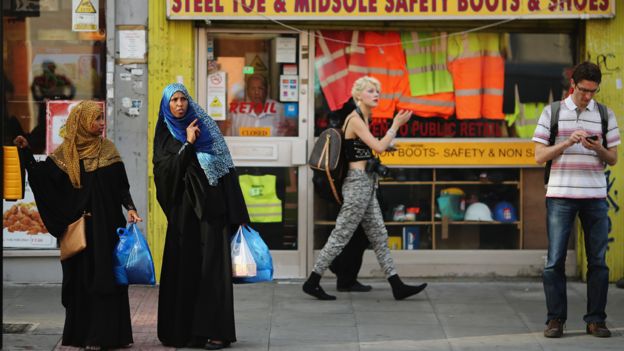
women wait to cross a road in London
This year has seen a spike in anti-Muslim hate crimes, and a new survey shows women are suffering the most - so what's it like to be a black British Muslim woman at the moment? Not great, says Muna Ahmed.
A man mimed shooting Linda with a rifle as he crossed the road. A man spent an entire train journey staring aggressively at Sonya, his face inches from hers.
These are the kind of incidents Muslim women face every day.
One young woman told me she has stopped listening to music so she can hear if someone is following her. Another has considered taking off her headscarf because she doesn't feel safe.
Many women worry about being attacked or singled out because of their faith. Most have experienced verbal abuse. They worry about being out after dark, and drive with their windows closed.
"The thought of being attacked crosses my mind now more than ever," says Natasha, a Muslim convert from Sheffield.
"I've always felt safe here in England, but post-Brexit, post the [terror] attacks, it's getting worse and worse."
It wasn't always like this. Growing up in Sheffield, I was just like every other kid I played with - I may have been a tad cheekier, but nobody treated me differently because of my race or faith.
At the weekends I would see people pouring out of the church and the mosque at either end of our street. I don't remember any hostility and I certainly didn't see any conflict between the faiths. It was just normal.
Everybody on my road knew each other. My friends Gemma and Tracy lived at the top of my street and we would walk to school together every day. When we got home we would eat fish-fingers and go straight out to play. Weekends were the best because we would get up early to watch cartoons and mum would make us pancakes.
I enjoyed all the religious holidays because there were always treats involved.
At Easter we would get chocolate eggs. During Ramadan we tried to fast so we could take part in the evening feast, but Mum knew that we would be starving by 4pm so she would leave a plate of food out, which my friends and I would sneak into the house and eat.
I loved the Christmas holidays because I would go and visit my grandmother and she would spoil me rotten. And on Eid I would get whatever I wanted.
Thinking about it now, I had the best of both worlds. But 9/11 changed everything.
I went from being a carefree teenager who had never been asked about my religion to having people constantly ask me questions about Islam - questions that I didn't have the answers to.
I asked my parents about al-Qaeda, and where Islam stood on terrorism. Every day I would come home with a different question, because the Islam that had become "the enemy" was not the religion I knew.
Ever since then, my country has not been a positive place to be a Muslim woman - and it seems to be getting worse.

The other day I saw a big crowd of people listening to a man with a megaphone shouting: "We need to get these Muslims out of our country, we need to stand united against Islam."
A lot of people seemed to be agreeing with him.
A few days after that I posted a video on Facebook about how the tabloids portray Muslims and the first person to comment was one of my childhood friends, a girl I used to play with all the time. She reeled off a list of radical preachers - as if they represent Islam. The conversation went on for a while, while I tried to educate her about Islam. But she was having none of it.
At one point she said: "You're welcome in this country but your religion isn't."
It got worse - the final thing she said to me was: "Muna, you have blood on your hands too."
I felt physically sick when I saw those words on my screen.
But Muslim women often experience abuse on social media these days.
Sonya is a 23-year-old British Asian Muslim. We sat and talked about our experiences, laughing at the silly assumptions people have about Islam - for example, that she'll have to have an arranged marriage. But it was less funny when she told me about the death threats she had received on social media.
"I was quite popular on Twitter, I used to put up information about Islam and things like that. But all of a sudden dozens of people started commenting and saying all sorts of horrible things, like: 'Go back to your country,' 'We're going to come and kill you,' 'We will hunt you down,' 'You are disgusting to look at.'"
I don't have any children but whenever I'm back home in Sheffield I always take my two nieces, 10-year-old Aaliyah and seven-year-old Amanie, out for ice cream.
As we approached the restaurant last time we heard police sirens - they had been called to the scene because a white man was yelling obscene Islamophobic language at two Muslim waitresses. I grabbed my two nieces and told them we'd come back later. As we walked off, Amanie looked at me and said: "Why is that man saying bad things about Muslims?"
How do you tell a seven-year-old that some people in this country will treat you unfairly because of your race and religion?
The first time I wore a headscarf to work, a woman who works in our building said I like looked like a North African kidnapper, in front of my entire team. I laughed it off, but I felt isolated and different from everyone in the room at that moment.
It's like people don't know how to react to us any more - why are people so anxious around Muslim women? We're not creatures from outer space, we're just women, and some of us choose to cover our hair. Why is it such a big deal?
Saadiya is a young British Asian woman who works in the City. Like me, the only time she wears a headscarf is when she is going to the mosque - but on those occasions she gets weird looks - looks I know all too well.
"When our family moved to this country they faced a lot of that, and it was a real struggle for them," Saadiya tells me. That was 30, 40, 50 years ago - we've come a long way since then, and yet it feels as if we are now going 10 steps back.
Even though I have a thick Yorkshire accent, I'm often made to feel like I don't belong. One minute I'm fighting off racists and then a second later I'm back in the ring defending my faith. It feels like I'm constantly justifying my own existence.
We are at risk of terror attacks like everybody else, but we also have to deal with the backlash. After major attacks we have to endure intimidating comments and fear personal attacks, all because of the actions of a terrorist. Being held accountable for the actions of extremists is a massive burden.
Some days I want to scream at the top of my voice that I have nothing to do with terrorism but it doesn't matter how loud I scream, I will always be tarred with the same brush.
All we want is to feel safe in our own country and to be accepted for who we are - because we are British and this is our home.
Link

Tuesday, 4 July 2017

UK sharia councils don’t prejudice women’s rights — they defend them

I spent last year travelling through Muslim Britain, partly in an attempt to address this niggling question of inherent misogyny. My findings surprised me. Take, for instance, the practice of sharia here, the system so widely viewed as inimical to the rights of women. In Oldham, 15 minutes up the road from Manchester Arena, I sat in on a session of the Wuzara Ulama sharia council, whose sole function turned out to be to grant divorces to women trapped in bad marriages, often over the heads of abusive husbands who didn’t want to separate. These women had no other escape route. Maulana Ejaz, the cleric from Dewsbury who heads the Council, estimates that in northern England where he operates, some 60 per cent of Muslim marriages are not registered under English civil law — which of course renders the English legal system powerless to offer would-be divorcees any redress at all.
None of Ejaz’s customers felt repressed by sharia. On the contrary, he was able to produce a dozen feedback forms from past clients, all of them women escaping abusive marriages, and all of them expressing gratitude for the councillors’ help and describing as ‘excellent’ the service they had received. In other words, the Wuzara Ulama — who do not charge for their services — are set up to defend, not prejudice, the rights of women.
There is much talk of ‘creeping sharia-isation’ in Britain, of the frightening notion that Muslims are evolving a parallel legal system that challenges and subverts the ancient principle of ‘one law for all’ laid out by Magna Carta in 1215. In the wake of the 2015 Paris attacks, the then Ukip leader Nigel Farage claimed there were more than 80 sharia courts in the UK. ‘Big ghettos’, he said, were being run according to sharia law while the authorities ‘turned a blind eye’ out of ‘moral cowardice’.
British sharia is not without its problems. The way it is implemented varies too much from council to council, and there is a good case for greater regulation. A formal government review has been underway since last year. But the notion that it is subversive is nonsense. Sharia scholars meet in councils, not courts, which operate subserviently to and in careful conjunction with English law, not in parallel to it. Islam, Ejaz told me, is clear on the matter of jurisdictional precedence: a good Muslim must follow the law of the land in which he lives. I found no Sharia ‘ghettos’, and the figure of 80 councils in Britain is a myth: Ejaz knew of no more than six. Given the essential public service his ulama provide, it may be that we need more of them, not fewer.
There is, of course, no punishment for crimes against God, such as adultery and drinking alcohol, in Britain, nor any likelihood of it ever being introduced. Stoning and hand-chopping — hudud punishments — are against the law. Sharia, in any case, may be a much gentler legal code than its public image suggests. I later heard an intriguing defence of hudud from a Salafi traditionalist in Oldham, a secondary school teacher called Samir, who thought of it as a kind of nuclear option, a weapon of deterrence rather than one intended for actual use, except in the most extreme circumstances. Adultery, for example, may be punishable under sharia by stoning to death. But the charge has first to be proven, not by one but by four independent witnesses to the act — and as he said, how often does that happen in real life? ‘There’s dogging, I suppose,’ said Samir after some thought. ‘But to be honest there’s not much of that going on in Oldham.’
I wondered about CCTV footage, but Samir said the jurists had thought of that and ruled it inadmissible: an adulterer can only be deemed in flagrante delicto if seen by actual people using their actual eyes. Islam, he went on, is more interested in contrition for sin than punishing people for it. The seriousness of the crime is clear from the sanction it theoretically carries, but the ‘four witnesses’ condition — introduced, as Samir saw it, by Muhammad himself — deliberately makes the punishment almost impossible to issue. To Samir, this was proof of the Prophet’s wisdom and ultimate humanity.
Terrible misogyny does exist in some Muslim communities, including British ones — of course it does, and it is a great social curse. The details of domestic violence I heard at the sharia divorce council were appalling. But inherent to Islam? A religion founded by a prophet married to Khadija, a rich, successful and very unrepressed-sounding business woman? I don’t think so. Many of the misogynistic ‘Muslim’ practices westerners most object to — arranged marriages, say, or honour violence — are sociocultural in origin, not religious. Female genital mutilation is millennia older than Islam. The clue is in the procedure’s medical name, Pharaonic infibulation. Non-Muslims often view the veil, particularly the Arabian niqab that leaves nothing but the eyes exposed, as a symbol of submissiveness rather than self-assertion, of repression rather than progress and liberation. At the beginning of my journey around Muslim Britain I felt sure I would find at least one niqabi who had been coerced into wearing it by a husband, a father, a brother. But I was wrong. I conducted more than a dozen interviews with niqabis and every one of them said they wore it out of choice; not one of them said they had been or felt forced.
Their explanations were startling in their variety. Some wore the niqab out of religious fervour. Some were political activists. Some, like Ahlam Saed, 25, from White City in west London, even wore it out of vanity.
‘I’m a make-up kind of girl,’ she told me, ‘and my eyes are my best feature. So I bought a niqab to draw attention to them.’
Saed became a fleeting internet sensation in 2016 when she posted footage of herself being abused in a shop in Shepherd’s Bush. Her assailant, an Afro-Caribbean who called her ‘Batman’ and ranted about Britain being a Christian country for Christians, was later arrested. ‘I only went in to get a packet of Starburst,’ Saed later told the Evening Standard. In the febrile debate over British Islam, nothing is ever as it seems.
Source