Showing posts with label Afghanistan. Show all posts

Monday, 31 August 2026

The FORBIDDEN Life Of Women In Afghanistan In 2026. I Was SHOCKED! 🇦🇫


The FORBIDDEN Life For Women In Afganistan in 2026.  I was SHOCKED! 

I returned to Afghanistan to see what life is really like in the most gender-segregated society on earth. In this video, I go behind the scenes to uncover the hidden reality for women today—from how they access beauty products with salons closed, to the secret world of weddings where men and women are completely separated.

We explore the devastating impact of women being banned from parks, gyms, and schools for girls over 12. Finally, I uncover a shocking truth about recent British government laws that are effectively supporting the regime's efforts to keep women at home and uneducated. This is a side of Afghanistan the world needs to see.

Tuesday, 2 August 2022

Send us a man to do your job so we can sack you, Taliban tell female officials


Still so many brothers support the Taliban, and make excuses for them. Just be honest you wish to remove women from public sphere and impoverish them too.

As economy collapses, women from Afghanistan’s finance ministry say they have been asked to suggest male relatives to replace them

The Taliban have asked women working at Afghanistan’s finance ministry to send a male relative to do their job a year after female public-sector workers were barred from government work and told to stay at home.

Women who worked in government positions were sent home from their jobs shortly after the Taliban took power in August 2021, and have been paid heavily reduced salaries to do nothing.

But several women told the Guardian they had received similar calls from Taliban officials requesting they recommend male relatives in their place, because the “workload in the office has increased and they need to hire a man instead of us”, according to one woman who did not wish her identity to be revealed.

Sima Bahous, director of UN Woman. ‘An entire generation is threatened by food insecurity and malnutrition,’ she warned in May. Photograph: Rex/Shutterstock
Sima Bahous, executive director of UN Women, said in May: “Current restrictions on women’s employment have been estimated to result in an immediate economic loss of up to $1bn – or up to 5% of Afghanistan’s GDP.

“There is almost universal poverty in the country,” she added. “An entire generation is threatened by food insecurity and malnutrition.”

Maryam*, 37, received a call from the HR department of the Afghan ministry of finance, where she had worked for more than a decade. She said: “I was asked to introduce a male family member to replace me at the ministry, so I could be dismissed from the job.”

Her voice quivering with frustration, Maryam, said she had worked her way up over many years within the ministry to head of the department. “How can I easily introduce someone else to replace me?” she asked. “Would he be able to work as efficiently as I have for so many years?

“This is a difficult and technical position I was trained for and have years of experience in. And even if he could do the same work eventually, what would happen to me?

“Since they came [to power], the Taliban have demoted me and reduced my salary. I cannot even afford my son’s school fees. When I questioned this, an official rudely told me to get out of his office and said that my demotion was not negotiable.”


Several attempts by the Guardian to seek a response and clarification from Taliban officials at the ministry went unanswered. It is not clear if women from other state departments have also been asked to send male relatives to do their job. However, Maryam said she was aware of at least 60 female colleagues from the finance department who had received similar calls.

“The Taliban have a history of eliminating women, so hearing this is not surprising or new,” said Sahar Fetrat, assistant researcher with the women’s rights division at Human Rights Watch (HRW), which has documented extensively the Taliban’s atrocities against women since they took over Afghanistan.

In a report this year, HRW investigated the loss of women’s jobs and livelihoods in Ghazni province since August 2021, when the Taliban seized power in Kabul. “Nearly all the women interviewed who previously had paid employment had lost their jobs,” an interviewee said in the report.

“Only female healthcare workers and teachers can go to work. Women working in other fields are forced to stay home now.”

Fetrat said: “Within the Taliban’s misogyny, women belong to men, as a property and an object representing the honour of the family.

“Therefore, in some cases like this they give women’s jobs and titles to women’s male relatives, and in other cases like the hijab, they punish women’s close male relatives for women’s public conduct and clothing,” she added, referring to an earlier ban that criminalised women’s clothing. According to the decree, issued in May, the male “guardians” of women who appeared in public “uncovered” would be fined and jailed for the offence.


Fetrat said these policies imposed new standards of “harmful behaviour in society, and that is normalisation of the objectification of women. It has a clear message for men, and especially younger men, that they ‘own’ women in their families and they must act as a moral authority and actively police women’s conduct.”

Maryam and her colleagues are mobilising to protest against Taliban policy. “We do not accept their order and we will try to get them to change it,” she said.

“We have created a group of female employees of the ministry. We are negotiating now, and we will demonstrate if they don’t hear us,” she added, urging the international community to extend support and solidarity.

The country is in the grip of a severe economic and humanitarian crisis. According to the UN, 20 million people now face acute hunger, more than 9 million have been displaced since the Taliban took power, and severe drought has affected farming.

Link

Monday, 3 January 2022

Parents selling children shows desperation of Afghanistan


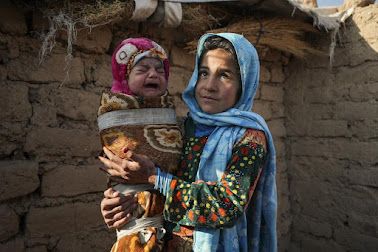
In a sprawling settlement of mud brick huts in western Afghanistan housing people displaced by drought and war, a woman is fighting to save her daughter.

Aziz Gul’s husband sold the 10-year-old girl into marriage without telling his wife, taking a down-payment so he could feed his family of five children. Without that money, he told her, they would all starve. He had to sacrifice one to save the rest.

Many of Afghanistan’s growing number of destitute people are making desperate decisions such as these as their nation spirals into a vortex of poverty.

The aid-dependent country’s economy was already teetering when the Taliban seized power in mid-August amid a chaotic withdrawal of U.S. and NATO troops. The international community froze Afghanistan’s assets abroad and halted all funding, unwilling to work with a Taliban government given its reputation for brutality during its previous rule 20 years ago.


The consequences have been devastating for a country battered by four decades of war, a punishing drought and the coronavirus pandemic. Legions of state employees, including doctors, haven’t been paid in months. Malnutrition and poverty stalk the most vulnerable, and aid groups say more than half the population faces acute food shortages.

“Day by day, the situation is deteriorating in this country, and especially children are suffering,” said Asuntha Charles, national director of the World Vision aid organization in Afghanistan, which runs a health clinic for displaced people just outside the western city of Herat.

“Today I have been heartbroken to see that the families are willing to sell their children to feed other family members,” Charles said. “So it’s the right time for the humanitarian community to stand up and stay with the people of Afghanistan.”

Arranging marriages for very young girls is a frequent practice throughout the region. The groom’s family - often distant relatives - pays money to seal the deal, and the child usually stays with her own parents until she is at least around 15 or 16. Yet with many unable to afford even basic food, some say they’d allow prospective grooms to take very young girls or are even trying to sell their sons.

But Gul, unusually in this deeply patriarchal, male-dominated society, is resisting. Married off herself at 15, she says she would kill herself if her daughter, Qandi Gul, is forcibly taken away.

Gul remembers well the moment she found out her husband had sold Qandi. For around two months, the family had been able to eat. Eventually, she asked her husband where the money came from, and he told her.

“My heart stopped beating. I wished I could have died at that time, but maybe God didn’t want me to die,” Gul said. Qandi sat close to her mother, her hazel eyes peering shyly from beneath her sky-blue headscarf. “Each time I remember that night...I die and come back to life. It was so difficult.”

She asked her husband why he did it.

“He said he wanted to sell one and save the others. ‘You all would have died this way,’ (he said.) I told him, ‘Dying was much better than what you have done.’”

Gul rallied her community, telling her brother and village elders that her husband had sold her child behind her back. They supported her, and with their help she secured a “divorce” for her child, but only on condition she repays the 100,000 afghanis (about $1,000) that her husband received.

It’s money she doesn’t have. Her husband fled, possibly fearing Gul might denounce him to the authorities. The Taliban government recently announced a ban on forcing women into marriage or using women and girls as exchange tokens to settle disputes.

The family of the prospective groom, a man of around 21 or 22, has already tried several times to claim the girl, she says. She is not sure how long she can fend them off.

“I am just so desperate. If I can’t provide money to pay these people and can’t keep my daughter by my side, I have said that I will kill myself,” Gul said. “But then I think about the other children. What will happen to them? Who will feed them?” Her eldest is 12, her youngest - her sixth - just two months.

Now alone, Gul leaves the children with her elderly mother while she goes to work in people’s homes. Her 12-year-old son works picking saffron after school. It’s barely enough to keep them fed, and the saffron season is short, only a few weeks in the fall.

“We don’t have anything,” Gul said.

In another part of the same camp, father-of-four Hamid Abdullah was also selling his young daughters into arranged marriages, desperate for money to treat his chronically ill wife, pregnant with their fifth child.

Abdullah borrowed money to pay for his wife’s treatments and can’t pay it back, he said. So three years ago, he received a down-payment for his eldest daughter Hoshran, now 7, in an arranged marriage to an 18-year-old in their native Badghis province. He’s now looking for someone to buy his second daughter, 6-year-old Nazia.

“We don’t have food to eat,” Abdullah explained, adding he also had to buy medicine for his wife, who soon would need more treatment. “She needs another surgery, I don’t have one afghani to pay for the doctor.”

The family that bought Hoshran is waiting until she is older before the full amount is settled, he explained.

But he needs money now for food and treatments, so he is trying to arrange a marriage for Nazia for about 20,000-30,000 afghani ($200-$300).

“What should we do? We have to do it, we have no other option,” said his wife, Bibi Jan. “When we made the decision, it was like someone had taken away a body part from me.”

In the neighboring province of Badghis, another displaced family is considering selling their son, 8-year-old Salahuddin.

His mother, Guldasta, said that after days with nothing to eat, she told her husband to take the boy to the bazaar and sell him to bring food for the others.

“I don’t want to sell my son, but I have to,” the 35-year-old said. “No mother can do this to her child, but when you have no other choice, you have to make a decision against your will.”

Salahuddin blinked and looked on silently. Surrounded by some of his seven brothers and sisters, his lip quivered slightly.

His father, Shakir, who is blind in one eye and has kidney problems, said the children had been crying for days from hunger. Twice, he said, he decided to take the boy to the bazaar and twice he faltered, unable to go through with it. “But now I think I have no other choice than to sell him.”

Buying of boys is believed to be less common than girls, and when it does take place, it appears to be cases of infant boys bought by families who don’t have any sons. In her despair, Guldasta thought perhaps such a family would want an 8-year-old.

The desperation of millions is clear as more and more people face hunger. By the end of the year, some 3.2 million children under 5 years old are expected to suffer from acute malnutrition, according to the U.N.

Nazia is one of them. The 4-year-old lay listlessly in her mother’s arms after visiting the World Vision health clinic.

Two years ago, Nazia was a plump toddler, her mother Fatima said. Now, her emaciated limbs are just skin covering bone. Her little heart beats visibly beneath her ribcage.

“The prices are high. Flour is expensive, cooking oil is expensive, everything is expensive,” Fatima said. “All day she is asking me to give her meat, yogurt and fruit. We don’t have anything, and we don’t have money to buy it for her.”

Charles, World Vision’s national director for Afghanistan, said humanitarian aid funds are desperately needed.

“I’m happy to see the pledges are made,” she said. But the pledges “shouldn’t stay as promises, they have to be seen as reality on the ground.”

Source

Monday, 30 August 2021

Is the Taliban’s treatment of women really inspired by Sharia?


According to Human Rights Watch, the Lord’s Resistance Army (LRA), a Ugandan rebel group whose stated goal was to create a state based on the biblical 10 commandments, kidnapped and killed tens of thousands of people in the 1990s and 2000s.

Their practice of abducting boys to train them as soldiers and girls to force them into sexual slavery has been documented and put before the International Criminal Court in The Hague, resulting in an arrest warrant for Joseph Kony, the group’s founder, along with four of his senior leaders, for war crimes and crimes against humanity.

Although according to its leadership, the armed group was a Christian army acting in God’s way, few op-eds have had to be penned arguing that the LRA’s actions are not in congruence with normative Christianity. It is just (rightly) assumed.

Unfortunately, a completely different set of rules is applied when it comes to Muslims. The commentary surrounding the most recent Taliban takeover of Afghanistan is but one example.

Reports have emerged that Afghan women are being forced to marry Taliban fighters, quit their jobs and schooling, as well as endure public flogging.

Rather than call for expanding asylum programmes or even exerting political pressure on the Taliban to reform, right-wing politicians in Europe and the United States have instead weaponised the ongoing instability in this war-torn country to score political points against their Muslim citizens and immigration proponents.

As Muslim citizens of Western nations, we have yet again found ourselves defending our community and faith against those wishing to exploit this tragedy to propagate Islamophobic tropes – the same tropes that were used to justify invading Afghanistan two decades ago.

We are now, as we were then, expected to clarify, condemn and distinguish our faith from the actions of a militant group claiming to act in its name, an unfair and exhausting demand not made of our Christian compatriots, regarding any armed group or war criminal claiming to act in Christ’s name.

Still, despite the double standard, we must take these moments as opportunities to educate. So let me be clear: The normative teachings of Islam are antithetical to the Taliban’s reported treatment of women.

The teachings of Islam, in all their diversity, encourage a woman’s spiritual aspirations absent an intercessor between her and God and define her identity as first and foremost a servant of The Divine, whose rights constitute a sacred covenant. In seventh-century Arabia, Islam’s advance took a woman from being treated as property to a fully independent agent who had control over her financial decisions and possessions and who had the right to choose to marry and divorce.

What about women’s employment? From the first generation of believers, women served as everything, from medical workers to warriors. For example, Rufaida Al-Aslamia was a surgeon recognised by the Prophet for her care for the wounded, her training of other women as nurses, and her role in establishing the first field hospital for the community. Nusaybah bint Ka’ab was known as the “Prophet’s shield” for defending him in battle, even when many men fled.

Islam’s teachings also emphasise the importance of seeking knowledge, for both men and women. In fact, the first known university in the world, the University of al-Qarawiyyin in the Moroccan city of Fez, was founded more than 1,000 years ago by Fatima al-Fihri, a Muslim woman. It is the oldest existing and continually operating educational institution in the world.

Fatima and her sister, Mariam, were highly educated and devoted to their faith. Upon her father’s death and her inheritance of his fortune (yes, Muslim women could inherit property centuries before their European counterparts), she and her sister decided to use their wealth to build an institution of higher learning.

The al-Fihri sisters’ dedication to the pursuit of knowledge is far from an isolated example. Four years ago, while on a speaking tour of the United Kingdom, I had the distinct pleasure of meeting Professor Mohammad Akram Nadwi, who authored an encyclopaedia of the Muhaddithat, the female scholars of Hadith, Islam’s collection of prophetic narrations.

He told me he had set out to write a short book about what he thought would be a handful of female Hadith scholars, and ended up completing 57 volumes (which he had to condense to 40 for publication) on about 9,000 of them. He continues his research and says there are thousands more women he could write about. I learned from him that many of the scholars we consider the pillars of our tradition had female teachers (not just students).

It is also worth noting that Dr Nadwi set out to study just scholars of Hadith. Many of these women also were scholars of fiqh (law), tafsir (scriptural exegesis) and other sciences along with Hadith. I remember wondering what the number would be had he set out to study Islam’s female scholars in general.

And yet these realities stand in sharp contrast to the image of Muslim women in the popular imagination, an imagination easily persuaded that the Taliban represents Islamic devotion, not deviance, in its treatment of women. According to the Institute for Social Policy and Understanding’s Islamophobia Index, the stereotype of Muslim misogyny is the most pervasive anti-Muslim trope tested among Americans.

Western political figures have long instrumentalised the image of the oppressed Muslim woman in need of Western saviours to justify European, and then later American invasion and exploitation of Muslim lands. While this tendency can be traced back to the Crusades, in the modern context, it takes the form of biased media coverage of Muslim women.

According to a Stanford study conducted by Dr Rochelle Terman, who based her analysis on data collected from 35 years of New York Times and Washington Post reporting, US news coverage of women abroad is driven by confirmation bias. Journalists are more likely to report on women living in Muslim and Middle Eastern countries if their rights are violated, but report on women in other societies when their rights are respected.

Some may argue that this is simply a reflection of reality. Women in Muslim majority countries, they contend, are violated more often. But this is not the case. Terman writes, “Even if the nations rank more or less equally on the women’s rights index, women in Muslim countries are shown suffering misogyny, while women in Western countries are portrayed in more complex ways.”

Even when their lived realities are similar, Muslim women are depicted as more mistreated than their counterparts of other faiths, reproducing the false notion that misogyny is exceptionally and inherently Muslim.

We must become critical consumers of information, questioning double standards and challenging bias, and not allow anyone to use the actions of a militant group to propagate bigotry. This is the only way we will truly stand with the Afghan people, women and men, who must lead any effort to support them.

Link

Monday, 27 July 2020

She Went to Prison for Killing Her Husband. The Pandemic Set Her Free.


On a Thursday morning in May, three days after Foroozan was freed from prison, she left her mother’s house to go to the market. It was the first time in six years that she had set foot on the streets of Herat, the capital city of a province of the same name in western Afghanistan. As she made her way through crowds of men wearing masks, she became lightheaded, as if “the world was revolving around her head.” It was nothing like how she had imagined it. “When I was in prison, I thought the outside world is heaven and those who are released, they’re on their way to heaven,” she said. But now, finally experiencing it for herself, she found it alienating and even frightening. “I thought everyone was staring at me,” she said. “Pointing their fingers toward me while whispering, as if they knew I was a prisoner, but of course it was all in my head.”

Foroozan was in the 10th grade when her family arranged for her to marry a man who was 25 years older. He was prone to violence, and for 15 years, she endured his physical and verbal abuse. One early morning, though, he directed his aggression at one of their two daughters. Foroozan grabbed a shovel and hit her husband repeatedly with the blade until he died. When she turned herself in to the police, her 12-year-old son, Maqsood, stepped forward, saying that he had helped his mother with the killing. Foroozan was charged and found guilty of murder and sentenced to 10 years in prison. Maqsood was sent to a juvenile rehabilitation center for two and a half years, and his sisters, Mozhdah and Mahtab, 9 and 7 at the time, were sent to a safe house.

Foroozan was one of as many as 20 women incarcerated in Herat Women’s Prison for killing their husbands. Many of them had been in abusive relationships, until the instinct to survive or to protect their children drove them to kill their abusers — and they ended up in prison with lengthy sentences with little chance of an early release. I first visited the facility in 2019, and most of the women told me they felt safer and more free in prison than they had at home with their families.


Many of these inmates have since been freed, after President Ashraf Ghani ordered the release of thousands of prisoners — mostly women, juveniles and sick people — to prevent the spread of the novel coronavirus. Eligible inmates were notified to pack their belongings and wait in the courtyard. Foroozan joined them, listening as a few names were called out. Those lucky prisoners were released, but after hours of waiting, Aalia Azizi, the prison manager, told the remaining women the bad news: “No one else is going home today, there has been a mistake.” Azizi didn’t know what the mistake was, only that she had clear instructions not to release anyone else.


The next day, the prison erupted into chaos. A group of angry inmates tried to smash through the bulletproof entrance gate and shatter the prison’s windows. The children’s playground was burned down, and a dozen inmates were hospitalized, some with serious injuries after swallowing broken glass as an act of protest. They had been promised freedom, and they were refusing to give it up. The violent demonstrations continued, and the prison, which was previously a relatively safe and peaceful sanctuary compared with the homes many inmates came from, fell into discord. Some prisoners went on hunger strikes, and others attempted suicide, all demanding their release.

Eventually the government offered a solution: If the women wanted to leave, they could buy off the remainder of their sentence with approval from the prosecutor’s office. Foroozan, desperate to reunite with her children, borrowed a little more than $1,000 from her relatives and paid her way out. She was released on May 11.


“Thanks to coronavirus, I am given a second chance to live,” Foroozan said. “To get out of the prison early and start a new life with my daughters at my side.” Mozhdah and Mahtab, who are now 15 and 13, described the last two months as the toughest period in all the years they were apart from their mother. “During the quarantine we were allowed only one phone call per month,” Mahtab said. “We couldn’t go to school, we couldn’t come home to our grandma and we couldn’t visit our mom. They had imprisoned us as well.” She cried as she spoke.


Foroozan and her daughters are together again, but the grim realities of being a woman in male-dominated Afghanistan hang over their daily lives. Inside the prison, Foroozan was able to earn a small income as a tailor, sewing dresses and repairing clothes for the guards and inmates, but in Herat she won’t be able to find a job anytime soon. The pandemic has disrupted the Afghan economy and left millions of people out of work.

The last of Foroozan’s savings went to pay a smuggler to get Maqsood out of the country after he was released from detention three years ago. He is currently in Germany, where he traveled by foot at just 14 years old after being released. In January, his asylum request was rejected by German authorities. His lawyer has appealed the case, but he could be deported back to Afghanistan when he turns 18 this year.

At her mother’s house, in between joyful moments and loud laughter with the girls, Foroozan is often dazed, lost in her thoughts, a dark world of uncertainty. Her husband’s family members have repeatedly threatened her and her children’s lives, promising revenge for his death.


One afternoon, Mahtab asked if she could go out to buy ice cream. Foroozan raised her eyebrow but bit her tongue and said yes. As Mahtab was going down the stairs, Foroozan ran after her, handing her a surgical mask: “Don’t touch your face and make it quick!” Once again, she is single-handedly protecting her children: protecting them from the virus, her merciless in-laws, a raging war and a patriarchal society that doesn’t welcome her or her daughters.

As she watched Mahtab disappear in the corridor, she whispered: “Inside the prison I had one problem. Now out here, I have a thousand.”

Link

Thursday, 19 September 2019

The woman who dares to run a feminist radio station in Afghanistan


The northern Afghan city of Kunduz is not the kind of place you'd expect to find a radio station run by women, promoting women's rights. But this is precisely what Radio Roshani is, and it's broadcasting today despite several attempts by the Taliban to kill its founder and editor, Sediqa Sherzai.

Radio Roshani broadcasts to a man's world. In most of Afghanistan, tradition has long dictated that women and girls are rarely seen or heard outside the home.

Amazingly, many men actually consider them their property.

In 2008, Sediqa set up Radio Roshani to challenge such attitudes but quickly found herself at loggerheads with the Taliban. Although no longer in government, it has remained a force to be reckoned with in many parts of the country. At first it warned Sediqa to stop broadcasting. Then, in 2009, rockets were fired at the station.

Briefly Sediqa halted broadcasts. She asked the Afghan government for protection, but it became clear that none was forthcoming. So after a few days she went back on air, "because we just couldn't give in to threats".

There has continued to be much local resistance. Men have often told Sediqa that she is leading local women astray, and promoting conflict between men and women in the home.

"These actions are so bad that you deserve to be killed - even more than an American does," they told her.

So it was with particular horror that Sediqa watched Taliban sweep into Kunduz in September 2015, taking complete control of the city. Very soon her phone rang.

"Someone speaking in the Pashtu language asked me where I was, wanting me to give my exact location," says Sediqa, who mostly speaks Dari (an Afghan version of Persian). "I wasn't sure who this person was and was suspicious. After that I turned off my phone and did my best to get away."

This was a wise precaution. After finding the radio station's staff had fled, Taliban fighters destroyed the station's archives, stole its equipment and planted mines in the building.

Even though they were eventually driven out of the city, the station remained closed for two months while explosives experts defused the mines and staff replaced the missing equipment. But death threats against Sediqa and her team have continued ever since.

Radio Roshani promotes womens' rights largely via phone-in programmes. One of the commonest concerns among women in Kunduz, Sediqa Sherzai says, are disputes that sometimes arise between wives in polygamous marriages.

"A lot of men, as soon as they have some money, go for a second or third wife, and so on," Sediqa explains.

According to Islamic convention, this is acceptable in cases where the first wife cannot bear children, she says, but in practice it's mainly done "for sex life purposes".

The husband is supposed to promote justice and harmony among his wives at all times, but Sediqa says they often don't. Most disputes between wives arise because the husband shows favouritism to one over another, she says.

"When the second wife brings more children, she's being treated more favourably than the first. And if the first or second wife are illiterate and the man then gets an educated wife, again she is treated more favourably because she is more educated," Sediqa says.

Often the wives who have the hardest time are those who did not consent to the marriage, having either been sold to the man by their parents or given to him in lieu of a relative's debt.

She adds that it's very rare for the women to support one another, and to apply collective pressure on the husband to behave well.

"There is little understanding or sympathy between them, because of the tensions in the marriage. Some are jealous of other wives because they are closer to the husband, while they [themselves] are more distant. So there is often hardly any co-operation between them."

While Radio Roshani is now the only radio station in Kunduz run by a woman, there are three others that were launched by women, and which still broadcast some programmes for women even though they are now mainly run by men.

Zohal Noori, who works both for Radio Roshani and one of the other stations, says that some men tune in to women's programmes, and that this is helping to change attitudes.

More are now willing to allow their wives to go to work and become active in the local economy, she says.

A growing number are also permitting their wives and daughters to be examined in hospitals, Zohal says, thanks largely to an influx of women doctors. There are still men, though, who regard this as unacceptable.

"They take [their wives and daughters] to clerics, who just tell them to read specified parts of the Koran. These women have no option but to just put up with the situation. Some get very depressed and some have even taken their own lives," Zohal says.

But if in general the situation for women in Kunduz has been improving, there have also been setbacks, partly because of a shaky security situation - underlined by a new major Taliban incursion on 31 August, which led to battles across the city.

"There are lots of assassinations, kidnappings and crime," Zohal says. "Kidnappings are very common at night and things are just getting worse and worse."

As a result, some families that had begun to allow girls to go to school with their brothers are now changing their minds.

It's also feared that talks now being held between US and Taliban representatives, could end up unravelling the progress made on women's rights that Radio Roshani and the other women broadcasters have fought for for so long.

The worry is that in the haste to pull its forces out of Afghanistan, the US will let the Taliban bring back Sharia (Islamic law).

"We're hoping that the peace negotiations will become a real peace," Sediqa says. "And not at the cost of women sitting back at home all day, and that all our achievements are not reversed."


Link

Tuesday, 5 March 2019

Thanks to this Afghan woman, 6,000 imams have taken gender-sensitivity training


 “I became very happy. When I got to school, it was my whole world,” she says.

Afghani was in fifth grade when the fighting between the mujahideen and the Soviet Union became so fierce that her family left Afghanistan for Pakistan. In Peshawar, she enrolled in master’s-level classes in Islamic studies and began learning Arabic. Once there, she came to see an Islam that was not what she had been familiar with.

“When I started learning Arabic and studying by myself, I found out that Islam is totally different from what my family was saying, what my environment was teaching,” she says.

“Everything was always a discrimination in our family,” says Afghani, who observed how her brothers behaved with their wives. “They were educated women, but my brothers stopped them from continuing their education and working,” she recounts. “I thought, if [my brothers] can go outside, why not my sisters-in-law?”


After 2001, when the Taliban were ousted from power in Afghanistan, scores of refugees started returning to the country, Afghani among them. She began setting up women’s centers where literacy was taught.

But when the project was taken to Afghani’s native Ghazni province, she ran into problems with the community – especially the imams of the mosques. She decided to invite one of the imams to her center, but he was embarrassed to meet a woman and said he wished nobody would find out. Afghani couldn’t believe his attitude: “I thought, my God, what is this?” But she chose to take a respectful approach and explained that she was educating women about Islam. “I said, ‘If you can find a single verse from the Quran or the hadith that education is bad, then I’ll stop right now and hand over the key of this center to you.’ ”

Slowly, she says, the imam became impressed with Afghani’s knowledge of Islam, and he started encouraging men to let their wives and daughters go to the center. Suddenly, the space was crowded with women hungry for education.

In 2008, Afghani was invited to a conference in Malaysia organized by the Women’s Islamic Initiative in Spirituality and Equality (WISE), a network for Muslim women. There she learned about a Filipina woman who was writing Friday sermons for imams about women’s rights. This gave Afghani the idea about gender-sensitivity training for imams. With the support of WISE and female Muslim scholars, “we developed a manual for the training,” she says.


Link

Tuesday, 17 January 2017

Thanks to this Afghan woman, 6,000 imams have taken gender-sensitivity training

Afghani knew the task ahead was not going to be easy. Initially, imams were shown the manual without them knowing it would be used for their own training. Afghani and her colleagues told the imams they wanted input on what they had developed. This is how the discussions began, and suddenly the training was in full swing. “Sometimes women are very clever. More than men,” Afghani laughs.
Some of the imams were immediately receptive to Afghani’s ideas. But with others, some issues proved very difficult. “Women’s political participation was the hardest thing,” she says. “Even ... now, some of the imams are not on the same page as [us].”
Of the 6,000 imams who have been trained by NECDO, one is Mohammed Ehsan Saikal, the imam in Kabul who has kept his mosque open to women for 12 years. He has been working with Afghani during this time and often preaches about the importance of education for girls. “I have three daughters, and all of them are highly educated and go to work,” he says. “The best thing I have received from this organization is enlightenment and awareness.”
Nargis Hamdard, age 20, is a female student at Mr. Saikal’s madrasa, which operates alongside his mosque. Her family used to be against education for women, but since she started coming to the madrasa, their opinion has changed. “I have learned that in Islam, women have the right to work and study. Now my family also believes this,” she says.