Showing posts with label Politics. Show all posts
Showing posts with label Politics. Show all posts
Friday, 29 July 2022


Tuesday, 22 May 2018
Don’t Mess With This Muslim From Texas—He Just Got Elected!

A Muslim immigrant winning an election in Trump’s America, where he’s made anti-Muslim and anti-immigrant bigotry a cornerstone of his campaign, is truly inspiring—especially in a red state like Texas. While Bhojani was subject to anti-Muslim attacks during the campaign, his win truly represents a victory of American values over Trump’s un-American views.
But this wasn’t an easy win for Bhojani, who possesses all the qualifications of someone who should easily win a local race. He’s a Boy Scout leader, a family man, has served on the city’s parks board for four years and is a lawyer practicing in the area. If he were Christian and white, I bet the GOP would’ve loved to recruit Bhojani.
But he’s not. Bhojani is a brown, Muslim Pakistani immigrant who came to America in 1999. And while the election was non-partisan, that didn’t stop a Republican state representative—who was not even a candidate in the race—from trying to gin up anti-Muslim animus. So there was Texas representative and Trump wannabe Jonathan Stickland doing his best to scare local voters about the dangers of a Muslim American seeking elected office.
Stickland, a Tea Party darling (but of course!), warned in a Facebook post that Bhojani was a Muslim, adding that “His ideas for our community would scare a majority of our residents but he’s very sneaky in how he presents himself.” (Interestingly, Stickland uses “sneaky” which historically had been used to smear Jews but now is also used to demonize Muslims.) Stickland warned that if elected, Bhojani would make "massive changes" to their mid-size city, clearly playing on fears of changing demographics and anti-Muslim sentiment.
Tuesday, 29 January 2013
Baroness Warsi: Fewer than one in four people believe Islam is compatible with British way of life

Fewer than one in four people now believe that following Islam is compatible with a British way of life, Britain's most senior Muslim minister will warn today. Highlighting unpublished research showing that a majority of the country now believes that Islam is a threat to Western civilisation Baroness Sayeeda Warsi will say that “underlying, unfounded mistrust” of Muslims is in itself fuelling extremism. And she will cite new figures from the Association of Chief Police Officers showing that between 50 to 60 per cent of all religious hate crimes reported to police in Britain are now perpetrated against Muslims.
“My fear is that seeing one community as the ‘other’ is a slippery slope that will enable extremists to advance their twisted interests unchecked,” she will say. “I don’t have to remind anyone what happens when an unfounded suspicion of one people can escalate into unspeakable horror.” Two years ago Baroness Warsi, who has responsibility in Government for faith and communities, was criticised claiming that Islamophobia in Britain “had passed the dinner table test”.
But in her speech to a support service for those who have suffered anti-Muslim attacks Baroness Warsi will say new data supports the evidence of widespread anti-Muslim feeling in the UK. She will cite new research by academics that shows that just 23 per cent of a representative sample questioned said that Islam was not a threat to Western civilisation. Just 24 per cent thought Muslims were compatible with the British way of life – with nearly half of people disagreeing that Muslims were compatible. This compares with research among Muslims that showed 83 per were proud to be British, compared to 79 per cent of Britons overall. “When I said that Islamophobia had ‘passed the dinner table test’ I got a fair amount of stick,” she will say. “There were those who denied the problem existed. There were those who said talking about it was dangerous. But let me tell you what’s really dangerous: It’s when a country turns a blind eye towards that discrimination.”
She said preliminary figures from the Association of Chief Police officers found that between 50 to 60 per cent of religious hate crimes were now perpetrated against Muslims - amounting to hundreds of attacks a year. But Baroness Warsi will warn that not enough leadership is being given by politicians to tackling Islamaphobia and misconceptions about Islam in the UK. “Anti-Muslim hatred is a form of prejudice and there should be no place in Britain for this prejudice,” she will say. “It would be a more powerful message from a non-Muslim, someone for whom this is not personally painful. ”The fact is that everyone should have an interest in this issue. “It’s not just a matter for Muslims or a matter for people of faith. It’s a matter for everyone who cares about Britain being the modern, equal, fair society that we want it to be.”
Baroness Warsi said more work needed to be done highlighting Muslim role models such as Mo Farah. “To those who say that there is a conflict of being loyal to Britain and a Muslim, you have to look no further than Mohamed Farah,” she will say. “Our national hero is a practising Muslim. The double gold medallist saw no conflict between crossing the finish line in the Union Flag and dropping to the ground in prayer. ”In fact, he showed how seamlessly religion and patriotism can go together.“ She will also cite Muslim like her own family - who fought alongside British soldiers in both world wars.
”Thousands of Muslims from the Commonwealth fought alongside the Allies in both the world wars. These patriots fought and died for the freedoms we all enjoy today. “People like my two grandfathers who fought for this country long before my parents came to its shores. And you will therefore understand why I will not take lessons on loyalty from those on the extreme right who demonstrate the ideology of intolerance – the very fascism that my grandparents fought all those years ago.” It’s a matter for everyone who cares about Britain being the modern, equal, fair society that we want it to be."
Baroness Warsi will pledge further Government support for combatting all types of Muslim discrimination and restore Britain's reputation for tolerance. ”Let’s prove that we once again can rise to the challenge and stamp out this new and rising form of prejudice. There should be no place in Britain for this prejudice.“ Source
Friday, 26 October 2012
Thursday, 31 May 2012
Tuesday, 28 February 2012
'Women treated worse than animals' in Pak:MQM chief

Mutthaida-e-Qaumi Movement (MQM), a key coalition partner in the PPP-led government, today lamented that women are ''treated worse than animals'' in Pakistan as the party held a massive rally in southern Sindh's provincial capital to highlight the need to empower them.
Thousands of women and girls in colourful dresses and waving the MQM flags thronged to the Bagh-e-Quaid Azam near the mausoleum of Pakistan's founding leader M A Jinnah.
Addressing the rally from London over phone, MQM chief Altaf Hussain, who has been in self exile in the UK, demanded more rights for Pakistani women.
"The world over women are considered equals in every sense. Unfortunately and sadly in Pakistan they continue to be treated worse than animals," Hussain said.
"Women in Pakistan are subjected to treatment meted out to second-or-third-class citizens. Worse, they are treated like animals. Crimes like honour killing, wani and marriage to the Quran are rampant under the veil of tradition," he lamented.
He mentioned honour killing, Karo Kari, acid crimes and domestic violence and even brought up topics like dowry and gender discrimination which are considered the social norm.
"The perpetrators of Karo Kari and acid crime should be hanged," Hussain said.
According to analysts, the rally in a country where women continue to be marginalised politically, was an attempt to attract women from the middle and lower classes in the country to the party fold.
He challenged the political and religious parties "to try to organize a rally of this magnitude". "Those talking about revolution should come and see this revolution of women," he said at the rally with the theme, 'Empowerment to women -- a better Pakistan'. The MQM supremo paid tributes to the women cadres, saying they had carried the party flag and run its affairs smoothly whenever the MQM men had to go underground or were in jail.
The MQM, Hussain said, wanted to create a Pakistan which was free from discrimination and where women had the freedom to make their own decisions.
The massive rally at the Bagh-e-Mazar Quaid Azam comes after the December rally of Imran Khan which showcased the rising political graph of the crickter-turned politician in the country.
source
Sunday, 1 May 2011
Turks welcome hijabi MPs

Merve Kavakçi was stripped of her Turkish nationality & banned from making her Parliamentary oath because of her hijab (Photo: AJV/The Muslim News)
When in 1999 Merve Safa Kavakçı was elected as a Virtue Party deputy (MP) for Istanbul, she faced protests from colleagues in Parliament simply because she wore the hijab (headscarf).
She was prevented from making her parliamentary oath because of her hijab, which is banned for civil servants in secular Turkey. She was eventually stripped of her Turkish citizenship, on the grounds that she had not disclosed her US citizenship (which she obtained on March 5, 1999).
In 2007 the European Court of Human Rights found that her expulsion from parliament was a violation of human rights.
The 42 year-old’s supporters received another boost earlier this month after a opinion poll revealed that the overwhelming majority of Turks are in favour of allowing women to enter Parliament with their hijabs.
78.1 percent of the 2,000 Turks who took part in the Strategic and Social Research Center poll said women should be allowed to wear the hijab in Parliament if they wanted to.
Another 19.5 percent said hijab wearing women should not become deputies.
The hijab debate was reignited earlier in March when a group of women, including journalists, representatives from NGOs and activists, launched an initiative.
The initiative demands the nomination of headscarf-wearing deputies in the parliamentary elections on June 12. The initiative calls itself “We want headscarved deputies.”
There is a strict ban on the wearing of the hijab in Turkey. Women wearing the hijab are not allowed to enter military facilities, including hospitals and recreational areas. There is currently no hijab wearing deputy in Parliament.
Asked if they find the number of women in such fields as politics, public administration and business adequate, 71.9 percent said “no” while only 23.4 percent said “yes.”
The international NGO Assembly for the Protection of Hijab (Protect-hijab) welcomed the study findings.
In a statement to The Muslim News a spokesman for the Assembly described the research as “positive feedback” adding that Turkey’s “legislators should take this research into considerations and address the current injustice experienced by Turkey’s hijab wearing women.”
Wednesday, 9 March 2011
Tuesday, 22 February 2011
Libya protests: massacres reported as Gaddafi imposes news blackout

Libyans have taken to the streets and buried their dead, accusing government forces of perpetrating massacres in Benghazi and other towns said to have been taken over by anti-regime protesters.
Opposition sources claimed that at least 61 protesters had been killed in three days of unprecedented unrest largely in Libya's impoverished eastern region, though it was not possible to confirm that figure.
Human Rights Watch reported that 24 people had been killed by Thursday.
Diplomats reported the use of heavy weapons in Benghazi, Libya's second city, and "a rapidly deteriorating situation" in the latest Arab country to be hit by serious unrest.
Amid a near-total official news blackout, fragmentary information and a ban on journalists entering Libya, there was a blizzard of rumours and claims about killings by mercenaries and defections by members of the security forces.
In one highly significant development, prisoners were reported to have escaped en masse from al-Jadida jail in the capital, Tripoli, which has so far been calm.
Supporters of a Libyan "day of rage" on Facebook reported that Derna and other eastern towns had been "liberated" from government forces.
Crowds in Tobruk were shown destroying a statue of Muammar Gaddafi's Green Book, and chanting: "We want the regime to fall," echoing the uprising in neighbouring Egypt. The city's airport was closed.
Troops were reported to have landed at Benghazi airport, suggesting a significant move into the city.
Security forces were also reported to be preparing to attack al-Bayda after protesters blocked the airport runway to prevent reinforcements arriving, according to one exile group.
A statement by the country's powerful revolutionary committees promised a "sharp and violent" response to those who dared to cross the regime's "red lines".
A sermon at Friday prayers in Tripoli, broadcast on state TV, urged people to ignore reports in foreign media "which doesn't want our country to be peaceful, which ... is the aim of Zionism and imperialism, to divide our country".
Gaddafi supporters were shown on TV staging noisy demonstrations, with the leader briefly appearing in the early hours of Friday at Green Square in the centre of the city, surrounded by crowds of cheering supporters.
Umm Muhammad, a political activist in Benghazi, told the Guardian that 38 people had died there. "They were using live fire here, not just teargas. This is a bloody massacre — in Benghazi, in al-Bayda, all over Libya. They are releasing prisoners from the jails to attack the demonstrators. The whole Libyan people wants to bring down this regime." Benghazi's al-Jala hospital was appealing for emergency blood supplies to help treat the injured.
Ramadan Briki, the Benghazi-based editor of Quryna newspaper, said 24 people had died. Ashour Shamis, a London-based Libyan journalist, said protesters had stormed the city's Kuwafiyah prison and freed dozens of political prisoners. Escapees set fire to the prosecutor's office, a bank and a police station.
Amateur footage showed buildings burning and protesters who had been shot dead. The pictures, given to al-Jazeera TV, recorded streets empty of police or army units. Much of the violence was blamed on "mercenaries" reportedly brought in from neighbouring Chad.
Amer Saad, a political activist from Derna, told al-Jazeera: "The protesters in al-Bayda have been able to seize control of the military airbase in the city and have executed 50 African mercenaries and two Libyan conspirators. Even in Derna today, a number of conspirators were executed. They were locked up in the holding cells of a police station because they resisted, and some died burning inside the building.
"This will be the end of every oppressor who stands with Gaddafi. Gaddafi is over, that's it, he has no presence here any more. The eastern regions of Libya are now free regions. If he wants to reclaim it, he will need to bomb us with nuclear or chemical bombs. This is his only option. The people have stood and said they will not go back."
Several demonstrations were reported in western Libya. The so-called Khamis brigades, special militia units commanded by one of Gaddafi's sons, broke up a demonstration in Alzentan.
Shamis predicted that the regime might hesitate before using massive force to restore order in Benghazi or elsewhere in the east. Gaddafi, in power for 41 years, is the Arab world's longest-serving leader and presides over one of its most repressive regimes.
Libya, current chairman of the Arab League, announced that it had asked for next month's summit to be postponed "because of the circumstances in the Arab region," the Jana news agency said.
The Foreign Office has meanwhile altered its travel advice on Libya, advising against all but essential travel to the cities of Benghazi, Ajdabiya, Bayda, Marj, Derna, Ajdabiya and Tobruk in eastern Libya. It also advised against all but essential travel to areas bordering Sudan, Chad, Niger and Algeria.
Saturday, 19 February 2011
Robert Fisk in Bahrain: 'They didn't run away. They faced the bullets head-on'

"Massacre – it's a massacre," the doctors were shouting. Three dead. Four dead. One man was carried past me on a stretcher in the emergency room, blood spurting on to the floor from a massive bullet wound in his thigh.
A few feet away, six nurses were fighting for the life of a pale-faced, bearded man with blood oozing out of his chest. "I have to take him to theatre now," a doctor screamed. "There is no time – he's dying!"
Others were closer to death. One poor youth – 18, 19 years old, perhaps – had a terrible head wound, a bullet hole in the leg and a bloody mess on his chest. The doctor beside him turned to me weeping, tears splashing on to his blood-stained gown. "He has a fragmented bullet in his brain and I can't get the bits out, and the bones on the left side of his head are completely smashed. His arteries are all broken. I just can't help him." Blood was cascading on to the floor. It was pitiful, outrageous, shameful. These were not armed men but mourners returning from a funeral, Shia Muslims of course, shot down by their own Bahraini army
A medical orderly was returning with thousands of other men and women from the funeral at Daih of one of the demonstrators killed at Pearl Square in the early hours of Thursday.
"We decided to walk to the hospital because we knew there was a demonstration. Some of us were carrying tree branches as a token of peace which we wanted to give to the soldiers near the square, and we were shouting 'peace, peace. There was no provocation – nothing against the government. Then suddenly the soldiers started shooting. One was firing a machine gun from the top of a personnel carrier. There were police but they just left as the soldiers shot at us. But you know, the people in Bahrain have changed. They didn't want to run away. They faced the bullets with their bodies."
The demonstration at the hospital had already drawn thousands of Shia protesters – including hundreds of doctors and nurses from all over Manama, still in their white gowns – to demand the resignation of the Bahraini Minister of Health, Faisal Mohamed al-Homor, for refusing to allow ambulances to fetch the dead and injured from Thursday morning's police attack on the Pearl Square demonstrators.
But their fury turned to near-hysteria when the first wounded were brought in yesterday. Up to 100 doctors crowded into the emergency rooms, shouting and cursing their King and their government as paramedics fought to push trolleys loaded with the latest victims through screaming crowds. One man had a thick wad of bandages stuffed into his chest but blood was already staining his torso, dripping off the trolley. "He has a live round in his chest – and now there is air and blood in his lungs," the nurse beside him told me. "I think he is going." Thus did the anger of Bahrain's army – and, I suppose, the anger of the al-Khalifa family, the King included – reach the Sulmaniya medical centre.
The staff felt that they too were victims. And they were right. Five ambulances sent to the street – yesterday's victims were shot down opposite a fire station close to Pearl Square – were stopped by the army. Moments later, the hospital discovered that all their mobile phones had been switched off. Inside the hospital was a doctor, Sadeq al-Aberi, who was himself badly hurt by the police when he went to help the wounded on Thursday morning.
Rumours burned like petrol in Bahrain yesterday and many medical staff were insisting that up to 60 corpses had been taken from Pearl Square on Thursday morning and that police were seen by crowds loading bodies into three refrigerated trucks. One man showed me a mobile phone snapshot in which the three trucks could be seen clearly, parked behind several army armoured personnel carriers. According to other demonstrators, the vehicles, which bore Saudi registration plates, were later seen on the highway to Saudi Arabia. It is easy to dismiss such ghoulish stories, but I found one man – another male nurse at the hospital who works under the umbrella of the United Nations – who told me that an American colleague, he gave his name as "Jarrod", had videotaped the bodies being put into the trucks but was then arrested by the police and had not been seen since.
Why has the royal family of Bahrain allowed its soldiers to open fire at peaceful demonstrators? To turn on Bahraini civilians with live fire within 24 hours of the earlier killings seems like an act of lunacy.
But the heavy hand of Saudi Arabia may not be far away. The Saudis are fearful that the demonstrations in Manama and the towns of Bahrain will light equally provocative fires in the east of their kingdom, where a substantial Shia minority lives around Dhahran and other towns close to the Kuwaiti border. Their desire to see the Shia of Bahrain crushed as quickly as possible was made very clear at Thursday's Gulf summit here, with all the sheikhs and princes agreeing that there would be no Egyptian-style revolution in a kingdom which has a Shia majority of perhaps 70 per cent and a small Sunni minority which includes the royal family.
Yet Egypt's revolution is on everyone's lips in Bahrain. Outside the hospital, they were shouting: "The people want to topple the minister," a slight variation of the chant of the Egyptians who got rid of Mubarak, "The people want to topple the government."
And many in the crowd said – as the Egyptians said – that they had lost their fear of the authorities, of the police and army.
The policemen and soldiers for whom they now express such disgust were all too evident on the streets of Manama yesterday, watching sullenly from midnight-blue armoured vehicles or perched on American-made tanks. There appeared to be no British weaponry in evidence – although these are early days and there was Russian-made armour alongside the M-60 tanks. In the past, small Shia uprisings were ruthlessly crushed in Bahrain with the help of a Jordanian torturer and a senior intelligence factotum who just happened to be a former British Special Branch officer.
And the stakes here are high. This is the first serious insurrection in the wealthy Gulf states – more dangerous to the Saudis than the Islamists who took over the centre of Mecca more than 30 years ago – and Bahrain's al-Khalifa family realise just how fraught the coming days will be for them. A source which has always proved reliable over many years told me that late on Wednesday night, a member of the al-Khalifa family – said to be the Crown Prince – held a series of telephone conversations with a prominent Shia cleric, the Wifaq Shia party leader, Ali Salman, who was camping in Pearl Square. The Prince apparently offered a series of reforms and government changes which he thought the cleric had approved. But the demonstrators stayed in the square. They demanded the dissolution of parliament. Then came the police.
In the early afternoon yesterday, around 3,000 people held a rally in support of the al-Khalifas and there was much waving of the national flag from the windows of cars. This may make the front pages of the Bahraini press today – but it won't end the Shia uprising. And last night's chaos at Manama's greatest hospital – the blood slopping off the wounded, the shouts for help from those on the stretchers, the doctors who had never before seen such gunshot wounds; one of them simply shook his head in disbelief when a woman went into a fit next to a man who was sheathed in blood – has only further embittered the Shia of this nation.
A doctor who gave his name as Hussein stopped me leaving the emergency room because he wanted to explain his anger. "The Israelis do this sort of thing to the Palestinians – but these are Arabs shooting at Arabs," he bellowed above the din of screams and shouts of fury. "This is the Bahraini government doing this to their own people. I was in Egypt two weeks ago, working at the Qasr el-Aini hospital – but things are much more fucked up here."
source
Wednesday, 9 February 2011
David Cameron tells Muslim Britain: stop tolerating extremists
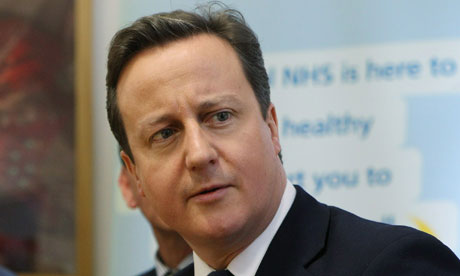
David Cameron will today signal a sea-change in the government fight against home-grown terrorism, saying the state must confront, and not consort with, the non-violent Muslim groups that are ambiguous about British values such as equality between sexes, democracy and integration.
To belong in Britain is to believe in these values, he will say. Claiming the previous government had been the victim of fear and muddled thinking by backing a state-sponsored form of multiculturalism, the prime minister will state that his government "will no longer fund or share platforms with organisations that, while non-violent, are certainly in some cases part of the problem".
In a major speech to a security conference in Munich, he will demand: "We need a lot less of the passive tolerance of recent years and much more active, muscular liberalism."
He will say that "some organisations that seek to present themselves as a gateway to the Muslim community are showered with public money while doing little to combat extremism. This is like turning to a rightwing fascist party to fight a violent white supremacist movement."
Cameron's aides, aware the speech may prove highly controversial, refused to identify the organisations in his sights, but it is clear one target is the Muslim Council of Britain.
Last night some Muslim groups criticised the prime minister for making the speech on the same day that the English Defence League is holding its biggest ever demonstration, in Luton.
Cameron will also make clear that his tougher stance extends to unambiguous support for the democracy movement in Egypt: "I simply don't accept that there's a dead-end choice between a security state and Islamist resistance."
His remarks suggest that a Home Office-led review into the government Prevent programme, being overseen by Lord Carlile, is going to lead to major changes.
It also suggests that he has sided unambiguously with figures such as Michael Gove inside his cabinet rather than his party chairman, Lady Warsi, who has complained of fashionable Islamophobia.
Cameron will argue many young men have been drawn to extremism due to a rootlessness created by the weakening of a clear collective British cultural identity.
He will say: "Under the doctrine of state multiculturalism we have encouraged different cultures to live separate lives, apart from each other and the mainstream. We have failed to provide a vision of society to which they feel they want to belong.
"We have even tolerated these segregated communities behaving in ways that run counter to our values. So when a white person holds objectionable views – racism, for example – we rightly condemn them. But when equally unacceptable views or practices have come from someone who isn't white, we've been too cautious, frankly even fearful, to stand up to them."
He will warn his audience: "Europe needs to wake up to what is happening in our own countries. We need to be absolutely clear on where the origins of these terrorist attacks lie – and that is the existence of an ideology, Islamist extremism."
This ideology he says, is entirely separate from Islam, and "at the furthest end includes those who back terrorism to promote their ultimate goal: an entire Islamist realm, governed by an interpretation of sharia".
But he adds: "Move along the spectrum, and you find people who may reject violence, but who accept various parts of the extremist world-view including real hostility towards western democracy and liberal values.
"If we are to defeat this threat, he says, its time to turn the page on on the failed policies of the past. So first, instead of ignoring this extremist ideology, we as governments and societies have got to confront it in all its forms."
Echoing Tony Blair after 9/11, he rounds on the soft left that "lump all Muslims together, compiling a list of grievances and arguing if only governments addressed them, this terrorism would stop".
Inayat Bunglawala, chair of an anti-extremist group called Muslims4Uk, said: "Mr Cameron's remarks are ill-judged and deeply patronising. The overwhelming majority of UK Muslims are proud to be British and are appalled by the antics of a tiny group of extremists and so will hardly be pleased with his lecture on integration.
"Ironically, the PM's comments come on a day when the viciously Islamophobic English Defence League are to stage their biggest demonstration yet on our streets. Integration works both ways and we would expect Mr Cameron and his government to be openly challenging these EDL extremists. Instead, he and his senior ministers have to date remained totally mute. It is disgraceful."
In opposition the Tories began considering the policy on Muslims, which critics say risks branding many as extremists even though they do not espouse violence.
Critics say it is based on flawed neo-Conservative thinking and risks backfiring, while supporters say it is necessary to tackle those who are fellow travellers with violent extremists.
source
Friday, 4 February 2011
Islamophobia: does Labour measure up?

By Bob Pitt
Labour Briefing, February 2011
"The Islamophobia Myth" was the title of an influential article by Kenan Malik published in the February 2005 issue of Prospect magazine. It argued that violence, hatred and discrimination against Muslims were at a very low level and that the threat of Islamophobia had been invented or at least greatly exaggerated, mainly by religious leaders hoping to suppress legitimate criticisms of their beliefs and to enhance their own status as community representatives. Malik's thesis was welcomed in some quarters at the time, including among sections of the left.
Six years on, far fewer people would buy that argument. Hostility towards Muslims and their faith has reached such a pitch that to deny this represents a major threat is simply untenable. When the racist hooligans of the English Defence League take to the streets in towns and cities across the UK brandishing placards with slogans such as "We will never submit to Islam", chanting "Burn a mosque down" and on occasion breaking through police lines to rampage through Muslim areas smashing shop windows and assaulting passers-by, who could seriously claim that Islamophobia is a myth?
The EDL and its ideology did not emerge in a political vacuum. When its leaders claim that Britain is undergoing a process of "Islamification", that the existing legal system is being supplanted by sharia courts or that mosques are potential organising centres for terrorism, they haven't thought up these ideas by themselves. These are themes constantly promoted by papers like the Express, the Mail, the Sun and the Daily Star, and it is this mainstream right wing Islamophobia that inspires and legitimises the more thuggish forms of anti-Muslim bigotry practised by the EDL and other far-right groups. Indeed, Nick Griffin has openly stated that the BNP aims to "take advantage for our own political ends of the growing wave of public hostility to Islam currently being whipped up by the mass media".
While Islamophobia is predominantly a right wing political phenomenon, but by no means exclusively so. Because this campaign against a minority community is framed as an attack on their culture rather than their ethnicity, it has been able to win the backing of people with otherwise progressive political views who would recoil in horror from traditional racism based on skin colour. Liberal and leftist Islamophobia is typically couched in terms of a defence of Enlightenment values, secularism, feminism or gay rights, but the effect is to reinforce the right wing narrative of British Muslims as an alien presence and internal threat.
Islamophobes of left and right will often claim that they are not attacking Islam as such but rather "Islamism" – a term that is applied so broadly as to cover almost all Muslim organisations which involve themselves in political action, the aim being to blur the difference between those groups promoting peaceful change through engagement with mainstream politics and those advocating violence.
Some of the fiercest critics of political Islam have been supporters of the Iraq war like Observer journalist Nick Cohen, who suddenly discovered that Islamism posed an existential threat to western civilisation after the Muslim Association of Britain emerged as a leading force in the organisation of mass anti-war protests. For others, hostility towards Islamism stems primarily from the fact that politically engaged Muslims are vocal critics of the Palestinian people's oppression by the Israeli state. Here Islamophobia is harnessed to the Zionist agenda of delegitimising political support for the Palestinian resistance.
The result of all this is a mood of resentment and antagonism towards Muslims, their beliefs and their organisations that extends across the political spectrum and through all sections of society. There are clear and very worrying parallels with the rise of antisemitism in the early decades of the last century.
What has the Labour Party's response been to this rising tide of Islamophobia? "Mixed" is the best you can say. In some cases Labour has shamefully adapted to the prevailing anti-Muslim mood.
One example of this was the disgraceful propaganda put out by Phil Woolas in Oldham East and Saddleworth during the 2010 General Election, the purpose of which was to "get the white vote angry" by claiming that the Lib Dem candidate was in an alliance with Muslim extremists. A Labour campaign leaflet featured headlines such as "Straight talking Woolas too fair for militant Muslims" and "Lib Dems in mosque planning permission stitch-up". Woolas's election agent suggested privately that traditional Conservative voters who were unhappy about backing the Tories' Muslim candidate might be persuaded to support Labour rather than the Lib Dems "if we can convince them that they are being used by the Moslems".
During the by-election that followed the court decision to disqualify Woolas, Jack Straw made a further pitch for the white racist vote by endorsing the myth of Asian grooming. His accusation that some men of Pakistani heritage regard young white women as "easy meat" won him the admiration of the Daily Mail's Melanie Phillips who hailed his stand against "Muslim sexual predators". This was nothing new for Straw. In October 2006 he condemned the Muslim face-veil as a "visible statement of separation" and revealed that whenever a constituent visited his surgery wearing one he asked her to remove it. Predictably, Straw's remarks unleashed a vicious media campaign against veil-wearing Muslim women, with "Ban the burkha" headlines splashed across the front pages of the right wing press.
That same month the then Communities Secretary Ruth Kelly announced on behalf of the Labour Government that there would be a "fundamental rebalancing of our relations with Muslim organisations", which involved sidelining the Muslim Council of Britain with its 500 affiliates in favour of an obscure outfit called the Sufi Muslim Council that barely had five members. In 2009 Kelly's successor Hazel Blears took the opportunity to break relations with the MCB entirely, on the basis of an accusation that one of its leading figures, Daud Abdullah, had signed a document "advocating attacks on Jewish communities all around the world" – an accusation that was completely untrue.
The severing of links between the Labour Government and the MCB was partly due to the latter's refusal to remain silent about the role of British foreign policy in enabling advocates of violent extremism to get a hearing among disaffected Muslim youth. The Sufi Muslim Council by contrast was viewed favourably because it placed the blame on Islamist ideology and let the Government off the hook. (The same reasoning lay behind the decision to funnel large sums of public money into another divisive and unrepresentative organisation, the Quilliam Foundation.)
In repudiating the country's largest Muslim organisation the Labour leadership was also succumbing to pressure from an anti-MCB campaign conducted by John Ware in his 2005 Panorama documentary A Question of Leadership and Martin Bright in his 2006 Policy Exchange pamphlet When Progressives Treat with Reactionaries: The British State's flirtation with radical Islamism, both of which portrayed the MCB as a nest of Islamist extremists.
Last year we saw a similar capitulation by the party leadership to an anti-Islamist witch-hunt when the NEC blocked Lutfur Rahman from standing as Labour's mayoral candidate in Tower Hamlets. The decision followed a campaign by Telegraph journalist Andrew Gilligan to expose Lutfur as an ally of "Islamic fundamentalists" at the East London Mosque who had supposedly infiltrated the Labour Party as part of a plot to transform Tower Hamlets into an Islamic state. The people of Tower Hamlets delivered their verdict on the NEC's acceptance of Gilligan's paranoid fantasies by electing Lutfur as an independent mayor with a massive majority.
In the interests of balance, it should be added that the Labour leadership's record on Islamophobia has not been all bad. To its credit, the last Government did introduce the religious hatred bill in an attempt to provide Muslims and other multi-ethnic faith communities with the same legal protection as Jews and Sikhs (who are defined as mono-ethnic and covered by the law against incitement to racial hatred) – only to see the legislation sabotaged by an amendment drawn up by Lib Dem peer Lord Lester.
However, it is prominent figures on the Labour left who have set an example to the rest of the Party in taking a firm and principled stand against the upsurge in anti-Muslim bigotry. Jeremy Corbyn, for example, has established warm relations with the North London Central Mosque in Finsbury Park since Abu Hamza and his gang were ousted in 2005 and has rejected attempts by the likes of Gilligan and the Quilliam Foundation to smear the present management as dangerous extremists.
During his eight years as Mayor of London, Ken Livingstone worked closely with organisations like the MCB and the British Muslim Initiative in defending the capital's Muslim communities and he was uncompromising in his refusal to bend to the forces of Islamophobia, notably in resisting the hysterical attacks that followed the welcome he gave to Yusuf al-Qaradawi during his visit to London in 2004. The struggle to get the Labour Party to purge itself of Islamophobia and adopt a more sensitive approach towards representative Muslim organisations will be greatly strengthened if Ken is returned to City Hall in 2012.
source
Wednesday, 3 November 2010
Smiling woman stabbed MP Stephen Timms over Iraq war

A woman stabbed a London MP twice in the stomach in revenge for him voting for the war in Iraq, the Old Bailey heard today.
Muslim Roshonara Choudhry, 21, smiled before she plunged the knife into Stephen Timms, who thought she was about to shake his hand at a meeting in east London.
Choudhry, of East Ham, is charged with attempted murder but refuses to recognise the court. She has instructed her legal team not to attempt to seek a not guilty verdict.
Mr Timms told how the woman, dressed in black, had booked an appointment at his weekly Friday afternoon surgery in the Beckton Globe community centre.
“I was sitting and I rose to greet her,” he told the court. “At that point I thought she must have been coming to shake my hand. She looked friendly and was smiling,” said the Labour MP for East Ham and a former Treasury minister. “Then she lunged at me with her right hand and it struck me here (pointing to the left of the middle of his stomach). I think I knew I had been stabbed although I didn't feel it at the time. I cannot actually recall seeing the knife.”
The court heard that Mr Timms, 54, cried out “what are you doing?” but Choudhry remained silent. The MP went on: “She stabbed me twice and I retreated although I was still not absolutely certain I had been stabbed. I retreated to the gents', lifted up my jumper and saw a lot of blood.”
Mr Timms was taken to the Royal London Hospital for emergency surgery and has now recovered to retake his seat in the Commons.
Choudhry, of East Ham, has insisted on not entering the court and is receiving legal aid.
The jury was shown dramatic still photographs from the CCTV cameras of Choudhry approaching the MP with her left hand extended as if in a handshake but with her right holding the knife behind her bag.
As Mr Timms reeled backwards from the attack days after the May general election, Choudhry was grabbed by security guard Faizal Butt and the three-inch knife was wrestled from her hand by him and the MP's assistant, Andrew Bazeley.
When police arrived they found she had a second knife with a five-inch blade in her bag.
Interviewed by detectives, Choudhry admitted she had intended to kill Mr Timms and had taken the second knife in case the first had broken during the attack, the court heard. She said she “was not going to stop stabbing (the MP) until someone made me”.
Asked why she had carried out the attack, she replied “punishment” for Mr Timms voting in favour of the Iraq war. She had acted “to get revenge for the people of Iraq,” she said.
Choudhry has pleaded not guilty to attempted murder and two charges of possessing an offensive weapon in May this year. It is believed to be the first time in living memory that a defendant has banned her lawyers from asking for a not guilty verdict.
At a pre-trial hearing she refused to enter a plea so the judge ordered that a not guilty plea be entered on her behalf. The trial continues.
source
Tuesday, 2 November 2010
Wednesday, 13 October 2010
Friday, 17 September 2010
Phil Woolas MP Accused of Stirring Racial Hatred to Get Elected

Phil Woolas, current MP for Oldham East and Saddleworth, stands accused of doctoring photographs, misrepresenting facts and fomenting racial and religious divisions in order to “make white folks angry” at his opponent, Lib Dem’s Elwyn Watkins, as part of a desperate bid to retain his seat in the run up to the May 2010 general election. Mr Woolas is accused of seizing on anti-Muslim sentiment in Oldham by claiming his rival endorsed a Muslim campaign to remove him.
A combination of Mr. Woolas’ voting record as Immigration Minister, his involvement in the expenses scandal, in which he claimed for tampons and women’s’ clothing, and a national swing against the Labour party were deemed to be unfavorable for his chances of re-election. His own election agent, Joseph Fitzpatrick, commented, “We are picking up the vibe that Phil is going to lose.” The Conservatives had chosen Kashif Ali, a Muslim, as their candidate, which, it was thought, would cause those Tory voters that disliked this selection to vote for the Liberal Democrats instead.
Given this situation, in the words of The Telegraph,
“Mr Woolas and members of his election team became convinced that he would be beaten by the popular Liberal Democrat candidate, Elwyn Watkins, who had sufficient momentum to wipe out the minister’s 3,590 majority.”
So in the weeks before the election, Mr Woolas’s team allegedly hatched a plan cynically to exploit racial tension in Oldham, the scene of race riots in 2001, by portraying Mr Watkins as a candidate courting the vote of Islamic extremists.”
Mr Fitzpatrick proposed to Steven Green, Mr. Woolas’ campaign adviser,
“If we can convince them that they are being used by the Moslems it may save [Woolas] and the more we can damage Elwyn the easier it will be to stop the Tories from voting for him.”
“We need … to explain to the white community how the Asians will take him out … If we don’t get the white vote angry he’s gone.”
This would lead to the publication of two pamphlets carrying such headlines as “Lib Dem pact with the devil” and “Targeted: militant extremists go for Phil Woolas”. A pamphlet released the day before the election even claimed that the Lib Dem campaign was backed by groups that had issued death threats against Mr. Woolas.
Two high court judges are presiding over the hearing against Mr. Woolas and, if found guilty, he could be fined and barred from public office. A new election would be triggered in the constituency.
source
Tuesday, 3 August 2010
Sayeeda Warsi: 'What I find amazing is the media's obsession with having to define me'
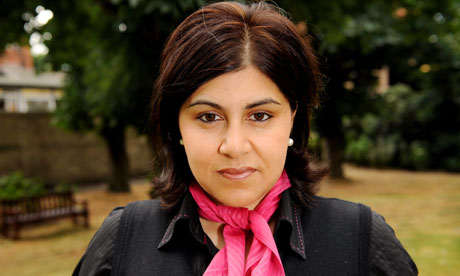
In all the fuss preceding Nick Griffin's appearance on Question Time last October, the great debate was about whether the programme would – as Griffin was gleefully predicting – promote the BNP to "the big time". As usual, Griffin turned out to be wrong. On the night, the star performance came from Baroness Sayeeda Warsi – a little known Tory peer, and relative newcomer to national politics, whose consummate demolition of the BNP leader made Jack Straw and Chris Huhne look like amateurs. If anyone joined the big time that night, it was Warsi.
To give Griffin his due, he was right about one thing. The show was indeed a golden opportunity to transform public perceptions of a party widely regarded as racist, anti-immigrant and resoundingly white. But it was the Conservatives who seized it – for there on our screens was a confident, likable, modern Muslim woman, the antithesis of a stereotypical Tory and apparently proof that David Cameron's Conservatives were no longer the nasty party.
Eight months on – and only eight years into her political career – at 39 Warsi is now one of the most powerful women in the country. Chair of her party, with a seat in cabinet as minister without portfolio, Warsi has been given a wide-ranging brief to work across government. As the former shadow minister for community cohesion and social action, she will be expected to focus foremost on social cohesion, and on the elusive matter of mending "broken Britain".
Her admirers make much of her down-to-earth appeal – her lack of airs and graces, her common touch, her common sense – all of which are apparent as soon as we meet. Over a KitKat and a cup of tea, she chats about motherhood, reapplies a quick dab of her daughter's Boots No 17 lip gloss, and poses for photos with a businesslike air of let's-get-on-with-it.
Warsi's brisk manner is that peculiarly Yorkshire blend of cheerful and grumpy – and she certainly wants you to know that's where she's from, for she references her Yorkshire roots with somewhat tiresome frequency. "There are parts of West Yorkshire," she points out proudly, "that I can reach, which maybe if you were from a different part of the country with a different accent it would be harder to reach."
She does indeed have a Yorkshire accent – but then, so do William Hague and Eric Pickles, so this could hardly be described as her USP. In terms of perspective and personal identity, surely what she brings to the cabinet table is gender, faith and ethnicity; Cameron has said as much himself, as have other colleagues, so you'd think this was pretty self-evident. Yet strangely, the only person who doesn't seem to agree is Warsi. In fact, she gets quite angry with me for suggesting such a thing – and by the time I leave, the interview has more or less descended into a row.
Warsi wouldn't disagree that her views are an interesting mixture of traditional and modern. An outspoken opponent of the Iraq war, she has called for dialogue with hardline Muslim groups, argued for asylum seekers to be granted the right to work, and criticised anti-terror legislation for radicalising Muslim youths. She would definitely, she has joked, fail Norman Tebbit's cricket test; when England play Pakistan, her loyalty lies firmly with with the latter. When Cameron made her a peer in 2007, Conservative Home ran an article by officials from the Margaret Thatcher Centre For Freedom, condemning her appointment as "the wrong signal at a time when Britain is fighting a global war against Islamic terrorism and extremism".
Warsi has also, however, said that BNP supporters have "some very legitimate views", described immigration as "out of control", and criticised the Archbishop of Canterbury for suggesting that sharia law in parts of Britain could foster social cohesion. In Luton last year she was pelted with eggs by Muslim protestors, who accused her of not being "a proper Muslim". Warsi had an arranged marriage at 19, but divorced in her early 30s, and was a single mum (her daughter, 13, goes to a convent school) before recently remarrying, to a Muslim divorcee. The extremist preacher Anjem Choudary has warned that "she is in danger", for "betraying Allah" and becoming "a 'coconut' – brown on the outside but white on the inside".
Exactly where Warsi sits in the whole debate about multiculturalism versus integration is not obvious, so I ask her to define her position. "Well I think there's a difference between multiculturalism per se, and state multiculturalism, where the state intervenes and says, 'You will do this, you will do that.'" For example, she offers, "When the state says 'We'll have winterfest instead of Christmas, so everyone feels included.' That's wrong."
But surely it's the state's decision either way? Whether schools call it winterfest or Christmas, it's still the state's decision. She disagrees: "A school should have the freedom to decide. If you have a school in the middle of a diverse society with lots of ethnic communities, then the head teacher in their professional judgment should know the best way to make everyone feel included. It's not for the state to say. 'You will teach A, B and C.'" That sounds like an objection to state centralisation rather than an argument specifically about multiculturalism. "Yes but it's also to do with state multiculturalism. For example, there was a county court that didn't put tinsel on its public desk because they thought it would offend! You see, that's the state intervening, saying you can't have tinsel there."
If she disapproves of state intervention so much, presumably she doesn't support the government's recent decision to make it a condition of entry for immigrants coming to join their spouses in Britain that they must learn to speak English first.
"No, not at all, I do support it. If you're saying, are you a multiculturalist or an integrationist, I'm an absolute believer in multiculturalism per se, where people have the right in their private lives to do what they want – as long as when it comes to the public sphere there is an acceptance of what the mainstream culture is, and our values and principles are. And our values and principles are about giving everyone an equal opportunity to improve their lives through economic involvement. They will not be able to do that if they don't speak the language of the land. We have to be quite clear about what people are joining here, and that includes having to join the language."
For Warsi, however, it doesn't include having to show your face in public, and she is vehemently opposed to a ban on the burka. "Why should we tell women what to wear? What it boils down to is choice. If women don't have a choice over what to wear then they are oppressed. But if a woman has a choice, and she chooses to wear whatever she chooses to wear, then she's not oppressed, is she? She's choosing what she wants."
I'm not sure why a woman can choose to wear what she wants, but not choose to speak what she wants. "Well just because a woman wears the burka, it doesn't mean she can't engage in everyday life." Some would argue, on the contrary, that in this country it does; that the burka alienates and disturbs to an extent that it creates a barrier between the wearer and the western world around her. "But there are women who wear the burka who run extremely successful businesses – internet businesses, which don't actually require you to be there face to face," she retorts. Which may well be true – but would only support Warsi's argument if what she really objects to is immigrants not earning money, rather than being ghettoised.
I'm sure Warsi does care about more than money. I'm just trying, I say, to identify your consistent principle which says no to banning the burka, but yes to making immigrants speak English. "The principle," she says, looking increasingly exasperated, "is one of equality and opportunity!"
Warsi talks passionately about the isolation and abuse of immigrant women without English, unable to understand their rights in this country or ask for help. It's unfortunate that the Pakistani ex-wife of Warsi's new husband recently claimed that she cannot speak or read English, so didn't understand he was divorcing her, and mistook the decree nisi for a utilities bill. The family row has been played out in the pages of a Sunday tabloid paper, and Warsi understandably refuses to discuss it.
But she must understand better than most the difficulty for many poor women in remote rural countries to access education and learn English. Far from giving them an equal opportunity, the government is arguably denying them the opportunity to come here at all – where it could ensure that they learned English – by making them stay in a country where it has no influence at all over their access to education. And what about spouses who have no intention of working in this country, but legitimately wish to lead a quiet and private domestic life?
"No, but coming to Britain is a privilege," she says flatly. "It's not an automatic right."
Warsi's own father arrived in Yorkshire from Pakistan in 1960, with £2.50 to his name, and she credits his work ethic – "the belief that if you work hard you can achieve anything" – as the guiding political philosophy of her life. The second of five sisters, she grew up in a working class, Labour-voting household – until her father started his own furniture business, became rich and joined the Conservative party. Educated at comprehensive school and Leeds University, Warsi became a lawyer and set up her own practice in Dewsbury. It was only in 2002 that she became involved in politics – and when Oliver Letwin heard her speak at a party conference fringe meeting the following year he suggested she stand for parliament in Dewsbury in 2005. She lost, but was made a peer two years later, and appointed to the shadow cabinet.
Her core political values, she has often said, are belief in the free market and individual liberty. But she also said in the past that what made her at Tory, more than anything else, was Labour's attitude to ethnic minorities. She said once that when she heard Alan Johnson refer to "leaders of the Muslim community", she thought, "I couldn't sit in a cabinet of people who still think like that; that somehow there are these alien groups in our nation, each of them represented by a leader who talked to the government on their behalf. It's almost the kind of approach of 'we know what's best for you brown people.' I find that patronising."
When I suggest that Johnson was perhaps just describing pluralism, she snaps: "That's not pluralism! You can't divide people on that basis." But it sounds as if her real anger was towards the "self-appointed religious leaders – men, you know, in beards" claiming to speak on her behalf – and she tells me she got involved in politics because, "I just felt, post 9/11, that the national voices weren't necessarily the voices of what ordinary people thought. That wasn't what the majority of British Muslims were feeling. I've always been confident in my identity, and I thought the whole debate needed to be had from the perspective of someone who was confident."
That sounds like a reasonable desire to offer herself as an alternative representative – a role not unlike the one she got so angry with Johnson for describing. Now she starts to look really annoyed.
"When I'm here at Central Office I'm identified by the fact that I'm part of the Conservative family. Why should I be identified on the grounds of my race or religion? What I find amazing is the media's obsession with having to define me."
But it's not the media, I point out – it's her leader. "She is the first Muslim in a cabinet or shadow cabinet," was Cameron's proud boast on The Andrew Marr Show within days of her appointment in 2007 – a view echoed by her colleague Andrew Mitchell, who declared, "She clearly has a reach within and outside the party which others of us don't have." Another hailed her as "a bridge builder – a thoroughly modern British Muslim woman."
If she doesn't like these labels, I ask, why did she accept an award last year from the Equality and Human Rights Commission as Britain's most powerful Muslim woman? "You should listen to the acceptance speech I made," she huffs. I did, I say, and quote it: "I hope in five years we don't have this award, because actually we should be taking it for granted that British Muslim woman are powerful."
It sounded like a sensible acknowledgement that we're not there yet, and a hope that her success might help us in that direction. To have a female Muslim cabinet minister is so clearly a cause for celebration that her reluctance now to acknowledge it makes little sense. It makes a bit more sense when she adds, "For someone like me, from 2005 to now, there have always been people on the sidelines who wondered if I'm a token appointment, if I'm being used. Am I going to spend the rest of my life trying to convince them otherwise? No of course not. I can't be bothered."
But it's hard to escape the impression of Warsi wanting to have her cake and eat it. If she's happy for her party to present her as the poster girl for the newly inclusive Conservatives, it seems a bit rich to object when anyone else talks about her in such terms. "I'm actually bored of these interviews, with all due respect," she says crossly. "And with this constant obsession with who are you, what's your identity, what is it that you stand for?"
Then, for a moment, the mood seems to lighten. "It's about," she says, "bringing additional value to the table. Your race, your ethnicity, your origin, your background – they all bring additional value." Finally, we seem to have arrived at a point of agreement. So when she says, "Did David want me to do Question Time because I was a brown woman? Or did David think she was a bloody solid media performer?" The answer seems obvious. Doesn't she think it was both?
"No, I don't!" she snaps. "I absolutely think it's the second one."
source
Monday, 19 July 2010
Catherine Heseltine Elected MPACUK's CEO

The Muslim Public Affairs Committee (MPACUK) is proud to announce that our new Chief Executive Officer is Catherine Heseltine. Since joining MPACUK in 2003, Catherine has made a consistently outstanding contribution to the work of the organisation. Her various roles have included working as the head of our campaigns team, appearing on television documentaries including Channel 4's 'Women Only Jihad', as a media spokesperson and mentoring new members.
Catherine is an English born revert to Islam and her election victory sets an historic precedent. In true pioneering spirit, MPACUK is the first British Muslim organisation to elect a woman as their CEO. We believe Catherine’s leadership will enhance MPACUK’s work in defending the civil rights of Muslims.
Catherine was born in 1978 and grew up in Islington, North London. She attended Westminster School and went on to do a BA in Education at Goldsmiths College, University of London. She became Muslim in 1999 while at University. She has worked for 10 years as a nursery teacher in London schools but is now taking on the role of CEO of MPACUK full-time. Her interests outside of her campaigning and community work include sports (tennis, sailing and skiing).
When asked about her historic achievement in being elected to lead a major national British Muslim organisation, she replied "I hope that this historic step will be a landmark in the development of a new wave of Muslim women leaders and will spark a revolution in the way Muslim women are enabled to contribute their talents in the service of both the Muslim community and wider society."
About MPACUK: The Muslim Public Affairs Committee is a civil rights group that campaigns on issues affecting Muslims in the UK and abroad. MPACUK runs Britain’s biggest Muslim website and has made numerous media appearances.
Read more:
Thursday, 13 May 2010
Speaking up: Young muslims take on the extremists

How can mainstream young Muslim students get heard when fundamentalists often have a stranglehold on their groups and societies? Saniya Gour, 17, an east London A-level student, has struggled. "Everyone where I live is so extreme. There are very few who are not hardline about things. And, as a girl, they don't want to hear what you have to say. I go to Leyton Sixth Form College and when I asked one of the heads of Isoc (the Islamic Society) if I could speak, he said no. They don't even like me talking to guys. They say: 'You're wearing a headscarf, you shouldn't be talking to boys'."
However, Saniya and other young Muslims now have a national forum where they can learn leadership skills and how to speak up. The Young Muslim Leadership Network (YMLN), funded by the Government as part of its controversial Prevent programme designed to stop violent extremism, is working hard to make its mark. It needs to. Early soundings by some of its two dozen members show that it is up against powerful forces.
The network was founded last year for young people aged 16 to 21, and has three groups – two in London and one in Birmingham. The central London group is researching university Islamic societies, and members have been shocked at what they have found. Hazura Bazeer, 18, a member of the central London branch of the YMLN, is in her final year at Coombe Girls' School in New Malden, Surrey, and has a place to study medicine at King's College, London. She says: "In one case that we heard of, a girl was slapped in the face for not wearing a headscarf, and, in one society, women were not allowed to speak and had to hold up their questions in writing."
On many campuses, societies are run by extremists, and moderate Muslim students avoid them. Such students also know that these societies are now closely monitored by the authorities – even more so after the recent University College London-educated alleged "underpants bomber" – and worry about the consequences of membership.
She points out that a lot of societies don't have any election process. "There is no democracy," she claims. "Posts are just handed on, so it is all just a vicious circle."
Her group is sending out a questionnaire to students and consulting on what changes people would like to see. It is also planning to visit more open Isocs, such as those at Oxford and Cambridge, in order to produce a code of good practice. "These societies have a lot of potential and ought to be a really cool part of university life."
Muhammad Saqib, 20, who is a student at Manchester University and active in the Birmingham group, has only recently become a practising Muslim. "I only started praying last year. Before that, I just thought it was a strict religion with a lot of rules that just seemed quite depressing. All these Muslims blowing themselves up gave quite a negative impression."
However, a talk at the LSE made him realise "that Islam is just the opposite", and now he is helping to produce a series of short video clips aimed at counteracting stereotypes and encouraging young Muslims to become engaged in society. The group has already interviewed Clare Short, the former Cabinet minister, and various prominent Asian figures, and, when the DVD is finished, they plan to show it in schools and to youth groups.
But Naqeeb Ahmed, 29, project officer for the network, knows from his experience at the University of Birmingham that young Muslims are often prime prey for extremists. "They've been brought up in liberal families, but then they get to university and start to explore their own identity and who they are as a Muslim, and they get drawn into these societies and become more and more extreme so that, eventually, even if their own father dies, they refuse to say a prayer in the house for him because they have been told that that is wrong. I've seen it so often myself. And these groups are strong and well-funded. We're up against the petrodollar – and how easy is it to fight that?"
Najda Khan, 18, who works for Bradford Metropolitan District Council, says schisms within Muslim communities can be deep and divisive. "Where do I start?" she says, rolling her eyes. "It can be about someone praying in the wrong way, about the Prophet's birthday, about issues with the Council of Mosques." She has already founded a campaigning environmental group and spoken to the House of Lords. "I'm passionate about getting young Muslims politically active."
These young people are also working to counteract prejudices about Islam. Crude stereotypes of oppressed women and bushy-bearded terrorists are, they say, reinforced by an irresponsible media, while barriers such as poverty, lack of confidence and family tensions stop many young Muslims playing their full part in society.
The network recently held its second national conference in London, and Bazeer, like others, values the chance to meet. "There aren't many Muslims where I live, and I don't have other Muslim friends at school. Alcohol is a big problem. You get invited to birthday parties, and there you are with a load of drunk people and you're sober. It can be difficult. And my friends say: 'Oh you're so innocent. You don't do this and you don't do that'. Everyone in the network is dealing with these kinds of misconceptions and stereotypes."
The network works alongside other organisations, such as the Federation of Student Islamic Societies and the Young Muslims Advisory Group, set up by Hazel Blears, the former Secretary of State for Communities and Local Government. However the Prevent programme, which has backed the YMLN with £110,000, has drawn widespread condemnation from critics who say it is being used to spy on Muslim communities. In March, a cross-party committee of MPs published a report, after an investigation into the three-year-old programme which has spent £53m on funding more than 1,000 community projects, which found it was doing more harm than good.
But Don Rowe, senior adviser on curriculum resources for the Citizenship Foundation, which administers the network, points out its aim is simply to "increase the young people's understanding of how our society works, so that they will feel more comfortable engaging with people in power and have more faith in the system and how it works. If they can sit down for an hour with someone like Clare Short and discuss a whole range of issues they have identified as important, it is bound to increase levels of trust and understanding".
source
Wednesday, 12 May 2010
I'm a Muslim & the BNP got my VOTE!
I'm a Muslim & the BNP got my VOTE! from Tre Azam on Vimeo.
With the rise of the BNP, how much is voting in-action, particularly in Muslim and ethnic minorities to blame?
People all over the world to this day are dying for the right to vote, for the right to have a say and for the right to a fair and democratic society, and yet every year hundreds and thousands of people including Muslim Brits choose not to vote in local and general elections, yet get angered and shocked with the rise of groups such as the BNP.
This documentary will reveal how and why public opinion and engagement with the voting system within Great Britain has changed. It will also look into whether political groups such as the BNPs greatest asset are non-voting ethnic minority communities, and what we can do about it.
The aim of this documentary is to inspire action, get people off their backsides and get involved in an election where we have a voice and CAN tip the scales.full doc coming soon.
Please note: We are not politically inclined, we do not have anything against the BNP (apart from the obvious), we do not have allegiance to any party but are purely trying to inspire people off their backsides and into booths, if we the people become empowered perhaps we can have more of a say in the country we love and live in....it will be the BRITISH PEOPLE who put the GREAT back into GREAT BRITAIN!
Produced by: Tre Azam
Directed by: Abid Mahi
Subscribe to:
Posts (Atom)