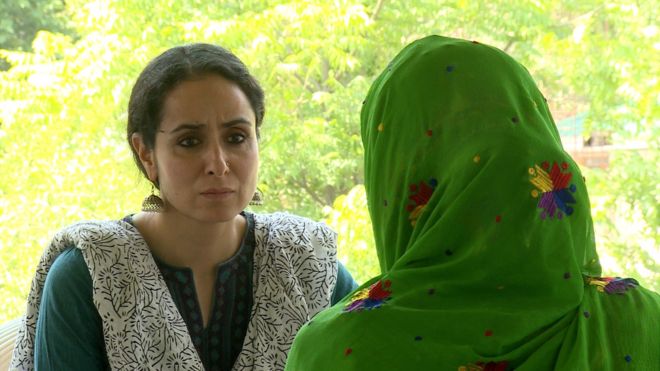
It was the summer of 1971, and the distant murmurs of a war that began months earlier had made their way to Rajshahi in Bangladesh, across the north bank of the Padma River, to Noor Jahan’s door. The 14-year-old was playing in the courtyard with her little sister when a loud military truck came to a halt outside the family’s farmhouse.
Armed soldiers threw the two girls into the back of the truck, where they discovered several women sitting back to back with their hands tied. “They told us to look down and to remain silent,” recalls Jahan, now 65. The truck continued through the small town, making several stops; each time loading more women and girls into the back as if they were cattle. All the women were sobbing silently, Jahan describes, too afraid to make a sound.
“We had no idea where they were taking us. I watched from the corner of my eye as the marigold fields surrounding our home disappeared from sight,” says Jahan. “I remember clutching my sister’s hand tightly and being terrified the entire time. We had all heard about the Butcher of Bengal and his men.”
The Butcher of Bengal was the nickname given to Pakistan’s military commander, Gen Tikka Khan, notorious for overseeing Operation Searchlight, a murderous crackdown on Bengali separatists in what was then East Pakistan, which led to a genocidal crusade during the liberation war that followed.
But Jahan was about to become a victim of another brutal tactic of the Pakistani army. Alongside the killings, soldiers carried out a violent campaign of mass rape against Bengali women and girls, in what many historians believe amounted to a direct policy under Khan’s command to impregnate as many women as possible with “blood from the west”.
When the truck finally came to a stop, the girls found themselves in military barracks. The next few months were a blur for Jahan, who regularly passed out during her confinement. “We lay there like corpses, side by side. There were 20, maybe 30, of us confined to one room,” she recalls tearfully. “The only time we saw daylight was when the door creaked open and the soldiers marched in. Then the raping would begin.”
During the conflict that led to the birth of Bangladesh, military-style rape camps such as the one in which Jahan was held were set up across the country. Official estimates put the number of Bengali women raped at between 200,000 and 400,000, though even those numbers are considered conservative by some.
Though ethnic rape was feature of Partition years earlier, what Bengali women experienced was one of the first recorded examples of rape being used as a “consciously applied weapon of war” in the 20th century. But despite its shocking scale, little remains known about it outside the region.
Within Bangladesh, widespread stigma led to the women being ostracised by their communities, and their horrifying accounts were often suppressed by shame. Today, a plaque on the wall of the Liberation War Museum in Dhaka says it all: “There are not many records of this hidden suffering.” Yet in every corner of Bangladesh, there are survivors with terrifying testimonies.
In August 1971, Razia Begum had gone looking for her husband, Abu Sarkar, who had been missing for several days. She wandered anxiously through the abandoned streets of Tejturi Bazar in Dhaka, where Sarkar was a fruit seller, but he was nowhere to be found. Begum turned a corner, when she found herself face to face with a group of soldiers. She tried to run but was struck on the head with a rifle; a scar she still bears.
Begum was dragged to a nearby forest where she was raped repeatedly over a period of weeks. The soldiers were stationed close by and returned at different times of the day. “They tied me to a tree and took turns raping me during their breaks,” says Begum, now 78. After they were done with her, the soldiers threw Begum into a shallow ditch.
A passerby eventually found her and took her to a shelter, which Begum describes as a lost-and-found for women who were abducted during the war. Such makeshift shelters had been set up in districts across the region for the many women who had been abducted and abandoned miles from their home.
“Women didn’t often leave the house during that time, so many of us didn’t even know our proper addresses,” says Begum. Begum’s husband tried four different shelters before he found her and took her home. “I don’t like to think about what happened,” says Begum. “But after all these years, it has been difficult for me to forget. I still have nightmares.”
On 16 December 1971, the war came to an abrupt end. Although independence had been won, thousands of Bengali women, such as Jahan and Begum, would be rescued from shelters and rape camps across the country.
Maleka Khan, then secretary of the Bangladesh Girl Guides Association, was tasked with mobilising female volunteers to help with war recovery efforts. But after learning about the discovery of women who had been raped and held captive in underground bunkers near Jahangir Gate in Dhaka, Khan decided to lead the rescue mission herself.
When Khan arrived, she was shocked by what she saw. “There were women who were completely naked,” Khan, now 80, says. “They were abandoned in bunkers, where they had been kept and tortured during the war.” Khan bought the women clothes and, after helping them out, she describes carefully wrapping them in saris and blankets.
“They were in a state of shock and couldn’t speak,” says Khan. “Some had their hair chopped off, while others were heavily pregnant. There was an air of disbelief about the whole thing. It was all so horrific.”
The women were taken to safe houses provided by the government of the newly independent Bangladesh. In an effort to integrate rape survivors back into society, Sheikh Mujibur Rahman, the founding father of the nation, granted them the honorific of Birangona (war heroine) and established a rehabilitation programme for the women, of which Khan became executive director.
“It has been 52 years and we still haven’t received an apology from Pakistan for the horrendous war crimes it committed against the Bengali people,” says Saida Muna Tasneem, Bangladesh’s high commissioner to the UK.
Bangladesh has already succeeded in getting genocide recognition from the Lemkin Institute for Genocide Prevention and Genocide Watch, and US Congress recently introduced a historic resolution recognising that a genocide occurred in 1971. The government is now lobbying for the UN and international community to recognise that a genocide was committed during the liberation war.
“Lack of recognition remains an open wound for the millions who were directly impacted by the atrocities that took place, many of whom are still alive today,” says Tasneem. “This dark chapter of history has been kept in the shadows for too long.”
Showing posts with label War Crimes. Show all posts
Friday, 14 April 2023
‘We lay like corpses. Then the raping began’: 52 years on, Bangladesh’s rape camp survivors speak out
Friday, 9 March 2018
Sunday, 21 January 2018
Bollywood and the Colonisers
I've always had issues with Bollywood, without a doubt the vibrance, the showcasing of culture in terms of dance,music and clothing I can appreciate, but the casual sexism, caricaturing of minorities/ethnicities and the stalkerish behavior shown as romance is really quite troubling.
There have been some truly masterful Bollywood films, I especially appreciated films depicting the fight against colonialism and the injustice of the British Raj and the struggle for freedom and independence.
So its incredibly disheartening to see Bollywood host an unjust and oppressive child-murdering leader like Benyamin Netanyahu, this man boasted he would destroy any hope of a Palestinian state if elected to office. Such a shame Indians have forgotten those who struggled so hard to free their country from the shackles of colonialism and support a tyrant like this. But I guess it is to be expected in an increasingly ethno-nationalist India which brushes the oppression of minorities under the carpet.
It's a shame so many have selective amnesia, they cannot recognize that the Palestinians struggle against the same oppression they once did. They want the same self-determination and freedom from colonizers that India gained.
They cannot see the parallels between Jallianwala bagh and the daily targeting and shooting of innocent protesters. The many protesters arrested by the British Raj and the thousands of Palestinians especially children languishing in Israeli jails.
Moreover so many Indians work in Gulf they make money in Muslim countries yet become cheerleaders for the Zionist Apartheid state which would never allow them to work there. My respect for those that refused to meet Netanyahu they will be judged as on the right side of history. Especially disappointed in Amitabh Bachchan, he had the admiration of so many he could have used that to promote understanding, instead he supports a brazen war-criminal.
Disgusted.
Wednesday, 22 November 2017
Kashmir 'mass rape' survivors fight for justice

"We were getting ready for bed when the soldiers came. They took the men away. Some started drinking alcohol. I was holding my two-year-old daughter in my arms when they tried to grab me.
"I resisted, and in the scuffle she fell out of my arms, and out of the window. She was crippled for life.
"Three soldiers grabbed me, tore my pheran, my shirt - I don't even know what all happened after that. There were five of them. I still remember their faces."
Zareena was also in the same house. It had only been 11 days since her wedding.
"I had returned from my parents' house that very day.
"Some soldiers asked my mother-in-law about all the new clothes hanging in the room, so she told them, 'here, she is our new daughter-in-law, our new bride'.
"What happened after that, I cannot begin to describe it. We haven't just been wronged, what we have faced is an infinite injustice. Even today when we see soldiers we start shaking with fear."
The people of Kunan and neighbouring Poshpora accuse the Indian army of carrying out a planned mass rape of the women in these two far-flung villages. They also claim that while the women were gang-raped, the men were subjected to horrific torture, and that they have been fighting for justice these last 26 years.
In Srinagar when I spoke with a minister in the state government, Naeem Akhtar, about these allegations he said that in conflicts like Kashmir truth often gets obscured by the layer of dust that settles on it.
And now it seems a group of young Kashmiri women are determined to wipe this dust away.
Saturday, 12 August 2017
Sunday, 18 December 2016
Aleppo is about the sanctity and dignity of each and every human life

As a Muslim, I find my community in selective outrage. The same desire for moral consistency applies to us as Americans. Today I watched with admiration the powerful words of Ambassador Samantha Powers speaking at the United Nations, addressing Russia and Iran:
“Are you truly incapable of shame? …
Is there no act of barbarism against civilians,
no execution of a child,
that gets under your skin, that just creeps you out,
just a little bit?”
Yes, these are powerful words. I found myself nodding in agreement. Yet I wonder where the same moral outrage was in our own country’s use of drones against Pakistan, Afghanistan, Yemen, Somalia, Libya, Iraq and Syria. Where was the same outrage when we bombed wedding parties and blew grandmothers to smithereens? Where was this moral display in Abu Ghraib and the forced feeding of prisoners at Guantanamo Bay, Cuba? Where is the moral speaking to power when we destroyed Iraq and Afghanistan, enable the Israeli occupation of Palestine by providing both military and political cover for Israel, and expedited shipment of weapons to Saudi Arabia to wreak havoc upon Yemen?
SourceThursday, 14 May 2015
'Fire at every person you see': Israeli soldiers reveal they were ordered to shoot to kill in Gaza – even if the targets may have been civilians
One solider, a First Sergeant in the IDF’s engineering unit who was sent to Gaza City, said: “The briefing on rules of engagement was [to open fire at], ‘Anything you think you should [open fire at]… Anyone you spot that you can be positive is not the IDF.’ The only emphasis regarding rules of engagement was to make sure you weren’t firing at IDF forces, but other than that, ‘Any person you see.’ From the very start they told us, ‘Shoot to kill.’ As far as the IDF was concerned, there wasn’t supposed to be any civilian population there.”
The Israeli air force dropped thousands of leaflets on areas it was preparing to attack, but according to the testimonies, it was assumed that once these leaflets had been distributed, anyone left would be from Hamas, or one of the other militant groups that took part in the war.
Another first sergeant, from an infantry division operating northern Gaza, said that he was told that, “if it looks like a man, shoot. It was simple: You’re in a motherf***ing combat zone. A few hours before you went in the whole area was bombed, if there’s anyone there who doesn’t clearly look innocent, you apparently need to shoot that person.”
Tuesday, 24 March 2015
When You Kill Ten Million Africans You Aren't Called 'Hitler'
Take a look at this picture. Do you know who it is?
Most people haven’t heard of him.
But you should have. When you see his face or hear his name you should get as sick in your stomach as when you read about Mussolini or Hitler or see one of their pictures. You see, he killed over 10 million people in the Congo.
His name is King Leopold II of Belgium.
He “owned” the Congo during his reign as the constitutional monarch of Belgium. After several failed colonial attempts in Asia and Africa, he settled on the Congo. He “bought” it and enslaved its people, turning the entire country into his own personal slave plantation. He disguised his business transactions as “philanthropic” and “scientific” efforts under the banner of the International African Society. He used their enslaved labor to extract Congolese resources and services. His reign was enforced through work camps, body mutilations, executions, torture, and his private army.
Most of us – I don’t yet know an approximate percentage but I fear its extremely high – aren’t taught about him in school. We don’t hear about him in the media. He’s not part of the widely repeated narrative of oppression (which includes things like the Holocaust during World War II). He’s part of a long history of colonialism, imperialism, slavery and genocide in Africa that would clash with the social construction of the white supremacist narrative in our schools. It doesn’t fit neatly into a capitalist curriculum. Making overtly racist remarks is (sometimes) frowned upon in polite society, but it’s quite fine not to talk about genocides in Africa perpetrated by European capitalist monarchs.
Mark Twain wrote a satire about Leopold called “King Leopold’s soliloquy; a defense of his Congo rule“, where he mocked the King’s defense of his reign of terror, largely through Leopold’s own words. It’s 49 pages long. Mark Twain is a popular author for American public schools. But like most political authors, we will often read some of their least political writings or read them without learning why the author wrote them (Orwell’s Animal Farm for example serves to re-inforce American anti-Socialist propaganda, but Orwell was an anti-capitalist revolutionary of a different kind – this is never pointed out). We can read about Huck Finn and Tom Sawyer, but King Leopold’s Soliloquy isn’t on the reading list. This isn’t by accident. Reading lists are created by boards of education in order to prepare students to follow orders and endure boredom well. From the point of view of the Education Department, Africans have no history.
When we learn about Africa, we learn about a caricaturized Egypt, about the HIV epidemic (but never its causes), about the surface level effects of the slave trade, and maybe about South African Apartheid (which of course now is long, long over). We also see lots of pictures of starving children on Christian Ministry commercials, we see safaris on animal shows, and we see pictures of deserts in films and movies. But we don’t learn about the Great African War or Leopold’s Reign of Terror during the Congolese Genocide. Nor do we learn about what the United States has done in Iraq and Afghanistan, potentially killing in upwards of 5-7 million people from bombs, sanctions, disease and starvation. Body counts are important. And we don’t count Afghans, Iraqis, or Congolese.
There’s a Wikipedia page called “Genocides in History”. The Congolese Genocide isn’t included. The Congo is mentioned though. What’s now called the Democratic Republic of the Congo is listed in reference to the Second Congo War (also called Africa’s World War and the Great War of Africa), where both sides of the multinational conflict hunted down Bambenga and ate them. Cannibalism and slavery are horrendous evils which must be entered into history and talked about for sure, but I couldn’t help thinking whose interests were served when the only mention of the Congo on the page was in reference to multi-national incidents where a tiny minority of people were eating each other (completely devoid of the conditions which created the conflict no less). Stories which support the white supremacist narrative about the subhumanness of people in Africa are allowed to be entered into the records of history. The white guy who turned the Congo into his own personal part-plantation, part-concentration camp, part-Christian ministry and killed 10 to 15 million Conglese people in the process doesn’t make the cut.
You see, when you kill ten million Africans, you aren’t called ‘Hitler’. That is, your name doesn’t come to symbolize the living incarnation of evil. Your name and your picture don’t produce fear, hatred, and sorrow. Your victims aren’t talked about and your name isn’t remembered.
Leopold was just one part of thousands of things that helped construct white supremacy as both an ideological narrative and material reality. Of course I don’t want to pretend that in the Congo he was the source of all evil. He had generals, and foot soldiers, and managers who did his bidding and enforced his laws. It was a system. But that doesn’t negate the need to talk about the individuals who are symbolic of the system. But we don’t even get that. And since it isn’t talked about, what capitalism did to Africa, all the privileges that rich white people gained from the Congolese genocide are hidden. The victims of imperialism are made, like they usually are, invisible.
Labels:
Africa,
Belgium,
Colonialism,
Europe,
Genocide,
War Crimes
Tuesday, 18 November 2014
Thursday, 23 May 2013
In Cairo, desperate Egyptian men search in vain for Syrian brides
On the outskirts of the vast Egyptian capital, Egypt ends and the latest Syria enclave begins. Women tie their headscarves in a distinctly Syrian way. They buy Syrian spices and trinkets from vendors whose shops are now tables lined along the streets. There is a constant murmur of stories about the desperate circumstances that forced the residents to flee places such as Homs and Damascus in the past year.
The only sign that one is still in Egypt is the sound of Egyptian men and their mothers, who flock every day in the hopes they can exploit the dashed hopes of the Syrian revolution. Too poor to take an Egyptian bride, the men have heard that Syrian refugees are cheaper, prettier, better cooks and easier to marry.
“I am looking for a Syrian bride,” a 39-year-old painter, his calloused hands showing his struggle to survive, tells a Syrian man selling pita bread and spices outside the local mosque. “They are less complicated.”
The Syrian has heard this a dozen times already that day and doesn’t even respond, but rather points to a professionally made sign in front of the mosque behind him. It says that the mosque “announces that it has nothing to do with the marriage of Egyptian men to Syrian sisters. That’s why there shouldn’t be any questions regarding this issue in any of the offices of the organization. May Allah punish those responsible for spreading these rumors.”
The painter is undeterred. “Maybe there are Syrian women around the corner?” he asks.
The Syrian, who asks that he be identified only as Khalid, just shakes his head.
Before the sign, Khalid said, he fielded the question 100 times a day; now it is only 50. It’s difficult to know if he’s exaggerating.
“They ask us where the office is to buy a Syrian woman, as if they are buying a chicken. They don’t believe us when we tell them it doesn’t exist,” said Khalid, who said he was 26. “Our women are not for sale. We are here because we did not want to be killed.”
Men across the region are now seeking Syrian brides. In Turkey and Jordan, where refugee camps pepper the landscape, the desperation of the Syrians is far easier to spot as rich Persian Gulf men scour the camps to buy brides living in tents. Rape, child brides and temporary marriages are prevalent.
“People are marrying off their daughters for as little as 100 Jordanian dinars ($70) because of the bad circumstances inside the camp in return for money,” said Marwa al Saloumy, who works on women’s issues for a regional advocacy group called Al Zahra.
But in Cairo, where there are no camps, the dashed dreams of both Egyptians and Syrians in the post-Arab Spring world meet on more equal terms. Egyptian men, now poorer as the economy founders, find hope in the desperate Syrians, who can’t live in their own nation because a war that once promised revolutionary change has brought devastation and forced flight instead.
Syrian women say the men instantly spot them by their dress and approach them constantly. Alaa, a woman who fled Damascus three months ago to the Helwan neighborhood that has now become a Syrian enclave, said the harassment has been one of her biggest challenges.
In light of what is happening in Syria, “this is not the time to marry and celebrate and enjoy life,” Alaa said. And because of it, “Egyptian women now are starting to hate Syrian woman.”
That Egyptian men believe they could marry someone for less is changing marriage across Egypt. Men are demanding more of women and are willing to offer less, women report, and the standards for taking a bride are falling. Where an Egyptian man was once expected to provide a home and prove he can work before he could marry, now many believe they can have a Syrian bride for as little as $45.
The men come to the areas where Syrians have congregated all day, hoping to escape forced marriages or no prospects at all. They go to the mosque, to the makeshift Syrian vendors, to apartment complexes where Syrians are known to live. They approach one stranger after another, asking for a woman in the same tone they would ask directions – security guards at apartment complexes, Muslim clerics, anyone whose accent identifies them as Syrian.
For the Syrians, defending the women in their community has become a means to maintain their dignity even as they are living in dire circumstances.
“The thugs of Bashar Assad have spread these false rumors,” explained Khalid. “He has destroyed our nation and now he is destroying the reputation of our women.”
According to the United Nations High Commissioner for Refugees, there are nearly 70,000 Syrian refugees living in Egypt, most in and around Cairo, all arriving in the last year.
But it is unclear how many Egyptians have taken a Syrian bride. Instead, it is a crisis built on rumor.
One regional women’s organization reported recently that 12,000 Syrian women have married Egyptian men in the last year. But according to the Ministry of Justice in Egypt, the official number of marriages between Egyptian men and Syrian women between January 2012 and March 2013 is 170, with 57 of those nuptials between January and March 2013, according to an Al Ahram online newspaper report.
Moreover, neither side wants to admit they are partaking. Syrians here find such claims insulting, and Egyptian women don’t want to admit that their men could find Syrians more attractive.
Some Muslim clerics have urged Egyptian men to marry Syrian women as an act of charity, and there are even rumors that top members of the Muslim Brotherhood, the secretive religious society through which Egyptian President Mohammed Morsi rose to prominence, have taken Syrian women as second wives.
Earlier this month, the National Council of Women condemned the push to marry Syrian women, urging Egyptian officials to intervene. It even set up a hotline for Syrians to call and complain.
The number doesn’t work.
Egyptian matchmakers say they keep getting requests for Syrian women but refuse to oblige. They say they do not want to create yet another problem for Egyptian women – another obstacle to marriage.
Nashwa Soltan has worked as a matchmaker for a decade. For the first time, in the last year, two of every 10 men she meets ask for a Syrian bride.
“He has difficult demands,” Soltan said, referring to one such man she is working with. “He is a 54-year-old widower and he has three children, two of them are in college and the third is in sixth grade. And he wants a beautiful woman in her 40s who doesn’t have children and who doesn’t want to have any children.
“He wants someone to cook for his kids and wake up early for him and his children. He wants a servant,” Soltan said.
Soltan tried to hook him up with three Egyptian women, but the Egyptian women always turned him down.
“He tells the women from the first date that he won’t change anything in the house and that each one of his children likes certain types of food and he is expecting her to cook for each one of them,” Soltan said. When he asks to only see Syrian women, Soltan said she refused.
The painter, who refused to give his name, appeared to be just as unlucky. After the sellers lectured him on why he was on a fool’s errand, he walked quietly around the corner where no Syrian women awaited him.
Frustrated, he walked away. The Syrians vendors smirked as though they had won a fight.
“We still have our dignity” Khalid explained.
Read more here: http://www.mcclatchydc.com/2013/05/14/191195/in-cairo-desperate-egyptian-men.html#.UZoe1LVwrp4#storylink=cpy
Tuesday, 19 March 2013
Bosnian woman helped make rape a war crime
There were days when she prayed for a bullet to end her suffering. When she thought she was dying of a heart attack, she whispered "Thank you God."
A young judge, Nusreta Sivac was one of 37 women raped by guards at a concentration camp in Bosnia. They never discussed the nightly traumas — their pained glances were enough to communicate their suffering. She also witnessed murder and torture by Bosnian Serb guards — and was forced to clean blood from walls and floors of the interrogation room.
She told herself to memorize the names and faces of the tormentors so that one day she might bring them to justice.
Today, it's partly thanks to Sivac's efforts to gather testimony from women across Bosnia that rape has been categorized as a war crime under international law. Thirty people have been convicted at the international war crimes tribunal in The Hague and another 30 cases are ongoing. She personally helped put the man who raped her repeatedly during her two months in captivity behind bars.
"Most of the strength I took from the idea that one day this evil would be over," she told The Associated Press this week ahead of International Women's Day on Friday.
The U.N. Special Representative on sexual violence in conflict said Sivac and other victims are helping to make sure wartime rapists pay for their crimes.
"The courage these women have shown coming forward and sharing their stories demonstrates the need to break the silence and stigma surrounding sexual violence in conflict," said Zainab Hawa Bangura. "These survivors are helping to end impunity by making sure perpetrators are brought to justice."
Bosnia's 1992-95 war was the bloodiest in the series of armed conflicts that erupted when the Yugoslav federation fell apart and its republics began declaring independence. It took over 100,000 lives and devastated the region. According to the UN, between 20,000 to 50,000 Bosnian women were raped — many in special rape camps — during the war that was fought between the new country's Serbs, Croats and Bosniaks.
African conflicts have seen even more harrowing figures: Between 250,000 and 500,000 were raped during the Rwandan genocide, and hundreds of thousands more in conflicts in Sierra Leone and the Democratic Republic of Congo.
Sivac's ordeal started in the spring of 1992 when Bosnian Serbs took control over her native Prijedor, in the northwest of Bosnia and threw Muslim Bosniaks and Catholic Croats in concentration camps. Alongside the women were 3,500 male prisoners, hundreds of whom were killed.
Sivac, a Muslim Bosniak, would start the day counting the bodies of the men who were tortured to death overnight. "Their bodies lay there in the grass in front of the building. Sometimes 20, sometimes 30 of them," she recalled outside the factory in Omarska where she was held for two months.
During the long days of forced labor in the camp's restaurant, the women listened to tortured prisoners screaming, calling for help and begging for mercy with voices that would become weaker until they went silent. Then the guards would force the women to clean the interrogation rooms, strewn with bloody pliers and batons. At night, guards would come to take the women away one by one — to rape.
Her captivity ended in August 1992 when a group of foreign journalists found the facility. The images of skeletal prisoners behind a fence and naked bodies beaten black and blue shocked the world and prompted an avalanche of reactions that forced the Serb leadership to release the prisoners.
Sivac's pre-war colleague from the Prijedor court, prosecutor Jadranka Cigelj, was also among the 37 Omarska women. The two escaped to neighboring Croatia, where they began collecting testimonies from hundreds of women who had been raped.
They spent years transcribing testimonies, convincing victims to break their silence and putting together legal dossiers which they then presented to the investigators at the International Tribunal for War Crimes in Former Yugoslavia, based in The Hague.
During this process, she said, "it became obvious how many women from all over Bosnia were affected. But I wasn't surprised by the big number."
For centuries, rape was considered a byproduct of wars — collateral damage suffered by women, horrors often overshadowed by massacres. Even though the Fourth Geneva Convention of 1949 prohibited wartime rape, no court ever raised charges until Sivac and Cigelj presented their overwhelming evidence.
The effort finally paid off in June 1995 when the two traveled to The Hague to take part in preparations for the first indictment by the Yugoslav war crimes court.
Their collected evidence exposed the magnitude of rape which courts could no longer ignore. According to the United Nations, it was a major "turning point" in recognizing rape as a war crime.
Sivac remembers the sunny July day the two realized their work would be soon rewarded.
They enjoyed a coffee in an outdoor cafe in The Hague and wrote a few postcards back to their torturers in Prijedor.
"Dear Friends," they wrote. "We hope you will soon join us in this wonderful city."
A year later, the tribunal indicted eight Bosnian Serb men for sexual assault in eastern Bosnia — a verdict based on testimonies collected by Sivac and Cigelj.
It was the first time in history that an international tribunal charged someone solely for crimes of sexual violence.
Nerma Jelacic, spokeswoman for the Yugoslav war crimes court, recalls the "shocking" testimony in subsequent cases where some victims were as young as 12.
"We had cases where both mother and daughter came to testify and both were subjected to same kind of torture and kind of crimes," she told AP.
Sivac who has since testified in several cases, including against Bosnian Serb leader Radovan Karadzic, is satisfied with what she has achieved, although she wishes the ongoing cases would accelerate. "It's slow, very slow," she said. "But it is a start."
One of the Omarska guards she testified against was released in 2005 after he served two-thirds of his seven-year sentence.
Sivac ran into him on the street one day in Bosnia.
"We stared at each other," she said. "He was the first one to lower his head."
Monday, 24 December 2012
Bosnian war rape victims suffer in silence, wait for justice
Fika was 15 years old, and her sister 17, when they were captured and repeatedly raped by Bosnian Serb soldiers who swept through eastern Bosnia early in the country's 1992-95 war.
"We were forced to watch each other being raped, and I still feel my pain and the pain of my sister," she said. "They wanted us to admit we were spies, so they beat us till they knocked out our teeth."
Twenty years on, Fika is among thousands of Bosnian Muslim women whose search for recognition and support from the Bosnian state is being blocked by Bosnian Serb leaders who fear a wave of compensation claims. Her sister died at the hands of their torturers.
Rights groups are losing patience, warning that the psychological toll is only getting worse with time.
"The silence surrounding the wartime rape of women in the Serb Republic ... is deafening," Amnesty International wrote in October.
Fewer than 40 rape cases have been prosecuted in the 17 years since the war ended, and legislation at the state level to extend compensation and rehabilitation rights to rape victims of the war is gathering dust, hostage to ethnic politicking.
The lesson of Bosnia has spurred a push by Britain to raise awareness of sexual violence in war when it takes over the chairmanship of the G8 group of industrialized nations next year.
Under the Preventing Sexual Violence Initiative, the British government plans to send police officers, lawyers, psychologists and forensic experts to Bosnia and other conflict and post-conflict countries to work with local authorities on the issue.
"Bosnia and Herzegovina is seen as a priority country," Ann Hannah, a spokeswoman for the initiative, told Reuters. She said a team would arrive in Bosnia early in 2013.
"We have a very strong feeling there is a window of opportunity to make a significant breakthrough on this issue," Hannah said. "Without its resolution, any peace process is incomplete."
A delicate balance of Muslims, Serbs and Croats, Bosnia was torn apart as federal Yugoslavia dissolved. An estimated 100,000 people died, most of them Muslims. Some estimates put the number of women raped at up to 35,000, again the majority of them Muslims.
"MY HEART IS ROTTEN"
With peace, the country was split into two autonomous regions - the Serb Republic and the Federation of Bosnia and Herzegovina, home to mainly Muslims and Croats. The country is ruled by a system of ethnic quotas, with each region enjoying a high level of autonomy and the central state often left powerless to legislate over the entire territory.
The story of Fika, as she asked to be called, is indicative. She declined to give her real name, fearing the stigma attached to many wartime rape victims in Bosnia. Reuters reached her through a non-governmental organization that helps rape victims.
Caught up in a wave of ethnic cleansing of Muslims from eastern Bosnia, Fika was captured and held at a Serb-run detention camp in the town of Vlasenica. She says she lost count of how many times she was raped by her captors.
Finally released, Fika fled to the northern town of Tuzla, now part of the Federation, dropped out of school and struggled to support her mother, who was widowed during the war, and younger sister.
Now 34 and a mother, she has not told her three children what happened to her, nor will she return to her home in Vlasenica, which is now part of the Serb Republic and where she believes her rapists still live.
Three years ago, spurred by recurring nightmares, she raised the courage to report two of them, whom she recognized as locals of Vlasenica, to police in the region, but charges were never brought.
She has been diagnosed with post-traumatic stress disorder and receives 250 euros ($330) per month from the Muslim-Croat Federation as compensation for her war trauma.
Those like her who live in the Serb Republic receive nothing, however, because the law there only recognizes those who can prove damage to at least 60 percent of their body as civilian victims of war, disregarding psychological trauma.
Fika told her husband what happened to her, but says she regrets doing so because of the toll it has taken on their marriage.
"I have no idea what keeps me going," Fika said. "My heart is rotten."
At least three separate bids have been made in recent years to enshrine the rights of wartime rape victims in state law, so far without success. Bosnian Muslims accuse the Serb Republic of blocking their efforts.
"We have created a nation-wide strategy designed to ensure reparation for the victims of wartime rape but from the very beginning we knew the government of the Serb Republic was hardly likely to accept it," said Saliha Djuderija, assistant minister for human rights and refugees in the Bosnian central government.
PERPETRATORS STILL FREE
Amnesty International said the Serb Republic "is still failing to acknowledge the needs of wartime rape survivors - indeed, the existence of a problem at all."
Authorities there, it said, "have never made a meaningful attempt to collect data on this population, to understand and quantify their problems or to develop policies that would address their specific needs."
Bosnian Serb War Invalids Minister Petar Djokic denied this, saying his government was exploring ways to resolve the issue while safeguarding against the possibility of false claims.
"We have already discussed this with some non-governmental organizations dealing with this problem to see how we can resolve this institutionally in the best way," Djokic told Reuters, "without creating another problem for ourselves through any attempted abuse of the social support system.
"We want to protect the victims of sexual violence in a just manner, but all such victims will have to prove exposure to sexual violence, though not necessarily medical confirmation of the level of bodily damage," Djokic said.
As time passes and victims are left to deal with their trauma alone, the psychological scars deepen, psychologists say, worsened often by the knowledge that the perpetrators are still walking among their victims.
"It only aggravates the condition and their experience of trauma reaches the level of psychological terror," said Teufika Ibrahimefendic, head of the ViveZene NGO and a psychologist who has worked with rape survivors for years.
"The community must recognize the rape as a war crime and each victim must be recognized."
Fika agreed: "For me, the war never ended. And it never will." Source
Subscribe to:
Posts (Atom)
.jpg)