Showing posts with label misogyny. Show all posts

Tuesday, 28 April 2026

Misogyny Is Haram in Islam: Reclaiming a Misunderstood Truth


In many conversations today, Islam is unfairly associated with the oppression of women. Cultural practices, political realities, and selective interpretations are often mistaken for religious teachings. However, a closer and more honest look at Islamic principles reveals something very different: misogyny hatred, devaluation, or unjust treatment of women is fundamentally incompatible with Islam. In fact, it is haram (forbidden).

The Spiritual Equality of Men and Women


At its core, Islam establishes the spiritual equality of all human beings, regardless of gender. The Qur’an repeatedly emphasizes that both men and women are equally accountable to God and equally capable of righteousness:

“Indeed, the Muslim men and Muslim women, the believing men and believing women… God has prepared for them forgiveness and a great reward.” (Qur’an 33:35)

This verse is not symbolic, it is explicit. Worth is not determined by gender, but by character and faith. Any ideology that diminishes women simply for being women directly contradicts this foundation.

The Prophet’s Example: A Model of Respect

The life of the Prophet Muhammad offers a practical demonstration of how women are to be treated. He uplifted women in a society where they were often treated as property. He consulted women, valued their opinions, and emphasized kindness toward them.

One of his most well-known teachings states:

“The best of you are those who are best to their women.”

This sets a clear moral standard. Misogyny, whether expressed through abuse, dismissal, or discrimination is not only discouraged but directly opposed to prophetic character.

Rights Granted, Not Given by Society

Islam introduced rights for women that were revolutionary in their historical context, rights to inheritance, education, consent in marriage, and financial independence. These are not favors granted by men; they are divinely mandated الحقوق (rights).

For example:

A woman has the right to own and manage her own wealth.
She must consent to marriage; forced marriage is invalid.
She is entitled to education and personal development.

To deny or undermine these rights is not just cultural malpractice, it is a violation of Islamic law.

Culture vs. Religion: A Crucial Distinction


Many practices that appear misogynistic in Muslim societies stem from cultural traditions, not Islamic teachings. Patriarchal customs, misinterpretations of scripture, and power structures have, at times, overshadowed the ethical clarity of Islam.

Blaming Islam for these practices is like blaming a constitution for the actions of those who violate it. The problem lies in human behavior, not divine guidance.

Misogyny as ظلم (Oppression)

In Islam, injustice (zulm) is a grave sin. Misogyny, by its very nature, is ظلم, it denies women their dignity, rights, and humanity. Whether through systemic discrimination or everyday attitudes, it stands in direct opposition to Islamic ethics.

The Qur’an repeatedly condemns oppression in all forms. There is no exception made for gender-based ظلم.

Reclaiming the Narrative

For Muslims and non-Muslims alike, it is important to separate Islam from the actions of individuals or societies that fail to uphold its teachings. Challenging misogyny is not a rejection of Islam, it is a return to it.

Muslim communities today are increasingly engaging in this process: revisiting texts, amplifying women’s voices, and confronting harmful norms. This is not innovation; it is restoration.

Conclusion

Misogyny is not just discouraged in Islam, it is incompatible with it. The faith calls for justice, compassion, and dignity for all people. Any belief or practice that undermines women contradicts these principles and must be recognized for what it is: not Islam, but a deviation from it.

Understanding this distinction is essential, not only for correcting misconceptions but for building communities that truly reflect the values Islam teaches.

Monday, 21 August 2023

The Scam Behind the Invalid Misyar, Mut'ah and Secret Muslim Marriages


Secret marriages among red pill Muslim men and women have unfortunately become common, due to an increase in narcissism in our societies. Codependent Muslim men are also getting roped into this by their narcissistic brothers, only to have their lives and marriages ruined by terrible advice that goes against Islamic principles and morals.

Thursday, 22 December 2022

The Rise of the Muslim Incel: Ideological Victim Blaming and Its Harm to Muslim Women and Men


The internet is a place of extremes. While the risks of a global information and communication system built on binaries has long been foretold, we are now fully down the rabbit hole of an increasingly disturbing phenomenon of anti-female sentiment in the shape of Red Pill and Incel movements.

Much like its political opposite of ‘woke’, the term Red Pill – a cultural reference to the fin de siecle blockbuster The Matrix – denotes a kind of social and political awakening. The Matrix itself (a film created during the end of a millenia when cultural anxieties are brought most provocatively to the fore) projects an alternative reality in which the main character is given a choice between swallowing a red pill that will allow him to learn the hard truth about the world in which he lives and a blue pill that will allow him to stay oblivious and return to his normal life. Similarly, proponents of these ideologies believe patriarchy is a social mirage that masks a deeply misandrist society.

Conversely, these movements have constructed, and are now fully immersed in, a reality in which female privilege overwhelmingly shackles men to positions of disadvantage. According to Incel communities (the term Incel stands for ‘Involuntarily Celibate’ and refers to men who display romantic frustrations because they consider themselves unable to attract women ) that follow this inverted truth, the interests of women dictate social and political systems, leaving men marginalised and discriminated against. These cyberculture enclaves act as ideological havens for aggrieved men who believe they are downtrodden by the force of female entitlement. Worryingly, they have made violent protrusions into the real world in the shape of increasingly misogynistic attitudes, abuse against women and, at the extreme end of the scale, mass shootings and other violent hate crimes.

In reality, Inceldom and Red Pill thought is the result of the social anxiety that exists around the role of male identity in these volatile economic times. As the nuclear family, and the traditional gender and economic roles that define it, face threats from social, political, cultural and global shifts to its foundations, the gender orthodoxy which hallmark capitalist societies is left disfigured.

Minceldom and Red Pill thinking in Muslim spaces
The binary nature of the internet, and the divisive social architecture it creates means the contrived male vs. female dynamic was always the most vulnerable to manipulation on digital terrain. Likewise, the age old trope of Muslim as ‘other’, provides the perfect blueprint for a dichotomous internet culture to so neatly map itself upon. As such, it is perhaps no surprise that Inceldom has found such healthy expression in the online Muslim world. While political powers hang upon a vilified Muslim identity in order to justify the industrial-complexes on which they depend, the Muslim identity will always be ripe for exploitation. This tortured social alchemy creating a proud army of Mincels; ‘Muslim involuntarily celibate men’.

There are a number of factors which result in young Muslim men being so taken by this inherently racist and sexist ideology which, not insignificantly, was borne from white, Christian, male culture- hitherto top of the global food chain – on niche internet forums such as Reddit and 4chan.

During these increasingly uncertain social and economic times, Muslim families – and questions pertaining to gender roles in the Muslim home- face similar contestations. This environment of uncertainty is similarly generating existential discomfort amongst Muslim men for whom bedrocks of masculinity such as marriage and economic primacy are no longer at arms reach, creating an identity crisis which sees Muslim men aggressively assume exaggerated and superficial qualities of masculinity as defence.  

Internalised Islamophobia is another significant driver of this currency of misogyny amongst young Muslim men; as the Muslim identity is increasingly problematised, Muslims by default are placed on the back foot,  qualifying Islam through a secular, non-Muslim lens; attaching it to symbols of perceived greatness to make up for its perceived deficiencies. With the racialised make-up of Muslims in the west, there are also many racial nuances that further complicate this unfortunate tendency – whitewashing for legitimacy is synonymous with secularisation in the Muslim world.

The validation that young Muslim men seek is satiated when WASP (White Anglo-Saxon Protestant) culture, and its most prominent media figures, wrongly attribute, and glorify, a whole range of racist, orientalist and Islamophobic tropes to Islam and Muslims. In effect, Muslim men have begun to accept false and crude stereotypes regarding Islamic masculinity that are being celebrated by burgeoning online communities, as they are reclaimed as part of Western tradition and heralded as the way forward. For a generation of young Muslim men, this represents a shift in a value system that has always had them in a chokehold, and which now present an opportunity for cultural redemption. Coupled with lazy political thinking which creates a false alliance between right-wing and Muslim interests in popular Muslim thought, the ground becomes fertile for the rapid growth of this ideology

The attention economy on which digital content thrives means that naturally, Muslim male influencers are now taking on and promoting the ideological cadences of this internet movement that glamourises sexual and domestic violence. The convolution between misogyny and Islam is so cemented in modern Muslim thought, that anti-female views become the basis by which social media influencers lay their claim to Islam – it has become a mark of Islamic authenticity in the Dawah world to speak disparagingly of the idea of female rights. These influencers, who are clocking up tens of thousands of hits and are increasingly legitimised, appear to revel in the subversive nature of their anti-female views, apparently unaware that the identity they occupy is just as much a making of secular ideology as the feminism they claim to be fighting a righteous battle against. As a community we appear to be willingly donning the monstrous mask of Islamophobic caricatures, now placated by social media influencers.

Muslim men who have been conscripted by this false doctrine are equally pacified by the reassuringly simple narrative that they propagate, and which provides a welcome distraction from the complexities of real life.

Real life examples of how this is harming muslim women and children are endless. Emotionally and physically abusive relationships are all but celebrated online – and disturbing narratives coming directly from Muslim men – who are expressly comparing women to Shaitan – are promoting the mistreatment of women, wrongly in the name of Islamic ideology. One haunting example includes a Muslim man who boasts about his partner serving him tea having just delivered their child, and revelling in the subjugation of a physically and emotionally vulnerable woman. Ironically, this attitude is antithetical to the Prophetic tradition that Islam is built upon which includes an honourable focus on empathy, compassion and charity – not to mention a whole moral code upon which marital relations and rights are honoured.

The construct of the punitive, harsh and corrective Muslim male in popular Muslim thought is simultaneously and contradictorily portrayed as both the result of divine law and natural order, and as a punishing measure for the straying of Muslim women. In reality, it is Muslim women that should be lamenting the loss of Islamic masculinity, through social tantrums, or otherwise. This emptying of Islamic masculinity is exemplified in how the terms of debate regarding polygamy are shaped entirely by male desire, and the social responsibility, which a majority of scholars classify as the purpose of multiple marriages, remains an invisible and neglected consideration.

Miscategorisation of a growing problem
While the underlying reasons for the sprouting of Inceldom in Muslim digital spaces are many and complex, the insistence that we see within the Muslim community of those that recognise it harms, of lazily ascribing blame for the popularity of these movements to ‘feminism’ – in short, women – does nothing to address or remedy this distressing trend. In fact, it mirrors the wider pattern amongst the Inceldom beyond the Muslim world, where there is an insistence on portraying Red Pill communities as fighting a cultural war against feminism. We are effectively affirming their own deluded narrative.

In the eyes of incels, the feminist is the ultimate evil and the main cause of their social demise. Equally, amongst Red Pill apologists, the idea of the ‘feminist’/ liberal Muslim woman is presented as the sole driver for men involuntarily being pushed into hateful stances. Despite the recognition that Red Pill thought is antithetical to Islam, we are seeing this constant excusing of male behaviour.

This false equivalence between feminism and Inceldom is itself another contradictory dimension to Inceldom – the former is an intellectual, political and social movement spanning centuries and borne from an extended history of abuse and inequality – and which includes a whole spectrum of positions – and the latter an undesirable and unintelligible internet off-shoot based on self-victimisation. This posturing does little to address the gravity of the situation at hand.

Once again, the gender debates that occupy Muslim men and women are tellingly based on suppositions about our own religion, which are entirely reactive and false. Just like the answers to social unease amongst Muslim men cannot be found in secular or non-Muslim solutions, the expression of this social angst should unequivocally not mirror that of non-Muslim, or unislamic cultures like Red Pill. In the same way that conventional gender roles in Muslim and non-Muslim, Western culture are in no way aligned, Muslim men cannot hark back to a history of gender norms that does not belong to Islamic culture. They should not interpret Red Pill as a rallying cry of solidarity from men across the globe; their aims and motivations are not the same. Islamic masculinity comes from a place of security and Taqwa, not insecurity and panic.

Equally, the reductive and patently false flag of ‘Islam is a feminist religion’ itself does Islam a disservice – Islam, a divine moral code set by our Creator, will always be transcendentally and substantively more than any humanly defined phenomenon. Islam established women’s God-given rights as equal believers, and exists as a universal truth that outspans any earthly social movement and its claims to parity or equity. The need for muslim women to lay claim to feminism as a means of equal treatment speaks of the conceptual dwarfing of Islam in western intellect, and the mistreatment of Muslim women in Muslim societies.

If the Muslim feminist is continually touted as the ultimate evil, and feminism itself attributed to female ungodliness, then as a community we need to address why Incel culture is repeatedly spoken about as an inevitable response to feminism, and not men being just as prone to unIslamic ideologies. We need to think about why an entirely male phenomenon is being attributed to women. And why Muslim women clutching onto secular models of equality is not seen in the same victimised way – despite the shameful mountain of statistical evidence which demonstrates that a worrying number of women are on the receiving end of physical, emotional and spiritual abuse in our communities.

Taken to its logical conclusion, this line of argument which assigns no blame to men, implies that men are morally infallible, and women inherently corrupt. This reasoning reinforces the most ugly tenets of Red Pill thinking and creates the ideal environment for domestic and spiritual abuse of women to thrive. It is especially insulting given women are overwhelmingly the victim of Red Pill and Incel culture, not men; it is in essence ideological victim blaming. It shifts the onus onto women and encourages further self-victimisation amongst men who are developing increasingly warped perceptions of reality.

The undercurrents of this thinking, the idea of the original female sin and the morally reprehensible woman, are as old as time and as alien to Islam as the Red Pill ideology they prop up and support. They demonstrate the disfigured, ahistorical Islam that is adopted by men in these movements, and are worsening a situation whose only cure is to return to the Qur’an and Sunnah, and for men to adopt the sense of responsibility, honour, accountability and kindness that characterised our Prophet ﷺ.

While this apologism collectively allows Muslim men, and the hateful male spaces that exist within them, to evade responsibility – and does nothing to advance the lost masculinity they claim to mourn – individually it does young Muslim men a great disservice. It grants them an impunity that does them a disfavour as believers particularly, and denies them the opportunity for self-reflection and growth. When young men see prominent figures in the community defer accountability for the wrongs of Mincel onto Muslim women, they are effectively being told not to assume any duty or obligation as Muslim men – it is entirely emasculating.  In keeping with a more general trend in Muslim cultures of disburdening men from responsibility, it stunts their moral development and prevents them from reaching their potential. If our moral well-being depends upon an unadulterated  relationship with reality and our own selves – what might cultural and religious leaders be doing in cushioning men from these social, economic and personal blows?

Unfortunately it is in keeping with the ideological migration we see of furthering away from the Sunnah. While the grounds of the debate continues to shift to more extreme positions, we risk alienating more and more women, while they face further individual and collective scrutiny in demanding their basic rights as believers. Muslim men need to understand that misogyny, the ideological bedfellow of Islamophobia, is a characteristic of the forefathers of anti-Muslim sentiment, the Quraish, and should be eschewed by the inheritors of our faith. It is without doubt an inherent trait of the Jahil.

Moving forward
What we need to see is Muslim men unequivocally denouncing this movement which is part of a larger, unrelenting course of punishing Muslim women that exists beyond our faith community and appears to have no geographical borders or limits. If Muslim women are the ideological punch bag of world leaders, domestic policy, and the wilderness of internet discourse and its material impact on our homes – what hope do we have of moving forward as a community? Who can muslim women turn to if we are both the cause and victim to our apparently justified abuse?

The countless examples of the Prophet’s ﷺ love, mercy, kindness, compassion and tenderness to the women in his life and in society at large should be the basis by which we begin the conversation on gender relations, given the wider climate. The well-known example of Banu Qainuqa, a Medinian tribe that dishonoured a Muslim woman and against whom the Prophet ﷺ lay siege for 15 days as a result, goes some way in demonstrating the tradition of respecting and upholding the dignity of Muslim women in Islam.

There must be a concerted effort to finally decouple misogyny from Islam as it now exists in the mind of Muslim men, and to understand Islam not as an endorsement of or reaction to modern or pre-modern eras, but a timeless ideology which stands independently and which wholly recognises men and women as twin halves in faith. Muslim men need to be educated on our history, to fully recognise that misogyny is not a Muslim trait, and never has been. In the conventional social hierarchy, changes to which birthed this screaming and distressed Red Pill movement, Muslim men sit far below the white men who promulgate this view. A defining feature of racist ideology is the pandering to men of colour who they deem as inferior, when it suits their misogynistic agenda. Muslim men, like women, are no more than a tool in the broader Incel manifesto.

The idea of Muslim women’s rights, based on Islamic tenets and not lies we are being told about our own religion needs to be reestablished amongst Millennial and Gen Z Muslims in an uplifting, non-condescending way, we are not lollipops and we need to jettison the fable like narrative of femininity that infantilises us as less than male believers in the eyes of our Creator.

And while hairs will be split about the tone women take as we are crushed under the heel of a rampant misogynistic Islamophobia, I only hope men will pause to reflect on our actual call. Only when men approach the table with a sense of the Prophetic qualities of humility are we in a position to have a meaningful conversation and a necessary departure from the deadlock we are in. There are countless nuanced debates about how women can better themselves as believers and armour themselves against thinking and practice that is unIslamic in nature – where are these conversations taking place in Muslim men’s spaces? Where are we seeing religious and cultural figures making critiques which centre men’s agency and accountability in a movement which is openly violent against women? The answer to these questions that are generated in the male Muslim community lie exactly there, and as believers in Allāh, Muslim women have to have faith that they will be answered, by the will of Allah.

Link

Tuesday, 20 December 2022

Why this Muslim is pushing back against Andrew Tate


In late October, a video went viral on Twitter, showing former British kickboxer Andrew Tate learning how to pray like a Muslim from a friend and fellow MMA fighter, Tam Khan. Days later, Khan confirmed Tate’s conversion to Islam.

It was a blow to Muslim women like myself, and to parents and others in the community who had been breathing a sigh of relief since Tate was banned across every major social media platform in August. Our big fear: this might cement his popularity with some Muslim men. It is a worry that has only been amplified by Elon Musk’s decision to reinstate Tate’s Twitter account.

In one of Tate’s most notorious videos, he talks about how he would respond if a woman was to accuse him of cheating: “It’s bang out the machete, boom in her face and grip her by the neck. Shut up b**** … slap, slap, grab, choke,” he says. Tate has previously said in a tweet that “if you put yourself in a position to be raped, you must bear some responsibility”.

Comments like these have made Tate a central figure in digital red pill culture and its increasingly violent overtones. The term, “take the red pill”, is a pop culture reference taken from the 1999 sci-fi movie The Matrix; it means opening your eyes to the truth. What was actually a transgender allegory according to the film’s creator Lily Wachowski is now used to describe a digital movement of mainly white ultraconservative men who believe that they are victims of feminism and are mistreated by society.

What has been particularly worrying for many in the Muslim community in the West is that Tate has become a role model for some Muslim men, especially after expressing his admiration for Islam in this YouTube video. These men have taken to Twitter, in a corner of the social media platform that some in the community have nicknamed MT or Muslim Twitter, to align themselves with Tate and his views.

But many Muslims — both women and men — are also pushing back against this trend, warning of the risks involved if the poisonous material being peddled by the likes of Tate gains acceptance among broader sections of the community’s youth.


As secondary school teacher Nadeine Asbali wrote in the New Statesman in August, Tate’s content “has its hooks” into Muslim boys, some of whom share his content on social media. “Figures such as Tate even praise Muslims, inflicting their own patriarchal ideas onto a faith that is predicated on the very opposite,” she wrote.

Prominent Muslim intellectuals in the West — such as author Khaled Beydoun and Shabana Mir, professor at Chicago’s American Islamic College — have also publicly expressed worries about the rise of red pill culture among young Muslim men.

Others have been more direct in condemning the misogyny of men like Tate and in explaining how their words and actions contradict the teachings of Islam.

Bilal Ware, professor of history at the University of California in Santa Barbara, posted a series of Instagram posts criticising da’wah influencers who have been hosting Tate on their podcasts and in YouTube videos. “Giving platforms to unrepentant misogynists, whether converts or lifelong believers sends a clear message: abusers welcome.” He also took a stance against toxic masculinity by saying, “The Muslim ‘manosphere’ has become a preserve for emasculated, intimidated men to play tough by bullying women. This is not Islam.”

Joseph Lumbard, an associate professor of Quran studies at the Hamad Bin Khalifa University in Doha, has been tweeting to challenge the suggestion that by converting to Islam, Tate’s reputation is fully rehabilitated — despite no denouncement of his violent misogyny. “Too many Muslim men are seeking to give him a pass, claiming ḥusn al-ẓann [having a good opinion] and that Islam wipes away all sins,” Lumbard tweeted on October 29. “These are indeed important Islamic principles that apply in the vast majority of cases, but not when they are employed to excuse violent misogyny, grifting, and all manner of fisq [wickedness] and fasād [corruption] that AT’s [Andrew Tate’s] social media platforms continue to promote.”


This pushback from within the community — and especially from teachers and scholars — is critical because Tate’s popularity represents a broader trend of red pill culture taking hold among some Muslim men.

In recent years, digital platforms like Twitter and Reddit have given rise to what the Muslim online community calls “mincels” – Muslim incels. They use Twitter and Redditt threads to troll Muslim women online, blaming single mothers for the ills of society, saying that a man has the right to beat his wife, and calling for the return of female concubinage and advocating a “no-strings-attached nikah”.

The irony is that many of those spreading red pill culture online belong to a white, ultra-far-right worldview that is often openly Islamophobic.

I am both wary and sceptical of Tate’s conversion, because I question what it was that attracted him to my faith. Consider his earlier video, where he reacted to Will Smith’s “red table talk” with his wife Jada Pinkett-Smith regarding her infidelity by saying that watching the clip had made him want to convert to Islam because in a Muslim country she would have been stoned to death. I suspect that it is white Islamophobic and Orientalist misperceptions of Islam as being a religion that permits violence towards women that are the basis for Tate’s conversion. “I am going to find myself a nice Islamic-a** wife, and build up a big pile of rocks in case she gets fresh,” Tate says at the end of the video.

I worry that Tate is taking advantage of his popularity among alt-right Muslim men to rehabilitate his image and rebrand himself.


We as a community have to acknowledge that we also hold part of the blame for Tate’s popularity among some of our male youth. Our madrassas, Saturday schools and households are often lacking when it comes to educating our Muslim youth on healthy relationships and on respecting girls and women from a young age.

We need more and more Muslim men to join us in pushing back on misogyny in all its forms — online, on campus, at home, on the streets, and in the masjid. 

Link

Monday, 14 November 2022

Why Muslim women are upset with Andrew Tate’s conversion


Many have asked why Muslim women are upset with Andrew Tate’s conversion. That is the wrong question. We should be overjoyed when anyone accepts Islam.


The issue is the celebration connected with definitive declarations such as, “The top G accepted Islam!” and, “He’ll bring real masculinity back into this Ummah!” The issue is some Muslim men viewing a man who *domestic violence shelters* described as “capable of radicalizing men and boys to commit harm offline,” as a paragon of manhood. The issue is the glorification of a personality – pre-Islam – associated with exploitation of women. The issue is expressing unfettered jubilation without nuancing, “inshAllah through Islam he can find the best form of reformation.” The issue is the celebration, without any acknowledgement of the ramifications that the celebration is of his messaging before.
The Prophetic Tradition of Honoring Women
The Prophet ﷺ took a generation of men and women who were from a culture which buried their own baby girls alive, to a generation of men who honored women, and women who saw honor in themselves.


This mentorship started from infancy, even in the most sacred space. The Prophet ﷺ used to pray while carrying his granddaughter Umāma, and when he prostrated he placed her down and when he got up he carried her. [Bukhari, Muslim] Ibn Hajar quotes the scholar Fakahani in explaining that the Prophet ﷺ  did so to show them in action how to honor girls. [Fathul Bari].
The comprehensive change of a generation is summarized by Omar’s raḍyAllāhu 'anhu (may Allāh be pleased with him) statement, “In the times of ignorance, we used to have no regard for women whatsoever. But when Islam came and Allah made mention of them, this caused us to realize that they have rights upon us…” [Bukhari]
Revelation transformed a culture of violence, ownership and objectification of women to one in which women and men were, as described by t

he Prophet ﷺ “partners” [Ahmad], and as the Quran describes, “allies” [Surat At-Tawbah: 9;71]
Islamic law and Islamic history have shown us the depth of care and critical participation of women, as established by the mentorship of the Prophet ﷺ :
1.Spiritual space: Aishah raḍyAllāhu 'anha (may Allāh be pleased with her) narrates about a Mother of the Believers that she was in i’tikaaf with the Prophet ﷺ “and she was bleeding in between her periods. She used to see the blood and she would perhaps put a dish under her for the blood.” (this was the bleeding of istihaadha, not menses, which take different rulings for prayer) [Bukhari]
If a Mother of the Believers would go to the masjid in istihaadha, and because of not having today’s hygienic resources would put a tray under her to protect the masjid from her blood, but would still pray in the masjid – then what does that say about a woman’s access and connection to the house of God?
2. Intimacy: While there is a depth and breadth of discussion on the issue from a legal perspective, Ibn Taymiyyah’s words speak to a recognition of women’s needs even in spaces wrongfully considered taboo: “Causing harm to the wife by not having intercourse is grounds for annulment in all cases, whether the husband did that intentionally or otherwise, and whether he was able to do it or not; it is like maintenance and even more important.” [Fatawa alKubra]
How often have women been made to feel like sex is only for men, that being sexual beings is only for men? And yet Omar himself changed law on how long men could serve in the army when he overheard just one woman complain she was sexually lonely without her husband. [Ibn Qudamah, alMughni]
3. Scholarship: Women scholars played a critical role in Islamic history. Aisha, the daughter of the great saw]companion Saad ibn Abi Waqqas, taught Imam Malik. Sayyid Nafisa, the great granddaughter of the Prophetﷺ himself, was the teacher of Imam alShafi. Karimah alMarwaziyyah, the greatest hadith scholar of her time, was the teacher of alKhatib alBaghdadi. Shaykha Fatima bint Muhammad alSamarqandi was a scholar who the famous Salahudin alAyoubi and his predecessor Noor alDin would seek fatawa from, seeking advice on state matters. These are simply a handful of thousands of women scholars in our history. [Sh Akram Nadwi’s AlMuhadithaat, Ibn Hajar’s alIsabah fi Tamiz alSahaba, Ibn Sa’ad’s al-Tabaqat, and alSakhawi’s alDaw’ al-Lami’]


A Dangerous Following & The Muslim Male Reaction
The Prophet ﷺ is associated with uplifting women. Contrast this with Andrew Tate, whose brand is associated with men who harm and objectify women. In fact, a sister who is working on publishing a study with a university sent me a message explaining, “I work in social services in England, I’ve come across several young men newly referred to the social services for violent behavioral challenges, and when interviewing and working with each of these young men in the last year we have identified at least 65% of them had consumed Tate’s material.” While she recognized this may be correlation rather than causation, she mentioned that the fact so many of them cited him by name is alarming.
Despite all this, before Tate even accepted Islam, some men micro-influencers were hosting him on podcasts and promoting him on their pages. They were platforming someone who was proud to have a webcam business of exploiting women for entertainment, who spoke and joked openly about committing violence against women and objectified women in some of the most derogatory ways. These micro-influencers who platformed him are not scholars. In fact, I have heard men scholars in the past denounce Tate and warn Muslim men from following him. Why were these men hosting him as an example of manhood before he even became Muslim, when these views are so blatantly far from Islam?
Dear Brothers: When you praise Tate as a “true man” who can bring that manhood into the Ummah with his conversion, you communicate to many women that you literally do not care about what happens to your sisters.
Can you see why Muslim women, especially women who are victims and survivors of domestic violence and those who work with women and children who are, could be terrified that Muslim men will adopt Tate’s pre-Islamic attitudes towards women? And even worse, now take Tate’s previous attitudes and deem them Islamic?
This week, sisters who have written publicly regarding feeling terrified about staying in this community because of many Muslim men’s loudly celebratory and un-nuanced reaction, have received death threats from Muslim men who follow Tate. These women were told they aren’t actually believers and they saw Muslim men on multiple live social media streams joking about raping them. Yes, they did report these accounts. But the fact that this has been the experience of so many women who have vocally expressed their concerns, is certainly in line with that same type of branding.
Conversion
We welcome conversion joyfully. And we should all recognize that rectification takes time, support, and mentorship. Conversion is an opportunity to perfect not only one’s beliefs, but also one’s character in following the pinnacle of character ﷺ
We should pray Andrew Tate will become the best of us and that we all become better. We should want him to have incredible support and mentorship to become his best self in front of Allah and in the footsteps of the Messenger (peace and blessings of God be upon him). But that process- as we all recognize- takes time. And the fact that we aren’t giving him time before he is immediately lauded as an example and hosted on so many platforms, is alarming and speaks to the real issue.
This is not an issue of conversion. The issue is commentary on the reaction of some men in our community, the silence of too many in the face of those men, and the willingness for them to not only not recognize how their reaction is so viscerally painful for women, but also how violent some of these same “brothers” are when they disagree with their sisters, and the double standards of these same men when it comes to women.


So celebrate conversion, yes, but also recognize the necessity for public accountability and responsibility to uphold the Prophet’s ﷺ mandate to men:
“…I enjoin you to be good to women.” [Bukhari] 

From Maryam Amir fb

Tuesday, 21 June 2022

Murdered women: A history of ‘honour’ crimes


That sentence rang in my head throughout my career as a senior reporter at the Jordan Times and as an activist on this topic.

A few months later, I was assigned to cover court hearings on homicides in Jordan. Again, I came across dozens of stories of women who had been murdered by their male relatives for reasons related to so-called “family honour”. Some of these cases I investigated, including Kifaya’s.

To my surprise at that time, the majority of perpetrators would get away with little more than a slap on the wrist. Their sentences would range from three months to two years in prison.

But in Kifaya’s case, the court rejected the “rape excuse that was uttered by her brother and handed him a 15-year prison term for manslaughter”, as I wrote in my report for the Jordan Times. It was an unusually harsh sentence for its time.

But that sentence, like most of those relating to “honour” crimes, was later cut in half because the victim’s family dropped their legal claims against the defendant, who was, of course, also a family member. While sentencing has gradually become more severe over the years, it is still possible in Jordan for defendants to have their sentences cut in half if the victim’s family drops the charges.

My career has exposed me to another unjust consequence of women being threatened with harm or murder by their family members. In Jordan, dozens of women used to be locked up in prison, without charge, for indefinite periods in “administrative detention”. In other words, the state was imprisoning them to stop them from being killed or harmed. The logic, surely, should have been to imprison the person who threatened them. But that is not what happened.

I discovered that this practice also took place in Yemen, when I went there to visit a women’s prison for my work in the late 1990s. Thankfully, Jordan no longer locks women up for being at risk of an “honour” crime – they are now sent to a safe house known as “Dar Amneh” instead, but this cruel practice only came to an end in 2018.

My reporting and activism on this topic began with Kifaya’s story. And my resolve only grew with each new story I heard. I took it upon myself to become the voice of those women who were unable to tell their own stories and to examine and expose the root causes of these types of murders.

If a wife violates her duty, she shall be ‘devoured by dogs’
Violence against women has been documented throughout history. Most of the ancient civilisations – among them the Assyrian, Roman and Sumerian – had penal codes that condemned “women adulterers and their partners” while allowing men to publicly have mistresses with little or no punishment at all.

The late Dr Vivian Fox, a US university professor who specialised in family and women’s history, argued that Judeo-Christian religious ideas, Greek philosophy and the Common Law legal code have all influenced modern Western society’s views and treatment of women.

“All three traditions have, by and large, assumed patriarchy as natural – that is male domination stemming from the view of male superiority,” she wrote in the Journal of International Women’s Studies. “As part of the culture perpetuated by these ideologies, violence towards women was seen as a natural expression of male dominance.

“Ordained by the Gods, supported by the priests, implemented by the law, women came to accept and to psychologically internalise compliance as necessary. Violence towards women in all its forms has and still thrives in such an environment.”

Matthew A Goldstein, a historian who has studied honour killings in the Roman Empire, explains how at the root of such murders – and the concept of “honour” itself – was the desire of men to ensure the children their wives bore were their own. By placing the responsibility for this “honour” on the shoulders of women, those women could be more easily controlled and, therefore, men could be more certain of the progeny of their children. In essence, the simplest way to ensure that men produced offspring of their own lineage was the suppression and control of the sexuality of their female mates.


Anne Boleyn before her execution [Getty Images]
Fathers were in control of the life and death of their daughters. Once a woman married, her father’s authority over her was transferred to her husband. Adultery by women was considered a felony under Roman law – punishable by death – and the state prosecuted family members and others for not taking action against adulterous female relatives by confiscating their property, according to Goldstein.

The Romans were not the first to enshrine this concept of “honour” – as borne by women – in law. The Hammurabi Code, which was written in 1780 BC and made law by the Babylonian king, Hammurabi, who reigned in Mesopotamia (modern-day Iraq) from 1792 to 1750 BC, was also severe when it came to penalising women adulterers. Their punishment was to be tied up and thrown into the river to die. There was no punishment at all for male adulterers in this Code.

The Laws of Manu of ancient India were written around 200 BC. They stated: “Though destitute of virtue or seeking pleasure elsewhere, or devoid of good qualities, yet a husband must be constantly worshipped as a god by a faithful wife.” On the other hand: “If a wife, proud of the greatness of her relatives or [her own] excellence, violates the duty which she owes to her lord, the king shall cause her to be devoured by dogs in a place frequented by many.”

In the 1st century AD, chastity, virginity, and the “good behaviour” of women were highly prized across Europe. According to Jacob Burckhardt’s book, The Civilization of the Renaissance in Italy, for example, German adulteresses were flogged and buried alive.


“It was common throughout Europe for men to murder their wives because they suspected infidelity and to kill their daughters because they eloped. It was also common for brothers to kill their sisters because they refused to marry the man their family had chosen for them,” Burckhardt writes.

The situation remained the same in Europe during the Middle Ages.

In 1536, Anne Boleyn, the second wife of King Henry VIII and queen of England in the 1530s, was executed on charges including adultery, witchcraft, incest and conspiracy against the king. The charges against her were highly suspect. One admission of adultery from her music teacher, Marc Smeaton, was extracted under torture. It is widely accepted by historians today that all Anne was really guilty of was failing to produce a male heir – she gave birth to one daughter and suffered multiple miscarriages, at least one of a male foetus – and having a strong personality. Therefore, the charges against her were likely to have been concocted by the king or his aides as a way to get rid of a troublesome woman and make way for a more compliant consort – Jane Seymour, who was one of Anne’s own ladies-in-waiting – who might be able to produce a son.

The late Egyptian activist and feminist Nawal el-Saadawi pointed out in much of her research that murdering and burning women in the West for adultery was a common practice in the 14th century as well.

In the Dark Ages, “wise and smart women” were considered sorceresses by the Church in Europe and were killed, burned or locked in hospitals for the “mentally ill”, Saadawi explained. The real reason for these heinous acts, she argued, was that male priests were afraid of losing power. Women with knowledge of plants and other methods of treating the sick, offered an alternative to the priests’ use of “holy water and God’s powers”.

There were other reasons why a woman in Europe might find herself murdered by her relatives. In 1546 in Italy, Isabella Morra, the 25-year-old daughter of the baron of Favale, was murdered by her brothers. The reason: She had exchanged poetry with a Spanish nobleman, Don Diego Sandoval de Castro, the governor of Cosenza. Isabella had already been locked away in the family castle before this because her love of poetry was deemed unseemly for a woman.

In Europe, penal codes that punished women for adultery but excused it in men continued throughout the centuries. In France in the early 1800s, four jurists drafted the Napoleonic Code, which placed women under male guardianship, explained Georgina Dopico Black in her book, Perfect Wives, Other Women: Adultery and Inquisition in Early Modern Spain.

The Napoleonic Code stipulated that wives had to obey their husbands, while husbands had the power to send them to solitary confinement for adultery and to divorce them – but not the other way round. If a man caught his wife in the act of adultery and killed her, he was excused by law, Black wrote.

The depiction of women as evil and immoral was also reflected in the world of the arts. In her book, The Second Sex, French philosopher, novelist, and essayist Simone de Beauvoir argued that popular European culture in the 1880s frequently portrayed women as sinners. De Beauvoir argued that plays and operas based on this theme often gave communities the right to punish evil women since their “misbehaviour is offensive to the entire community”.


The late Egyptian writer Nawal el-Saadawi during an interview with Reuters in Cairo on May 23, 2001 [Mona Sharaf/Reuters]
Meanwhile, Judy Mabro points out in her book, Veiled Half Truths: Western Travellers’ Perceptions of Middle Eastern Women, that in the Victorian era between 1837 and 1901, images of women in popular culture were frequently those of women who were “hysterical, mad and filled with mad diseases”.

Moving closer to our own time, in 1996, Jordanian scholar and feminist, Lama Abu Odeh tackled so-called “honour” killing. In particular, she addressed the issue of virginity, stating: “The hymen becomes the socio-physical sign that guarantees virginity and gives the woman a stamp of respectability and virtue.”

The writer during a 2020 protest in Amman following the killing of a Jordanian woman, Ahlam, allegedly by her father [Annie Sakkab/Al Jazeera]
Abu Odeh, who examined several court verdicts pertaining to “honour” crimes in Jordan, pointed out that a woman might suffer violence if she was spotted conversing with a man behind a fence or seen leaving the car of a man and that, in both instances, “the woman is seen as having jeopardised not her vaginal hymen, but her physical and social one. She moved with a body and in a space where she is not supposed to be”.

In 2002, former UN special rapporteur on violence against women, Radhika Coomaraswamy, described the term “honour” as a “magic word that can be used to cloak the most heinous of crimes”.

Much later, the UN Office on Drugs and Crime conducted a global study on homicide that was gender-related to women and girls for the year 2017.

The report indicated that a total of 87,000 women were intentionally killed that year, including 50,000 who were killed by intimate partners or family members, meaning that 137 women across the world are killed by a member of their own family every day.

Figures from the UN Population Fund from 2000 show that more than 5,000 women are killed annually for reasons related to “family honour”, although experts estimated the number to be much higher even back then.

In my own research, I found that many “honour” killings were not reported at all or were classified as suicide or accidents.

In Jordan, things started to take a positive turn in the late 2000s. It had been a long time coming.

In 1998, shortly after I had won the Reebok Human Rights Award for my activism and reporting on honour crimes, a Jordanian pharmacist approached me to suggest we form a group to tackle the problem at the grassroots level. I was excited by the idea. We emailed our friends and urged them to spread the word. The National Jordanian Committee to Eliminate So-called Crimes of Honor was founded the following year. We decided to hold our meetings in our houses. At the first one, 30 people turned up.

Within a few weeks, we had formed a core group of seven women and four men who would meet on a weekly basis to discuss the best means of raising awareness about the issue of “honour” killings and lobbying for the abolition of all laws that discriminate against women and afford the perpetrators of such crimes leniency.

We prepared a petition and collected 15,000 signatures. For the first time, Jordanians signed their names and gave their full contact details on a petition. In the past, people had always been reluctant to sign a petition for fear of being harassed by security agencies. The country had been under martial law from the 1950s to the 1980s, during which time political parties were banned and people were forbidden to distribute pamphlets or circulate petitions. Although these laws had ended in the late 1980s, people remained cautious for some time afterwards.

The writer speaking at a protest in downtown Amman in 2015 [Photo courtesy of Rana Husseini]
Our activities were also aimed at high school and university students because we hoped they would take up the cause. And they did.

It was clear that the public mood was in our favour. We used to take the petitions everywhere we went. We would encourage the (mostly male) waiting staff at restaurants and cafés we visited to sign, and most would after hearing our arguments. If we saw the chefs, we would also ask them to sign too. On one occasion, I saw a street cleaner and approached him with a pen. He grabbed it quickly and told me: “Of course I want to sign this petition. It is against our religion to kill a human being.”

On another occasion, we walked into a shop and identified ourselves. The shopkeeper replied, “I’ve been waiting for you,” and signed.

Of course, some people refused – either because the topic did not interest them or because they believed “honour” killings were justified.

We divided ourselves into teams and toured the governorates to talk to people from all walks of life. In general, we found most wanted to learn more and many signed.

Soon, the local dailies and other media outlets started reporting on our activities. With that came harassment from some conservative MPs and religious figures who accused us of being Western and Zionist agents whose ultimate goal was to destroy the morals of Jordanian families.

Columns and editorials were written attacking us. And one conservative member of the lower house of Parliament, Mahmoud Kharabsheh, told me in person: “Women adulterers cause a great threat to our society because they are the main reason that such acts [of adultery] happen. If men do not find women with whom to commit adultery, then they will become good on their own.”

The writer and fellow activist Sahar Aloul taking part in a demonstration against honour crimes in December 2016, in front of the Jordanian parliament [Photo courtesy of Rana Husseini]
He lobbied against us in the lower house and circulated a petition among his colleagues a few days before the reform of Article 340 – which allows reduced sentences for men who kill their wives or female members of their family for committing adultery – was due to be debated in November 1999. He criticised the government for allowing the debate, calling it an “invitation to obscenity”.


I was present in Parliament on the day Article 340 was debated. Kharabsheh was the first to speak. “This draft is one of the most dangerous legislation being reviewed by the House, because it is related to our women and society,” he told the assembly.


There were defenders of the proposal to abolish Article 340. Nash’at Hamarneh, a leftist from Madaba – a majority Christian town about an hour from the capital, Amman – argued that Jordanian society could not develop unless women were given their full rights. “This article has become a sword over the necks of our women. [Furthermore] we have never once heard of a man being killed in the name of honour,” he said, amidst vehement indignance from lawmakers.

At the end of the session, when it was time to vote, I took a peek from the balcony to see who might vote in favour of reforming the law. I was expecting a count of hands and for the names of the deputies and how they had voted to be called out. But, despite almost a dozen deputies speaking out against Article 340, one deputy asked: “Why are we wasting more time?”

The speaker asked who was against the proposed bill to reform the law. The majority of the deputies waved their hands and that was that. A decision had been taken and the bill had been rejected without even the pretence of a count of hands. Article 340 remains law to this day.

Jordanian tribal leaders attend a rally against honour killing outside parliament on February 14, 2000. Around 3,000 Jordanians gathered outside parliament to demand the cancellation of a law that gives lenient punishment to those who commit ‘honour’ crimes [File: Ali Jarekji/Reuters]
It was a blow, but during our activism, we also received signs of support from high-level officials, people who believed in the cause, and some columnists. The late Iyad Qatan, secretary-general of the Ministry of Information at the time, was a courageous man who helped us gain access to documents that facilitated our work. He also helped free some of our petition signature-collectors from police stations on a few occasions.

On another occasion, in February 2000, we organised a public march led by Prince Ali – the half brother of King Abdullah – and Prince Ghazi bin Mohammad to Parliament to demand an end to such crimes and the abolition of discriminatory laws, including Article 340.

Afterwards, Prince Ali posted on an internet chatroom: “Contrary to some opinions, the demonstrations were organised and carried out without any governmental or institutional help.


“In fact, the prime minister [Abdur-Raouf  Rawabdeh] stood against it. He contacted Jordan TV and the papers and asked them not to publicise the demonstration. When we moved to the government, the prime minister was supposed to meet us. However, he sneaked out before we arrived…

“In reality, forces both within the government and Parliament had never intended the bill [to amend Article 340] to pass in the first place… the reason behind it is not about the article itself but fear that the article will lead to reforms…reforms that would hold them accountable, loosen their grip on power, by allowing people to move creatively and freely in progressing our country.

Prince Ali, brother of Jordan’s King Abdullah, embraces Jordan’s Senate Speaker Zaid al-Refa’e outside parliament on February 14, 2000. Thousands of Jordanians gathered outside parliament to demand the abolition of Article 340 of Jordan’s Penal Code, which grants leniency to those who kill female relatives found or suspected of committing adultery.

“It is an old game where parliament and government oppose each other outwardly to give the image of democracy at the expense of the people and our progress, and meanwhile innocents are murdered and our country remains economically stagnant.”

More and more people started to speak out against these crimes and the unjust laws that allowed them to continue.

In the past, many Jordanian men would casually say they would kill their sisters if they did anything perceived to have damaged their family’s “honour”.

But for the past 10 years, I have found that men’s reactions to my lectures and to the topic, in general, have undergone a major shift. Many men have become much more interested in being part of the solution.

And there have been small changes along the way. In 2003, for example, a royal committee recommended changes to Article 98 of the Jordanian Penal Code that had been used as leeway for perpetrators of such murders by their lawyers. It stated: “Whoever commits a crime in a fit of fury which is the result of an unjustifiable and dangerous act committed by the victim, benefits from a mitigating excuse.”

The committee recommended that the principle be disallowed as an excuse for crimes against women unless a husband caught his wife in the act of adultery and it extended this right to women who caught their husbands in an act of adultery.

Lenient sentences against men accused of honour crimes have continued, of course. In 2014, for example, a court revoked the death sentence of a man convicted of shooting and killing his daughter, sentencing him to 10 years in prison instead. The daughter, who was in her late 20s, had left her marital home for several days, the court was told, and her father wanted to “cleanse the family’s honour”. His sentence was reduced after the family agreed to drop the charges against him.

But the changes that have taken place have filled me with hope. Still, the fight continues and demands dedication, commitment and patience.

Link

Monday, 10 January 2022

Bulli Bai: India’s Muslim women again listed on app for ‘auction’


On January 1, Quratulain Rehbar, a journalist from Indian-administered Kashmir, woke up to see herself listed for an “online auction”. Her photograph was sourced without her permission and uploaded on an app for “sale”.

She was not alone.

Photographs of more than 100 Muslim women, including prominent actress Shabana Azmi, wife of a sitting judge of Delhi High Court, multiple journalists, activists and politicians were displayed on the app for auction as “Bulli Bai” of the day.

Even Fatima Nafees, 65-year-old mother of disappeared student Najeeb Ahmed, and Pakistani Nobel laureate Malala Yousafzai were not spared by the perpetrators behind the app.

After last July’s “Sulli Deals“, in which nearly 80 Muslim women were put up “for sale”, “Bulli Bai” was the second such attempt in less than a year.

“Both ‘Bulli’ and ‘Sulli’ are derogatory words used for Muslim women in local slang. However, this time the Punjabi language was used in the ‘Bulli Bai’ interface along with English,” journalist Mohammad Zubair, who works for fact-checking website AltNews, told Al Jazeera.

Rehbar, who had previously reported on the “Sulli Deals” auction in July last year, told Al Jazeera she was shocked to see her photograph on the app.

“When I saw my photograph, my throat got heavy, I had goosebumps on my arms and I was numb. It was shocking and humiliating,” she said.

While there was no real sale involved, the online application – created on Microsoft-owned open software development site GitHub – was, according to Rehbar, intended “to degrade and humiliate vocal Muslim women”.

The app was taken down on Saturday, with victims saying the interface of the GitHub extension on “Bulli Bai” was strikingly similar to the one used by “Sulli Deals”.

By Saturday evening, dozens of other Muslim women began posting their shock and outrage on social media after seeing their photographs and details on the app.

Among them was Ismat Ara, a journalist in the capital, New Delhi.

Ara filed a complaint on Saturday with the Delhi Police against “unknown people” for harassing and insulting Muslim women on social media “using doctored pictures in unacceptable and lewd context”.

Based on her complaint, a first information report (FIR) was registered by Delhi Police’s Cyber Crime Unit on Sunday, invoking various sections of the Indian Penal Code that pertain to promoting enmity on grounds of religion, threatening national integration and sexual harassment of women.

Following another complaint by Sidrah, whose photo also appeared on the app, a police case was also registered in India’s financial capital Mumbai against various Twitter handles and the “Bulli Bai” app developers.

However, Ara said she is not hopeful regarding the police investigation, her fears stemming from the fact that the probe in “Sulli Deals” has seen no arrests made even after six months.

Fatima Zohra Khan, a lawyer based in Mumbai whose name figured in both “Sulli” and “Bulli Bai” deals, had also filed a complaint with Mumbai police last year.

“We got no response from Twitter, GitHub and Go-Daddy [web hosting company] despite Mumbai Police themselves requesting them to reveal data. These websites refuse to share information unless a court warrant is produced,” she told Al Jazeera.

Police officials in New Delhi and Mumbai did not respond to Al Jazeera’s queries on the latest “auction”.

“It is sad to see how these hate-mongers are licensed to target Muslim women without any fear. This is not the first time such an auction has taken place,” said Ara.

“The women who have been targeted are vocal women who raise issues of Muslims on social media. It is a clear conspiracy to shut these Muslim women because we challenge the Hindu right-wing online against their hate crimes,” she added.

During the Muslim festival of Eid al-Fitr last year, a YouTube channel named “Liberal Doge”, shared pictures of Pakistani women in a sexualised video, titled “Eid Special”. It was removed by the company after outrage.

Weeks after the incident, Muslim women were “auctioned” on Twitter under the “Sulli Deals”.

Several Indian parliamentarians have raised the matter with the government, including Priyanka Chaturvedi, based in the western state of Maharashtra, home to Mumbai.

After her tweet calling out India’s IT minister to take “stern action” against “misogynistic and communal targeting of women”, the minister said GitHub had blocked the user responsible for hosting the site and the “police authorities are coordinating further action”.

 “Police complaints were registered during the time of ‘Sulli deals’. However, no action was taken. That is the reason why these people feel emboldened,” Chaturvedi told Al Jazeera.

Rehbar said it was “particularly alarming” for Muslim women who are “fighting patriarchy and restrictions” on one hand and “facing such harassment” on the other.

“Often women are asked to remove their pictures from social media and hide. After such attempts to harass Muslim women, it will be difficult for many women to take a stand.”

Rana Ayyub, a Mumbai-based columnist with The Washington Post, told Al Jazeera people are “hailing targeted harassment of women without being identified by law”.

“Bulli Bai takes hate crimes in India to another dangerous level where Muslim women are being virtually violated and made a free-for-all for a bigoted mob,” she said.

“These auctions of women from the minority communities display the moral degradation of India and its constitutional values.”

Link

Tuesday, 13 July 2021

Secret Marriages


Some brothers and sisters have asked me to comment on a practice that is increasingly reported of travelling Muslim scholars and teachers of Islam in the West, and those who travel to the West as teachers and preachers. This is the practice of contracting secret marriages in the places these scholars visit or pass through.

The first thing to be said is that people generally do not make a secret of actions and relations except when they have some sense that these actions and relations, if known, would be disapproved of. Those who take the responsibility of public teaching of Islam must know that they are seen as representatives of the religion and looked up to as role models. Not only the words they preach but also their actions and lifestyle influence the decisions and actions of others; before God they are liable for that influence and for its consequences in the lives of others. Preachers, teachers, and other public figures in the community, have a responsibility to ensure that their conduct adheres to the ideal of those who fear even to displease God, let alone wilfully disobey His commands or those of His Messenger, upon him be peace.

Every Muslim knows that good deeds repel evil ones. God has said so in His Book: “Verily, the good deeds remove the evil deeds”. (Surah Hud 114) The effort of preparing for prayers and doing the prayers through the day helps to sustain God-wariness, to prevent failures and shortcomings from becoming established habits with consequences hard to undo. We strive after good thoughts, words and deeds in order to disable and annul temptation, so that we acquire, so far as God wills, something to negate/counter the harms and wrongs that we accumulate to our account over a lifetime.

But how many of us are mindful that the converse is also true: that evil deeds can negate, undo or outweigh good ones? The following is reported by `Abd al-Razzaq in his Musannaf:

Ma`mar and Sufyan al-Thawri narrated to us from Abu Ishaq, who narrated from his wife saying that she called among a company of women on `A’ishah. A woman said to her: O umm al-mu’minin, I had a slave-girl, whom I sold to Zayd ibn Arqam for 800 with deferred payment of the price. Then I bought her from him for 600 and I paid those 600 on the spot and I wrote him 800 as debt. `A’ishah said: By God!How evil is what you bought! How evil is what you bought! Tell Zayd ibn Arqam that he has invalidated his jihad with the Messenger of God, peace be upon him, except if he repents. (Abd al-Razzaq, al-Musannaf, 8/185)

Note here the strength and presence of mind of `A’ishah. In her indignation against this legal trick to do what God’s law fiercely condemns and pronounces as illegal (namely, loans on interest), she does not exaggerate or lose her balance of judgment. She does not hesitate to say of Zayd that, by taking part in this transaction, he has annulled his effort of jihad. But she also remembers to say, ‘except if he repents’. Some wrongs (like riba) are indeed so heavy in their nature and their personal and social consequences that that they may annul one’s good deeds. Yet, until death is known to be imminent, the door of repentance is not closed to any sinner, and God has said that He loves to forgive.

Secret marriage is one of several kinds of violation by men of the rights and dignity of women. I have been informed that it is increasingly common for Muslim preachers in Europe and America and for those visiting the West to marry women in secret and for a short period, after which they, presumably, end the marriage, before going on to contract another marriage of the same sort somewhere else. This is a violation of the laws and good purposes of marriage, and a vicious exploitation of women whose circumstances oblige them to enter into such contracts. The wrong is analogous to riba, which is a violation of the laws and good purposes of lending money, and severely injurious to those whose circumstances force them to borrow in this illegal way.

Marriage in Islam is presented as a good deed, a noble thing to do, when it is done in the manner and for the purposes described as ma`ruf – i.e., according to the known, established norms of kindness and public, legal form. It is explicit in Surat al-Nisa’ that even when a Muslim contracts a marriage with a slave, he must inform her family and get their consent, and he must pay her the mahr. What is explicitly forbidden is taking lovers in secret, debauchery, and fornication, i.e., sexual relations without responsibility for the other person and for the consequences of the act. Secret, temporary marriages are (just like the legal tricks to enable riba) a legal cover for what is illegal and known to be so.

Marriage is both a personal and social fact for the contracting parties. It is not merely one and not the other. It is an integral part of what makes marriage a good deed that it should be done with the intention of building a legal, social, physical space in which children are to be welcomed and raised. It is an integral part of what makes marriage a good deed that it connects families not hitherto connected, or it extends and consolidates existing connections. In this way, marriage widens the network of family relations, so that there is multiplicity of siblings and cousins, uncles and aunts and nephews and nieces, among whom responsibility for each other’s well-being (physical, economic and spiritual) is shared, usually unevenly, as means and talents and situations are diverse. The social relationships facilitate and diversify, and thereby strengthen and support, the burdens of personal relationship of the husband and wife. It goes without saying that when a man contracts a marriage he commits himself, in principle, to provide for his wife for her lifetime – it is not lawful for a Sunni Muslim to contract a marriage knowing in advance that this commitment is temporary. Let us suppose that a Sunni Muslim owns an oil-well and he is able to pay out, all at once, as much money as any woman could expect to have in a whole lifetime: for this Sunni Muslim it is still unlawful to contract a marriage knowing that it is temporary, however much he pays out, and unlawful also, obviously, for the woman. Of this man it may be that his great wealth makes him the greater sinner, since he could use it not to indulge himself but to assist others to get married.

What distinguishes a marriage as such, what ennobles it above any form of improper association of man and woman, is that it is proclaimed to be a responsible union: marriage proclaims the couple’s right to privacy and intimacy with each other, and the purposes of that right. The neighbourhood and community must know the legal status of the couple’s being together, so that they can celebrate their relation and support it. Secret marriages, in addition to violating the rights of women, also violate the right of the community to be spared the innuendoes and slanders that are so corruptive of social order, harmony and trust. Such marriages do the same long-term damage to what is nowadays called ‘personal and social capital’, as American-style fast foods (and other ‘instant’ conveniences, not least social media ‘friendships’), do to long-term physical and mental health, and to the long-term sustainability of how food is produced and distributed.

The Prophet, peace be upon him, said: ‘Proclaim the marriage’ (Sunan al-Nasa’i, 3369; Musnad Ahmad, 15697; Sunan Sa`id ibn Mansur, 635). This a clear injunction that marriages must be proclaimed, made public, not held in secret. That is the practice of the Prophet himself, of all his Companions, and of the prominent scholars of the early generations. None of them ever indulged in secret marriages and they never, explicitly or tacitly, approved any such marriages. We read in al-Mughni, k. al-Nikah that among those who expressed explicit disapproval of secret marriages are: `Umar ibn al-Khattab, `Urwah ibn al-Zubayr, `Ubaydullah ibn `Abdillah ibn `Utbah, `Amir al-Sha`bi. Abu Bakr `Abd al-`Aziz says: ‘Such a marriage is void’. There too we find that the majority of the jurists say that the proclamation of marriage is recommended, i.e., they do not make it a legal condition for the validity of a marriage, assuming that it has been legally witnessed. Some say that proclamation is mandatory. This is the opinion of al-Zuhri: ‘If someone marries secretly, brings two witnesses but commands them to keep it secret, it would be obligatory to separate the husband and wife’. Similarly, it is reported that Imam Malik’s opinion is that non-proclamation of marriage invalidates the marriage (al-Mughni, k. al-nikah).

Even those scholars who do not make proclamation a legal condition for the validity of a marriage do not express approval for keeping it secret. Ibn Taymiyyah, as forceful and forthright as ever, likens secret marriages to prostitution (Majmu` al-fatawa, 32/102).

In sum:

Sunni fiqh condemns secret and temporary marriages (secret or public) because they are so injurious to the rights and dignity of women, and because they diminish the good that comes from marriage, namely family life and family relations with all that they provide of testing and training for mind, heart and temperament, and for all the consolations of sharing feelings and experiences across generations. Contracting secret/temporary marriages reduces marriage to sexual relations in an ugly sort of rental arrangement, that is profoundly demeaning, especially to women. Accordingly, I strongly advise women to be careful before they consent to marry anyone. I strongly advise them to inform, consult with and find support from, family, friends and community before they make any commitments so that the matter is known, and so that their rights are observed and respected. It is better (for women and men) to endure the hardships of being single than to enter into contracts that insult the laws and norms, and seek to subvert the purposes, of marriage as commanded by God and His Messenger, upon him be peace.

As for those who present themselves in public as teachers and preachers of Islam and yet have entered into such contracts, what can I say? It is obligatory for them that they refresh their intentions in due fear of God and that they remember that the door to repentance, to reform, and to making amends, is not closed.

God’s Messenger has affirmed in many places that God loves to forgive His creatures if they turn to Him. He makes the way to forgiveness easy for whoever repents sincerely. No believer’s sins, however great or numerous, can be greater than His mercy.

Sh. Akram Nadwi

Link

Tuesday, 29 June 2021

Outrage after Pakistan PM Imran Khan blames rape crisis on women


 Pakistan’s prime minister, Imran Khan, is facing backlash after he blamed victims of rape for wearing “very few clothes”.

The former cricket captain was questioned by the Axios journalist Jonathan Swan about the ongoing “rape epidemic” in Pakistan and responded by saying: “If a woman is wearing very few clothes it will have an impact on the man unless they are robots. It’s common sense.”

He did not elaborate on what he meant by “few clothes”, in a country where the vast majority of women wear conservative national dress.

More than a dozen women’s rights groups, including the Human Rights Commission of Pakistan, released a statement demanding an apology. “This is dangerously simplistic and only reinforces the common public perception that women are ‘knowing’ victims and men ‘helpless’ aggressors,” they said.

The politician Maryam Nawaz, who is the vice-president of the Pakistan Muslim League-Nawaz and daughter of the former prime minister Nawaz Sharif, said Khan was a “rape apologist” and that people who validated rape had the same mindset as the perpetrators.

Kanwal Ahmed, a campaigner for women’s rights, tweeted: “Makes my heart shudder to think how many rapists feel validated today with the prime minister backing their crime.”

Weekend protests have been organised in the cities of Karachi and Lahore.

Earlier this year the prime minister was accused of “baffling ignorance” by one of the country’s top rights groups after he advised women to cover up to prevent rape.

His media team later insisted the comments in the national language of Urdu had been misinterpreted.

When questioned by Swan about his previous remarks about rape victims, Khan responded saying it was “nonsense” and he was instead referring to Islam’s “concept of purdah” which is to “avoid temptation of society”, often done through covering oneself.

Victims of sexual abuse are often viewed with suspicion and criminal complaints are rarely seriously investigated in Pakistan. Much of the country lives under a so-called “honour” code where women who bring “shame” on their families can be subjected to violence or murder.

The country regularly ranks among the worst places in the world for gender equality.

Nationwide protests erupted in 2020 when a police chief admonished a gang-rape victim for driving at night without a male companion. The French-Pakistani mother was assaulted in front of her children on the side of a motorway after her car ran out of fuel.

Link

Monday, 5 October 2020

The role of women in Islam | DW Documentary

<iframe width="560" height="315" src="https://www.youtube.com/embed/Jf-RQyrvIGw" frameborder="0" allow="accelerometer; autoplay; clipboard-write; encrypted-media; gyroscope; picture-in-picture" allowfullscreen></iframe>

Tuesday, 7 November 2017

This is my country, too

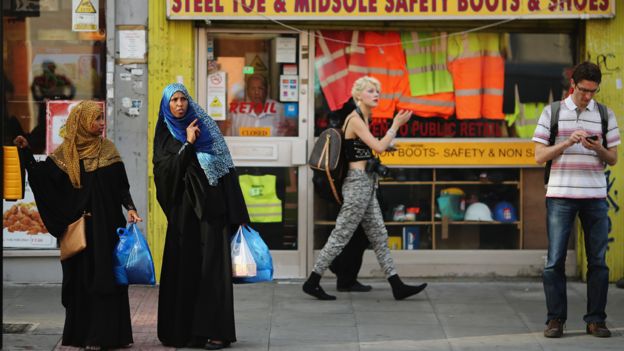
women wait to cross a road in London
This year has seen a spike in anti-Muslim hate crimes, and a new survey shows women are suffering the most - so what's it like to be a black British Muslim woman at the moment? Not great, says Muna Ahmed.
A man mimed shooting Linda with a rifle as he crossed the road. A man spent an entire train journey staring aggressively at Sonya, his face inches from hers.
These are the kind of incidents Muslim women face every day.
One young woman told me she has stopped listening to music so she can hear if someone is following her. Another has considered taking off her headscarf because she doesn't feel safe.
Many women worry about being attacked or singled out because of their faith. Most have experienced verbal abuse. They worry about being out after dark, and drive with their windows closed.
"The thought of being attacked crosses my mind now more than ever," says Natasha, a Muslim convert from Sheffield.
"I've always felt safe here in England, but post-Brexit, post the [terror] attacks, it's getting worse and worse."
It wasn't always like this. Growing up in Sheffield, I was just like every other kid I played with - I may have been a tad cheekier, but nobody treated me differently because of my race or faith.
At the weekends I would see people pouring out of the church and the mosque at either end of our street. I don't remember any hostility and I certainly didn't see any conflict between the faiths. It was just normal.
Everybody on my road knew each other. My friends Gemma and Tracy lived at the top of my street and we would walk to school together every day. When we got home we would eat fish-fingers and go straight out to play. Weekends were the best because we would get up early to watch cartoons and mum would make us pancakes.
I enjoyed all the religious holidays because there were always treats involved.
At Easter we would get chocolate eggs. During Ramadan we tried to fast so we could take part in the evening feast, but Mum knew that we would be starving by 4pm so she would leave a plate of food out, which my friends and I would sneak into the house and eat.
I loved the Christmas holidays because I would go and visit my grandmother and she would spoil me rotten. And on Eid I would get whatever I wanted.
Thinking about it now, I had the best of both worlds. But 9/11 changed everything.
I went from being a carefree teenager who had never been asked about my religion to having people constantly ask me questions about Islam - questions that I didn't have the answers to.
I asked my parents about al-Qaeda, and where Islam stood on terrorism. Every day I would come home with a different question, because the Islam that had become "the enemy" was not the religion I knew.
Ever since then, my country has not been a positive place to be a Muslim woman - and it seems to be getting worse.

The other day I saw a big crowd of people listening to a man with a megaphone shouting: "We need to get these Muslims out of our country, we need to stand united against Islam."
A lot of people seemed to be agreeing with him.
A few days after that I posted a video on Facebook about how the tabloids portray Muslims and the first person to comment was one of my childhood friends, a girl I used to play with all the time. She reeled off a list of radical preachers - as if they represent Islam. The conversation went on for a while, while I tried to educate her about Islam. But she was having none of it.
At one point she said: "You're welcome in this country but your religion isn't."
It got worse - the final thing she said to me was: "Muna, you have blood on your hands too."
I felt physically sick when I saw those words on my screen.
But Muslim women often experience abuse on social media these days.
Sonya is a 23-year-old British Asian Muslim. We sat and talked about our experiences, laughing at the silly assumptions people have about Islam - for example, that she'll have to have an arranged marriage. But it was less funny when she told me about the death threats she had received on social media.
"I was quite popular on Twitter, I used to put up information about Islam and things like that. But all of a sudden dozens of people started commenting and saying all sorts of horrible things, like: 'Go back to your country,' 'We're going to come and kill you,' 'We will hunt you down,' 'You are disgusting to look at.'"
I don't have any children but whenever I'm back home in Sheffield I always take my two nieces, 10-year-old Aaliyah and seven-year-old Amanie, out for ice cream.
As we approached the restaurant last time we heard police sirens - they had been called to the scene because a white man was yelling obscene Islamophobic language at two Muslim waitresses. I grabbed my two nieces and told them we'd come back later. As we walked off, Amanie looked at me and said: "Why is that man saying bad things about Muslims?"
How do you tell a seven-year-old that some people in this country will treat you unfairly because of your race and religion?
The first time I wore a headscarf to work, a woman who works in our building said I like looked like a North African kidnapper, in front of my entire team. I laughed it off, but I felt isolated and different from everyone in the room at that moment.
It's like people don't know how to react to us any more - why are people so anxious around Muslim women? We're not creatures from outer space, we're just women, and some of us choose to cover our hair. Why is it such a big deal?
Saadiya is a young British Asian woman who works in the City. Like me, the only time she wears a headscarf is when she is going to the mosque - but on those occasions she gets weird looks - looks I know all too well.
"When our family moved to this country they faced a lot of that, and it was a real struggle for them," Saadiya tells me. That was 30, 40, 50 years ago - we've come a long way since then, and yet it feels as if we are now going 10 steps back.
Even though I have a thick Yorkshire accent, I'm often made to feel like I don't belong. One minute I'm fighting off racists and then a second later I'm back in the ring defending my faith. It feels like I'm constantly justifying my own existence.
We are at risk of terror attacks like everybody else, but we also have to deal with the backlash. After major attacks we have to endure intimidating comments and fear personal attacks, all because of the actions of a terrorist. Being held accountable for the actions of extremists is a massive burden.
Some days I want to scream at the top of my voice that I have nothing to do with terrorism but it doesn't matter how loud I scream, I will always be tarred with the same brush.
All we want is to feel safe in our own country and to be accepted for who we are - because we are British and this is our home.
Link