Showing posts with label Prostitution. Show all posts

Monday, 2 October 2023

Uncovering Iraq's religious front for child prostitution | Iraq's Secret Sex Trade

This powerful investigation into Shia clerics in some of Iraq's holiest shrines uncovers a network of exploitation of young women and girls, trapped into prostitution and pimped out by a religious elite. For the first time the clerics' secret sex trade has been captured on camera. Undercover filming and victim testimony reveal how they procure young women for male clients, and are prepared to conduct ‘pleasure marriages’ with children.


Tuesday, 28 January 2020

India: The Child Sex Highway | 101 East


A notorious highway in the Indian state of Madhya Pradesh is the site of a shocking trade.

Girls as young as 10 are being forced to work as prostitutes - and it is their own families selling them to passing truckers.

The girls are from the Bachara tribe, an unprivileged-caste community known as Dalits.

Most of the Bachara men say discrimination stops them from getting jobs, so generations of girls have supported their families through prostitution.

Meneka's mother forced her into prostitution at the age of 15. She now has a two-year-old daughter of her own and says she feels trapped.

"I feel like I am born in the wrong place, doing the wrong thing. But what can I do? I can't say much because this is our tradition."

Filming undercover, 101 East discovers that girls as young as 10 are being offered to men.

While India introduced tougher child rape laws in 2018, advocates say the laws are not properly enforced.

"The people who are exploiting the child - they are not customers, they are rapists," says Asheif Shaikh, the founder of a local NGO that frees local girls from what he describes as sexual slavery.

"This practice is like the serial rape of the children ... They are raped about 10 to 12 times in a day."

Madhya Pradesh has the highest number of reported child rape cases of any state in the nation.

In this exclusive investigation, 101 East exposes the Indian villages where parents sell their daughters for sex.

Tuesday, 19 March 2019

Educating brothel children in Pakistan should be a priority


The call to prayer echoes across the ancient walled city of Lahore. Worshippers hurriedly make their way towards the centuries-old Badshahi Mosque, and in its shadow thrives a trade older than the grand mosque itself.

Condemned by the devout and exploited by the elite, the sex workers of Heera Mandi, Lahore’s infamous red-light district, earn their living on the margins of society. Open doorways offer a fleeting glimpse into the realities of the women who live here, most of whom face a daily struggle to make ends meet.

Each has a different story to tell. Some were born into the trade while others were trafficked from rural villages and poorer parts of the city; lured by men with the prospect of marriage or employment and then sold off to brothels.

A winding alleyway leads to a small, concrete building with green doors. An unexpected chanting of nursery rhymes can be heard. Inside, a cluttered, makeshift classroom equipped with wooden desks, an alphabet-strewn blackboard and walls plastered with colourful drawings. The voices belong to the children of Lahore’s sex workers.

They are the forgotten by-product of Pakistan’s undercover sex trade; spending their days on the streets and returning at night to sleep on brothel floors. They face malnutrition, physical and mental abuse and are prime targets of trafficking.

According to Sahil, a local NGO, child sexual abuse cases in Pakistan have increased from nine cases per day in 2017 to 12 cases per day in 2018. Between January and June 2018, 2,322 child abuse cases were reported from all four provinces of Pakistan. The data revealed children between the ages of 6 and 10 were most vulnerable and, of the total cases reported, the majority of victims were girls.

Like shameful secrets, society prefers to keep them hidden and, to the Pakistan government, most of these children don’t exist. Since many are without fathers – a prerequisite to obtaining a birth certificate – school enrolment is not only difficult but nearly impossible.

“Every child deserves an education regardless of their background,” says Lubna Tayyab. “These children have dreams to become artists, teachers and doctors – to be respected members of society – and nobody has the right to deprive them of that.”

Born and raised in the red-light district herself, Lubna was taunted at school and made to feel like an outcast. Determined to provide an education for children who no other school seemed to want, she founded her project, Apni Taleem, which in Urdu means “Our Education”.

In 2011, Lubna converted the ground floor of her home into a classroom and began offering free schooling to the children of sex workers in her neighbourhood. She went door to door, engaging mothers in discussing the importance of education and encouraging their kids to attend. It wasn’t easy – most mothers were reluctant since their children were expected to contribute to the family income by begging on the streets, but Lubna persisted.


She made a special effort to recruit girls, who were less likely than their brothers to attend, and began offering free school meals. A dozen turned up, and today over 70 children are being taught a range of subjects, including literacy, numeracy and religious studies.

Apni Taleem operates on a budget of roughly £20,000 a year. Local donors show no interest in funding a school for the children of sex workers so UK-based Muslim Charity has stepped up; contributing towards the cost of rent, teacher’s salaries and educational resources.

The Pakistan government has also been reluctant to help. “They insist the children can attend government schools, but that’s not feasible,” says Lubna. “Government schools are meant to be free but in practice they’re not. Uniforms, textbooks and exam fees are costs sex workers can’t afford.”

The school is more than just a facility; it is a safe haven protecting vulnerable children from the harsh realities of street life. According to the Trafficking in Persons Report 2018, Pakistan does not meet the minimum standards for the elimination of sex trafficking but efforts to carry out more prosecutions are underway.

Last year, it reported investigating 6,376 alleged sex traffickers and prosecuting 6,232; an increase from 2,979 investigations and 2,021 prosecutions from the previous year. Pakistan also approved the Prevention of Trafficking in Persons Act 2018, which seeks to safeguard the rights of human trafficking victims. Overall efforts to combat trafficking remain inadequate compared to the scale of the problem.

Meanwhile, the safety of sex workers and their children remains a real concern. Local police do not provide adequate protection, so violence is a daily occurrence in their lives. Some of the children at the school have already been sexually exploited and their protection remains a key, underfunded priority.

Noor is determined her daughter gets a decent education. “She loves to learn,” she says. “Before the school, she was on the streets while I worked. I was constantly terrified not knowing where she was and what could happen to her.” Despite the challenges these women face, they remain resilient and spirited. Their eyes show hope for a better future and this small school is a big catalyst for their children to discover their full potential.

Lubna Tayyab unexpectedly passed away last month. Her husband and daughter, Fiza Tayyab, are committed to keep her project running. “This school was my mother’s dream and I’ll do everything I can to keep her dream alive,” says Fiza.

Irfan Rajput, director of international programmes at Muslim Charity says: “We are saddened to hear of Lubna’s death. She was a true humanitarian who fought passionately for the rights of women and children in Pakistan. We will continue to support the school in whatever way we can.”


 If you would like to support Lubna’s legacy and educate some of the most vulnerable children in Pakistan, please donate

Link


Friday, 28 April 2017

Ross Kemp Extreme World - India


This was hard to watch, because well it is India. The way women are dehumanized and murdered for the pleasure and profit of men, yet another side of the evil that is patriarchy. The trafficker admits he targets Advasi and Muslim girls, it made me think all the men that care so much about cows or are obsessed with hijab/purdah why does this not concern you? 

Monday, 9 May 2016

Dozens of Syrians forced into sexual slavery in derelict Lebanese house

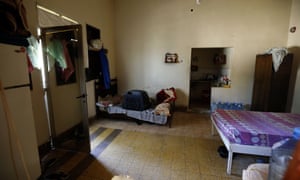
A room used by trafficked women at Chez Maurice.
No words, just horror.
Police and judicial officials say the women were trafficked from war-torn Syria and Iraq, recruited by agents of the network for supposedly legitimate jobs such as restaurant workers, before being imprisoned at Chez Maurice.
“They were perhaps looking for weaker families, where nobody is going to ask about the woman, such as if her father died in the war,” said Mousallam. “They are hunters. They did not for a moment treat them as humans.”
Those who resisted working as prostitutes were raped and beaten, and then forced to have unprotected sex with customers. They were sometimes electrocuted or whipped, in an environment that judges described as “a journey to hell”.
The indictment said the women were forced to have sex with customers more than 10 times a day, making between $30-70 per session, all of which was taken away by the guards, including any tips, in effect making them sex slaves.
Jabbour said she hoped the Chez Maurice case would act as a model for similar situations in the future, with women treated as victims rather than being on par with those who run any network.
But she said there would also have to be a cultural shift in the way Lebanese society looks at prostitution. Kafa is not in favour of legalising prostitution, saying it legitimises exploitation and the treatment of women as commodities. Instead, it advocates punishing human traffickers and sex buyers.
Though Lebanon is one of the more liberal Middle Eastern societies, domestic violence and gender inequality are still pervasive. A one-of-a-kind survey carried out by Kafa, which interviewed sex buyers in Lebanon, found that many thought that if prostitution was completely prohibited, rates of rape would increase, and so it was necessary to have a sub-class of women who would shield the rest of society from male sexuality. Most of the interviewees felt entitled to have sex whenever they pleased, and also believed that the prostitutes enjoyed having sex with them, on top of being reimbursed.
“Everything evolves around the sexuality of men,” she said. “We raise boys and men with the idea that it’s very normal to buy sex and to have sex whenever they want, not to control their sexuality.”


Wednesday, 24 April 2013

India woman speak out on “sex marriages” with wealthy Arabs


Geeta is 19-years-old. She is attending a local university in Varanasi, but she is unmarried and her family is not well off. As a result, she became the victim of what has been described in the country as “sex marriages” with wealthy Arab men, who come to the country on business trips and purchase Indian women to be their wives for a certain period of time.
She recently sat down with Bikyanews.com to discuss her ordeal with who she described as a “Saudi Arabian man” who had paid her family some $2,000 for one month of “services.”
“I couldn’t go through with it after the first week. It was horrible,” she said, asking that her surname remain anonymous.
For her, it began in February, when a man appeared at her house, offered money to her family and then had a “Qazi” – or Muslim cleric in charge of marriages – come to the house to marry the couple. In the contract, she said, there would be an automatic divorce after the man left the country.
“I was taken away to a hotel where he forced me to have sex with him repeatedly for days. It was rape and I didn’t know what to do,” she revealed.
After only a week with the man, forced to remain in the hotel as he went to business meetings, she packed her few belongings and fled, finding refuge at a friend’s house. There, she has remained, refusing to speak to her family and seeing a psychiatrist on a regular basis to help overcome the anguish and struggle she was forced to endure.
“I will never speak to my family after what they did. I was a sex worker and forced to do things against my will. I am shocked and so sad that this happened. I know other girls who are forced into similar things and it is wrong that our police and government do nothing,” she argued.
Women’s rights activists in the country have pointed out that these short term “contract marriages” are illegal in India and supposed to be illegal in Islamic law, but they are increasing across the country. In a recent Telegraph report, Hyderabad is becoming the central location for the marriages, as wealthy Arab businessmen come to the city in search of girls and young women to “service” them for their stay in India.
In a similar case, Inspector Vijay Kumar reported that one man “had paid 100,000 Rupees (around £1,200) to the girl’s aunt Mumtaz Begum, who in turn paid 70,000 Rupees to her parents, 5,000 Rupees to the Qazi, 5,000 Rupees to an Urdu translator and kept 20,000 Rupees herself. The wedding certificate came with a ‘Talaknama’ which fixed the terms of the divorce at the end of the groom’s holiday.
“The next day he came to the house of the victim girl and asked her to participate in sex but she refused. She is a young girl and the groom is older than her father,” Inspector Kumar told The Telegraph.
It is part of an ongoing debate over women’s issues in the country and one that is seeing young girls and women being used by families suffering from poverty. For social workers in the country, from Varanasi to Hyderabad to Mumbai and Delhi, they are seeing a rise in these marriages.
“We are having to deal with women and girls coming to our offices on a regular basis seeking help and we have to keep it silent for fear their families will force them again to go into these situations,” one social worker told Bikyanews.com in Delhi. “We just want the government and police to arrest these men and family members who are forcing their daughters into sex work.” Source

Monday, 15 April 2013

Modern Day Child Prostitution in Kabul, Afghanistan: Children are used as Sex Workers in Afghanistan to Serve Foreigners


When we hear about the news in Afghanistan, the mainstream media tells us stories of explosions and deaths of military personnel and civilians. A story that is not being told is of child prostitution slavery in Afghanistan.
“There is a police operation going on by a neighborhood police chief in Kabul that has girls working for him,” says German contractor Hans, who does not want to release his last name for security reasons.
“You know prostitution is legal in Germany and I don’t mind paying a fair price for a sex worker, but here in Afghanistan the prostitutes are children, teenagers and that is where I draw the line. I have a 14-year-old daughter back home in Germany and I do not condone child prostitution,” says Hans.

A 15-year-old named Badria Durrani says, “I was forced into prostitution because the police in the area said they will arrest my father. My father is just a baker and he does not want any trouble with the police, so I work as a prostitute having sex with foreigners because that is what the police want me to do.”
Badria’s father Mohammed Durrani says “I did not agree, but the police threaten to throw me in jail, so I agreed because I have to support my 3 wives and 8 children as a baker. With the extra income my daughter makes after she pays the police their 40% share, the rest of the money is for our family.”
“Also, the police told me not to worry. My daughter will only serve foreigners so Afghan men will not know that she is a prostitute and later she will be able to find an Afghan husband for marriage,” says Mohammed.

“I don’t want to do this anymore but what choice do I have? If I run away my father will be thrown in jail and then our family does not have money to pay for rent and will be kicked out of our home. I have to sacrifice my life for our family. I hate this government and these foreigners that come here to have sex with girls my age, but the government here is not protecting us. They send these police from the north of Afghanistan to take advantage of us,” says Badria.
A 12-year-old girl named Ara Atta says, “My father was killed by the Americans because he did not stop his car at a checkpoint, trying to take my mother to the hospital because she was going into labor. The Americans shot at the car and killed my father but my mother was not harmed and taken to the hospital and my brother Ibrahim was born.”
“The police told my mother that she will not receive my father’s retirement check for working at the Ministry of Agriculture unless I work as a prostitute serving foreigners. My mother at first refused but she relented once the police told her that I would be able to keep 60% of the pay and be able to keep supporting my mom and 6 brothers and sisters and the other 40% would go to the police,” says Ara.

Ara further stated, “I don’t want to do this but we have no choice. If I run away, the police will ensure that we will not receive my father’s retirement check. I curse them and the foreigners that are using my body for sex but I have to do this or my mother and siblings will go hungry and we will be out in the street because we don’t have money for rent.”
The invasion of Afghanistan by the United States and International Security Assistance Force (ISAF) offered the Afghan people democracy and social changes for women through education and new careers that were closed to them under the Taliban.
What has actually happened here in Afghanistan is that the government institutions that were established by the U.S. and ISAF, such as the Afghan Police, are using female children and women for profit to serve foreigners as their sex slaves.
Source

Monday, 25 February 2013

India's Muslims grapple with wedding racket


 Until recently, Hyderabad was hotspot for a disturbing form of sexual tourism, practiced mainly by visitors from Islamic countries, especially in the Arab world.
Seeking a short-term liaison, but wanting not to violate religious prohibitions against adultery, such visitors enter into brief, arranged marriages for a fee – often with girls young enough to be their granddaughters.
"In 90% of cases the women are as young as 15 and 80% of the time they are divorced within a week of the wedding ceremony," Bina Hassan, a women rights activist who has campaigned against this practice for years, told Khabar South Asia. "In rare cases the same girl is married numerous times, [though] usually the Arabs look for only virgins."
Many people have benefitted from such arrangements. The men can claim that they had not sinned according to Islam, which permits polygamy. Meanwhile, financial proceeds go to the girls' families, the agents who negotiate the deals, and the qazis (priests) who officiate.
For the brides, however, the results can be grim. After being deserted by their temporary husbands, they often find themselves without a home to return to. Their parents feel a sense of social stigma and want nothing to do with them. A real marriage is out of reach.
Community moves to end practice
Over the past two years, the Muslim community in Hyderabad has worked together with the government in order to halt such marriages and better protect local women. The results have been impressive. In 2012, only two such weddings were reported – compared to 58 during 2011.
Elders on the state Waqf Board played an instrumental role, government sources say.
"These weddings have been going on for decades, but no steps had been taken. The government decided to work through the Waqf Board because merely banning these weddings would not have produced any result. We needed the co-operation of the Muslim population," Andhra Pradesh Minister for Minorities Welfare Mohammed Ahmadullah told Khabar.
Waqf Board chairman Mohammad Saleem said one incident in particular galvanized opinion. "The straw that broke the camel's back was an incident in May 2012 in which a 73-year-old United Arab Emirates national became the centre of public ire when he tried to desert his bride of two days," he told Khabar.
According to journalist Omer Farooq, "the issue is quite dead now. The racket no longer flourishes."
Poverty cited as underlying cause
The grim economic picture for Muslims residing in Hyderabad's old-city quarter provides a context for the proliferation of dubious marriages. Packed into a medieval walled city, residents have the lowest literacy rate for women and a per capita income far lower than the Andhra Pradesh average of Rs. 71,540 ($1319).
The computer software industry – which gave the city its new nickname of "Cyberabad" – has had little impact on the urban Muslim community. "It's a ghetto, where people live in grimy conditions without access to even running water," Waqf Board general secretary Rumaan Idris Ali told Khabar.
For some families caught up in such dire conditions, black market weddings appeared to provide a way out.
In one case, according to assistant commissioner of police S.K. Rao, a 14-year-old girl (name withheld) was married in 2008 to three different men, all of them as old as her grandfather.
"The girl was pretty and looked older than her real age. Today she works as a construction labourer in some other city," Rao told Khabar. "We were helpless because her family was supporting these marriages."
Mussrath, 16, was married to a man in his 50s but dumped after three days in a local hotel. Her father then fixed her marriage to 70-year-old man, Rashid Ali, from Dubai. "She was taken to the same hotel, used and divorced," Rao said.
Mussrath's father found a third groom – 63-year-old Ahdul Rehman Abdullah from Oman – before her mother alerted the police.
Stories like this are becoming far less common, Waqf Board general secretary Ali said. Thanks to community vigilance, he said, young girls are no longer preyed on by racketeers.
But the discarded wives require rehabilitation. "They lack the means to put up legal fights. So the government must take up their cases," he said.
Racket moves to Mumbai
While sham marriages are becoming a thing of the past in Hyderabad, the problem is far from being resolved in India as a whole, authorities say. Rather, racketeers have simply moved their operations to other locations.
Mumbai, in particular, appears to be the new destination of choice for "grooms" seeking a no-strings-attached wedding.
The city's police on December 28th cracked an operation involving agents that brought young girls from Hyderabad to take advantage of the unreformed situation in Mumbai. In the suburb of Dongri, police rescued 12 girls – some as young as 13 – who were being paraded before Arabs by agents who had brought them in by overnight train.
"The girls were promised Rs. 200,000 ($3,700), out of which the agents would keep half," Assistant Police Commissioner (Women's Cell) Savithri Waslankar told Khabar. "Their aim was to have as many weddings as possible in the span of a few weeks so that they could make enough money to return home."

Thursday, 29 November 2012

A feminist revolution that cruelly backfired - and why Amsterdam's legal brothels are a brutal lesson for Britain about telling the truth on sex gangs and race


Seven girls laugh together at the supper table. One talks of her sister, a fashion model signed with a famous London agency. Another mentions her married brother, an artist in the north of England. A third — 17 with blonde hair tucked under an Alice band — says she plans to become a beautician on a cruise ship.
At the small house, the blinds are closed so no one can peep in. Two terriers and a bull mastiff bark ferociously if there is a footstep outside the bolted front door.
For these middle-class girls, groomed into sex slavery by street gangs, have been rescued and are living in a safe house a few miles from De Wallen, the notorious red-light area of Holland’s capital, Amsterdam.

They are the lucky ones. Thousands of other young Dutch girls, some only 11 or 12 years old, are still in the power of the prowling gangs after a controversial social experiment to legalise brothels.
In a chilling parallel to the scandal sweeping Britain’s towns and cities, where a multitude of girls have been lured into sex-for-sale rings run by gangs, the Dutch pimps search out girls at school gates and in cafes, posing as ‘boyfriends’ promising romance, fast car rides and restaurant meals.

The men ply their victims with vodka and drugs. They tell them lies: that they love them and their families don’t care for them. Then, the trap set, they rape them with other gang members, often taking photos of the attack to blackmail the girl into submission.
Befuddled, frightened, and too ashamed to tell parents or teachers, the girls are cynically isolated from their old lives and swept into prostitution.  
So dangerous are the gangs that the girls at the safe house never venture out alone, and when they have a coffee together in the back garden they are not allowed to talk about their past in case neighbours overhear.

‘You never know who has big ears,’ says Anita de Wit, 48, the mother of three who set up the safe house last month. It is thought to be the first of its kind in the world. ‘The gangs can kill, and will try to get these girls back because they earn them money. We do not want them coming here to harm them. ’
Anything-goes Amsterdam has long been hailed as a sex mecca. The red-light district attracts thousands of customers, many of them tourists, who walk through alleys where half-naked prostitutes prance in the windows of some 300 brothels illuminated with scarlet bulbs.
A century ago, the brothels were banned to stop the exploitation of women by criminal gangs of Dutch men. But gradually the sex establishments crept back, with the authorities turning a blind eye.
In 2000, after pressure from prostitutes (demanding recognition as sex workers with employment rights) and Holland’s liberal intelligentsia (championing the choice of women to do what they wished with their bodies), the brothels were legalised. The working girls got permits, medical care, and now there are 5,000 in the red-light district.
But things went badly wrong. Holland’s newly legal sex industry was quickly infiltrated by street-grooming gangs with one target: the under-age girl virgin who can be sold for sex.
The men in the gangs are dubbed — incongruously — ‘lover boys’, because of their distinct modus operandi of making girls fall in love with them before forcing them into prostitution at private flats or houses all over Holland, and in the window brothels. The lover boy phenomenon has appalled Dutch society, not least because of the sheer numbers of girls involved.

As Lodewijk Asscher, 38, a leading politician, says: ‘Hard-line criminal behaviour is happening behind those windows. Girls are physically abused if they don’t work hard enough. It is slavery, which was abolished a long time ago in the Netherlands.’
He has championed new rules in Amsterdam’s red-light district from January. Prostitutes will sign a register and the minimum age for sex workers will be raised from 18 to 21, to try to stop girls being forced to work by the gangs.
Holland hopes the rot will be halted. Last year, 242 lover boy crimes were investigated by police, half of them involving the forced prostitution of girls under 18. Campaigner Anita de Wit says this is a fraction — ‘one per cent’ — of the true number. ‘There are thousands of girls being preyed on by male gangs in Holland,’ she says.
Anita visits schools to warn girls exactly what a lover boy looks like, and makes no bones of the fact that most of the gangs are operated by Dutch-born Moroccan and Turkish men.
‘I am not politically correct. I am not afraid of being called a racist, which would be untrue. I tell the girls that lover boys are young, dark-skinned and very good looking. They will have lots of money and bling as well as a big car. They will give out cigarettes and vodka. They will tell a girl that she is beautiful.
‘The gangs know who to pick out: the girl with the confidence problems, with the glasses, or who looks overweight. They flatter her and seem like the “knight in shining armour”. She is drawn to her new boyfriend like a magnet.

Anita’s bluntness is a far cry from the approach in Britain, where political correctness has stopped police and social workers telling girls the same home truths: that in many towns, particularly in the north of England, the handsome men chatting them up at the school gate are very likely to be of Pakistani descent. They, too, ply the girls with alcohol and gifts, pretending to be genuine boyfriends.

This week a report into our own sex gangs — by Sue Berelowitz, Deputy Children’s Commissioner for England — was criticised (by the NSPCC, among others) for discounting the evident link between Asian gangs and the sexual exploitation of white and mixed race girls. Berelowitz chose to downplay the race factor, despite official figures showing a worrying percentage of men involved in this type of sex crime are of this heritage.
Mohammed Shafiq, director of the Lancashire-based Ramadhan Foundation, a charity working for ethnic harmony, has just visited Holland to see the work of Anita de Wit and her charity ‘Say No to Lover Boys Now’, which believes that girls should be warned where the danger lies — for their own sakes.
He has complained that the British authorities treat the subject as taboo because of fears of being branded racist. ‘That is wrong. These gangs of men should be treated as criminals whatever their race,’ he says.
In Holland, as in Britain, the abusers are drawn from a tiny minority of their communities — which are appalled by their crimes. But the lover boys seem to see white girls as worthless, to be abused without a second thought.
Anita began her campaign when her own daughter, Angelique, then aged 15, was lured into a sex gang after meeting a 21-year-old Moroccan boy at a coffee bar near her school.

Anita was divorced and running a restaurant in a village outside Amsterdam when it all began. It was eight in the evening and Angelique came into the restaurant with three male friends. She said one of them was her new boyfriend, Mohammed. ‘He had long curly hair, was very handsome and polite to me,’ remembers Anita.
‘Angelique asked if she could take the three boys back home for a coffee, and I said yes. I was due back at eleven that night and I thought my other two children — Angelique’s younger brother, who was 13, and her older sister — would be there.’

But when Anita got home, she found that every bottle in the drinks cabinet was empty. Angelique was lying in bed drunk. Mohammed and his two pals had disappeared. Although Anita did not know it then, Angelique had been raped by two of the men. The other man had taken her son to play football in the park to get him out of the house. Angelique’s older sister was, in fact, staying with friends.
‘I was horrified,’ says Anita. ‘Angelique lied, saying she had just had too much to drink. I was annoyed she had been drinking at all. I said I did not want Mohammed at my house ever again. We had a row. But that is the classic technique used by the lover boys — they deliberately engineer a rift between the girl and her parents.’
From then on, Angelique’s behaviour changed. She went missing from school. If she did go to class, Mohammed and the lover boys would be waiting to pick her up in a big car with dark windows and false number plates. Her teachers complained to Anita, but Angelique was in love with Mohammed and at war with the teachers and her mother.
She would disappear from home for hours, often coming back only late at night. Sometimes, she would go missing for days, saying she had been with friends.
In fact, Angelique had been sleeping with a host of Moroccan men and earning money for her ‘boyfriend’, Mohammed. ‘Her mobile phone would ring continuously, all day and through the night, too. She would even take it into the loo with her.

‘When I looked at it later, there were violent texts saying: “If you don’t come out now, you are for it and your family, too,”’ recalls Anita today.
After several months, Anita rang the police for help. Her daughter was taken to the family court where a judge placed her under a curfew at home. She had to report to her mother every two hours. ‘Angelique would come in say hello, and then run out of the house again,’ says Anita. ‘The judge said she had to leave her mobile phone downstairs at night. But the gang just gave her another one, and the men kept ringing her. They gave her cannabis and she became dependent on them for it.’

The judge, in desperation, sent Angelique to a youth prison where, for 11 months, she used her phone card to keep in touch with Mohammed, but gradually the relationship fizzled out.  
When, at last, she was moved to an open centre for troubled youngsters, Anita hoped for the best. But her daughter met another lover boy there. He was called Rashid and was a stooge planted to recruit girls by the gangs. He persuaded her to escape from the centre and together they hitch-hiked to Rotterdam.
There, Angelique found that Rashid was also part of a sex gang. She was put in a seedy house and again made to work as a prostitute.
‘She was forced to swallow 14 ecstasy tablets a day and take the date-rape drug, GHB. The gang beat her with a baseball bat if she refused to sleep with the men who were brought to her. They dyed her brown hair with kitchen bleach because they said men would pay more for blondes. She’s never told me how many men she had to go with,’ says Anita. After six weeks, Angelique escaped. She ran to a shop and called her mother, who brought her home.
Yet — incredibly enough — even then the lover boys came after her. She visited the city centre with a girlfriend and a stranger, a young Moroccan, asked her out for a date. He promised Angelique that he was a proper boyfriend, that he loved her: but he was grooming her, too.
The Moroccan plied her with drugs, and asked her to live with him in a flat near the red-light district. When Angelique, by now 18, agreed, he said he was in debt and put her to work in the De Wallen window brothels.
‘I went to see her in the windows,’ says Anita. ‘I had to keep in touch with my daughter. It was only in January of last year that she realised she had been exploited by the gang and returned home at last.’
Angelique’s story is terrifying. But, at the safe house, there are equally disturbing tales. There is Eline, who was an 18-year-old virgin when she met a Turkish lover boy at a New Year party at her local youth club.
Eline thought she was in love with him, but within a few weeks the rest of his group had gang-raped her on a patch of waste land, photographed their crime, and were threatening to tell her parents if she did not sleep with other men to earn them money.  
I hear about Beatrice, who met her lover boy as she rode her bike to a new school. She was 12 years old. He was leaning against his car outside; with a big gold chain round his neck, he looked like an actor in a rap video.
He was back a few days later, and told her she was pretty. The fourth time they met, she agreed to go for a drive. He took her to a house where he raped her. He told her she was now his prostitute, his property, and that their relationship was perfectly normal.
By 14, Beatrice had slept with dozens of men and, unbeknown to her civil servant parents, was even coerced into acting as an agent for her lover boy’s gang by introducing them to other girls.
The girls in the safe house, who are aged between 15 and 25, have now escaped from the horrors of their past. They are learning to live again. And with the new minimum age and register of prostitutes, the winds of change are blowing in Amsterdam’s red-light industry.
But Eline shakes her head a little sadly as she says: ‘The lover boys are always one step ahead. They are making a fortune from these young girls. It is everyone’s duty to tell the truth about what is happening — particularly to potential victims.’
It is a sobering lesson not only that political correctness must not prevent people voicing their fears about grooming gangs, but also that Holland’s liberal approach to sex has backfired disastrously on many of these damaged victims.

Source