Showing posts with label Sexual Abuse. Show all posts

Wednesday, 11 February 2026

"The Epstein Files: A Wake Up Call for Muslims" - Usuli Khutbah


TRIGGER WARNING: SA, PDFILIA, ABUSE

Today, Dr. Khaled Abou El Fadl analyzes the newly released Epstein Files. Sermon given at The Usuli Institute on 6 February 2026.

Thursday, 1 November 2018

Huddersfield grooming gang: The Islamophobia issue


Earlier this year, one of the victims of the Rotherham grooming gang anonymously wrote a very informed and intelligent piece on this issue for the Independent.

In it, she said that grooming gangs are upheld by religious extremism and even went so far as to compare them to terrorist networks. But even she - having very good reason to allow herself to be tempted to take the racist approach - condemned the work of people like Stephen Yaxley-Lennon aka Tommy Robinson , saying he doesn't speak for her, and said that she and other survivors are 'uncomfortable' with the EDL's protests.

In her own words, she 'experienced horrific, religiously sanctioned sexual violence and torture' and described how her main abuser beat her as he quoted scriptures from the Quran to her. And in Oxford, it was said that sexual assaults were particularly sadistic.

But, despite what some right-wing media and extremists want you to think, the fact is this isn't actually the case with every Asian grooming gang in the news.

It's a point that the prosecutor of the Rochdale grooming gang, Nazir Afzal, has already made.

Speaking about the case in an interview with The Guardian in 2014, he said:

There is no religious basis for this. These men were not religious.
"Islam says that alcohol, drugs, rape and abuse are all forbidden, yet these men were surrounded by all of these things. So how can anyone say that these men were driven by their religion to do this kind of thing?

"They were doing this horrible, terrible stuff, because of the fact that they are men. That’s sadly what the driver is here. This is about male power. These young girls have been manipulated and abused because they were easy prey for evil men."

In an interview with the New Statesman earlier this year, he described the ethnicity of street groomers as 'an issue', but gave more weight to the night-time economy that they often work in, the availability and vulnerability of the young girls who are often around it and the community's silence and lack of action to tackle the problem.

And I believe, based on the evidence heard in court, that what he said is also true of the Huddersfield grooming gang.

One of the victims in Huddersfield was Asian - something that also happened cases such as Rochdale and Newcastle, but is not often reported by the media.

The ringleader, Amere Singh Dhaliwal, converted to Sikhism after the abuse. He wears a turban, carried a kirpan in it and swore on the Guru Granth Sahib before taking to the witness stand. Raj Singh Barsran, who hosted many of the 'parties' in his house, is also a Sikh.

We shouldn't focus on race and religion and the discourse should be about something much more important - for a start, the causes of hebephilia and ephebophilia.


Link

Tuesday, 16 October 2018

The Trifecta of Rape Culture, Sexual Abuse and Muslim Communities – Debunking False Statements


“If she just wore hijab/niqab, she wouldn’t get harassed or raped …”

This line, often uttered to dismiss cases of rape where the victims did not observe hijab, is one that is not only false, but completely fails to understand the true meaning, role and purpose of hijab.

No doubt, hijab is indeed an obligation in Islam; it is a command from Allah and should be observed by believing women[1]. There are Divine Wisdoms behind its obligation, and in some cases, it can deter a certain type of attention.

However, it is not a force field that physically prevents a rapist from raping his victim. Modest dressing cannot prevent rape or lewd behavior from the abuser. Nor should we ever expect a person whose heart and soul are so corrupted that they would dare to commit such a crime in the first place, to feel deterred merely by some extra layers of fabric. Numerous women have been sexually assaulted and raped while wearing their hijab.

One sister — a convert who wears the hijab and relied upon a small group of other Muslims to be her “community” — shared the following:

“… I thought it was weird for him to sit so close to me, but I didn’t really think anything of it. He’s a “good boy.” Prays five times a day. Ten years my senior and a PhD student at my university. Super intelligent. Calls his mother (who lives overseas) every day despite time zone differences. Meets all the markers of a good person. But I don’t think I’ve ever been alone with him before this.

We were just talking, he paused and pulled me on top of him. Suddenly I was laying on him, and he was holding me against him tightly. I was super freaked out, but I laughed and was like, “[name], stop! What are you doing?” Obviously, I tried to push against him to get off, but he flipped me, so I was pinned underneath him in a matter of seconds, and he was straddling me. He ripped off my hijab, pulled up my shirt and bra and started to bite my breasts.

I was completely in shock and tried to reason with him to stop. He said something like he’s seen how I look at him (???) and he knows I want him (?????). Completely, absolutely, disgustingly false.

He held my hands down when I tried to push him off, and I began to fight him with everything I had in me. He pulled down my pants and started to penetrate me with his fingers. By then I was crying, and I kept on telling him over and over to stop, but he said to just let him do it. “If you really don’t like it then why are you so wet?”

I was terrified and never felt so much like I’ve lost control of my body before. I remember just repeating his name endlessly, as if he would somehow hear his name and wake up and realize what he’s doing. I’ve never been intimate with a man even consensually, so it was beyond overwhelming. Eventually he said, “Relax, it’s not like I’m going to rape you.” And he stopped.

I never figured out what the heck he meant by that. Did he not realize what he just did?!? I put my clothes back on as fast as I could, and I left. I haven’t told anybody. I saw him once on campus by chance, and I felt like I was having a heart attack. For a few weeks after, he kept on texting me and asking how I was and stuff. I never responded. Throughout the entire ordeal and after, I get the feeling that he truly doesn’t think he did something wrong.

This was about three months ago, and none of my friends who were there with me even know. I feel like maybe I should tell the girls at least, so they can watch out for him, but they would never be so stupid to hang out with a man alone in his apartment. I do worry that they would judge me for it. My friends think I’m weird for never hanging out with them whenever I know he’s around, but I don’t know if they’ve put it together. It’s certainly distanced me from them in some regards. I’m a convert and my closest family lives a plane flight away, so these friends are really the only community I have.

I’ve thought about it literally every day. All the time. I’ve prayed and tried to find the same peace in my body as I did before, but it’s so difficult. I find myself wanting to make wudu over and over, and I never really feel pure again.”


Full article 

Sunday, 26 November 2017

Islamic schools in Pakistan plagued by sex abuse of children

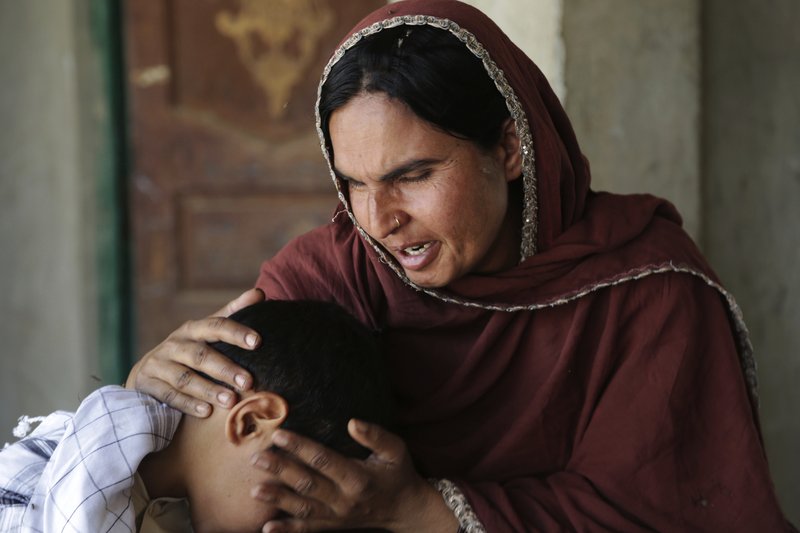
Kausar Parveen struggles through tears as she remembers the blood-soaked pants of her 9-year-old son, raped by a religious cleric. Each time she begins to speak, she stops, swallows hard, wipes her tears and begins again.

The boy had studied for a year at a nearby Islamic school in the town of Kehrore Pakka. In the blistering heat of late April, in the grimy two-room Islamic madrassa, he awoke one night to find his teacher lying beside him.
“I didn’t move. I was afraid,” he says.
The cleric lifted the boy’s long tunic-style shirt over his head, and then pulled down his baggy pants.

“I was crying. He was hurting me. He shoved my shirt in my mouth,” the boy says, using his scarf to show how the cleric tried to stifle his cries. He looks over at his mother.
“Did he touch you?’” He nods. “Did he hurt you when he touched you?” ″Yes,” he whispers.
“Did he rape you?” He buries his face in his scarf and nods yes.
Parveen reaches over and grabs her son, pulling him toward her, cradling his head in her lap.

Sexual abuse is a pervasive and longstanding problem at madrassas in Pakistan, an AP investigation has found, from the sunbaked mud villages deep in its rural areas to the heart of its teeming cities. But in a culture where clerics are powerful and sexual abuse is a taboo subject, it is seldom discussed or even acknowledged in public.
It is even more seldom prosecuted. Police are often paid off not to pursue justice against clerics, victims’ families say. And cases rarely make it past the courts, because Pakistan’s legal system allows the victim’s family to “forgive” the offender and accept what is often referred to as “blood money.”

The AP found hundreds of cases of sexual abuse by clerics reported in the past decade, and officials suspect there are many more within a far-reaching system that teaches at least 2 million children in Pakistan. The investigation was based on police documents and dozens of interviews with victims, relatives, former and current ministers, aid groups and religious officials.

The fear of clerics and the militant religious organizations that sometimes support them came through clearly. One senior official in a ministry tasked with registering these cases says many madrassas are “infested” with sexual abuse. The official asked to remain anonymous for fear of retribution; he has been a target of suicide attacks because of his hard position against militant groups.


Sunday, 20 August 2017

Islamic scholars offer themselves on sale for one-night stands with divorced Muslim women

The cleric, the investigation found, was already married. Still, he negotiated his role-play as a husband for a night with India Today's reporters posing as relatives of a divorced Muslim woman.
Will your wife object to it?" asked India Today's reporter.
"No, no. She won't have any objection," imam Nadeem replied.
"Have you spoken with her?" prodded the reporter. "No, I haven't spoken with her. I haven't told her. What's the need to tell her?" Nadeem shot back.
The Moradabad imam admitted he had officiated several nikah halala marriages before. This time, he proposed a package deal for the entire service, including sex. "It's Rs 1 lakh," he demanded.
Imam Nadeem guaranteed issuing divorce after spending a night with the bride for her to become eligible to go back to her first husband in accordance with the personal law. The business of one-night grooms is widespread, the India Today investigation observed.
DELHI
At Delhi's Jamia Nagar, the team met Zubair Qasmi, a qualified maulana married with two wives. He nominated himself up for a third at the prospect of nikah halala, in exchange for money.
"I spend many nights out. It's much easier to manage this with two (wives). One would think I am with the second. And the second would think I am with the other. It's not at all difficult with two (wives)," he bragged.
Zubair Qasim based his fee on mehr - money or gift the groom pledges to his bride during Islamic marriages.
"Don't worry about anything. I'll make every arrangement. If Rs 30,000 is set as mehr, it will be either 40,000 or 50,000 (in return for participation in nikah halala). No problem in it," Qasim said.
The rot runs deep.
Next, India Today's investigative journalists visited Mohammad Mustaquim of Delhi's Darul Uloom Mahmoodia Madrasa.
Educated in Islamic studies, he was keen to do what he had done several times before -- sleeping with divorced women to consummate nikah halala.
"There was a woman in the room. I went there and had sex. Before leaving at 2-3 am, I divorced her," he confessed.
NO FORMAL MARRIAGE NEEDED?
Mohammad Mustaquim performed nikah halala even without formal marriage.
"So you have taken part in three nikah halala. You actually married on one occasion, right? The other two nikha halala were without marriage," the reporter asked.
"Without marriage," he admitted. "After sleeping with her, I left at 1 am."
Mustaquim's fee for this service included donation for his madrasa. "You'll have to pay Rs 20,000 for the madrasa. I am ready to do it for whatever amount. I have done it several times before," he said.
As India awaits the Supreme Court's judgement over triple talaq, the dangerous trapdoor of nikah halala remains wide open for divorced Muslim women, the probe noted.
THE ROLE OF CLERICS
In some cases, potential deals were found to be brokered by clerics themselves.
At Bulandshahr's Til Gaon, imam Zahir-ul-lah of Mewatian Masjid introduced India Today's undercover reporters with a prospective groom for nikah halala.
Arif, the groom-to-be, was quick to boast about his masculinity despite his old age.
"My programme is all set, today, tomorrow or the day after. I am always fit 24x7, mashallah!" he remarked. His price: Rs 25,000 for a night.
In western UP's Hapur district, the team next met Mohammed Zahid, who runs a madrasa at Sikheda village.
He marketed his services for nikah halala as a professional.
"We'll see to it. We have the men. It will be done through them. If you don't trust them, I am always available for it," he said.
"How much money in total would you like us to organise for you?" asked the reporter.
"Between 1 lakh and 1.5 lakh," he answered. "Not above Rs 1.5 lakh and not less than Rs 1 lakh."
HINDU, MUSLIM LEADERS REACT SHARPLY AFTER EXPOSE
Rising above their political differences, Hindu and Muslim leaders called nikah halala a criminal act after India Today broadcast its investigation.
They demanded that the perpetrators should be prosecuted for rape.
"This is lust. It's not permissible in Islam. This is a criminal offence committed in the name of religion," said Maulana Maqsood-ul-Hasan Qasmi, the head of the Imam Council of India. "These people should be thrown out of the mosques. They should be booked."
Zafar Sareshwala, chancellor of the Maulana Azad National Urdu university, blamed personal laws for certain regressive practices in Islam.
"These people should be put in jail and charged with rape," he said, demanding strong action against men participating in nikah halala for one-night stands. "I think the genesis of the problem lies in the Shariat Act of 1937," he insisted. Authors of the personal laws, he added, had been "millions of miles away" from the teachings of Islam.
Maulana Ansar Raza of the Gharib Nawaz Foundation called for immediate ex-communication of religious scholars offering themselves for nikah halala. "They should be beaten with shoes and thrown out of mosques. They should be charged with rape. Nikah halala is a regressive un-Islamic practice," he said. "I salute India Today for this story."
In his comments, BJP spokesman Gaurav Bhatia, himself a lawyer, underscored the need for abolishing nikah halala like the sati practice in Hinduism. "Nikah halala and polygamy, as triple talaq are regressive. Sati is abolished. So should be these practices," he said. "India Today's expose will help the civilised society to come forward for human rights and dignity."

Tuesday, 8 March 2016

Innocence Lost: Child Sexal Abuse


In England, 85,000 women are raped on average every year; and 400, 000 women are sexually assaulted every year. One in 20 children have been sexually abused, and over 90% of them were abused by someone they knew.

Muslims are far from immune to crimes of sexual violence. The statistics are equally horrifying, if not worse because the number of reports tend to be much lower due to social stigma and lack of trust and access to the authorities.

In Pakistan, nearly 3,000 cases of child sexual abuse were reported in 2013; 40% of abusers were relatives, family friends, or acquaintances; and the most vulnerable age to abuse for both boys and girls was between 11 and 15.
In Egypt, 83% of Egyptian women reported experiencing sexual harassment at least once while half of them experienced it on a daily basis.

Despite these statistics – and numerous horrific anecdotes – sexual violence is an issue that Muslims all over the world still prefer to remain silent about. The stigma regarding sex, which may once have originated out of the Islamic concept of hayaa’ (modesty), has become a disease in and of itself, one that simply perpetuates un-Islamic beliefs and allows these filthy crimes to continue taking place on a daily basis.

An upcoming documentary, “Breaking Silence,” bravely confronts the deep-rooted cancer of sexual violence and particularly sexual abuse of children that exists in many, many Muslim families and communities.

As illustrated by the stories of four Muslim women who were sexually violated as children by those whom they trusted – whether family members or friends – even parents who are aware of the abuse often turn a blind eye or accuse their children of lying rather than admit the truth.

One major reason for the twisted attitudes existing regarding sexual violence amongst Muslims is an ignorance and lack of education about what Islam truly teaches about sex, including the difference between consensual sexual activity and sexual violence (whether against adults or children).

Despite the fact that the Shari’ah discusses and encourages a holistic sexual education from a young age, many Muslims prefer to follow deviant notions of ‘honor’ and ‘shame.’ The true shame and dishonor lies not in admitting that sexual violence takes place, but in allowing them to continue rather than to educate oneself, one’s children, and the entire community about Islamic values regarding sex.
Prophet Muhammad (PBUH) and his Companions were very honest and open about sexual education, even with regards to children.

'Abd al-Rahman ibn al-Aswad narrates:
"My father used to send me to A'ishah and (as a child) I used to go to her (i.e. beyond the curtain). When I became adult (i.e. reached puberty; became baaligh), I came to her and called to her from behind the curtain: "O Umm al-Mu'mineen, when does the bath become compulsory?" She said: "So, you have done it, O Luka'! And (in answer to the question), when the private parts conjoin."
(Al-Dhahabi in Siyar A'lam an-Nubala)

Source

Thursday, 9 October 2014

Online abuse of women in Pakistan turns into real-world violence


 Internet abuse of women in Pakistan is triggering real world violence against them, but large social media companies, such as Facebook and Twitter, are moving too slowly to stop it, internet rights group Bytes for All said.
Women face online threats globally, but they run a unique risk in conservative Muslim Pakistan, where there is a tradition of men killing women seen as having injured a family's honour, besides punitive laws against blasphemy.
With law enforcement too weak to fight the violence sparked by online campaigns, activists want giant internet firms to roll out greater protection for users, from streamlining how they tackle complaints to faster action against threats of violence.
"These technologies are helping to increase violence against women, not just mirroring it," said Gul Bukhari of Bytes for All, and the author of a report released this week as Pakistan experiences a surge in sectarian hatred, attacks on minorities and blasphemy quarrels.
"A lot of the crime we are witnessing would not have been possible without the use of these technologies."
There have been more than 170 complaints of cybercrime against women this year in Pakistan's most populous province of Punjab, the Federal Investigation Agency says. No figures were available for the remaining three provinces.
None of the cases was successfully prosecuted because women usually reached a compromise with the suspect, said Syed Shahid Hassan, an official with the cybercrime office in the provincial capital, Lahore, where 30 employees work full-time.
Since police rarely act when women are harassed online, few cases are reported, activists say.
About 32 million of Pakistan's 180 million people use the Internet, the group said in its report, mainly on mobile telephones. About 12 million are on Facebook and some 2 million use Twitter, domestic media say.
ASSASSINATION BID
In one case documented by Bytes for All, an online hate campaign last year urging the rape and murder of a prominent human rights defender culminated in shots being fired at the woman and her husband.
She received hundreds of threats and the addresses of her family were posted online, along with pictures of her and her daughter.
"She suffered nightmares of being raped, of family members being harmed because of her," the group said.
Facebook took down the pages, but had to do so again when they were posted by a different user, the group said, and Twitter took a month to deal with her complaint.
Twitter declined to comment on specific cases but says it took tough steps last year to protect privacy and tackle abuse.
Facebook is "passionate" about protecting users, says its content policy director Monika Bickert, who formerly worked at the U.S. Justice Department to target sex traffickers and crimes against children.
"My background has given me an appreciation of how serious this issue is," Bickert said.
But the woman is unlikely to get justice, as police have lost all the evidence, and the sole witness has died.
BLACKMAILED INTO RAPE
In another case that spotlights the limitations of Pakistan's police, a 14-year-old girl was blackmailed into submitting to repeated gang rapes after her boyfriend threatened to post online a video he had secretly shot of the two together.
The slight, shy girl told Reuters she was too ashamed to tell her family and gave into her abuser's demands.
Bukhari's investigation showed police got the girl's age wrong and did not charge her abusers with statutory rape.
"She's 18," one police officer told Reuters, but admitted he had not looked at school records to ascertain her age or searched for evidence of the abuse online.
Though the case is nearly two years old, authorities have not asked Facebook for evidence, the girl's lawyer said. The site said it would investigate if the rape video proved to have been posted on its pages.
Twitter and Facebook had made it easier to report abuse but more needs to be done, said Bukhari.
"The companies are responding a bit better to women in the West," she said. "But voices in other countries are not being heard with as much seriousness and that puts women in danger." 

Thursday, 31 October 2013

Wednesday, 30 October 2013

InshaAllah this evil man will die in prison, shunned by his entire community. Also the daughter must have known what what was going on she should have been  punished accordingly.


A pensioner who repeatedly raped a deaf and mute girl he had trafficked into the UK to work as his domestic servant has been jailed for 13 years.
Ilyas Ashar, 84, brought the girl to the UK from Pakistan in June 2000 when she was aged around 10. She was beaten and forced to sleep and work in the cellar of Ashar's five-bed family home in Eccles, Greater Manchester.
Their victim, who had no family or friends in the UK and had never been to school in Pakistan or Britain, was taught by the Ashars to sign her name so they could steal more than £30,000 in benefits. She was made to work for the Ashars for almost a decade.
The girl was sexually abused from pre-puberty, Minshull Street crown court in Manchester heard. Ashar would routinely rape the girl in the cellar and other houses the family owned while she tried to fight him off.
Ashar was convicted by a jury last week of 13 specimen counts of rape, though the court heard that the abuse happened "many, many times more". He was convicted at an earlier trial of two counts of trafficking a person into the UK for exploitation, two counts of furnishing false information to obtain a benefit and one of permitting furnishing of false information to obtain a benefit.
His wife, Tallat Ashar, 68, was jailed for five years for two counts of trafficking a person into the UK for exploitation and four counts of furnishing false information to obtain a benefit.
Their daughter, Faaiza Ashar, 46, who was found guilty at an earlier trial of two counts of furnishing false information to obtain a benefit and one count of permitting furnishing of false information to obtain a benefit, was given a 12-month community order with 300 hours of unpaid work.
Passing sentence, the judge Peter Lakin said: "You Ilyas Ashar and you Tallat Ashar did not treat this girl as a human being. To you she was merely an object to be used, abused and cast aside at will.
"You took full advantage of her extreme vulnerability. You exploited her physically, you exploited her mentally and you exploited her economically. There was throughout a distasteful undercurrent of violence and intimidation.
"All that she had in her life was the love of her family and her own human dignity. You two took that away from her. You consigned her to a life of misery and degradation."
He added: "Throughout these proceedings not one of you have shown any remorse. You are concerned with your own selfish, self-centred interests. You Ilyas and Tallat Ashar are deeply unpleasant, highly manipulative and dishonest people."

Thursday, 19 September 2013

Abuse of Asian girls missed because of focus on white victims, says report


The report, Unheard Voices: the sexual exploitation of Asian girls and young women, suggests that Asian girls, including Muslims, are under-reporting abuse to police and authorities because they fear not being believed, or because they are threatened with bringing shame and dishonour on their families.
"I knew we would uncover cases, but I was shocked at the numbers coming forward and the horrific nature of the crimes," said Shaista Gohir, chair of the network, based in Birmingham. "What we discovered is that these sexual predators will target any girls who are vulnerable and accessible, regardless of their background, ethnicity or faith."

Source