Showing posts with label Kashmir. Show all posts

Thursday, 26 January 2023

‘We have no one’: The women and girls sold as brides in Kashmir


Arsheeda Jan* speaks fluent Kashmiri with an accent that suggests it is not her first language. The 43-year-old is originally from Kolkata but now lives in a two-room wooden home on the banks of the river Jhelum on the outskirts of Srinagar city. Her eyes fill with tears as she describes how she arrived in Kashmir more than two decades ago.

Her parents died when she was a child, she explains, and she and her four siblings were sent to live with relatives. “We were very poor,” she says.

When she met a middle-aged Bengali woman who promised her a job in a shawl factory in Kashmir, Arsheeda saw an opportunity to earn some money. She was 13 years old.

“She told me that will provide me with a job in Kashmir and we have to do embroidery on shawls. I had no idea where Kashmir is,” Arsheeda recalls.


She didn’t tell her siblings about her plan.

When she reached Kashmir, the woman, who was herself married to a Kashmiri man, kept Arsheeda in her home for a week. During that time, Arsheeda says she did all of the household chores in the belief that the woman was going to help her build a better life for herself.

“I kept on asking her ‘where is the job?’ Then one day a man and his father arrived with a bearded man who was supposed to do my nikah (marriage contract).”

A photo of a woman looking outside through a window indoors.
Arsheeda has had no contact with her family since she was trafficked two decades ago [Rifat Fareed]
When Arsheeda cried, the cleric explained that he could not marry her against her will and left. But the family found someone else who was willing to do it.

“The agent threatened me that if I raise my voice she will kill me. I was very scared,” she says.

Still just 13, Arsheeda was married to a labourer nine years her senior.

“When my husband entered my room for the first time, I was shivering. I tried to flee many times but failed. Then I became pregnant. I gave up on the idea that I can ever leave this life,” she says.


Arsheeda, who now has four children, has had no contact with her family in Kolkata since she left.

“When there is a fight with my husband he asks me to leave and pay the money for which he bought me,” she says.

Pointing to a scar on her forehead, Arsheeda explains: “My husband beats me sometimes and he taunts me.”

When her husband is violent, she says she tries to take shelter in her neighbours’ house but that they are unwelcoming. “[They] inform my husband,” she explains. “Some neighbours assume I have slept with many men, that’s how they think I landed here. They don’t understand …”

“Everyone looks at me differently. I still feel alien.”

Link

Thursday, 30 January 2020

“I collapsed outside the jail…I could not believe that my son was taken thousands of miles away”


Srinagar, Indian-occupied Kashmir: Ateeqa Begum’s 22-year-old son, Faisal, is among the thousands who were arrested as part of a massive crackdown by the Indian government to prevent dissent after it revoked Article 370. Faisal was sent to a jail in the Indian state of Uttar Pradesh without even informing the family.

This is Ateeqa’s story, in her own words:
“On the afternoon of August 6th, when a complete curfew and communication blockade was in place in Kashmir, my son Faisal Aslam Mir, 22, went out to buy medicines for me. I had insisted that the situation is not good and he should not go, but he told me that he will be back in 30 minutes. That was his last time at home.
Friends informed me they saw him being arrested by police and bundled into a police jeep. I was shaken and collapsed upon hearing this.

But I somehow knew that that he has not done anything so he will be released. I went to the police station and they told me he will be released. I went to the police station for three days continuously and they assured me that he will be released.
When they shifted him from the police station to Srinagar’s Central Jail, I went to meet him there. He cried when he saw me wearing old clothes and told me, “do not be like that.” The next time I met him I wore new clothes. I was very happy to go and meet him. I also cooked his favorite mutton and onion gravy. I went very early in the morning to the Central Jail with food and his clothes.
When I was waiting for my turn with a slip in my hand I saw a woman crying and enquired about what had happened. I learned that 20 people who were lodged in the jail have been shifted to Uttar Pradesh during dawn. I collapsed outside the jail and a friend had to pick me up. I could not believe that my son was taken thousands of miles away and booked under the draconian Public Safety Act (PSA). It meant two years for him in jail.
I live alone at home now. I visit the court everyday where I have filed a petition against my son’s detention.

My son was my only support. My daughter is married and has two children. It is very difficult to fight all the battles and the worst of all is the battle against loneliness. Sometimes I lose my sanity, I go to shrines every Thursday and pray for my son’s release. That’s my only hope.
Every time I look at his photo in my kitchen I start talking to it and then I think, am I losing my mind? I know it is not only my son who is in jail, there are so many families suffering.
I am alone and it is very hard for me to manage everything. I am broken. I have cried only in these months.
This was not the first time that my son has been arrested. He was arrested before for taking active part in protests. He was booked under the PSA and tortured in jail. When he was released his health deteriorated and he suffered from psychiatric issues. Since then he had stopped taking part in protests.
He was now working as a salesman at a shop and was trying to start his own business of readymade clothes.

I would always tell him to call me several times a day as I don’t know how to operate a mobile phone. He would inform me even if he would go for a shave or haircut. I was happy that he will not be arrested again because he was not doing anything. He was not pelting stones or taking part in any demonstrations.

My son was not doing anything wrong and he was not given this chance. Isn’t this government forcing children to extremes by arresting them even when they did nothing? They did not give my son a chance to live. Isn’t it the right of our children to give them a chance to live?
They told me every day that they will release him in the evening till he was shifted to a jail in Uttar Pradesh. That is what they do to everyone. They are pushing people to the edge.
Only me and my God knows what is happening within me. I have left everything to God and pray to him only day and night.
My husband died fifteen years ago. He was a driver. He died suddenly. After my husband’s death, life has been really hard.

I forgot my husband’s tragedy now and I am only thinking about my son.
I have no purpose in life but to wait for my son’s return from jail. I will fight for him everywhere to bring him back till I am alive.”

Link

Friday, 1 November 2019

As Kashmir’s blackout continues, they wait for word of their son


The ashes are cold in Umar Bashir Naikoo’s domed bread oven, and his family is desolate.

More than two months ago, the 14-year-old boy was seized from his village home here in the middle of the night, bundled into a police van, and driven away, according to his sister.

Since his father’s death, Umar, a newly fledged baker, had been the family breadwinner. But this fall, all his mother knew of her son’s whereabouts was that he was in jail 1,000 miles away, under a law allowing detention without charge or trial for up to two years – a law that prohibits the detention of minors.

“He used to feed the family,” said his mother, Saleema Bano, sitting with other relatives in a dim room of their home last month. “Only Allah knows how he is now.”

Now, after a habeas corpus petition established Umar’s age, the court has ordered his release – though his whereabouts are unclear, amid monthslong restrictions on communications within Kashmir and with the rest of the country. But his family’s experiences highlight the deep suspicion and frustration pent up in Kashmir today, particularly between residents and Indian police, that has dramatically deepened since summer.

A ‘closed-door’ impeachment process: Three questions.
Umar is one of an estimated 4,000 people arrested in Kashmir after the Indian government stripped the partially autonomous region of its special status in early August, provoking violent protests in the Muslim-majority area – including, his family claims, many youth held illegally under the controversial Public Safety Act (PSA).

Government officials say that more than 300 people were booked under the law, and many transferred to jails outside Kashmir, but that several of those detained under preventive custody have been released.

“The detentions are being constantly reviewed. People will continue to be released,” Jammu and Kashmir government spokesperson Rohit Kansal said at a press briefing on Oct. 12.

The government in New Delhi has defended the move to revoke the long-troubled territory’s status as a step to boost the economy, and quell decades of unrest and insurgency, stemming from many residents’ desire for independence or union with Pakistan.

Of the thousands of Kashmiris arrested, most were listed as “stone pelters and other miscreants,” according to a Reuters report. In recent years, a generation of young Kashmiris brought up amid the conflict have become increasingly active in showing their support for separatist rebels: attending protests, lobbing stones at soldiers, and attempting to protect militants. Security force tactics such as firing pellet guns, which have blinded scores of people, have further soured the mood toward Indian rule.

On the evening of Aug. 7, Umar was hard at work in the small bakery he had set up earlier this year, making piles of flatbread ahead of the Muslim festival of Eid al-Adha. He went to bed after supper, only to wake up to odd noises at 2 in the morning.

As he stumbled out of his bedroom he found soldiers and policemen ordering all men in the house to go outside, while his sisters and mother were huddled into a living room, according to his sister Gousia.

“What is your name?” a soldier asked Umar. As soon as he gave it he was whisked away, while the house rang with cries and wails.

Relatives said he was taken for no reason, but the fact that the police were looking for him suggests that they suspected Umar had taken part in protest rallies and perhaps thrown stones at Indian soldiers.

It has been more than ten weeks since his family last saw Umar, in the central jail in Kashmir’s capital, Srinagar, where dozens of families come every day in search of their arrested relatives.

“One of his teeth was broken when we met him,” recalled Gousia. “We took some clothes for him … but the officials said black clothes were not allowed” because of the color’s association with protests. “Next day when we went to see him we were told he’d been shifted to Varanasi jail” in Uttar Pradesh, 1,000 miles south, subject to a PSA detention order.

No member of his family could afford to visit. But they filed a habeas corpus petition in a Srinagar court, supported by a certificate from Umar’s former school bearing his birth date. The district magistrate, who had signed the PSA order, questioned the validity of the certificate, but a court-ordered inquiry confirmed his age. On Oct. 15, the government announced it would drop charges against Umar, and he will be released.

“The inquiry report proved that he was a minor and he can’t be jailed under the PSA [Public Safety Act],” says Mir Shafqat Hussain, who represented the teen in court. “Now, he has to be brought back from the jail and the family would have to receive him.” But even he does not know whether Umar has indeed been released, or where he is.

Link

Sunday, 4 August 2019

Home, After 24 Years in Jail: ‘My Memory Fails Me, I Lost Everything’


In a low ceilinged room inside his home in downtown Srinagar, Mirza Nisar Hussain, 40, struggles to recognise the man who just hugged him. As the two men embrace, Nisar’s weak eyes turn for answer towards his elder brother.

“He is our uncle, our mother’s maternal cousin,” Nisar is told by Zaffar Hussain, his brother who works as a private teacher.

Yet Nisar seems clueless. His empty, moist eyes gaze at the man with the curiosity of a newborn. Having spent the past 24 years in jail, he is visibly struggling to reconnect with his roots.

“What can I do? Memory fails me. I spent 24 years of my youth in jail. I lost everything,” he says.

Mirza Nisar is one of four men from Jammu and Kashmir acquitted Monday by the Rajasthan High Court after the prosecution’s failure to prove charges of their involvement in the 1996 Samleti bomb blast.

Nisar was 16 when sleuths from the Delhi Police’s Special Cell arrested him and another brother of his, Mirza Iftikhar, from Nepal’s capital Kathmandu for their role in the bombing of Delhi’s Lajpat Nagar market, also in 1996, which killed 13 civilians and injured 39.

The two brothers had a flourishing shawl business started by their father, now deceased. “Once in jail, whenever there was a blast in the country, we were questioned and tortured because we were Kashmiris and Muslims. We kept telling them we are innocent but they didn’t listen to us,” says Nisar.

The two brothers’ sudden arrest led to the closing of their business as their eldest brother, Zaffar, had to follow the case in court. “I was studying for medical entrance which I had to give up. I started a small coaching centre and also got three sisters married in the meantime. No one should go through what we have endured in all these years,” Zaffar tells The Citizen.

While Iftikhar was acquitted in 2010 of his involvement in the Lajpat Nagar bombing, Nisar was booked in the Samleti blast case, casting a shadow on prospects of his early release.

“In all these years, I read religious books which gave me comfort and solace in the darkness of the barracks in jail,” he says.

On Monday, a convict held at Jaipur Central Jail had gone to court for an appearance. “When he returned, he broke the news of our acquittal. I couldn’t believe it at first. When I told others they cried in joy,” says Nisar.

At their home in Srinagar’s Fateh Kadal locality, a Kashmiri chef (waza) has taken over the kitchen to deal with the deluge of visitors coming in to congratulate the family for the “miracle”.

The rush of visitors keeps Nisar on his toes. Men and women are sitting in separate rooms but everyone wants to witness the miracle. As his close relatives shake his hand and hug him, Nisar initially looks at them with empty eyes.

“He is Papa,” Zaffar says of the man, their mother’s cousin, who has just hugged Nisar. A spark lights up in Nisar’s eyes as he again stands up to hug ‘Papa’.

“We had given up hope. When I shared the news of Nisar’s acquittal with my mother and sisters, they were shocked. God is great. This is nothing less than a miracle,” Zaffar says.

Along with Nisar, Mohammad Ali Bhat and Lateef Ahmed, both residents of Srinagar, were released from jail on Tuesday after the court acquitted them of all charges in the Samleti blast case.

“Now the fight for justice begins. We will sit down, all of us who were released, and chalk out a legal strategy to seek compensation for what we have lost. The government can’t return the 24 years I spent in jail. At least they can provide us compensation so we can start our lives afresh,” says Nisar.

Link

Wednesday, 22 November 2017

Kashmir 'mass rape' survivors fight for justice

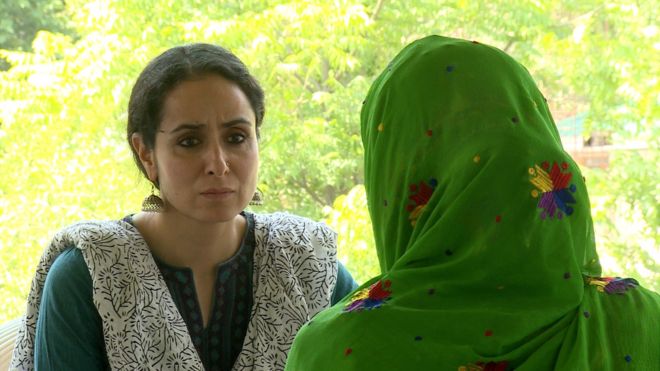
Aliya talking to victim
"We were getting ready for bed when the soldiers came. They took the men away. Some started drinking alcohol. I was holding my two-year-old daughter in my arms when they tried to grab me.
"I resisted, and in the scuffle she fell out of my arms, and out of the window. She was crippled for life.
"Three soldiers grabbed me, tore my pheran, my shirt - I don't even know what all happened after that. There were five of them. I still remember their faces."
Zareena was also in the same house. It had only been 11 days since her wedding.
"I had returned from my parents' house that very day.
"Some soldiers asked my mother-in-law about all the new clothes hanging in the room, so she told them, 'here, she is our new daughter-in-law, our new bride'.
"What happened after that, I cannot begin to describe it. We haven't just been wronged, what we have faced is an infinite injustice. Even today when we see soldiers we start shaking with fear."
The people of Kunan and neighbouring Poshpora accuse the Indian army of carrying out a planned mass rape of the women in these two far-flung villages. They also claim that while the women were gang-raped, the men were subjected to horrific torture, and that they have been fighting for justice these last 26 years.
In Srinagar when I spoke with a minister in the state government, Naeem Akhtar, about these allegations he said that in conflicts like Kashmir truth often gets obscured by the layer of dust that settles on it.
And now it seems a group of young Kashmiri women are determined to wipe this dust away.
http://www.bbc.co.uk/news/world-asia-41268906

Thursday, 21 October 2010

Kashmir: picture post


A Kashmiri woman yells after what she says was unruly force used by Indian police to break the doors and window panes in her locality during an anti-India protest in Srinagar. — Photo by Reuters

Saturday, 6 February 2010

Kashmir Day


Pakistan is marking Kashmir day with countrywide demos to show solidarity with the people of Kashmir. Pakistan believes that there can be no lasting peace with India unless the core issue of Kashmir is settled.

Just yesterday Pakistan’s Military Chief said the country’s army would remain focused on India.

Despite international pressure on Pakistan to deploy more forces on its Western Border to fight the Taliban the Pakistani army is still eyeball to eyeball with the Indians after India reactivated its forward operating airbases and deployed its forces on the border with Pakistan.

That prompted Pakistan to go for a policy of a quid pro quo by sending her forces to take up defensive positions and reinforce her forward positions to thwart off any Indian attack.

The Indian military Chief has recently talked about a Cold Start option, i.e. to strike first and mobilise later policy.

However Pakistan’s military Chief General Kiyani said such take was dangerous and that any such option could lead to a spiral of events that would be difficult to control.

The Indian talk interestingly came on the heels of a visit by the American defense secretary Robert Gates to India where he warned that India may not be able to show restraint if she was attacked again.

Tensions over Kashmir remained a key sticking point between the two Nuclear armed nations.

India recently signaled that it would restart talks at secretary level with Pakistan in what is seen party due to the American pressure on India but Pakistan’s foreign Ministry replied by saying that the Indians must outline the agenda for the talks.

Wednesday, 28 October 2009

Parvez Rasool: Cricketer, not a terrorist

The superb innings he has played in Bangalore ensures that Parvez Rassol will have at least some happy memories of his trip to Karnataka.

The young Kashmiri cricketer arrived in Bangalore last weekend for an Under-22 cricket tournament, but was arrested by the Karnataka police who said traces of explosives were detected in his bag. Furious team-mates blamed the police for treating him like a terrorist, just because he's a Kashmiri. Parvez was released for lack of evidence.

And then he got down to business. 68 runs for Jammu and Kashmir's Under 22 team on the opening day of the match against Karnataka - putting his team in control.

Parvez explains how tough it was to block out what happened off the field. "What happened was wrong. I just want to say that this was an unfortunate incident. What happened was God's will - that is all. The first day when the police took me away, I felt pressure. The second day it was less. Then during the next two days, I began concentrating only on the game."

His team wore black bands during the match to express their anger. Coach Abdul Quayoom says cricket officials in Karnataka showed no team spirit. "I think they could at least have sent an official to the police station with me, but nobody came. Or at least they could have come and told the boys don't be frightened - we are with you. But nothing like that happened."

Parvez's bag was sent to the Forensic Science Laboratory for testing - and results are still awaited. Meanwhile, his team is doing well on the second day of its test match, exacting what they describe as their revenge.

Sunday, 28 June 2009

Indian Military Continues Killing and Raping Kashmiri Women


Immediately after the bodies of two young Muslim women, Nilofer Shakeel and Asiya Jan, were found here on May 30, locals suspected the involvement of security forces from nearby bases.

Anger rippled through the state when, only days after the incident, the state's chief minister, Omar Abdullah, said medical tests indicated the women had been neither raped nor murdered. Later forensic tests showed that they had, and Mr. Abdullah ordered a high level judicial inquiry into the crimes.

But by then the murders had triggered statewide protests. At least two people were killed and hundreds wounded. In Shopian this week, the protests continue.

This week, authorities said they would follow the recommendations of an interim report from the inquiry and suspend four police officers for destroying evidence and "dereliction of duty." The final report is due at the end of the month.

In Shopian, people say they will continue to protest until the culprits are locked up. "So far, the authorities have done nothing to help us at all," says Shakeel Ahmed, Ms. Shakeel's wretched-looking husband as he sits at home. Nearby, village children have gathered to play with the couple's toddler.


In recent years the Kashmir Valley – once described by former United States President Bill Clinton as the most dangerous place on earth – has been relatively peaceful. The calm came largely due to renewed peace talks between India and Pakistan, which both rule portions of Kashmir but claim it in its entirety, as well as the adoption by many separatist groups of nonviolent means of agitation.

But most people in the state still yearn for freedom from Indian rule. Last year, a government plan to transfer land to a Hindu shrine in the state sparked the biggest pro-independence protests since the early 1990s.

Any crime that is suspected to involve security forces – an omnipresent reminder of Indian rule – tends to be seized upon by separatist groups. Despite the relative calm, some 600,000 security forces remain stationed in Kashmir. Their presence is bitterly resented.

"After the transition from violence to nonviolence in the separatist movement there is no need for the deployment of so many security forces in the villages," says Yaseen Malik, a separatist leader and former fighter. "Why should they be deployed in civilian areas when there is no need of them now?"


Thirty protesters were hurt Tuesday when police fired shots in the air and teargas during fresh protests in Indian Kashmir over the alleged rape and murder of two Muslim women, police said.

The injuries were reported in southern Pulwama district where riot police used force to disperse hundreds of stone-throwing students "to maintain law and order," a police officer said.

"Three of the injured are in critical condition," he said.

However, residents reached by telephone said the demonstrators were peaceful when police blocked them and chased them away by firing shots in the air and scores of teargas shells.

Residents, mostly parents of students, later attacked the district's main police station with rocks, rods and bricks, witnesses said.

Earlier in the day hundreds of Muslim students marched through the streets of Indian Kashmir's summer capital Srinagar.

Chanting "We want freedom" and "punish the killers", they later dispersed without violence.

Similar peaceful demonstrations were held in other towns in the Muslim-majority Kashmir valley, witnesses said.

Anger over the deaths last month of a 17-year-old girl and her 22-year-old sister-in-law has effectively shut down much of Kashmir valley, including Srinagar, for nearly two weeks.

Indian officials had insisted the two women had drowned, but their families accused security forces of abducting, raping and killing them.

On Sunday, police said forensic tests showed they had been raped, sparking more protests.

In most of the region, schools, shops and banks opened Tuesday after separatists called for an end to their eight-day long general strike, but the women's hometown of Shopian remained shut up.

Separatists have urged students to continue daytime protest marches.

Authorities have issued a ban on demonstrations in an attempt to curb the daily protests, which have so far claimed one life and left nearly 400 injured.