Showing posts with label Fostering. Show all posts

Wednesday, 12 February 2025

The Rewards of Fostering Children in Islam


Fostering children is one of the most compassionate and rewarding acts a Muslim can perform. In Islam, caring for orphans and vulnerable children holds immense virtue, bringing both worldly and spiritual rewards.

 A Path to Jannah

The Prophet Muhammad (peace be upon him) said: “I and the one who cares for an orphan will be together in Paradise like this,” and he held his two fingers together (Bukhari). This hadith highlights the elevated status of foster parents in the Hereafter. By providing love, care, and support to a child in need, a Muslim secures a lofty place in Jannah.
 Earning Continuous Rewards (Sadaqah Jariyah)

Fostering a child is an ongoing act of charity (Sadaqah Jariyah). Every meal provided, every lesson taught, and every act of kindness shown to the child contributes to a continuous stream of rewards. Even after one’s passing, the good deeds instilled in the child will continue to benefit the foster parent.

Strengthening the Ummah

Islam encourages strong community bonds. When a child is cared for within a loving and Islamic environment, they grow up with the right values and morals, contributing positively to society. Fostering is an act that strengthens the Ummah by ensuring no child is left abandoned or neglected.

 A Means of Attaining Allah’s Mercy

The Prophet (peace be upon him) was known for his immense kindness to orphans, and he instructed Muslims to do the same. In a hadith, he mentioned that softening one’s heart comes from caring for an orphan (Ahmad). Fostering children invites Allah’s mercy and softens the hearts of those involved.

 A Great Act of Compassion and Love

The rewards of fostering extend beyond the spiritual realm. Many foster parents find a deep sense of fulfillment in providing a home to a child in need. The love and attachment formed through fostering bring joy and purpose to both the child and the foster family.

Following the Example of the Prophet (PBUH)

Prophet Muhammad (peace be upon him) himself was an orphan, raised by his grandfather and later his uncle. His compassion towards orphans and vulnerable children serves as an example for Muslims to follow. Fostering a child is a way to emulate his noble character and fulfill a great Sunnah.


Fostering children in Islam is not just an act of kindness; it is a means of attaining immense rewards in this life and the Hereafter. It is an opportunity to transform a child’s life, strengthen the Muslim community, and draw closer to Allah’s mercy. May Allah bless and reward those who open their hearts and homes to children in need. Ameen.

Monday, 11 December 2017

Muslim foster parents: ‘We'd never had a Christmas tree - it made them so happy’

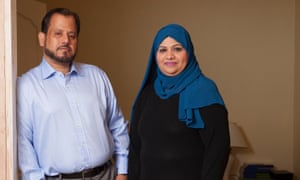
Riffat and her husband Sajjad, at their home in Slough
Just before Christmas seven years ago, Riffat and Sajjad were at home when the phone rang. It was the foster agency letting them know that three children they’d never met would be arriving shortly. The children – two sisters and a brother – were in urgent need of short-term care. Sajjad and Riffat had been approved as foster carers only two months earlier and these would be their first placements.
“We were excited, but I was also a bit nervous,” recalls Sajjad, 50. The couple had tried to start a family after they married, but fertility problems led to six failed cycles of IVF. They considered adopting, but eventually decided to sign up as foster carers.
Both are observant Muslims of Pakistani heritage. Riffat, 46, was wearing a headscarf when we met, and prays five times a day. How did they cope with the arrival of three white English children raised in a Christian household?
“I will never forget that day,” recalls Riffat, who grew up in Pakistan and moved to Britain after marrying in 1997. “It really was like being thrown in the deep end.” They bought chicken and chips from the local takeaway for the children and the support worker told the couple about the children’s bedtime routine.
Once the children were asleep, Sajjad headed out on an urgent shopping mission. “We are Muslims and we’d never had a Christmas tree in our home,” says Riffat. “But these children were Christian and we wanted them to feel connected to their culture.” So he bought a Christmas tree, decorations and presents. The couple worked until the early hours putting the tree up and wrapping presents. The first thing the children saw the next morning was the tree.
“I had never seen that kind of extra happiness and excitement on a child’s face,” remembers Riffat. The children were meant to stay for two weeks – seven years later two of the three siblings are still living with them.
Riffat has grown used to surprised looks from strangers and people asking if the reason she has such fair-skinned children is because she married a white man. But she focuses on the positives – in particular how fostering has given her and Sajjad an insight into a world that had been so unfamiliar. “We have learned so much about English culture and religion,” Sajjad says. Riffat would read Bible stories to the children at night and took the girls to church on Sundays. “When I read about Christianity, I don’t think there is much difference,” she says. “It all comes from God.”
The girls, 15 and 12, have also introduced Riffat and Sajjad to the world of after-school ballet, theatre classes and going to pop concerts. “I wouldn’t see many Asian parents at those places,” she says. “But I now tell my extended family you should involve your children in these activities because it is good for their confidence.” Having the girls in her life has also made Riffat reflect on her own childhood. “I had never spent even an hour outside my home without my siblings or parents until my wedding day,” she says.
Just as Riffat and Sajjad have learned about Christianity, the girls have come to look forward to Eid and the traditions of henna. “I’ve taught them how to make potato curry, pakoras and samosas,” Riffat says. “But their spice levels are not quite the same as ours yet.” The girls can also sing Bollywood songs and speak Urdu.
“I now look forward to going home. I have two girls and my wife waiting,” says Sajjad. “It’s been such a blessing for me,” adds Riffat. “It fulfilled the maternal gap.”

Monday, 20 February 2017

'I know they are going to die.' This foster father takes in only terminally ill children

The Bzeeks opened their Azusa home to dozens of children. They taught classes on foster parenting — and how to handle a child’s illness and death — at community colleges. Dawn Bzeek was such a highly regarded foster mother that her name appeared on statewide task forces for improving foster care alongside doctors and policymakers. 
Bzeek started caring for foster children with Dawn in 1989, he said. Often, the children were ill.
Mohamed Bzeek first experienced the death of a foster child in 1991. She was the child of a farm worker who was pregnant when she breathed in toxic pesticides sprayed by crop dusters. She was born with a spinal disorder, wore a full body cast and wasn’t yet a year old when she died on July 4, 1991, as the Bzeeks prepared dinner.
“This one hurt me so badly when she died,” Bzeek said, glancing at a photograph of a tiny girl in a frilly white dress, lying in a coffin surrounded by yellow flowers. 
By the mid-1990s, the Bzeeks decided to specifically care for terminally ill children who had do-not-resuscitate orders because no one else would take them in.
There was the boy with short-gut syndrome who was admitted to the hospital 167 times in his eight-year life. He could never eat solid food, but the Bzeeks would sit him at the dinner table, with his own empty plate and spoon, so he could sit with them as a family. 
There was the girl with the same brain condition as Bzeek’s current foster daughter, who lived for eight days after they brought her home. She was so tiny that when she died a doll maker made an outfit for her funeral. Bzeek carried her coffin in his hands like a shoe box.
“The key is, you have to love them like your own,” Bzeek said recently. “I know they are sick. I know they are going to die. I do my best as a human being and leave the rest to God.” 
Source