Showing posts with label Buddhists. Show all posts

Tuesday, 12 September 2017

‘It only takes one terrorist’: the Buddhist monk who reviles Myanmar’s Muslims

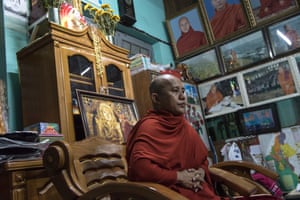
Ashin Wirathu
Islam represents only 5% of Myanmar’s population of 54 million, but nationalists like Wirathu are pushing the idea that the faith puts Buddhism, and the very essence of Myanmar, in jeopardy. He claims the 1 million Rohingya Muslims living in precarious conditions in his country – described by human rights agencies as the most persecuted people on Earth – “don’t exist”.
“It only takes one terrorist to be amongst them,” he says. “Look at what has happened in the west. I do not want that to happen in my country. All I am doing is warning people to beware.”
Wirathu adds that if Donald Trump or Nigel Farage need some advice he will happily share his ideas. These include infiltrating the Facebook pages of Muslim groups, getting all Islamic schools to record their lessons, and government surveillance of internet activity, including emails. Wirathu claims he has his own army of individuals screening the net in Myanmar.
On the well-documented situation of the Rohingya in Rakhine state – where people have been left without access to medicines, aid, and basic human necessities such as clean water, sanitation and food – Wirathu is dismissive. The Rohingya have been mostly couped up in camps since the 2012 violence, and the silence of Myanmar’s leader Aung San Suu Kyi and her National League for Democracy on their plight has attracted growing criticism.
Wirathu rejects the stateless Rohingya as illegal immigrants, a view echoed by the government. He will only discuss them if the description “Bangladeshis” is used, and even then Wirashu says the situation is not as it is portrayed.
“If it is true what [outsiders say], then I would offer help but I have visited the camps on many occasions. The aid agencies are refused access because they are using the refugees to fill their own pockets. Bangladeshis are posing for the media. They are not starving. They have so much food that they are selling it on in their shops – stealing even from their own.”
On the allegations that women have been abused and raped by the military, he laughed: “Impossible. Their bodies are too disgusting.”
There have been calls outside Myanmar for Aung San Suu Kyi to return her Nobel peace prize for her failure to tackle the situation with the refugees, which has broken her own promises on human rights.
Source

Saturday, 9 September 2017

The Battle for Myanmar’s Buddhist spirit

A good video from The Guardian, UK. In Myanmar, different groups of Buddhist monks are battling with how to deal with the country’s minority Muslim population. While some advocate peace, others, such as the extremist Ma Ba Tha, are stoking up hatred and violence. The Guardian visited Myanmar to investigate how the monks’ actions are threatening to destabilise the country’s newly established democracy.


More info here.

Wednesday, 25 July 2012

Scant compassion for Muslim Rohingya refugees


Entering the Rohingya camps along the Bangladesh-Myanmar border is restricted.
Officially they don't even exist, but in reality authorities tolerate their presence. Bangladeshi official say there are about 300,000 unregistered Muslim Rohingya refugees from Myanmar living in dismal and squalid conditions with no electricity or drinking water and restricted from access to hospitals or schools. Leaving the camps is prohibited, but many find a way out anyway.
Visitors are not welcome, especially ones with cameras. Police informants are placed inside and out to keep an eye on unauthorised visitors. We managed to sneak in during a sudden spell of heavy monsoon downpour. The rains were a blessing; the police informants ran for cover and we walked unnoticed into the camp. As we climbed up the narrow muddy lanes, an eerie silence hung thick in the air. Behind each improvised tent we passed, we could see the eyes of men, women and children peering out. They were all quiet, as if in hiding. Some were shaking. They were scared.
Last month, sectarian violence between the Rohingya Muslim minority and the Buddhist majority left about 80 dead and many more injured in Myanmar's Rakhine state bordering Bangladesh. The violence was taken as a sign of more to come; thousands tried to flee across the border into Bangladesh and they continue to do so.
Authorities in Bangladesh's capital Dhaka do not see these fleeing Rohingyas as refugees but as illegal asylum seekers, and the country's border guards are under strict order to send them back to where they came from. Still, many make it across.
Huddled in a dark makeshift tent made of mud and plastic sheets, I tried to speak to a group of them. It took time to build trust, to get the conversation going. Their silence speaks much louder than words. Some wept. A 14-year-old girl broke the silence.
She said one word.
"Rape".
The others followed suit. They told us the Myanmar army and police go house to house, abducting men and sexually abusing women. One of the elders described what was happening in his homeland as state sponsored sectarian violence. And it is escalating, he said.
For decades, Muslim Rohingyas have suffered extreme discrimination. Their dark skin and religious difference are a source of deep prejudice amongst Myanmar's Buddhist majority.  They are prohibited from owning land, running businesses, practicing their religion or getting married.
Myanmar's move towards democracy last year instilled many Rohingya with a new sense of hope. Most are supporters of Aung San Suu Kyi, but she has remained uncomfortably quiet on their plight.
Roughly 29,000 Rohingya are recognised as refugees by the Bangladeshi government and UNHCR. In the eyes of the Bangladesh authorities the 300,000 others don't exist, so they do not receive any UN aid.  A handful of aid agencies work with them, but none of them want to be filmed or named.
They say if we film these camps, the Bangladeshi authorities could shut their aid programmes down. Authorities have already refused $33m in UN aid money for the Rohingya and local Bangladeshi community in the area, saying that this would make life too comfortable and may risk attracting more refugees to Bangladesh.
As the downpour turned to a drizzle we made our way out of the camp before the informants showed up. The monsoon weather kept us safe, before it stopped we had to move. As we hurried out, a group of Rohingyas hurried in, like us, using the rain as the only source of cover.