Showing posts with label Holland. Show all posts

Thursday, 23 March 2017

When the Netherlands Had a Muslim-Majority Empire

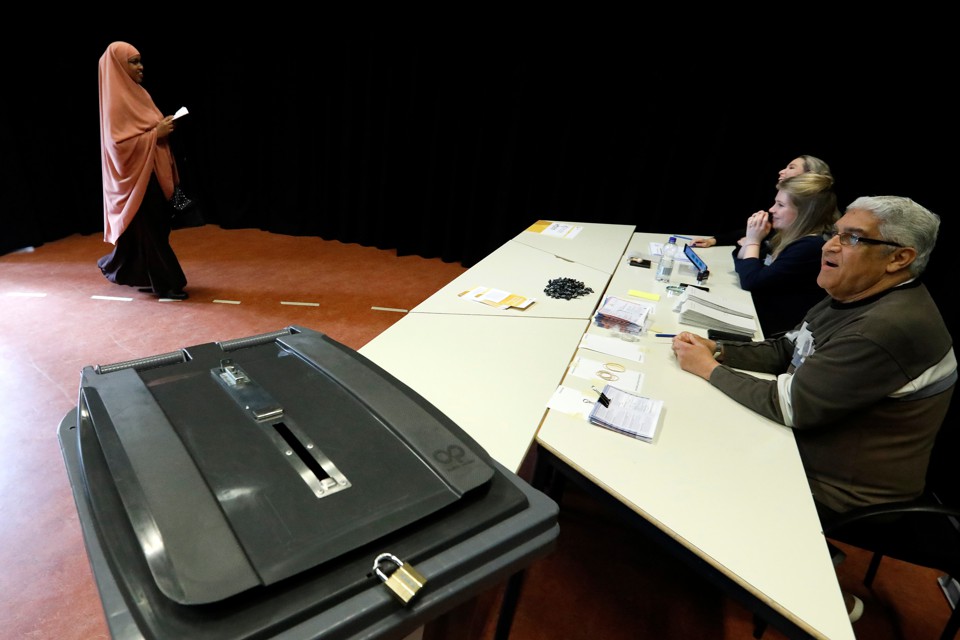
A woman arrives at a poll station to cast her vote in the Dutch general election in The Hague, Netherlands on March 15, 2017.A woman arrives at a poll station to cast her vote in the Dutch general election in The Hague, Netherlands on March 15, 2017

The war did little to soften Dutch imperial ambitions. In 1946, while Nazi leaders faced prosecution in The Hague in the Netherlands, Dutch soldiers were rounding up and slaughtering Indonesian freedom fighters in a brutal counter-insurgency designed to take back control over their former colonies. Indonesia has claimed that 40,000 died after World War II in a years-long killing spree by the murderous Dutch captain Raymond Westerling on the eastern Indonesian island of Sulawesi.

But while the Netherlands’s historical intolerance of Islam and suppression of Islamic practices and movements in their colonies are a matter of record, many Dutch have yet to grapple with their nation’s colonial legacy. Henk Schulte Nordholt, professor of Indonesian History at the University of Leiden, said that Wilders’s rise reflects the Dutch people’s ignorance of their own history. After the disintegration of the Ottoman Empire, the Dutch empire “was the biggest Islamic empire, without many people in the Netherlands really realizing that,” he added.

There has been some progress. The Dutch government has begun paying modest reparations to some of the widows of Indonesians executed during the Netherlands’s attempt to recolonize Indonesia after World War II. But this is only a first step. “We tend to discover new cruelties in our colonial past and then instantly  forget it so next year there is a new revelation and new discovery. It’s a very structural amnesia.” Contributing to this amnesia is the fact that only a small number of Indonesians moved to the Netherlands after the 1960s, making the country’s colonial legacy even less apparent, Nordholt said.

As a result, the Dutch have managed to preserve their self-image as a historically liberal, tolerant nation, distinct, say, from their German neighbors to the east. As with many other self-professed liberal nations, like the United States and Germany, Dutch enlightenment values have always clashed with baser, tribal impulses in the nation’s politics.

Geert Wilders’s anti-Islam rhetoric Islam recalls earlier eras of Dutch politics. His anxieties over a supposedly Islamicizing nation are distinct from imperial Dutch worries about Islam providing a vehicle for anti-colonial resistance. Nonetheless, historical ignorance in the Netherlands helps explain why so many Dutch view Islam as foreign even though the religion is deeply tied to their country’s history.
“People have no idea,” Nordholt said. “There is ongoing amnesia about the colonial past.”


Monday, 8 October 2012

Dutch-Muslim girl says faces daily assault over faith


Comment: I think these 'local boys' boys are quite possibly also Muslim and are attacking her because she is too and because she dares to pursue an education and not dress the 'way she should'....
AMSTERDAM: She can’t tell her parents. They would keep her at home and force her to marry. She has gone to the police, but they have refused to intervene. For Fatima, a Moroccan-Dutch 19-year-old university student, life has become terrible.
“I can’t walk to university any more and don’t have money to pay for a taxi. I have to brave it and suffer every day to get to class,” she told Bikyamasr.com at a cafe on the outskirts of Amsterdam. For her, life is a struggle.
“I can’t talk to my parents about it because they threatened me already to send me to Morocco for school and to find a husband. This is my home,” she said.
Her ordeal began last Spring, when she would walk the same route to the University of Amsterdam where she was taking her first round of coursework. She liked to dress up for school and had been wearing what other Dutch girls her age often do in the warmer months: a skirt and tanktop.
“I wanted to be noticed at school, and I was, but also on the streets,” she said.
She said that a group of local boys began harassing her on a daily basis, commenting on her body and propositioning her. “I didn’t give them notice and they didn’t ever touch me.”
It all changed one morning when her mother called and they overheard her speaking Arabic. Fatima said that is when they began to get even closer.
“It was a few days later when they jumped on me and started swearing at me and calling me horrible names like ‘Moroccan slut’, ‘prostitute’ and others,” she revealed. “The first time it happened, they grabbed my chest and behind, but nothing more. I thought it was a one-off thing and I yelled at them when they ran away.”
She didn’t call the police or report the incident, hoping, she said, it would not happen again.
But the following day, the boys attacked again. She said they tore at her clothes and “they inserted fingers … it was the worst experience of my life. I thought they would rape me.”
When she went to the police, in tatters, she said the officers on duty laughed when she tried to report the incident.
“They told me to wear better clothes and to hide being Arab. And they didn’t move to do anything. I was so shocked and hurt. I didn’t know what to do,” she said.
For the next few weeks, calm returned to her routine and the boys were not present, but then they returned and the assaults began again. After two more sexual assaults on her, she has since taken different routes.
“But they somehow find me. I have been attacked at least 10 times and each time they call me names about being an Arab and Muslim. The police say they would like to help, but they need some evidence. They think I am lying,” she said.
For her, being an Arab, a woman, and a Muslim in the lower class areas of Amsterdam has been a struggle. Fatima hopes that she can start finding a ride to university to end her turmoil.
“I can’t say anything to my parents because they would keep me at home and force me to marry someone in Morocco. I am Dutch and I will fight this no matter what,” she said, adding that she plans to go to the central police station to file a report against the boys for attacking her and the police officers who sat idly by.
The Netherlands has seen a rise in anti-Islam sentiments in recent years and Fatima is only one of numerous hate crimes erupting across the once tolerant society.

Tuesday, 2 August 2011

The rise and fall of Geert Wilders’ ideology


After years of capitalizing on the fear of Islam, Dutch right-wing politician Geert Wilders’ ideology has been severely dented by the Arab Spring and far-right terrorism in Norway.

The year 2011 looked bright for Dutch MP Geert Wilders, founder of the Party for Freedom, or PVV. In the fall of 2010 his party won 16 percent of the seats in parliament and obtained a decisive role in the new government coalition, with the Christian Democrats and Conservative Liberals. Opinion polls early this year indicated that his Freedom party would even overtake the Labor party as the second largest. Wilders has maneuvered himself into the driver seat, becoming the most important politician in Dutch politics and is slowly starting to become a household name on the international terrain as well.

Fear of Islam

Wilders’ party program has been based on what we could call the Vienna school of thought – referring to the year 1683 when the Ottomans tried to overtake Vienna. By referring to this historical event, cultural conservatives argue that Muslims have, and will, always strive to take over Europe and enforce on it its “barbarian” rule.

The accompanying discourse of cultural conservatives is very civilizational. Wilders and his counter-parts repeatedly stress the difference between Christian-Jewish and Islamic values: Enlightenment versus barbarianism, democracy versus dictatorship and freedom versus oppression. This difference, Wilders argues, is intrinsic and makes Europe incompatible with Islamic values – leaving no other option than to counter the influence of Islam.

By constantly linking Islam with issues such as immigration, public safety and terrorism, a paradigm is created in which Islam is the problem, and erasing it becomes the solution. This paradigm facilitates Wilders to argue that the Quran is similar to Hitler’s ‘Mein Kampf’ and should be banned, or describe over a million Muslims in the Netherlands as “Islamic voting cattle.”

The Arab Spring

The argument that Islam is incompatible with Western values, such as democracy, has in the past been defended by the number of Muslim majority states that harbor a dictatorial regime. Indeed, states in which Islam is the largest or sole religion, political freedom is often scarce.

As the Arab Spring erupted early this year in Tunisia, Egypt and many other states in the Middle East and North Africa, it exposed that not Muslims but merely Arab regimes are incompatible with democracy. The protest scene was very much secular in nature as the protesters called for more political freedom, not more religion.

In Syria, every Friday hundreds of thousands of Muslims continue to risk their life for freedom. Even though the regime employs death squads, tanks, snipers and torturers, ordinary men are bold enough to face death to fight for their ideals. The Arab Spring is their “Bastille”, knocking at the gates of dictatorship and oppression. The Arab age of enlightenment has started, which Wilders tends to ignore as it severely undermines his ideology.

Christian-fundamentalist terrorism

Norway’s Christian terrorist, Anders Breivik, also adhered to the Vienna school of thought and his views are shockingly similar to Wilders’. Breivik’s over 1,500 pages-long manifest encompasses the urge to purify Christian Europe from Islam and calls for support for Israel. In essence, the manifest reads as a violent adaptation of the Freedom Party’s program.

Breivik was unmistakably inspired by Wilders, labeling the PVV as the “only true conservative party” in Europe. Although it is unfair to stain Wilders’ “guilty by association”, it does raise the question of the (unintended) consequences of protracted hate speech directed at a race, religion or ethnicity.

Moreover, Breivik’s mass murder exposed the fallacy that merely Islamic fundamentalism is violent.

His terrorist act was inspired by the images of Medieval Christian Europe, just like the Muslim Caliphates inspired al-Qaeda. Breivik is as much a product of Christian fundamentalism as Bin Laden is from radical Islam.

2011, therefore, dawned as the year in which millions of Muslims peacefully marched for political freedom and a Christian, Islam-hating terrorist killed dozens of innocent children. Consequently, Wilders’ ideology is finally shattered to pieces.

source

*Anno Bunnik, a political commentator living in the Netherlands, is a graduate from King’s College London and interned at the Carnegie Middle East Center and the International Centre for Counter-Terrrorism.

Tuesday, 14 June 2011

Muslim and gay: 'Allah made me this way'


“If Allah didn’t want me this way, he wouldn’t have made me this way,” says Omeed.

He’s a 27-year-old Dutch guy who believes he’s basically a good person and, therefore, a good Muslim too. But he’s also openly and unashamedly homosexual. How does he fit the two together?

Omeed (not his real name) was born here in the Netherlands, but his parents are first generation immigrants from Pakistan. He describes his family life not so much as strictly Islamic, but certainly ‘traditional’ with strong Muslim values. He did all most of ‘normal’ Islamic things, like observing Ramadan and studying the Qur’an.

Given this background, he was more than a bit worried when he first realised in his early teens that he was attracted to boys: “I thought […], oh no, I’m from a Muslim family – what’s going to happen?”

Not a real problem
But those concerns were more about his family’s reactions [see the item on Omeed and his family] than those of his religion. In fact, Omeed says being Muslim and gay is something he’s never regarded as a real problem: “I was and am still a believer but I also knew that Allah made me this way. If Allah didn’t want me this way, he wouldn’t have made me this way.”

He also came to these conclusions quite quickly: “I knew very early on that this wasn’t a matter of choice on my part. After all, I would never have chosen to be gay and Muslim, because that would be such a difficult path to choose for yourself.”

As a result, he concluded quite simply that this is the way he’s ‘meant to be’. After all, coming from a traditional, ‘heterosexual’ Muslim family, clearly... “There’s no choice or ‘learned behaviour’ involved. I am as I am, I think I’m a nice and a good person. I don’t do any harm to anybody – at least I try not to do so deliberately – and that’s more important than my sexual inclination”.

Exception
Omeed acknowledges he is an exception in the Dutch Muslim community, where homosexual men and women seldom come out 100 percent as most of their ethnic Dutch counterparts do. However, he says more and more gays and lesbians from a Muslim background are coming out partially – i.e. carefully, to a very select circle of friends and – in some cases – family members.

But basically, Omeed says he believes Allah wills and makes us to be the way we are, and if you can accept that then you can accept your own sexuality too.

Don't make it a problem
His advice to other young Muslims – and, come to that, anyone from a conservative-religious community - facing up to their homosexual feelings is not to make a problem out of their religion or let the religious interpretation of ‘others’ stop you being who you are.

Nonetheless he recommends that young gay Muslims be cautious about who they come out to, but not let this prevent them seeking support, either from friends or professionals. Although he’s never been a victim of real aggression, he knows it’s out there and that in the larger Muslim community homosexuality remains taboo.

Source

Monday, 28 February 2011

Dutch broadcaster removes anti-Wilders cartoon after threats to staff


Comment: The Islamophobic Danish cartoons were promoted by you under pretext of freedom of speech but this thought-provoking cartoon is labelled 'disgusting' and forcibly removed.Geertz, you hypocrite!


The website of a left-leaning public broadcaster has removed a cartoon depicting a plan by the far-right PVV party as a Nazi death camp following serious threats to its staff.

The cartoon, by Adriaan Soeterbroek and posted on the VARA’s Joop.nl site, ridiculed a PVV plan to create
"hooligan villages", likening them to a Nazi concentration camp with PVV leader Geert Wilders showing the inmates into a shower. In World War II millions of people, mostly Jews and Roma gypsies, were killed in Nazi gas chambers disguised as showers.

The VARA says it removed the cartoon after careful consideration, saying that while freedom of expression is a key right some of its staff felt too threatened to continue working. The broadcaster has reported the incident to the police.

Due to its initial refusal to remove the cartoon, PVV top candidate Machiel de Graaf refused to participate in a debate the VARA broadcast on 16 February ahead of the 2 March provincial elections.

Source


Tuesday, 7 December 2010

Sex abuse in Muslim families goes unreported


Four Dutch-Moroccan women, Rabea, Zohra, Ibtisam and Saïda, were all sexually abused by members of their families: their fathers, uncles, brothers or cousins.

After years of silence, they have decided to speak out because they know that many other Muslim women suffer the same fate. A care worker: “Taboos, secrecy, silence, shame and a closed community are almost a recipe for sexual abuse.”

The idea of ‘family honour’ meant that Rabea, Zohra, Ibtisam and Saïda kept their mouths shut. Now they are telling their stories to try and break the taboo surrounding sexual abuse in Muslim families. They no longer see themselves as victims. Their mission is to help other women who are in trouble now.

Young victims Their stories are individual but share much common ground. They were all around four or five when someone in their family started abusing them. The girls all kept silent because of threats, but also for fear of bringing ‘dishonour’ on the family. They didn’t even consider going to the police. Even now, they think that would be going too far.

Rabea was abused as a little girl by her father. She became caught up in herself and grew defiant.

“It’s so unnatural. If you’re beaten up at school or on the street, you go to your parents or your teacher. But this is your father. That goes against everything you believe in. I didn’t know how to talk about it and to whom I could turn. I was in danger of ending up in prostitution, but that didn’t happen luckily. Other people’s support and my belief in Jesus Christ helped to give me strength in the end.”

Robbed of everything Zohra kept her story to herself for years. She now tells of how she was raped by her cousin in Morocco when she was five:

“I was staying with my aunt and my cousin was looking after me. That day is engraved on my memory – he robbed me of everything. My aunt caught us. She said she’d deny everything if I told my parents. Nobody would believe me. I lost trust in everything. You’re damaged by sexual abuse, but I’ve learned that you can recover.”

Recipe for abuse

Kristina Aamand has heard lots of similar stories. She works at an emergency shelter for young women in Denmark which, like the Netherlands, has a large Islamic immigrant population.

“It goes on in immigrant and native Danish families. It’s just that we never look for it in the Muslim community. When I was being trained, I was told I didn’t need to learn anything about sex abuse in Islamic countries because incest was forbidden by Islam and didn’t happen. That was really naïve. Taboos, secrets, silence, shame and a closed community are almost a recipe for sexual abuse.”

Cast out of the family Ibtisam was abused by her brother almost daily between the age of six and 12. “If I told on him, he would blame me. I would be killed or cast out of the family. I felt dirty, unhappy and rejected by my own family. I was very lonely. I was a girl that wasn’t alive. I was breathing but that was all.” The abuse stopped a year after Ibtisam threatened to tell on her brother.

Saïda was the victim of several abusers. She still suffers from the consequences every day. “I was abused from the age of four to 20 by different people. It destroyed me both physically and mentally. I felt afraid. I am still unable to be intimate with men, or fall in love. I did not have a normal childhood.” The doctor said she was mad. A couple of years ago, Saïda set up a project for abused Islamic girls. She realised there are more girls like her who do not tell their stories.

Confide Zohra, Rabea, Ibtisam and Saïda are not alone. There are more indications of sexual abuse in Islamic families. A crisis centre in Friesland takes in victims of honour-related violence. Half of them turned out to be sexually abused by a relative. Most of them have a Moroccan or Turkish background, some of them are Iraqi, Afghan or Kurd.

Zohra, Ibtisam, Saïda and Rabea are older now and have got their lives back in order. They want women with similar problems to confide in someone they trust. “They are not alone. Telling your story gets easier. I hope victims can draw strength from our stories,” says Ibtisam.

source

Wednesday, 27 October 2010

Rejection of violent jihad by Dutch terrorist not unique


Imprisoned Dutch terrorism suspect Jason Walters' decision to renounce violence is not unique. A number of radical leaders in Islamic countries have done the same. Once in jail, they repented and called on their followers to renounce radical Islam.

Jason Walters, who is 25, is the first extremist Muslim convict in the Netherlands to renounce his radical ideology. From his cell in Vught prison he wrote a letter explaining his change of heart which was published by Dutch daily de Volkskrant on Saturday. Jason, allegedly a member of the so-called Hofstad Group, was sentenced to 15 years in prison for throwing a hand grenade at a police team which was trying to arrest him in 2004. Four policemen were injured.

Mea culpa
Sceptics say Jason Walters only wrote his letter hoping for a reduced sentence. It was published only days before his appeal hearing before the Amsterdam court. Judges will decide on Wednesday whether the Hofstad Group was a terrorist organisation.

According to RNW's Mohamed Amezian, Jason's renunciation of violence should be taken at face value. He says it is in line with a trend among radical Muslims.

RNW's Mohamed Amezian says that Jason's repentance is nothing new. Many radical Muslims realise in prison that violence is not a means to further their ideals, he said, explaining that "violent jihad's following has dwindled. Its leaders are voices crying in the wilderness. And they have become more pragmatic. There is less and less support for violent attacks, so why continue preaching that message?"

De-radicalisation
Mohamed Amezian has conducted research into de-radicalisation. He thinks Jason Walters may have known about similar cases in the recent past, seeing there is an international network of Islamic activists.

"I think Jason was aware of these development among jihadists. They maintain a close-knit network using internet and other modern means of communication. It's not surprising, now that he has had the opportunity to reflect in prison, that he should reverse his previous decision to become an active jihadist."

Possibly the governors of Vught prison where Mr Walters is held played a part in this, following the example of Saudi Arabia, Lybia and Egypt where authorities actively promote de-radicalisation of imprisoned jihadists. Vught prison is declining to comment.

Abandoning violent jihad: some recent cases

• Moroccan-French Muslim Robert Richard Antoine Pierre, also known as Lhaj, publicly renounced radical Islam in Morocco a couple of years ago. He declared that Muhammad was not a prophet, but the founder of a state and a civilisation. During his period in detention, Mr Pierre became an apostate, turning away from Islam.

• Another major Islamic jihad leader in Morocco, Mohamed al Fizazi wrote a letter of renunciation from his prison cell in 2009, addressing Muslims in Europe. Mr Fizazi's earlier ideas could be described as extreme. During Ramadan in 2000 he spoke in a mosque in Hamburg, Germany, inciting his audience to embark on violent Jihad. Among the people listening were some of the September 11, 2001 Twin Towers attackers. The same Mr Fizazi wrote last year, "We followed the wrong path then and we overshot the mark."

• Algerian detainee Hassan Hattab called on his followers in January 2009 to renounce violence and to open a dialogue with the authorities. Mr Hattab was one of the founders of al-Qaeda in the Islamic Mahreb (Morocco, Algeria, Lybia, Mauritania and Tunisia). In 2007 he turned himself in.

source

Wednesday, 20 October 2010

Dutch MP's anti-Islam comments 'provoked abuse'


Muslim witnesses have testified that a Dutch MP's anti-Islamic comments had led to attacks and intimidation, and they pleaded with judges to convict him and give him a symbolic fine of €1.

Geert Wilders is facing charges of inciting hatred and discrimination against Muslims for statements that include comparing Islam with Nazism and calling for a ban of the Koran and a tax on Muslim scarves, which he calls "head rags". His trial has been seen as testing the limits of free speech.

Prosecutors last week acknowledged they have failed to prove the case against him and called for his acquittal. The judges' verdict is expected on 5 November.

"Arson. Attempted arson. Vandalism. Disturbances. Incivility to people attending mosques. Obscenities. Intimidating behaviour – they have all become everyday occurrences" as a result of Mr Wilders' public remarks, said Mohammed Enait, speaking for an alliance of Dutch mosques that had asked to testify as victims in the case.

Mr Wilders denies inciting hatred of Muslims, claiming he criticises Islam as an ideology that rejects Western values. He argues it is not a crime to state what many Dutch voters believe.

Mr Enait said Dutch Muslims have suffered tangible damage as a result of Mr Wilders' repeated negative remarks about Islam. He said there are countless incidences of "children being cursed at while they walk. Stories from women ... who are spit upon, mocked because they wear headscarves".

Mr Enait, from Rotterdam, said the mosque he attended as a child had been burned down. Dozens of mosques in the Netherlands were burned in 2004 in apparent retaliatory attacks after the killing of filmmaker Theo van Gogh by an Islamic radical who is now serving a life sentence.

source

Sunday, 28 March 2010

Muslims quietly take Wilders' abuse


Day in and day out, Dutch Muslims are told their religion is "a fascist ideology" and "a threat to Dutch society"


By Sheila Kamerman and Dirk Vlasblom for NRC Handelsblad

They hear their "so-called prophet Muhammad" is "a barbarian, a mass murderer and a paedophile", or words to that effect. The indignities come from a member of parliament: Geert Wilders.

After leaving the right-wing liberal VVD party in 2006 and setting up his own Party for Freedom (PVV), Wilders has made criticism of Islam his one main issue.

He is being heard by native Dutch people who fear the country of 16 million is suffering under the burden of its estimated one million Muslim citizens. Wilders obtained 5 of the 25 Dutch seats in European parliament last year. His PVV did very well in the two municipalities in which it participated in recent local elections. Some polls have predicted his party could become the biggest in parliament after the upcoming national election.

One wonders why the Muslims he is targeting are not standing up against his attacks and letting themselves be heard.

When asked this question, Islam expert Mohammed Cheppih immediately countered it: "Aren't we all Dutch?," he asked. "Society as a whole should stand up to Wilders. Wilders is destroying the Netherlands. We should all ignore him."

Counterproductive? Farid Azarkan, the director of an interest group of Moroccan-Dutch people, SMN, agreed. "Where are all the reasonable Dutch people who say: 'This is not how we treat each other here'?" Ideally, non-Muslims would support their Muslim compatriots en masse, Azarkan ventured. "Suppose that all the women in Almere [the one city where Wilders' PVV won the most council seats in the local election] would don a headscarf." Azarkan chuckled at the idea of such a form of protest against the PVV's proposed headscarf ban in municipal buildings there: "But that is not realistic."

Azarkan has thought about instigating large-scale protests, but believes it would ultimately be counterproductive. "Imagine we would organise a mass demonstration, say, on the Malieveld in The Hague," he said, referring to a meadow near buildings housing the national government. "It would suddenly be filled with thousands of headscarves. People who don't fear Islam wouldn't be bothered by it. But those are not the people we need to convince. The people who support Wilders however, will go ’Yuk, there they are'."

The fear of rubbing native Dutch people the wrong way by lashing out at Wilders is one argument why Muslims aren't organising themselves. Another is that a movement would be hard to establish because there is no single Muslim community in the Netherlands. Moroccans, Turks, Somalis, Surinamese, Iranians and Iraqis in the Netherlands all have their own religious lives and communities. They are impossible to mobilise, according to Azarkan. Faith in democracy A unifying, Dutch Islam has yet to develop, said Loubna el Morabet, who is a PhD researcher in social science at Leiden University. "This is an ongoing process. Muslims in the Netherlands are already very Dutch," she said. "I have done research in the Netherlands and England and learnt that Muslim students here have adopted the Dutch mentality. This is their country."

Arkazan offered the example of the lack of success of Muslim parties as an argument why any fear of Muslims "taking over" the Netherlands is "a joke". In this month's municipal elections, Islamic parties failed to obtain a single council seat anywhere but in The Hague. "Obviously, Muslims vote for a party that suits them, they don't vote for a religion," said Arkazan. "We call that integration."

Many Muslims and non-Muslims in the Netherlands are uncomfortable with the things the PVV has been saying. The party has suggested Muslims who don't adjust to the dominant Dutch culture should be deported. It has also talked about shooting criminals of Moroccan descent in the knees.

But for most who disagree with him, their faith in democracy is larger than their fear of Wilders.

"Of course I feel threatened when I hear Wilders speaking," said Loubna el Morabet. "But if I take a step back, I realise he will never be able to carry out his ideas. Taxing headscarves is nonsense and halting immigration from Islamic countries is discrimination. The principle of equality is deeply embedded in Dutch law." Compromises Even if he wins the upcoming national election, many Muslims don't believe he can change Dutch, let alone European, laws that protect them. "And you can't rule a country ranting and raving," Farid Azarkan said about Wilders' politics.

Several Muslims interviewed said they would welcome a large PVV after the June election. If Wilders were to be forced to take responsibility and make compromises, his rank and file would realise he can't deliver, they said.

The Netherlands is always ruled by coalition governments and if Wilders were to form one "he would need to have clear ideas about other issues than just Muslims," said El Morabet. "What does he really want for our country? The only statements he yells are anti-Islam, everything else is hazy."

Cheppih, however, disagreed. "It is extremely frustrating that other parties don't preclude governing with Wilders. It would be a clear sign if other parties would say: 'We don't want to cooperate with the PVV'. The party is empty and has hardly taken positions on anything." Cheppih encouraged other political parties to rule out any coalition with the PVV after the election. "Society as a whole should hit back hard: we do not accept this! Make that clear. Otherwise, things could escalate. The fear he sows is imaginary, but he is being heard. The higher the minarets, the more frightened the people." Personal encounters This fear of Islam is fuelled by the media hype surrounding Wilders, said El Morabet. "I think it is ridiculous that media pay so much attention to a party that has garnered a handful of seats in the municipal elections. [Left-wing liberal party] D66 was the real winner of the local elections and that happens to be the one party that tells Wilders: 'You are shutting people out, you discriminate'. That gets relatively little attention."

To counter the anxiety some native Dutch feel for Islam, Farid Azarkan thinks, Muslims need to try to remove this through personal encounters. "You have to reach out to people. A minority happens to be xenophobe. I don't believe you can sway all of them. They have to notice out on the streets that you may be Muslim, but apart from that, you are all right.”

source

Tuesday, 2 March 2010

Wilders goes for headscarf ban in the Hague


A ban on headscarves for city council workers and in all institutions and clubs which get local authority money will be the most important point in the PVV´s negotiations to join governing coalitions in Almere and the Hague, says party leader Geert Wilders.

Speaking to RTL news, Wilders said the ban would be central to talks to form new local authority executives in the only two cities where the party is contesting the March 3 local elections.

The ban will apply to 'all council offices and all other institutions and clubs which get even one cent of council money,' he said.

The PVV is tipped to emerge as the biggest party in Almere and second biggest in the Hague.

Speech

Wilders brought up the ban again in a speech to supporters in Almere, where he entered the room to the Rocky theme tune Eye of the Tiger.

The ban will not apply to other religious items such as Christian crosses and Jewish skull caps because these are symbols of our own Dutch culture, Wilders said in his speech, receiving a standing ovation from the crowd.

The speech began with a 'lengthy tirade' against the 'arrogant Labour party', according to the Volkskrant report of the meeting. 'If you translate the PvdA's Arabic language election brochures they say 'bring your family here. You get benefits, we pay for everything', the Volkskrant quoted the PVV leader as saying.

'Almere must become the safest city in the Netherlands,' he said. 'There will be an end to subsidies for Turkish macramé and Arabic finger painting. Not just the Netherlands but all of Europe will look to Almere.'

Discrimination

Wilders is currently facing charges of discrimination and inciting hatred against non western immigrants and Muslims. He always maintains he is opposed to Islam, not Muslims themselves.

Earlier this week, Wilders told the Telegraaf the PVV´s commitment to maintaining the current retirement age of 65 would be crucial in negotiations to form a new national government, following the collapse of the CDA, Labour and ChristenUnie alliance last weekend.

Most parties have already ruled out forming a coalition with Wilders. Only the Christian Democrats and right wing Liberals VVD have not done so.

Opinion polls make it likely that four parties will be needed to form a new government after the June 9 vote.

© DutchNews.nl

Mr Wilders has previously demanded in parliament that women who wear hijab should be subject to a 'head rag tax'.

Friday, 18 September 2009

1000 Euros Hijab Tax in Netherlands


Muslim women should have to pay a $1,500 headscarf tax, a right-wing Dutch politician proposed during a parliamentary session.

It's time "to clean up our streets," Freedom Party leader Geert Wilders said.

"This is pollution of public spaces. Let us do something about this symbol of oppression."

The headscarf tax, which Wilders called a "head rags tax" at one point, was intended to "demotivate" people to wear Muslim attire, he said.

The money would go to women's "emancipation programs," he said.

The tax would apply only to Muslim women and not to women of the orthodox Christian or Jewish faiths who wear similar headscarves, Radio Netherlands Worldwide reported.

Wilders was raised Roman Catholic and attributes his politics to "Judeo-Christian values."

He made his proposal during Ramadan, the Islamic month when the faithful believe God gave the Koran to the Prophet Muhammad, a time of fasting, self-reflection and extra prayer to teach patience, modesty and spirituality.

Other parliament members denounced Wilders' proposal. Minister of Housing, Communities and Integration Eberhard van der Laan called it "hysterical," while progressive Democrats 66 leader Alexander Pechtold called it xenophobic and racist, the Dutch news Web site NU.nl reported.

The Court of Appeal in Amsterdam ordered Wilders' prosecution Jan. 21 for "the incitement to hatred and discrimination."

Britain banned him from entering the country Feb. 12, calling his presence a "threat to one of the fundamental interests of society."

Wilders' 2008 short film "Fitna," which he described as "a call to shake off the creeping tyranny of Islamization," was widely condemned.

Thursday, 13 August 2009

Netherlands: Hide yourself to be accepted


"Notice: No Moroccans!" That was the common request from four store managers of Servex (a company that manages various small supermarkets on the Dutch railway stations) when asked to submit the profiles of the employees sought.

It was a very shocking notice that the Bureau of Discrimination Affairs in the Hague immediately filed a lawsuit against Servex, bringing the company to court.


Anti-Discrimination Law

Do you have to hide your true self to be accepted? This is the main question asked in a nationwide campaign addressing discrimination in the Netherlands. The campaign was launched after accepting a new law on anti-discrimination facilities. This law recognizes the urgency of easily accessible, professional, and independent handling of complaints on discrimination. Also, the law should enable the Dutch authorities to have full and accurate insight into the origin and magnitude of discrimination in the Netherlands.

For the attainment of these objectives, the law requires that every city with an independent police agency should also have a bureau of discrimination affairs, like the one in the Hague. Forty-three of these bureaus are currently active and spread throughout the Netherlands.

As a way of promoting the new anti-discrimination legislation, a campaign was launched to make people more acquainted with the bureaus in different areas of the Netherlands. TV commercials, websites, web banners, advertisements in newspapers, magazines, and posters in bus stops are among the methods of raising awareness.


Hide To Be Accepted

The Amsterdam-based advertising agency Imagine has based the campaign's main idea on some people carrying faces of others covering theirs to hide their true identities. For instance, a Muslim woman who is shown wearing a headscarf is seen to be holding the picture of an unveiled woman.

The concept is applied but with different categories: a black male waiting for a taxi while holding a picture of a Caucasian male; two elderly people holding pictures of younger people; etc.. A voice-over asks the viewers, "Do you need to hide your true self to be accepted? If you feel discriminated against, call 0900-2 354-354 or visit discriminatie.nl. "

Art.1 Contribution

One of the associations working on discrimination affairs in the Netherlands is Art.1 (Article one). The name refers to the first amendment of the Dutch constitution, which declares that all forms of discrimination are banned by law. A significant amount of the currently active bureaus on discrimination affairs belongs to the Art.1 association. The new law allows the cities in need of bureaus to pick their own partners, a significant majority of cities have selected Art.1 as their main partner.

Worth mentioning here is that Art.1, with more than 10 years of experience in the field, has had an advisory role in both the content of the new law and in the propaganda of the campaign.

New Approach, Better Results

Mariëtte de Heide, managing director of Art.1, explained, "Based on our previous experience and many surveys done by Art.1, we were able to prevent the two main mistakes which can be made with a campaign like this," she added.

The first mistake is to focus too much on discrimination being an illegal act, since research shows this never decreases the negative thoughts that some people have towards other groups. It actually makes it stronger. The second mistake is to victimize people who are being discriminated [against]. This leads to a feeling of shame and prevents people from filing complaints when faced by such a situation — the opposite of what we are trying to accomplish.

Making a real change using a 27-second commercial or a simple poster is quite a challenge. Fleur Boose, communications advisor at the Dutch Ministry of the Interior and Kingdom Relations, emphasizes, "We try to show that everybody can be in a position in which they feel they have to be different from the outside rather than from inside."

By using a large variety of images, Bosse hopes to appeal to the actual experience of as many people as possible and stimulate them to report discrimination at any of the specialized bureaus.

Negative Stereotyping

However, for this message to be communicated, various stereotypes were used to represent groups of people.

One scene in the commercial is described by Postbus51, the governmental general information service, as a "female police officer who is talking to a man. She is holding a picture of a male officer in front of her face." However, when watching the commercial, one actually sees a dark-skinned man wearing a typical Moroccan djellaba and standing in front of a mosque while emotionally yelling at the female officer (holding the male officer's picture).

The stereotype shown is the Muslim or Moroccan male not accepting female authority — discrimination based on gender. This is seen as a surprising image in a campaign directly focusing on discrimination.

When asked why this particular image is used, Boose explained that it is simply impossible to guarantee that the visual material will be equally appreciated by every viewer: "We thoroughly tested the campaign using test panels. We found the concept to be sufficiently appreciated by this panel for us to move forward and launch the campaign in this form."

Caucasian Complaints

De Heide was surprised when that specific image was pointed out to her as being a negative stereotype: "I never looked at it this way. We strongly appreciate feedback on this or other views regarding this campaign. This feedback will be used in the evaluation of the campaign and may influence the way the campaign will be run next time."

A few complaints were filed against the campaign from a group that was not expected to have such attitude. "Some complaints were from Caucasian middle-class middle-aged males stating they also face discrimination, but this is hardly ever recognized in any campaign," Mariëtte added.

Campaign Info.

Objectives

The campaign was launched on June 23, 2009 and continued until August 2, 2009. The main objective was to raise the percentage of complaints filed regarding discrimination. Research done by Art.1 has shown that approximately 80 percent of all experiences of discrimination do not end with an official complaint, which the campaign aims to change. Serious results are required and expected from that campaign.

Initial Results

The primary results have already been subjected to analysis. "The positive impact of this campaign is huge. Throughout the entire country, a significant increase in the amount of filed complaints is reported.

In the major cities, the amount of complaints has even tripled," De Heide proudly stated, "More complaints mean more insight, so we can improve our activities to prevent and react to discrimination of any form in the Netherlands. For the future, we still hope that with more data available, we can get the law to also make it mandatory for the local government to work on prevention."

Muslims and Discrimination in Netherlands

Even though the campaign is not focused on a specific ethnic, religious, or peer group, it strongly appeals to the Dutch Muslim community. The image of the veiled woman carrying a picture of an unveiled woman in front of her face is a very powerful image. If Muslims also increase the amount of complaints filed regarding discrimination, it can benefit them in various ways.

A recent report issued by the Radboud University for the National Centre for Diversity Expertise of the Dutch police force shows that religiously motivated discrimination hits Muslims more than other religious groups. The focus here is on discrimination, such as threats, insults, violent abuse, and damage to objects.

Figures show that mosques as places of worship witnesses discrimination acts three times more than churches, and even nine times more often than synagogues.
Therefore, if the final evaluation statistics of this campaign are to show an increase in the amount of complaints by Muslims, that would be a positive development for the Muslim community in the Netherlands.

Reject That Fact of Life

Surprisingly, a report issued by the European Union Agency for Fundamental Rights (FRA) on discrimination against Muslims in Europe revealed that not knowing how or where to report discrimination was only the third reason for not reporting.

The fact that Muslims believe that discrimination is simply "a fact of life" for Muslims living in the West is a bigger reason for not reporting, while Muslims' disbelief that reporting actually helps is the most important one. Even though this campaign was a huge step in the right direction, it probably will not convince every Muslim to file a complaint after a discrimination-related incident.

*For full contact list of the anti-discrimination campaign in the Netherlands, click here.

Sources:

  1. AH to go weert Marokkaans personeel. NU.nl.16 July 2009.Accessed on 5 Aug. 2009.
  2. Discriminatiezaken doet aangifte tegen AH to go. NU.nl.17 July 2009. Accessed on 5 Aug. 2009.
  3. Antidiscriminatiecampagne van start.” “Allochtonenblog.” 24 Jun. 2009. Accessed on 5 Aug. 2009.

Nourdeen Wildeman is a Muslim revert from the Netherlands. He is a member of the 'OntdekIslam' (Discover Islam) foundation which is the main Da'wah platform in his country. Furthermore, his contribution to the local Islamic community consists of organizing and giving lectures, working as main host speaker on the National Islam Congress, writing columns and articles for the Dutch Islamic Broadcasting Organiation (NIO) and others. Wildeman also created the online Dutch mosque database (www.moskeewijzer.nl) where both muslims and non-muslims can find detailed information on +/- 400 mosques in the Netherlands .

Saturday, 11 July 2009

Third of Dutch Muslims contemplate emigration


Thirty-six per cent of Turkish and Moroccan migrants in the Netherlands are thinking about emigrating due to the increasing popularity of the controversial Freedom Party PVV, a study conducted by polling agency Moviction showed Monday. Dutch current affairs television programme NCRV Netwerk which commissioned the poll, is to air the study's results Monday night.

More than half of Dutch Muslims think about emigrating from the Netherlands "every once in a while," the study said.

At the same time, however, 76 per cent of Dutch Muslims say they feel at home in the Netherlands.

However, 57 per cent indicate this feeling has decreased since the rise of Geert Wilders, the controversial Freedom Party leader who is highly critical of Islam.

Two in five Dutch Muslims claim they have experienced discrimination more frequently since the rise of the Freedom Party.

Almost one quarter - 24 per cent - of Dutch Muslims say they are "regularly" being discriminated against in the Netherlands. Seventy- five per cent feel native Dutch nationals have become more negative in their views towards Muslims since Wilders' popularity increase.

Remarkably, almost one fifth of Dutch Muslims - 18 per cent - partially agrees with Wilders' political ideas, while 30 per cent say they "understand" why so many Dutch nationals vote for the PVV leader.

Public television programme NCRV Netwerk commissioned the study following the Freedom Party's victory in the elections for the European parliament on June 4.

The PVV, participating in the elections for the first time, won 4 seats, becoming the second biggest Dutch party in the European Parliament.

On June 7, a national survey conducted by polling agency peil.nl said that if general elections for the parliament were to be held in the Netherlands that day, the Freedom Party would emerge as the biggest party.

The poll said the PVV would win 31 seats, beating establishment parties Christian Democrats and Labour, at an estimated 29 and 21 seats, respectively.

The Christian Democrats and Labour, which now hold 41 and 33 seats respectively, currently make up the coalition government together with the smaller Christian Union (6 seats).

Tuesday, 5 May 2009

American Jews applauding hate

Geert Wilders, the Dutch Islamophobe, went to USA and spoke in a jewish synagogue. His speech as expected was filled with hate. What shocked me is that these people in the synagogue were applauding his speech. Video below:


Another video here:


The Council on American-Islamic Relations (CAIR) today called on GOP leaders to demand that Rep. Adam Hasner, the head of Florida’s House Republicans, step down from his leadership post for co-hosting an event at which the speaker said Islam should not be recognized as a legitimate faith and Muslims should not have religious freedom.

In his address to the so-called “Free Speech Summit” in Delray Beach, Fla., Dutch anti-Islam politician Geert Wilders said: “Islam is not a religion. Islam is a totalitarian political ideologue. Islam [sic] heart lies at the Quran, and the Quran is a book that calls for hatred, that calls for violence, for murder, for terrorism, for war, and submission…We should also stop pretending that Islam is a religion...the right to religious freedom should not apply to Islam.”

Wilders also called for stopping Muslim immigration to the West, for removing Muslims from Western countries, for citizen loyalty oaths, for stopping the building of mosques, for closing down Islamic schools because they are “fascist” institutions, and for getting rid of “weak leaders.” He added that “we need strong leaders like here are [sic] today Allen West and Adam Hasner.”

Hasner is on the “host committee” for the conference and is pictured on an anti-Islam Internet hate site attending the event. He is shown with Pamela Geller, another conference sponsor, whose blog features categories such as “Advancing Islamic Lies,” “Islam 2008: Religion of Barbarism” and “Slavery: An Arab custom.” Geller has even been criticized by other Islamophobes for her extremism and for supporting far-right groups in Europe. She is currently involved in an Internet “flame war” over her support for an upcoming “Eurofascist” conference in Europe.

Another anti-Muslim group supporting the conference, ACT! for America, was recently involved in a controversy over a speech in Texas at which that group’s representative “described most or all Muslims in America as cooperating with terrorist organizations and supporting the overthrow of America.”

“It is unconscionable that a top leader of an American state legislature would host a gathering at which the faith of millions of Americans is denigrated and their rights denied,” said CAIR National Communications Director Ibrahim Hooper. “Republican Party leaders in Florida and nationwide must demand that Representative Hasner step down from his leadership post because of his support for Geert Wilders’ Nazi-like message.”

He said American Muslims have repeatedly called on the Republican Party to repudiate anti-Muslim bigotry within its ranks.

Hooper noted that earlier this year, Hasner attempted to block a “Florida Muslim Capitol Day.” In an e-mail to more than a dozen Jewish lobbyists, he wrote: “By now, I can't imagine you haven't heard about this upcoming lobbying day for Muslims in Tallahassee…Do you all intend to be part of an information campaign in opposition to it?”

In 2007, Hasner sponsored a screening of the anti-Muslim film “Obsession: Radical Islam's War Against the West” for state legislators.