
Found this so interesting.
I am a hardcore foodie, which means I love to eat. I was also born with Cerebral Palsy, which means I shake all the time—so cooking is not my thing, as I am banned from being around knives and fire. Those who cannot cook, watch, and I am obsessed with cooking shows. Forget Paula Dean; when it comes to on-air celebrity chefs no one makes my stomach go pitter-patter more than Chef Anthony Bourdain. He is absolutely fearless. He eats and smokes things I'd never have considered touching before I saw him do it first on No Reservations. No Reservations is no more, and the beautiful Bourdain has relocated to CNN. Parts Unknown, his new show now in its second season, is hands-down the best, most informative show on cable news. There is simply no competition, unlike on Bravo's Top Chef Masters where Chef Anthony happens to be my favorite judge.

It’s about 9 o’clock at night now as I’m writing this, which means only one thing….I SURVIVED MY FIRST DAY OF RAMADAN!!16 hours and 17 minutes. 16 hours and 17 minutes of looking the other way when someone was eating. Of seeing water and becoming hyper aware of my dry mouth. Of neglecting the three packs of gum waiting in my purse for me in all their minty glory. 16 hours and 17 minutes without my hourly cup of tea or even COFFEE. Gasp! (As a current coffee addict, that might have been harder to part with than the food.)…if this were a Tweet, this is when I would add the hashtag “#FirstWorldProblems”. Reading the last paragraph over, I realize how privileged I sound. And relative to the rest of the world’s population, I really am.I spent so much of my day forcing myself to stop thinking about food and water. But I knew the whole time when it would end. I knew that at exactly 8:36 p.m., I could enjoy iftaar (the first meal of the evening to break fast) and I was counting down the minutes.Not everyone is so lucky. Not everyone has a timer telling them when their hunger will end. While we sometimes might joke that we FEEL like we’re going to die of starvation or thirst while fasting, we know we won’t. And it’s a terrible and sad realization that there are people who aren’t so sure.I finally get it. I now see how and why fasting builds sympathy for the less fortunate- and it’s ONLY my first day! I would like to add that I never imagined a Cliff Bar could taste so savoury until I had one for iftar today (iftar is the first meal in the evening after breaking fast).
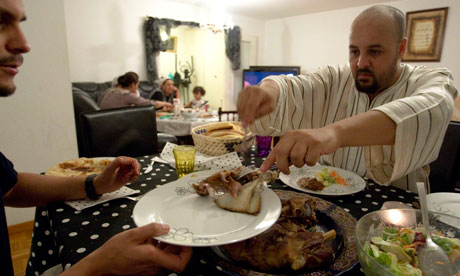

It has always been seen as a minority taste, dominated by specialist companies and independent retailers and largely neglected by gourmet restaurants.
But now the halal food market is seeing a surge of interest from mainstream producers and top chefs who are discovering a new market among young, middle class Muslims.
Sales of organic halal meat are up during the holy month of Ramadan, as Muslims prepare to mark the end of fasting with the festival of Eid al-Fitr this weekend.
Eid, "festivity" in Arabic, is typically celebrated with friends, family and good food, with many Muslims cooking a feast to mark the end of a month of abstinence from food and drink during daylight hours.
Upmarket restaurants have begun offering banquets complete with non-alcoholic cocktails to celebrate the end of abstinence and Harrods has introduced a range of halal gift confectionery to coincide with Eid.
There are an estimated 2.6 million Muslims in Britain, representing just over 3% of the population, but their appetite for meat outstrips that of the general population.
The market for halal fresh meat is estimated at £400m, equivalent to 11% of meat sales, according to Mintel.
Fast food chains such as KFC, McDonald's and Domino's Pizza are all working on trials offering halal meat, but options for upmarket dining have traditionally been more limited. That has now begun to change.
Zaika, a stylish Indian restaurant in Kensington, central London, frequented by well-known names including Formula One racing driver Jenson Button and comedian Ruby Wax, has launched a range of alcohol-free cocktails and has a wide variety of halal dishes on its menu.
Head chef Sanjay Dwivedi said: "It's been really busy during Ramadan and we've had so many young British Muslims coming in, some of them breaking their fast here or coming in later on to eat.
"They're all young, professional and moneyed and all quite trendy – they've got disposable incomes to go out and have really great food, and they know they can get halal meat here."
Awana, a Malaysian restaurant in Chelsea, has been running a Ramadan feast menu all month, catering for the evening meal when the daily fast is broken.
And Benares, a Michelin-starred restaurant in Mayfair headed by chef Atul Kochhar, serves several halal dishes, including pan-fried chicken breast, fennel infused Kentish lamb chops and marinated free range spring chicken.
Bord'Eaux, a French restaurant at the five-star Grosvenor House hotel on Park Lane, also offers halal chicken and lamb dishes.
"We don't advertise our menu as halal because some of our sauces contain wine, but if a customer wanted us to amend a dish and have a halal meal, we would happily accommodate them," said restaurant manager Raoul de Souza.
The trend extends to home cooking too. At Abraham Natural Produce, a mail order halal meat business, orders have increased by 40% during Ramadan as families have been planning ahead for their Eid menus.
Duck, beef and guinea fowl have been particularly popular for customers who want a British-style roast dinner.
Sarah Carr and her husband Ali run the business, which is based in Devon.
She said: "There's a growing awareness about animal welfare and ethical produce among all consumers, including Muslims.
"A lot of our clients tend to be younger Muslim professionals who have got into organic food either because they're foodies who watch Jamie Oliver and Hugh Fearnley-Whittingstall, or because they feel strongly about the ethical organic movement.
"These guys want to be able to sit down to a nice organic Sunday roast, and get cuts of meat they can't normally get in your average halal butcher."
Abraham Natural Produce has also supplied Fearnley-Whittingstall's restaurant, River Cottage, in Axminster, Devon, with halal organic cuts.
A spokesman for River Cottage said: "We've used their halal goat meat because of the fantastic quality.
"We believe everyone should have access to free range and organic produce and [it's important] that it comes from as local a producer as possible in season."
Harrods' gift confectionery, made by the Chocolate Factory, includes boxes of sugar coated fruit pastilles and raspberry and blackberry fruit-flavoured gums, made using halal gelatin.
Last year, the emporium launched a range of halal Belgian chocolates for Ramadan.


The NCSCR study observes that during this month Egyptians spend 66.5 per cent more on meat and poultry, 63 per cent more on sweets, and 25 per cent more on nuts and nibbles, and they host 23 per cent more banquets and dinner parties. The study further notes that at least 60 per cent of food on an average Egyptian family table, and more than 75 per cent of food in a banquet, goes to waste, which is to say tossed into the rubbish bin, during this month.
According to statistics from the National Census Centre, in the first week of Ramadan Egyptians consume 2.3 billion loaves of bread, 10,000 tonnes of fuul, 40 million chickens, 200 per cent more yoghurt and ghee, and some LE9 million worth of dried fruits, which accounts for 35 per cent of the annual trade in this festive staple. Across Egypt's 28 governorates, the National Natural Gas Authority has to pump out 20 per cent more natural gas, and the same applies to water. In addition, the peak hours for electricity consumption rise to between four and five hours, up from two to three hours per night the rest of the year. Much of this can be chalked up to Ramadan lighting decorations and, specifically, illegal taps into the grid in order to feed the decorations hoisted up in alleyways or even large squares.
Then there are the medical studies that indicate that the general state of public health declines during this month. In spite of the fact that there are only two meals a night during Ramadan, the Iftar at sunset and the Sohour before sunrise, medical authorities report higher rates of diabetes and cardiovascular illnesses due to overindulgence in fats and sweets. Some medical statistics also point to an increased consumption of over- the-counter medications related to digestive disorders, from stomach ulcers to colitis.
If the above facts and figures tell us anything it is that over-consumption during Ramadan drains the family budget, strains the national economy (due to the rise in food imports, particularly of dried fruits and nuts from Turkey, Syria and India), depletes Egyptians' savings and ruins their health. To compound matters, Ramadan, this year, coincides with the beginning of school, putting an additional strain on the Egyptian family budget, especially that of limited income families. Many of these are certain to find themselves encumbered by debt after the month draws to a close, largely due to careless spending.
The media offers a second type of testimony to the way we have come to celebrate Ramadan. One only has to open the several pages of TV guides in one's daily newspaper to appreciate the vast numbers of made-for- Ramadan TV serials, comedy programmes, celebrity talk shows, not to mention the phone-in contests and games that are aired throughout this month. The Egyptian television audience has a choice between more than 40 Egyptian or Arab serials broadcast over satellite networks. There are enough serials, alone, to take the viewer twice around the clock within a single day; enough to indicate beyond a doubt that Ramadan has become a month dedicated solely to entertainment and amusement. Evidently some quarters have begun to plead for a reduction in the numbers of programmes especially produced for television and the radio for this month because such is the glut that some producers have found it extremely difficult to find scheduling for their products during prime time. This applies in particular to the production sector of the National Radio and Television Broadcasting Company, the Cairo Company for Audio- Visual Production, and other such public companies that do not work jointly with private sector firms. From a practical and economic standpoint, all that time spent in front of the television until the early morning hours obviously diminishes one's competence and productivity at work during the daytime in Ramadan.
Which brings us to the third feature of the way we celebrate this month. So little value is given to work during this month, at least in the various government departments and agencies, that one might think that a whole class of civil servants, regardless of rank, regard Ramadan as the month of licensed indolence. Employees report to work late and/or sign out early on the grounds of their weariness due to fasting, and whoever dares object is treated to the growl, "Don't ruin my fast!" The labourer, engineer or physician who is diligent and conscientious at work is many times better than the man who prays, fasts and recites his Quran without putting their meanings into practice. This is precisely what the mufti of Al-Azhar, Sheikh Mohamed Hussein Tantawi, meant when he cautioned government employees against using fasting, prayer or reading the Quran as a pretext for not doing their jobs and hampering the welfare of the people.
A fourth phenomenon is the proliferation of mawaed al-rahman -- the banquet tables for the poor that are sponsored by MPs, business magnates, cinema celebrities and sports stars. The global economic downturn has not hampered the spread of these tables, which feed some three million people but which, at an estimated cost of around LE3 billion, have turned into something that blends ostentatious piety with status exhibitionism and politicking, as opposed to morally inspired charity. Recently the governor of Alexandria called for the abolishment of the mawaed al-rahman so that the money spent on them could actually be channelled to help the poor and the needy. Equally perturbed by the phenomenon, former mufti Nasr Farid Wasil said, "There is nothing wrong with the mawaed al-rahman per se, from the point of view of Sharia law. What is wrong is the extravagance that is lavished on them. We hear now of 'five-star' tables, when all that a Muslim should need to break his fast is some dates or a glass of juice and a little food."
In other words, instead of serving as a means to strengthen social cohesion the banquet tables have become an excuse for conspicuous spending.
From Saudi Gazette:

