Showing posts with label Inter-fatith intiative. Show all posts

Wednesday, 2 March 2022

To achieve peace is not easy........


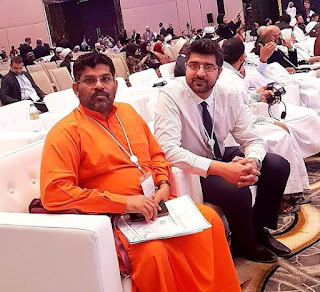
Whilst I was in Abu Dhabi for an International peace conference organised by Shaykh Abdallah Bin Bayyah and Shaykh Hamza Yusuf, I met this Hindu religious leader from India. He told me that once during Ramadan he had slept in his local Mosque in order to reach out and show solidarity with the Muslim community against a rise in Islamophobia attacks, where Muslims had been attacked and Mosques vandalised. He told me that months later his temple was burnt down by extremists claiming to be Hindu, because he had displayed a public act of support for the Muslim community. 


I asked him, despite receiving death threats and intimidation, what kept him strong and focused, knowing that he has a family to look after. His reply was:


"To achieve peace is not easy, and you have to make immense personal sacrifices. I will continue to support Muslims. If we sincerely care for people, and want to our communities thrive in respect of each other, then we have to be courageous by firefighting evil with goodness. This is the only way to defeat spiritual ugliness."

From FB page of Nadeem Ashfaq

Tuesday, 7 June 2016

Why a Christian Can View Muhammad as a Prophet

This Christian brother is a great friend to Muslims and I find him very fascinating indeed.:)
Basically, me admiring Prophet Muhammad isn’t “enough” for Muslims; in their eyes, I must take a few concrete steps towards Islam to be fully recognized as a “true believer.” Otherwise, I’m just a weirdo Christian who respects Muhammad, but doesn’t recognize him as a “the man.” Christians, on the other hand, have called me “pseudo Catholic” and “infidel” for my positive writings about Muhammad. For these Islamophobes, I’m quite simply a heretic. There’s no way around it. Perhaps my work is irritating to Muslims and Christians because I’m pushing a few traditional boundaries and making people question the very heart of their religious traditions and identities.
Here’s the main issue according to popular narratives: Muslims must recognize Jesus as a prophet of God, as laid out explicitly in the Qur’an. Muslims aren’t at risk of anything when they say “I believe in Jesus.” However, if we switched the situation (“I’m a Christian. I believe in Muhammad as a prophet”), people might start to question my credibility as a self-professed Christian. People might say, “Jesus is the only way. You’ve turned your back on God. You’re no longer Christian.”
I’m writing this piece to explain why I disagree with the idea that Christians can’t recognize Muhammad as a prophet. Really, what is in question here is the definition of “prophet.” “Prophet” can be defined as “a person regarded as an inspired teacher or proclaimer of the will of God.” Outside of the dictionary, I’ve always understood “prophet” to mean a messenger of a Higher Power who works on earth to bring justice and peace to humanity.
Full article

Tuesday, 12 May 2015

Why I, a Christian mother of a Muslim daughter, fear our nation’s Islamophobia

 
People stare as we tell our daughter Alana goodbye at the John Wayne Airport in California. Alana is a Muslim, and her head scarf turns heads every time.
Alana laughs to lighten the moment. “Oh, I hate airports,” she whispers to me. “As soon as I get on a plane, I know what people are saying, “Oh, God. A Muslim!”
The day before in the Nashville Airport, she got a full patdown by a TSA agent who asked to check her makeup bag, then said it tested positive for explosives.
“Explosives?” she asked.
Her old tote bag, an Eddie Bauer standby, was filled with a haul of new MAC cosmetics she’d recently purchased. Lipstick alert?
“He even swabbed my hands,” Alana says, still trying to laugh.
But her eyes look wounded, so I hurt for her and for the 1 billion-plus Muslims in the world who do not carry explosives in their makeup bags and never will.

Thursday, 30 October 2014

When Islam was at its strongest, it was also at its most open-minded.

                      
Ours is the oldest religion in the world,” said the Mandaean high priest to me in 2006, when we met during my diplomatic posting to Baghdad. He did indeed turn out to be the religious leader of an ancient people whose traditions go back to third-century Babylonia; he was also, for me, the man who opened a door to an Aladdin’s Cave of forgotten faiths.
Since then, I have witnessed on a mountaintop in the West Bank a sacrifice of lambs, done by Samaritan priests in precise observance of the Book of Exodus. I discussed Greek philosophy with Druze elders, who regard themselves as a branch of Islam but believe in reincarnation. I searched for the Zoroastrians of Iran, whose founder Zarathustra was among the first to teach (perhaps three millennia ago) that our fate after death might result from the good or evil that we do in our lifetimes. I encountered the Church of the East, which sent the first Christian missionaries to China in the seventh century and once, from its base in Iraq, covered a larger span of the earth than the Pope in Rome or the Patriarch in Constantinople.
These religions have survived fourteen centuries of Islamic rule, and their survival shows not only their own tenacity but also the potential for tolerance within Islam. Now, though, they are vanishing faster than ever before.
The brutal terrorist group called the “Islamic State,” which the U.S. and its allies are now fighting in Iraq, burst onto the front pages in August with a massacre of a little-known people called the Yazidis. The Yazidis are an extraordinary people, who have preserved traditions dating back to the time of ancient Assyria and mixed them with ideas that emerged from the most radical and imaginative of Muslim thinkers. They have faced, by their own tradition, 72 persecutions. That number does not include the Islamic State’s campaign of rape and murder or, in 2007, the world’s second worst terrorist attack, which killed nearly eight hundred Yazidis at Qahtaniyah near Mosul.
When I went back to see the Yazidis in northern Iraq in August, it was like an immersion in a sea of misery. Stranded in tents and dependent on charity, Yazidi refugees saw no future for themselves in Iraq and asked only for asylum in the West. They want to join the 70% of Iraq’s Christians who have already left. As for the Mandaeans, almost all have now sought refuge in Europe, Canada and Australia.
Nor is it only war-ravaged Iraq from which the minorities are fleeing. I could hardly find Zoroastrians in the great cities of Iran, such as Shiraz and Esfahan; instead, I found their fire-temple in north London. I discovered that tens of thousands of Coptic Christians, who keep the language of ancient Egypt alive in their liturgies, now live in the suburbs of Detroit along with more than 100,000 Iraqi Christians.
What amazed me, though, about these religions was that they had survived into the modern era at all. Imagine discovering some island off the coast of Ireland where the Druids still held sway: meeting the Mandaean high priest in Baghdad was similarly a throwback to the distant past. How can a religion conceived in the era of paganism still exist today, after 1400 years of Islam? The answers teach lessons about Islam — and about ourselves.
First, they show the importance of religion. A warped form of religion is what motivated the Islamic State to slaughter the Yazidis. It is also however what helped the Yazidis to survive over the centuries and keep their traditions and their identity. Religion can be a great source of division, but that is intimately linked to its power to gather people and unify them.
Second, when minorities leave, countries are diminished. Islam was the religion of a great world empire, so prestigious that “Islamic State” wants to steal its name: the Caliphate. Islamic State’s brutal and narrow-minded imitation is quite different from the original. The first Caliphs had Christians among their closest counselors; later Caliphs used Jewish astronomers and pagan mathematicians to turn Baghdad into a center of world learning.
When Islam was at its strongest, it was also at its most open-minded. The West’s diversity and its prosperity have similarly gone hand in hand. It is a poor outlook for the Middle East if loses its ancient minorities.

Tuesday, 26 August 2014

Can Muslims be friends with Jews and Christians?


O YOU who have attained to faith! Do not take the Jews and the Christians for your allies: they are but allies of one another and whoever of you allies himself 
 with them becomes, verily, one of them; behold, God does not guide people who are unjust. (Quran 5:51)
This verse is often quoted to show that Islam is intolerant.
Quran is a complete book of guidance and while studying various issues it should be kept in mind that a particular issue may be discussed over several chapters or several verses in the same chapter. A complete understanding can only be achieved by understanding the whole issue as presented over all the verses and chapters and not by looking at only part of the Quran. God specifically warns us against doing just that, upholding part of the Quran while disregarding the rest.

.. Then is it only a part of the Book that ye believe in, and do you reject the rest? but what is the reward for those among you who behave like this but disgrace in this life? - and on the Day of Judgment they shall be consigned to the most grievous penalty. For God is not unmindful of what ye do. (Quran 2:85)
To understand the issue of befriending the Jews, Christians or people of any other faith, we have to study all the concerned verses from the Quran collectively.

Let us look at some other verses about this issue. The following two verses regulate relations with any people, regardless of faith:

As for such [of the unbelievers] as do not fight against you on account of [your] faith, and neither drive you forth from your homelands, God does not forbid you to show them kindness and to behave towards them with full equity: for, verily, God loves those who act equitably. (Quran 60:8)
God only forbids you to turn in friendship towards such as fight against you because of [your] faith, and drive you forth from your homelands, or aid [others] in driving you forth: and as for those [from among you] who turn towards them in friendship; it is they, they who are truly wrongdoers! (Quran 60:9)
From the above verses, we learn that we are only discouraged from befriending those who fight Muslims because of their religion. Now let's go back to the verse immediately after 5:51, to see if it sheds some further light on the issue.

And yet you can not see how those in whose hearts there is disease vie with one another for their good will (the hostile Jews and Christians), saying [to themselves], "We do fear lest a change of fortune bring us disaster." But God may well bring about good fortune [for the believers] or any [other] event of His own devising, whereupon those [waverers] will be smitten with remorse for the thoughts which they had secretly harboured within themselves-  (Quran 5:52)
During the time of the Prophet when the Jews and Christians were in open conflict with the Muslims, there were some Muslims who were more concerned about maintaining there alliances with the Jews and Christians at the expense of the Muslim community. The above verse is referring to such situations where Muslims with doubts in their hearts will ally themselves with the enemy.

Chapter 5 Verse 57 of the Quran makes it clear again, who are not to be taken as friends; O you who believe! take not for friends and protectors those who take your religion for a mockery or sport,- whether among those who received the Scripture before you, or among those who reject Faith; but remain conscious of God, if you are (truly) believers. (Quran 5:57)

God teaches us throughout the Quran that there are righteous Jews and Christians. As such there is no prohibition for Muslims to be friends with Jews, Christians or people of any other faith who are of good character.

Quranic verses referring to the righteous Jews and Christians:
Of the people of Moses there is a section who guide and do justice in the light of truth. (Quran 7:159)
And We caused Jesus, the son of Mary, to follow in the footsteps of those (earlier prophets), confirming the truth of whatever there still remained of the Torah; and We sent him the Gospel, wherein there was guidance and light, confirming the truth of whatever there still remained of the Torah, and as a guidance and admonition unto the God-conscious. (Quran 5:46)

Verily, those who have attained to faith [in this divine writ], as well as those who follow the Jewish faith, and the Christians, and the Sabians - all who believe in God and the Last Day and do righteous deeds-shall have their reward with their Sustainer; and no fear need they have, and neither shall they grieve. (Quran 2:62)

Not all of them are alike: Of the People of the Book are a portion that stand (For the right): They rehearse the Signs of God all night long, and they prostrate themselves in adoration. They believe in God and the Last Day; they enjoin what is right, and forbid what is wrong; and they hasten (in emulation) in (all) good works: They are in the ranks of the righteous. (Quran 3:113-114)
And there are, certainly, among the People of the Book, those who believe in God, in the revelation to you, and in the revelation to them, bowing in humility to God. They will not sell the Signs of God for a miserable gain! For them is a reward with their Lord, and God is swift in account. (Quran 3:199)
The following verse from the Quran capsulates this issue:
O mankind! We created you from a single (pair) of a male and a female, and made you into nations and tribes, that you may know each other (not that you may despise (each other). Verily the most honored of you in the sight of God is (he who is) the most righteous of you. And God has full knowledge and is well acquainted (with all things). (Quran 49:13)

Thursday, 20 February 2014

MUSLIMS, OUR NATURAL ALLIES


I am a Catholic. My Church teaches me to esteem our Muslim friends and to work with them in the cause of promoting justice and moral values. I am happy to stand with them in defense of what is right and good. And so I stand with the young woman in the above video in defense of modesty, chastity, and piety, just as I stand with Muslims like my dear friends Shaykh Hamza Yusuf and Dr. Suzy Ismail against the killing of unborn children and the evil of pornography, and with my equally dear friend Asma Uddin of the Becket Fund in defense of religious freedom. In the great document Nostra Aetate, we Catholics are taught the following by the fathers of the Second Vatican Council:


The Church has also a high regard for the Muslims. They worship God, who is one, living and subsistent, merciful and almighty, the Creator of heaven and earth, who has also spoken to men. They strive to submit themselves without reserve to the decrees of God, just as Abraham submitted himself to God’s plan, to whose faith Muslims link their own. Although not acknowledging Jesus as God, they revere him as a prophet; his virgin Mother they also honor, and even at times devoutly invoke. Further, they await the Day of Judgment and the reward of God following the resurrection of the dead. For this reason they highly esteem an upright life and worship God, especially by way of prayer, almsgiving, and fasting.

Over the centuries many quarrels and dissensions have arisen between Christians and Muslims. The sacred Council now pleads with all to forget the past, and urges that a sincere effort be made to achieve mutual understanding; for the benefit of all men, let them together preserve and promote peace, liberty, social justice and moral values.

Let us heed this teaching. Let us, Muslims and Christians alike, forget past quarrels and stand together for righteousness, justice, and the dignity of all. Let those of us who are Christians reject the untrue and unjust identification of all Muslims with those evildoers who commit acts of terror and murder in the name of Islam. Let us be mindful that it is not our Muslim fellow citizens who have undermined public morality, assaulted our religious liberty, and attempted to force us to comply with their ideology on pain of being reduced to the status of second-class citizens. Let all of us—Christians, Jews, Muslims, and people of other faiths who “esteem an upright life” and seek truly to honor God and do His will—embrace each other, seeking “mutual understanding for the benefit of all men [and working] together to preserve and promote peace, liberty, justice, and moral values.”
Through the great work being done by my friend Jennifer Bryson—who is a devout Christian and a great American patriot who spent two years as an interrogator at Guantanamo—I have met hundreds of religiously observant Muslims over the past several years and many are now my close friends. They are among the finest people I know. Like faithful Christians and Jews, they seek to honor God and do His will. They work, as we do, to inculcate in their children the virtues of honesty, integrity, self-respect and respect for others, hard work, courage, modesty, chastity, and self-control. They do not want to send their sons off to wars. They do not want their children to be suicide bombers. They do not want to impose Islam on those who do not freely embrace it. They thank God for the freedom they enjoy in the United States and they are well aware of its absence in the homelands of many of those who are immigrants. It is not right for us to make them feel unwelcome or to suggest that their faith disables them from being loyal Americans. It is unjust to stir up fear that they seek to take away our rights or to make them afraid that we seek to take away theirs. And it is foolish to drive them into the arms of the political left when their piety and moral convictions make them natural allies of social conservatives. (A majority of American Muslims voted for George W. Bush in the 2000 election. A majority of the general voting population did not.)
I admire Muslim women and all women who practice the virtue of modesty, whether they choose to cover their hair or not. There are many ways to honor modesty and practices vary culturally in perfectly legitimate ways. Men and women are called to serve each other in various ways, and women who refuse to pornify themselves, especially in the face of strong cultural pressures and incentives to do so, honor themselves and others of their sex while also honoring those of us of the opposite sex. They uphold their own dignity and the dignity of their fellow human beings, male and female alike.

I have no doubt that in certain cultures, including some Muslim cultures, the covering of women is taken to an extreme and reflects a very real subjugation, just as in sectors of western culture, the objectification of women (including the sexualization of children at younger and younger ages) by cultural pressures to pornify reflects a very real (though less direct and obvious) subjugation. But, of course, we are in the happy position of not having to choose between the ideology of the Ayatollah Ruhollah Khomeini and that of Hugh Hefner.

Of course, defenders of pornification claim that they are “liberating women” and “celebrating female beauty.” The liberation claim is the very reverse of the truth. As for “celebrating female beauty,” let me ask you this: Is there an actress in all of Hollywood who when appearing at one of these absurd awards shows dressed in a see-through gown, bra-less and wearing a thong, can compare with the beautiful young Muslim woman in the video I posted? I submit that there is none. Oh, yes, to be sure, the actress will appeal to something in her male viewers. (I’m a man.Take it from me.) But it will not be their sense or appreciation of beauty. It will be something much lower and brutely appetitive. Their experience will be one in which who she actually is as a person is utterly submerged. The men viewing her will not be drawn in to wonder about her thoughts and feelings, her experiences of joy and sorrow, her strengths and vulnerabilities—the things that actually make her the unique person she is. Their experience will, quite literally, be an experience of de-personalized desire—the very definition of lust.

Source