Showing posts with label Denial. Show all posts

Thursday, 17 May 2018

How India's institutions are failing Muslims


Denial is a disease :(
In January, an eight-year-old girl was abducted, sexually assaulted and murdered in the Kathua district of Jammu and Kashmir. The girl was from the Bakarwal Muslim nomadic community. The eight men accused of participating in her abduction, assault and murder, on the other hand, are Hindus. The primary accused is a retired revenue official, while one of the others is a police officer.
When the girl's body was discovered near a temple in the forest, almost a week after her disappearance, Bakarwals demanded a special inquiry. The court-monitored investigation revealed that her abduction, rape and murder were purposeful and preplanned. It indicated that the attack on the girl aimed to scare the Bakarwal community away from Kathua.
Today, many people from the Hindu community, against all evidence, seems to be convinced that this crime could not have been committed by Hindus. Instead, they allege that the child must have been killed by the Rohingya or the Bakarwals themselves. They claim the entire case is a Muslim-Kashmiri conspiracy aiming to undermine the Hindus. 

What started as a demand for a probe by a higher impartial agency has now taken a definitive anti-Muslim turn, with the local Hindu population outright denying the possibility of Hindus being involved in the crime. 
But these anti-Muslim sentiments are not only being promoted by Kathua lawyers or members of the public. India's top institutions, and even the ruling party, seem to be following a similar agenda. 
After lawyers tried to stop the investigative team from filing the charge sheet against the men accused of the murder, the photos and videos of the agitation were shared widely in the media. Following a strong public reaction to the incident, the Supreme Court instructed the Bar Council of India (BCI) to send a fact-finding team to Kathua.
In their report to the top court, the BCI said the Kathua lawyers didn't prevent the special investigative team from filing the charge sheet and blamed the media for "misreporting". In fact, the team went beyond its mandate and even said the "demand" for a CBI probe into the crime "seems to be justified".
Many members of the ruling Bharatiya Janata Party (BJP) have also openly put their support behind the accused and criticised the investigation. Two BJP ministers in the state of Jammu and Kashmir addressed a rally in support of the accused, which caused a public outcry across India and both ministers were forced to resign from their roles. 
But after that all the BJP ministers resigned from the ministry. When new members from the party joined the government, it was pointed out that at least one of them was present in the rally opposing the probe. The new deputy chief minister insensitively said that the Kathua rape and murder was a minor incident and was being unnecessarily hyped.
Link

Sunday, 26 November 2017

Islamic schools in Pakistan plagued by sex abuse of children

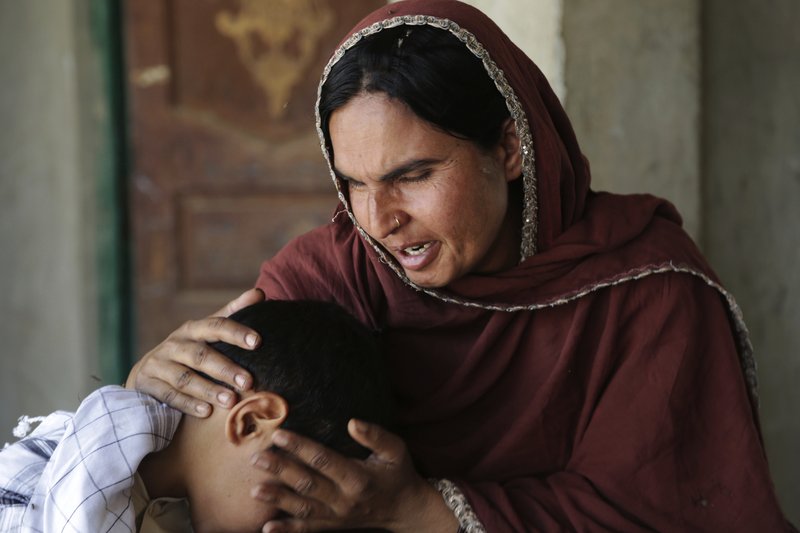
Kausar Parveen struggles through tears as she remembers the blood-soaked pants of her 9-year-old son, raped by a religious cleric. Each time she begins to speak, she stops, swallows hard, wipes her tears and begins again.

The boy had studied for a year at a nearby Islamic school in the town of Kehrore Pakka. In the blistering heat of late April, in the grimy two-room Islamic madrassa, he awoke one night to find his teacher lying beside him.
“I didn’t move. I was afraid,” he says.
The cleric lifted the boy’s long tunic-style shirt over his head, and then pulled down his baggy pants.

“I was crying. He was hurting me. He shoved my shirt in my mouth,” the boy says, using his scarf to show how the cleric tried to stifle his cries. He looks over at his mother.
“Did he touch you?’” He nods. “Did he hurt you when he touched you?” ″Yes,” he whispers.
“Did he rape you?” He buries his face in his scarf and nods yes.
Parveen reaches over and grabs her son, pulling him toward her, cradling his head in her lap.

Sexual abuse is a pervasive and longstanding problem at madrassas in Pakistan, an AP investigation has found, from the sunbaked mud villages deep in its rural areas to the heart of its teeming cities. But in a culture where clerics are powerful and sexual abuse is a taboo subject, it is seldom discussed or even acknowledged in public.
It is even more seldom prosecuted. Police are often paid off not to pursue justice against clerics, victims’ families say. And cases rarely make it past the courts, because Pakistan’s legal system allows the victim’s family to “forgive” the offender and accept what is often referred to as “blood money.”

The AP found hundreds of cases of sexual abuse by clerics reported in the past decade, and officials suspect there are many more within a far-reaching system that teaches at least 2 million children in Pakistan. The investigation was based on police documents and dozens of interviews with victims, relatives, former and current ministers, aid groups and religious officials.

The fear of clerics and the militant religious organizations that sometimes support them came through clearly. One senior official in a ministry tasked with registering these cases says many madrassas are “infested” with sexual abuse. The official asked to remain anonymous for fear of retribution; he has been a target of suicide attacks because of his hard position against militant groups.


Tuesday, 18 July 2017

Massacre of Muslims: A town still in denial

Once every year, the Mothers of Srebrenica host a ceremony to remember their fathers, sons, husbands and brothers who were hunted down and systematically murdered by Serbian forces on 11 July 1995. They were killed because they were Muslim.
This intensely moving event is held in the Potocari cemetery, where some of the 8,000 victims whose bodies have been found are buried. Many more are thought to remain undiscovered in the surrounding mountains.
The graveyard is opposite the United Nations base which was fatally abandoned by Dutch peacekeepers, a decision which gave the green light for the Srebenica genocide to take place.

Usually the mayor of Srebenica plays a major role in organising the ceremony. Not this year. Camil Durakovic, President of the Organising Committee and himself a former mayor, told us that "the mayor was not invited because he denies the genocide". 
Munira Subasic, president of the Mothers of Srebrenica, told us that "anybody who denies genocide is not welcome in the memorial centre".
Subasic, 67, lost her son Nermin and husband Hilmo in the genocide. She said: "In a town where genocide was committed, having a genocide denier as a mayor is unacceptable."
Her organisation speaks for an estimated 6,000 women who lost loved ones on 11 July 1995.

The denial of genocide

How can it be that Srebenica has elected a genocide denier just two decades after the deliberate, cold-blooded massacre of more than 8,000 Muslims in this once sleepy Bosnian town?
It is as if Buchenwald or Belsen had elected a Holocaust denier as mayor in the aftermath of World War Two.
The answer is grim. The massacre of Bosnian Muslims (so-called “Bosniaks”) in 1995 worked only too well.
Srebrenica is located in the Bosnian Republika Srpska, hard by the border with neighbouring Serbia. The Serbs ethnically cleansed the area – today a largely autonomous Serb majority statelet within Bosnia -  during the civil war, and Bosnian Muslims who return have not been made welcome.
Most of the town's former Muslim residents are either dead or have emigrated. Srebrenica is now controlled by Bosnian Serbs, many of whom refuse to accept that a genocide took place.
Nedzad Avdic, a survivor of the genocide, told us: "Our first child is starting at the local school. They are being taught that the genocide never happened.
“You turn on the TV and it is like the war never ended."
Source