Showing posts with label Germany. Show all posts

Wednesday, 26 February 2020

Germany shooting: chants of 'Nazis out' at vigils after gunman kills nine


Thousands of people have taken part in vigils across Germany after a gunman with apparent far-right beliefs killed nine people at a shisha bar and a cafe in the city of Hanau.

The suspect, a 43-year-old German identified as Tobias Rathjen, was found dead at his home after the rampage along with his 72-year-old mother in what appeared to be a murder-suicide.

Hundreds of people, many carrying candles or a white rose, gathered in silence in Hanau in the evening to show solidarity with the victims.

Large crowds also gathered in Frankfurt and at Berlin’s Brandenburg Gate, some carrying signs that read “Take racism personally” or “Never again!”, in scenes replicated across dozens of German cities.

The nine people killed at the two bars late Wednesday evening were aged between 21 and 44 and all had a “migrant background,” although some were German citizens, chief federal prosecutor Peter Frank said.

He added that evidence, including video footage and a “manifesto” found on the suspect’s website, showed Rathjen had “a very deeply racist attitude”.

Chancellor Angela Merkel condemned the “poison” of racism, as anger mixed with grief over the deadliest attack linked to Germany’s extreme right in recent months.

Relatives and friends of the victims gathered at the Arena bar on Thursday, an AFP reporter said, tearfully embracing one another.

“I couldn’t be any more upset,” said Inge Bank, 82, who lives near the bar. “We have to nip it in the bud if the Nazi party is coming back.

Steinmeier, who serves as a moral compass for the nation, condemned the shooter’s “brutal act of terror”. But he said he was heartened to see “thousands, maybe even tens of thousands” turning out across the country to honour the victims.

“We stand together, we want to live together and we show that over and over again. That is the strongest way to fight hatred,” he said, to the occasional shout of “Nazis out!” from the crowd.

Elsewhere, Frankfurt’s Eintracht football team held a minute’s silence ahead of its Europa League match against RB Salzburg.

As condemnation of the Hanau attack poured in, the co-leader of the far-right AfD party Joerg Meuthen stood out by saying the shootings were “neither right- nor left-wing terrorism” but the actions of “a madman”.

Politicians from across the political spectrum however accused the anti-Islam, anti-immigrant AfD of normalising hate speech and fomenting anti-foreigner sentiment in recent years.

German police have identified around 60 far-right adherents as “dangerous” individuals capable of carrying out a violent attack.

On Friday last week, they arrested 12 members of a German extreme right group believed to have been plotting “shocking” large-scale attacks on mosques, similar to the ones carried out in Christchurch in New Zealand last year.

Link

Monday, 27 January 2020

A Tale of Two Countries: While Germany still criminalizes the hijab, Sweden embraces it


Before telling the story of how differently Germany, my home country, and Sweden, a country I adore, treat Muslim women wearing the hijab, especially in the workplace, it is pertinent to provide the reader with some general background information regarding the demographic make up of these two EU members, along with some broad understanding of their very different takes on identity politics and lived multiculturalism.

1 in 4 people living in Germany today have what the country calls a “migrant background”, which in the UK is often known as BAME (Black Asian Minority Ethnic), or in Canada as belonging to a “visible minority.”

This relatively high number would technically classify Germany, a country of 82 million people, as a multicultural one. But unlike the UK or Canada, these immigrant Germans, whichever generation they belong to and no matter how long they have been in the country, have little political or social representation in the country of their residence which – despite its diverse demographic reality – is still exclusively run by whites, thus rendering the former virtually voiceless. All of this is in spite of the fact that Germany’s largest minority population, the Turks, having been in the country since the 1960s.

Even at the lowest levels of positions of power, be they in politics or education, the emergency services or local councils, law firms or insurance companies, the media or real estate firms, the lack of ethnic diversity and representation in Germany is shockingly outrageous. In 2018, Andrea Dernbach, one of the few progressive voices at Der Tagesspiegel, one of Germany’s leading centrist daily newspapers, wrote a piece titled “Diversity and Inclusion: Where Germany Is Still Too White”, revealing just how monochromatic German workplaces from classrooms to newsrooms really are. The skin color of choice? White, of course.

Germans are known and ridiculed for clapping applause when their passenger plane makes its landing on an airport tarmac, but I myself feel the need to clap whenever I see a black bus driver, a Turkish customs official, an Asian police officer or an Arab fireman in Germany because these sightings are so rare in my country it’s embarrassing. Can you believe that something so ludicrously boring as a black bus driver remains an exciting oddity in Germany, even in the supposedly oh so multicultural capital of Berlin?

Sverige: From emigrant nation to a nation of immigrants

Now take a look at Scandinavian Sweden on the other hand: today, the once overwhelmingly white country of currently 10 million people boasts large numbers of first, second and even third generation immigrant populations, such as Turks and Kurds, Somalis and – in recent years due to ongoing conflict – Syrians.

According to the government agency Statistics Sweden (SCB), at the turn of the 20th century Sweden’s foreign born population comprised a measly 0.7%. In 2010, this number was at 14.3%.

And a mere seven years later in 2017, the percentage of of inhabitants with a foreign background had risen to 24.1%, almost as high as in Germany. So what after the First World War had been a nation of net emigration is today a nation of net immigration, something that is clearly visible upon visiting any urban center in Sweden.

And while the number of Muslims in Sweden was estimated at 200,000 – 250,000 in 2000, according to Pew Research Center, that number had risen to over 810,000 in 2016. That is 8.1% of the population, an already higher percentage than in Germany which – as mentioned – has a much longer tradition of Muslim immigration, the majority from Turkey.

Unlike Germany, Sweden is known for it’s inclusive and holistic policies in everything from education to the environment, gender to health care; its globalist world view part and parcel of Sverige’s positive image within the international community of nations as a peace-loving and progressive country, thanks to avowed internationalists like former Prime Minister Olof Palme or former UN Secretary-General Dag Hammarskjöld (who both coincidentally met a violent death: the former murdered, allegedly by right-wing elements in the Swedish intelligence services as one theory goes, the latter having died in a mysterious plane crash, both cases remaining unsolved to this day).

Despite not being immune to the firebrand of right-wing populism and Islamophobia currently sweeping through the European “Union”, Sweden as part of the Nordic model of progressive economic and social policies remains a society still sufficiently steeped in social democratic values, whereas the former bastions of social democracy like France and Germany have ultimately fallen like dominoes to the relentless onslaught of the corporatocratic armies of neo-liberalism.

“Macronomics” are currently continuing to do in an already socially unequal France what Merkelism has already accomplished in Germany: exacerbate already dire social inequities even further, and thereby lay the groundwork for right-wing extremism to foot-soldier through to elected office, ultimately making immigrants – especially the most otherized of them all: Muslims – the scapegoat of choice.

I believe it is this combination of traditions (progressive domestic policies embedded in a postwar cosmopolitan mindset) that is responsible for Swedish children being fluent in English and the rapid and – unlike in Germany – utterly unagitated transition from an ethnically homogenous society to a nation of immigrants that consistently ranks in the top ten of the United Nations’ World Happiness Report.

Even their Muslims look way happier than our ones back home in Germany. Like veteran German politician Wolfgang Schäuble once said: “A society’s level of progress is measured by how at home its immigrants feel.”

And if there’s one issue where the fundamental divergence between progress-oriented, diversity- embracing, happy Sweden and reactionary, historically and cerebrally xenophobic Germans with their perpetual nagging and petty resentment towards life is at it’s most visible: it is that piece of cloth Muslim women from West to East wear, better known as the hijab, as the following anecdote will show.

As-salamu ‘aleikum in Arlanda
One winter evening about a year ago I arrived in the Swedish capital Stockholm on a flight from Doha, Qatar and was walking towards a deserted immigration hall at Arlanda airport when I looked at the cubicles for EU-citizens and couldn’t believe my eyes: one of the two the Swedish border police agents was black, a woman, and wearing a hijab — the female Muslim headwear — in the same dark blue as her uniform.

Being a born and bred German, thus hailing from a nation-state that until this day and despite the enshrined freedom of conscience in Article 4 of our Constitution bans people who wear religious headwear from becoming police officers or teachers, be they Sikh men or Muslim women, I was naturally caught by positive surprise. Had this been liberal, multicultural Canada, big whoop. But small and sheltered lily-white Sweden?

Still awestruck at this unparalleled level of inter-sectionality and representation, I stepped up to the agent (who looked Somali), handed her my passport, while she greeted me with a Swedish “Hej”, that traditional one-syllable greeting that in my unaccustomed ears always sounds so refreshingly upbeat and intimate whilst still maintaining professional cordiality, so unlike the merely colloquial and colorless English “Hey.” I replied with a friendly “Hi” and “As-salamu ‘aleikum” whereupon she in turn answered “Wa-’aleikumu s-salam.”

Unlike in Germany, where this scene might have raised eyebrows at the least and enmity at worst, her colleague in the adjacent booth, a blonde and blue-eyed cliché Swede who had definitely heard our exchange of salutations – as the arrival hall was totally deserted except for us approaching Business Class passengers, thus allowing sound to travel – couldn’t have cared less.

She just went about her job and smiled (something white German border patrol agents who make up the numeric majority of this federal police force rarely do, especially to non-whites, their subconscious Übermensch-mentality emanating from their stone-cold eyes and their menacing frown always reminding me of what Hannah Arendt meant by the “banality of evil”) amiably at the first approaching passenger.

After swiping my passport through the computer and it deciding that I was neither a threat to national security nor wanted by Interpol, I was handed back my travel document with a pleasant “thank you”, again something I have never had the honor to hear escape from a German federal agent’s mouth (they might say “Ok” or “Alles klar”, but never “Danke schön”), as if the passenger is the one providing the service and the officer the customer who is always right and therefore also has the legal right to be rude.

While walking to the exit I was so positively impressed by this short peek through the window of lived societal progressiveness, and at the same time so incensed at my own home country which is obstinately obstructive in all forward-looking matters, be it digitalization, e-mobility solutions, or religious inclusion, that I instantly logged into the airport-WiFi and took to social media and vented:

“Just landed in Stockholm from Doha. The Swedish border patrol agent was Somali, wore a hijab, and we greeted each other with a salam as if it were the most normal thing on earth. In the racist developing nation of Germany something like this would not be possible!”

That I was taken by surprise in the first place is a shocking testament to the current state of diversity politics in a culturally backward-looking Germany which still loves to debate circles around questions already made redundant by reality. White Germans love to ask things like “Is Germany an immigrant nation?” while 1/4 of the population – as I have mentioned above – has a migrant family history. Or “Does Islam belong to Germany” while out of a population of 82 million, Islam is practiced by roughly 5 million people in some form or another.

Other Western nation-states like the UK, Canada, and even idyllic Sweden, a country famous for many things, from Ikea to Ingmar Bergmann, Spotify to Zlatan Ibrahimović, but not exactly for it’s multiculturalism, ask similar questions. But the difference to Germany is that – despite rising Islamophobia and anti-immigrant bigotry in all these countries – they have answered them more or less in the affirmative (Britain admittedly rather begrudgingly as due to its colonial past, legal immigration from the outreaches of the former Empire has always had the feel of de-facto reparations for all the nefarious crimes committed).

And the driving force behind such affirmations has simply been a political will to acknowledge shifting demographic realities on the one hand and the corresponding realization on the other that cultural diversity in a nation-state context is a sustainable strength, not a weakness.

Germany’s cloth fetish
The relationship of white-majority Germany towards the hijab is best described as obsessive- compulsive disorder (OCD): No single issue will get my neo-atheist white compatriots – be they liberal or conservative, left-wing or far right – so riled up and their blood boiling with the same religious zeal that they fanatically oppose in Islamic-framed radicalism like that piece of the female Muslim headwear.

Not only does the hijab help white men (and self-loathing white women) to outsource their own misogynism when finger-pointing to it as demeaning to all women, thereby taking all agency away from the overwhelming majority who wear it out of their own free will, it also blatantly exposes the selectively Islamophobic nature of their anti-religious agitation: a male Jew wearing a kippah will not only not generate the same amount of outrage dispensed towards the hijab, but is furthermore perceived as someone that deserves special protection, unflinchingly granting him puppy license due to Germany’s genocide against the Jews.

This gives rise to an uncomfortable but legitimate question: will Muslims in Germany have to get holocausted first before getting to enjoy the minority protection they deserve? Like popular German recording artist Xavier Naidoo put it in a song of his: “Muslims are the new Jews.”

“Berlin trägt Kippa” (Berlin wears kippah) was the slogan of an organized protest last year against rising “anti-Semitism” in Germany’s capital city (in Germany, like in the U.S., anti-Semitism is routinely conflated with legitimate criticism of Israel, the former systematically employed to discredit the latter), but no one would dream of showing solidarity with Muslim women who face racist microaggressions on a daily basis by organizing a public demonstration under the banner “Berlin trägt Hijab.”

Interestingly enough, this asymmetry in solidarity comes despite the fact that the number of women in Germany who wear the hijab exceeds the tiny demographic of Jewish men sporting a kippah by far.

Furthermore, Germany’s hegemonic hijab discourse is so hypocritical that the anti-hijabistas are not even sure if they oppose the cloth for its alleged misogynism or because it violates the core tenet of a secular society, the division of state and church. Depending on what is convenient, they jump back and forth between both arguments like kids playing hopscotch.

Returning to Sweden: as already mentioned, even this Nordic nation (nordic still commonly being associated with whiteness) has seen a steadfast and utterly nonchalant progression from an overwhelmingly white to an ethnically diverse society, especially in the urban conglomerations of Stockholm, Göteborg and Malmö.

Even the 2018 electoral win of the misleadingly and ineptly named “Sweden Democrats” and their populist anti-immigrant, right-wing agenda has not put a stop to Sweden’s living up to its reputation as one of the most tolerant societies in the world: in the same general election which saw the Sverigedemokraterna secure a whopping and historic third place, Somali-born Leila Ali Elmi of the Green Party became Sweden’s first member of parliament to wear a hijab.

In Germany, many prominent members of its Green Party still view the hijab as a symbol of blanket oppression of women and on occasion will engage in liberal racist statements against Muslims that are not very far from the smack-in-your-face racist ones of the right-wing AfD party.

Sverige today is home to the third largest Somali diaspora in the Western world (after the U.S. and the UK, even before Canada with its comparatively hyperliberal immigration policies). And despite rising Islamophobic antipathy in Swedish society and racial profiling of non-white and Muslim male youths by an overwhelmingly white police force, these new Swedes don’t have to hide their religiosity.

Since 2011, when 26-year-old Donna Eljammal became Sweden’s first hijab wearing police recruit, Swedish Muslim women wishing to wear this sartorial article of their faith don’t have to choose between their religion and their career anymore. They can go on to serve their country as police officers and border patrol agents, without any infringements on the expression of their religious beliefs, as I myself witnessed first-hand upon meeting the hijab-wearing uniformed black woman who checked my passport at Arlanda airport’s immigration.

To my knowledge, following the inclusive policies of the Swedish police force, female Muslim firefighters and military personnel will also be allowed to wear the hijab as part of their uniform in the near future.

Iman Aldebe, the Swedish designer responsible for the police hijab I saw at Arlanda, and whose modern interpretations of traditional religious headwear are already part of the workwear of Swedish- Muslim nurses and paramedics, commented on the motivation of Muslim women wanting to wear the hijab at the workplace by saying the following:

“For these women, it’s only a garment. You put it on for religious reasons, but it’s not like you’re walking around and preaching. You just want to be like any other woman.”

In 2015, Swedish retailer H&M featured Aldebe’s styles in its fall catalogue. It doesn’t get any more inclusive than this, does it?

…but is still not allowed to be quintessentially German
Amid all these progressive developments in Sweden, one question begs to be answered: what is wrong with Germany? Why is it proudly regressing when it comes to the politics of ethnic and religious inclusion rather than progressing like Sweden?

Germany, the largest economy in Europe, political heavyweight within the EU next to France (another country that likes to play down the xenophobic fabric of its white-majority society while passionately subscribing to the identity politics of ethnic exclusion where the value of black, Arab and Muslim life – as in Germany – is determined by your success at FIFA football World Cups), seems to enjoy going around in circles on the carousel of political and public discourse when it comes to the two Is of immigration and Islam.

Tautological nonsense like “Islam is not a part of Germany, but Muslims are”, coming from various senior conservative politicians over the last decade, or tilting at the windmills of Islam by criminalizing the hijab or repeatedly committing the folly of trying to integrate immigrants without including them, thus reinforcing the stereotype of the arrogant, narcissistic and megalomanic German with his historically destructive delusions of grandeur and “my way or the highway”- approach to everything of import, are all irrefutable evidence of Germany’s Peter Pan-like unwillingness to grow up and shed its infantile and pathological white supremacist ways.

With regards to the hijab: in 2015 the Bundesverfassungsgericht in Karlsruhe, Germany’s highest court tasked with protecting the German constitution, ruled the general hijab-ban in place for teachers in public schools to be unconstitutional. In 2018, Berlin’s highest labor court declared Berlin’s misleading “Neutrality Law”, which prohibits religious clothing in civil service jobs like teaching, police, etc. but is de-facto a hijab ban, to be diametrically opposed to the ruling of the federal judges, implying the need for it to be scrapped.

It is 2020 now, and the situation on the ground hasn’t changed: despite landmark legal rulings from the highest courts in the land who have ultimate appellate jurisdiction, Germany in general and it’s largest and most cosmopolitan city Berlin in particular keep failing to implement these rulings and continue to bar Muslim women who wear the hijab from becoming teachers and judges, police officers and paramedics, border patrol agents and firefighters.

It will be interesting to see how long and far Germany (and countries like France with its burkini ban at French beaches and French retailer Decathlon’s banning of its sports hijab due to public white outrage or Austria with it’s hijab-ban in elementary schools), will be able to tread this path of societal regression, futilely trying to hold on to a provincialist past that – thank God – is no more.

Luckily, the majority of Swedes have understood how human development ideally works: like a perpetuum mobile of constant re-examination and self-improvement, rather than an eternal state of civilizational catharsis in which one is not only immobilized by one’s own backwardness, but also astonishingly proud of it.

Link

Tuesday, 22 October 2019

From being bullied to racially abused


From a young age society taught us to separate different people rather than make us feel as a unified group. Separate yourself from others, do not trust anyone other than yourself, and make sure you use everyone to you personal gain; there is no “common good”.
If you were blond and blue eyed, you were automatically one of the ‘elite’. We immigrants were always considered as scum, of no worth and no use. One of the biggest issues was that teachers were technically able to racially abuse students with no backlash. An example was that when teachers would want to organise a class activity, they would split the classroom in two. I know what you are thinking: “down the middle right?”- no, not at all. They would split the classroom from Germans and non-Germans or “foreigners”.
It would break my heart as I remember vividly my best-friend was a German and he would ask “Sir, can I go to the other team with Hassan?” – “No, you are better than him.” I didn’t realise back then what it meant as I thought maybe he meant that he was academically better than me, even though my grades were always higher.
It was extremely difficult when the other ‘German’ students were encouraged to bully us as the ‘foreigners’. With table tennis, although my friends and I would get there first, we would be pushed and punched aside as they had a right over us, because we were not German enough. For God’s sake, I was born in Germany, I speak German better than Arabic, and all my friends are German. This was not the end of it though, what really made me mad and started to make me brush all the Germans with the same brush although it wasn’t right was the incident that my sister had to go through.
Imagine being 9 years old and in year 4, you start wearing the hijab proudly and can’t wait to show your friends as this is a sign of maturity. To be greeted to the worst fear at that time. So she starts wearing the hijab and goes to school, the day starts with an assembly. The deputy headteacher of the primary school calls you up and asks you to remove your hijab. She was shocked, yet still had the power in herself to stand up to that adult and refuses to do so. What happens then? The Deputy Headteacher forcibly rips off her headscarf in front of her friends, classmates, and year group.
The school calls my parent in for a meeting. They were greeted in a very disrespectful way. “Hello, what do you want?” my father replied: “You wanted to talk to me, not I to you. If it were up to me I would not speak to you.” When they realised that my father was able to not only speak German fluently but also was able to confront them comfortably, they began to look a bit uncomfortable. He started to ask why they physically abused her as they forcibly removed the hijab from her head. They tried to convince my father that she should not wear the hijab at that young age, as this could damage her character whereas the only thing that could damage her character at that time was their actions towards my sister.
She refused to go back to that school but eventually believed that her cause was very important and carried on wearing her hijab in school as my father threatened to go legal. We started to see something very encouraging, in that because my father and sister stood their ground and defended their belief, other young girls started to wear their hijab in school as well which showed that it only takes one small spark of courage to make a change in a community.
All in all, life was like a roller-coaster, with my ups and downs. I’ve learned from them, and they have shaped me into who I am today, and if it wasn’t for those experiences, I wouldn’t have gotten the chance to pursue my life dreams. My time in Germany shows that despite the hardships in life, it may well be the very thing that pushes you to appreciate life just a little bit more.

Monday, 1 May 2017

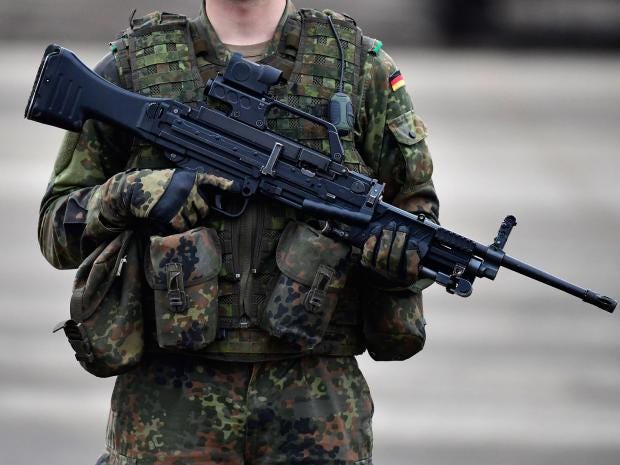
German soldier posing as a Syrian refugee arrested for planning 'false flag' terror attack

german-soldier.jpg
A German soldier found posing as a Syrian refugee has been arrested for allegedly planning a “false flag” shooting attack that would be blamed on asylum seekers.
The unidentified soldier was detained when he went to retrieve a loaded pistol he had hidden in a bathroom at Vienna International Airport.
The public prosecutor’s office in Frankfurt said the 28-year-old is suspected of planning a serious “state-threatening act of violence”, fraud and violating firearms laws.
The man’s suspected accomplice, a 24-year-old student, was arrested in Hammelburg for alleged involvement in the plot. 
Police have searched the homes of the two suspects as well as their friends and workplaces, with detectives seizing “extensive material” including mobile phones, laptops and documents.
Prosecutors said the soldier had no permission for the 7.65mm pistol stashed in Vienna, while illegal weapons were also found at his accomplice’s house. 
Both men remain in custody in Frankfurt as the probe continues.
The soldier was arrested days after prosecutors revealed that the man who orchestrated the Dortmund bus bombings had attempted to frame Isis to make money on shares.

Wednesday, 20 January 2016

‘No to Sexism, No to Racism’: Syrian refugees


The heinous attacks on women in Cologne cannot be condemned enough. More should have been done to prevent them and more must be done to bring perpetrators to justice. This is an expression of rape culture, of patriarchy, misogyny that exists in all cultures and all places. But here it is only being discussed because of the Arab or North African appearance of the attackers. Even the victims themselves are being ignored. 

The attacks are being exploited by anti-refugee/right-wing protesters to malign and stereotype all refugees. Organisations like Pegida say sex attacks were "in principle bad for the women, but good for us, because the people are being woken up." Indeed no one is more pleased with such a backlash against the refugees than Daesh themselves. It completely reaffirms their agenda and their attempts to alienate and polarize Muslims in Europe. 

Morever people like the Czech President Milos Zeman further assist Daesh by making statements like “The experience of western European countries which have ghettos and excluded localities shows that the integration of the Muslim community is practically impossible,” Ignoring the fact that there are many well integrated Muslim communities in Europe indeed European countries like Bosnia and Kosovo are Muslim!

Therefore is is imporant to not give in to the steretypes and to share news which also shows refugees in a postive light.

In Cologne, Syrians gathered with plaques condemning the attacks that took place in the city, and to thank the country for taking them in.

Refugees also gave out flowers to passers-by, and held signs saying: ‘We respect the values of German society’ and ‘We are all Cologne’. 

An American woman has told how she was rescued from being sexually assaulted on New Year’s Eve in Cologne by a group of Syrian refugees. She remains friends with one of her rescuers, a refugee who condemned the attackers saying they had “lost their minds” on drink and drugs.


Monday, 29 October 2012

Kristiane Backer: On the search for God

 
"As a journalist, as a communicator, I was itching to speak out, because a lot of times the media portrayed Islam so differently to this beautiful religion and how it really, truly is,” says Kristiane Backer on her sentiments in the years following her high-profile conversion to Islam.
Speaking to Today's Zaman, Backer speaks about her new book, Islamophobia in Europe, meeting Imran Khan and the journey which led her to the “beautiful values” of a religion which allows for her to look at the world differently.

Backer's journey began in 1995. Europe was shocked by the news that this well-known MTV presenter was converting to Islam. She had experienced the glitz and glamour of showbiz, rubbing shoulders with the likes of Bob Geldof, Mick Jagger, David Bowie and Annie Lenox; she had lived the so-called “high life,” hanging out with celebrities, being flown across continents, presenting MTV Video Music Awards (VMAs) and being invited to the most exclusive parties. Hers was a world that had no association with religion, far from any kind of spiritually.

However, at the height of her career, she met famous cricketer and current leader of Pakistan's political party Tehreek-e-Insaf (Movement for Justice) Imran Khan -- a relationship that changed the course of her life forever. Through her travels in Pakistan she began a personal quest in which she encountered a completely different world to the one she knew, a world which was dominated by a love of God.
Kristiane Backer's new book “From MTV to Mecca” -- or, as Bob Geldof prefers to say, “From Babe to Burqa” -- takes the reader on a journey of self-discovery. Through her travels from Pakistan to Bosnia, Hamburg to Saudi Arabia, LA to London, we follow Backer's quest for true freedom and true liberation. As she herself so beautifully writes: “The more I traveled on the path to God, the more I felt His blessings, and my faith grew into a strong, unshakeable tree. My heart had found another home.”

Can you give us a brief insight into your book “From MTV to Mecca”? Why did you write the book?
I wrote the book because there is a lot of Islamophobia in Europe, which I also experienced myself when in 1995 I became a Muslim. I was an award-winning presenter at the time, presenting shows on MTV; I had my own youth show in Germany, and when it came out that I was a Muslim I was sacked from my show, and with that pretty much my career on TV in Germany ended. For years agents have told me, “If you ever want to work on TV again, don't speak about Islam.” So I listened to their advice and I spent those years deepening my faith and learning about Islam, traveling, etc. But of course as a journalist, as a communicator, I was itching to speak out, because a lot of times the media portrayed Islam so differently to this beautiful religion and how it really, truly is. I wanted to speak out, and eventually I went on the Hajj when I was 40 years old, and that was reported very positively in the German press. A book agent came to me and asked me, “Would you like to write your story in a book?” and I thought, “Great!” My time had come to try and redress some prejudices, and try to take the reader by the hand and show how I dissolved the prejudices I initially had against Islam, and how I discovered the beautiful values of the religion and tried to practice some of them before I became a Muslim.
You had this glamorous job, a lifestyle envied by many people. What was it? What was lacking?
It was the connection to the divine, really, that was lacking. God was lacking in my life, to put it in a nutshell. Yes, I had everything a young person dreams of: partying, interviewing rock stars for a living, announcing videos, getting red carpet treatment wherever we were traveling with a team, but I was inwardly not truly satisfied.

How much about Islam did you know before you converted?
I was introduced to Islam in 1992, by none other than handsome sportsman Imran Khan, not an imam with a long beard. He was cricket captain at that time and just had won the World Cup, but I knew nothing about cricket, so he didn't mean anything to me. But he became my first teacher of Islam, so I studied for three years, I read a lot of books, I traveled to Pakistan many times, I asked scholars so many questions, as well as ordinary people in London and Pakistan. I studied for three years and then I converted, for myself, not for anybody else.

Tell us a bit about your experiences traveling around the Muslim world post your conversion. What were your initial reactions to the region? Did it differ greatly from your expectations and common Western conceptions?
Well, we don't have much of a conception; you don't hear much about Pakistan, except for negative news, so I loved it from the moment I got there. It's such a beautiful country with a very stunning landscape and mountains and lush green fields and deserts. People were very friendly and enormously generous, offering us their last bits and pieces, even in the poor mountainous areas… My trips put a lot of things in perspective and really made me think.
I was shuttling between the two worlds for a few years and really had key moments. In the West, time is money, and people don't have time for each other anymore because there are so many pressures. Also the sacred is completely lacking from people's lives here. Faith is pretty much marginalized, unfortunately, in the West, and with my book I am also trying to put faith back onto the map. So yes, in Pakistan God was everywhere, everybody did everything in the name of God, and also sacrificed themselves for others and for the sake of God, to please God.
You said that Imran Khan was the tool of God to make you convert. Could you explain what aspect of his belief influenced you the most?
It's not only one thing really. I was quite inspired by the way he built a charitable hospital in Lahore where the poor would be treated free of charge. And with an army of volunteers they worked day and night to raise the funds for the hospital, as a service to God in a way. So that was really impressive. In fact, he gave up his entire career to become a charity worker, to fulfill his promise to build this hospital, so that was quite amazing. It was really his whole philosophy, seeing the world through Muslim eyes, and I hadn't encountered that before. He had a slightly different view of the world, keeping the afterlife in mind for example, than people who don't have faith do. So for the first time I met somebody who so passionately believed in God and tried to better his own iman (faith) and study. And actually, as I had always liked philosophy, I was thrilled and I was captivated from the first moment. I started reading, looking into this.

In your book you mention the Naqshibandi [a Sufi spiritual order, or tariqa]. What was it about this tariqa that appealed to you? Do you still have connections to this Sufi order?
The Naqshibandi are a beautiful Sufi group, a beautiful tariqa. One of many I suppose, but predominantly based in Turkey, Iraq, Central Asia and so on. They are serious and their teachings are very profound and beautiful, and they're like some of the people I met. And at the time I also enjoyed what the sheikh taught us. I was a beginner and it was what I needed at that time. He said, “Prayers are your animal to ride to heaven, basically.” He stressed the importance of prayers and all sorts of things, seeing life from a spiritual perspective. In fact, when I converted, around that time all this turmoil happened, and I lost my job and my love. It was the Sufism in the Naqshibandi mosque that helped me see the events from a spiritual perspective, from a higher level. And I learned about the benefits of suffering… For a believer it's a win-win scenario: When things go wrong and you go through tests and trials you'll be purified, and that's good for you, and when everything goes really well it's a blessing from God.
After your travels and study of Islam, what do you think of Turkey's contribution to Islamic philosophy and culture?
Obviously Sufism and Islamic philosophy are the historical roots of the Ottoman Empire, and it's tremendous and something that goes back 800 years or more, in which a lot of philosophers and sheiks and masters have contributed to Islamic thought and philosophy -- so the heritage is incredibly rich. Unfortunately, as we all know, it got squashed during the [Mustafa Kemal] Atatürk times, so spirituality and Sufism became forbidden and you were liable to be caught by the police if you were to meet together and pray together. I think that's all quite sad, but as far as I understand it's all changing again.

Apart from the obvious implications with regard to your career, what were the reactions of friends and family on hearing about your conversion?
Well, my family didn't know what to make of it. They didn't necessarily understand why I embraced Islam. We had a lot of discussions and debates, and nowadays they support me. They support me because I am happy, and if it makes me happy they're fine with that. As Bob Geldof very kindly said in an interview, I'm not that different. I'm still who I am at the core, although I've changed many things; my core nature is still the same. So it's not like they can't recognize me anymore.

You had a lot of affiliations with VIPs before and after you converted. Did your belief change your perception of these people and vice versa?
My belief and my growing value system changed my views on everything, on the entertainment business and on people. Now I see people through different eyes and value them in a different way… That is the beauty of religion. It gives you the strength and power to stand up and to really follow one path, never mind whether it's hip or not. All that is irrelevant, when you think deeply about it. So Bob in my view is still an extraordinary human being, what he does for humanity, the poor and also for his children and for the people in his home. Charity starts at home, so our number one priority is whether we are a good person at home.
It's been a long journey of discovery, being a Muslim. I also had to learn that sadly not all Muslims who pray and fast are honest and good people; they may pray and fast and cheat and lie for the rest of their lives. I don't know how this goes together. It's always puzzling to me, but I guess it means their faith is superficial.

Did the negative media coverage in Germany change your attitude towards your home country?
I live in London for good reasons. It is because I feel that here I am accepted for who I am. There is a very vibrant Muslim scene going on, and it's just far more interesting and international. In Germany I feel things are just a little backwards when it comes to Islam and dialogue and dealing with Muslims in general.

You talk about the intense Islamophobia prevalent at the time of your conversion. Can you expand on this? How has the situation changed more recently, in particular post-9/11 and the Arab Spring?
In London I didn't experience any problems. That is why I stayed here. I think there are two trends: One is a good trend and one a negative trend. On the one hand, we have more access to halal food and halal products, and in fact the whole halal market is worth a staggering $2.1 trillion and consumer marketers and businesses are flocking to it. It's a vast untapped market, and it's becoming interesting for the economy and for businesses. Even fashion labels like Chanel and Zara cater for Muslims nowadays, making longer clothes -- tunics have become more fashionable… That's all great, but on the other hand there is a lot of Islamophobia going on -- and that's why I wrote my book and why I'm trying to get the message out, ideally to the mainstream -- obviously after 9/11, and nowadays with the awful things happening in the Middle East and the American ambassador being murdered over the derogatory film about Muhammad (peace be upon him). The film was terrible, but it is no reason to murder someone. So these events don't help, and unfortunately they'll hold us back.

Why did you wait years after your conversion in 1995 to publicly speak about Islam?
After losing all my jobs I was quite traumatized, since being a Muslim had seriously affected my career. However, hopefully things are turning around now, so that was one reason. I couldn't take it, it was so bad what happened, the negative press campaign. Also, I wanted to make a contribution but I also felt I wasn't quite ready to tell my story. I hadn't arrived yet. After MTV, what could I have talked about? My knowledge wasn't great enough, and the sheikh at the time recommended, “Put your din [religion] first into stabilizing your faith and really feeling comfortable with it.” I am so pleased about this advice, because now I can talk about Islam with great confidence, with some kind of knowledge, after some 20 years of reading into it.

You were a part of the Inspired by Muhammad campaign. Can you tell us a little about this?
Two years ago we had posters of different slogans of Muhammad (peace be upon him) and his teachings on buses, tubes and taxis, and my slogan was, “I believe in the environment. So does Muhammad (peace be upon him).” Just to shatter some of those misconceptions. We did this on the back of a YouGov [a market research agency] study that in the UK 50 percent [of people] associated Islam with terrorism, 58 percent with violence and 69 percent with the oppression of women. This shows what generally the people out here think, and it's a lot worse in Europe, so we all have a lot of work to do.

What does Islam give to you as a woman?
It gives me dignity as a woman. I'm respected as a person and I'm not constantly a sexual object. For example, when I worked for a Muslim TV station, Ebru TV, everybody was so respectful, nobody made a pass, whereas at Western TV stations often the language is gutter and it's all about flirtation and so on. And generally Western mainstream society is so sexualized, everything is innuendo and flirtation and so on, whereas in a Muslim context that doesn't happen. People are very respectful, and I really like that.

If we look at another famous convert -- Cat Stevens -- he shied away from music, performing, etc. to begin with. However, more recently his stance has mellowed and he's admitted to perhaps misunderstanding his faith early on. The longer you've been a Muslim, has your relationship with the religion changed?
I think it's a continued involvement. For me, it's a way of perhaps submitting, surrendering more gradually. I can't say it was opposite; it was different use of Islam, and luckily, alhamdulillah, I didn't have his influences and was exposed to different kinds of teaching -- more spiritually minded. The longer I've been a Muslim, the more I've surrendered as time has progressed. Before I couldn't speak out; nowadays I am more active and outspoken about this beautiful religion. I am not quiet anymore.

How can Islam and the West, in your opinion, live more comfortably going forward?
I have a very positive view. It can only get a lot better as more and more Muslims are born in the West and go through the education system and take up jobs in the mainstream and not remain in the Muslim bubble. Only through personal encounters can you dispel misconceptions. Suddenly you hear about something you have no idea about and you change your mind so I think it's very important to engage, to interact with society and not remain in your comfort zone. And unfortunately that is what happens in Germany and from both sides.

There are many young Muslim girls who would love to emigrate from Mecca to MTV, but you went from MTV to Mecca. What is your message to them?
Read my book and be inspired. I've been there and done that and it doesn't give happiness ultimately. You find happiness in faith and you can still be watching your MTV, but if you have that treasure of faith, then that is the greatest tool for happiness and contentment. It's not in consumerism. It's not in MTV.
Source