Showing posts with label UK. Show all posts

Monday, 14 February 2022

The Trojan Horse Affair


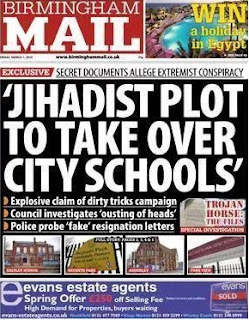
A strange letter appears on a city councillor’s desk in Birmingham, England, laying out an elaborate plot by Islamic extremists to infiltrate the city’s schools. The plot has a code name: Operation Trojan Horse. The story soon explodes in the news and kicks off a national panic. By the time it all dies down, the government has launched multiple investigations, beefed up the country’s counterterrorism policy, revamped schools and banned people from education for the rest of their lives.

To Hamza Syed, who is watching the scandal unfold in his city, the whole thing seemed … off. Because through all the official inquiries and heated speeches in Parliament, no one has ever bothered to answer a basic question: Who wrote the letter? And why? The night before Hamza is to start journalism school, he has a chance meeting in Birmingham with the reporter Brian Reed, the host of the hit podcast S-Town. Together they team up to investigate: Who wrote the Trojan Horse letter? They quickly discover that it’s a question people in power do not want them asking.

From Serial Productions and The New York Times comes The Trojan Horse Affair: a mystery in eight parts.

 Link


Thursday, 5 December 2019

UK chief rabbi owes us Palestinians an apology


The chief rabbi of the United Kingdom has weighed in on the row over alleged anti-Semitism in the Labour Party.

Writing in The Telegraph this week, Ephraim Mirvis claimed that Zionism is not separate from Judaism as a faith. He astonishingly implied that no one can have a view on this except Jews and Zionists.

So much for open debate and discussion!

He further claimed that “Zionism is a belief in the right to Jewish self-determination in a land that has been at the center of the Jewish world for more than 3,000 years.” The reality is that not all Jews agree with his definition, let alone non-Jews.

A survey of British Jews by City University London last year shows deep disagreement on the term, with 41 percent not taking up the political identifier “Zionist.” Thirty-one percent identified as anti-Zionist or non-Zionist, while 10 percent said they were unsure.

The survey also found that the number of British Jews who call themselves “Zionist” dropped from 72 percent in 2010 to 59 percent in 2015.

Muslims have a strong attachment to the cities of Mecca and Medina – and of course to Jerusalem – but should all Muslims have a right to move to Saudi Arabia?

And what about Christians? Where was Christianity born? The answer is in historic Palestine. Should all Christians have a right to go and live there?

The chief rabbi and Zionism both ask us to accept that only Jews have a right to determine where they live and never mind the impact of their demand on whoever already lives on that land.

In his article, Mirvis astonishingly fails to mention my people, the Palestinian people, even once. His anger with the left has unfortunately left him ignorant of our plight.

To the chief rabbi, we are invisible.

He did not once acknowledge our existence on the land, our own unshakable connection to it or that it was and still is our home – whether for those living in historic Palestine or in the diaspora.

We are in the diaspora because of Zionism.

The chief rabbi implies that we cannot disassociate Zionism from Judaism – by implication accusing all Palestinians who oppose Zionism – as indeed we do – of anti-Semitism.

This is why Ephraim Mirvis is wrong, with the greatest respect to him, to conflate the two – a religion and a political ideology.

Palestinians do not have a problem with Jews – or with any other group – wanting to live in a state or entity of their own.

However, Zionists chose a land with a people, not an empty land for their state. That is the key issue here. In 1948, 750,000 Palestinians were violently driven from their homeland to make way for the realization of Zionism’s goal, and since then millions of Palestinians have been deprived of their most fundamental rights.

As British Palestinians we abhor all forms of racism including anti-Semitism. We will stand with our fellow citizens who follow the Jewish faith in striving to eradicate the scourge of all racism in this country, including anti-Semitism and Islamophobia.

However, we will not accept the conflation of Judaism and Zionism to label us and those who support our legitimate right to self-determination in our homeland as anti-Semites.

The chief rabbi owes us Palestinians an apology for this conflation which suggests we are anti-Semites. Zionism owes us much more than an apology for our dispossession.

Link

Thursday, 25 April 2019

MAN ‘WHO KICKED PREGNANT MUSLIM WOMAN IN THE STOMACH CAUSING HER TO LOSE UNBORN TWINS’ IS JAILED


A ‘shabby racist’ has been jailed for nearly four years for repeatedly kicking a pregnant Muslim woman in the stomach before she miscarried her unborn twins.

David Gallacher attacked Samsam Haji-Ali and her husband Abdullah Sulamain in the car park of the Co-op in Bletchley, Buckinghamshire in August last year.

The 37-year-old racially abused her as she sat in the car, before kicking her in the stomach despite her shouting ‘I’m pregnant’.

He then set upon Mr Sulamain, hitting him across the head.

Prosecutor Christopher Wing said Gallacher told the expectant mother: ‘You come here with your clown outfit on, you fing people, you are the fing problem in this place’.

The court heard when Mr Sulamain went to try and calm Gallacher, he was hit across the head with a wine bottle and bag of ice. He received a four-inch cut, which later required stitches.

Sentencing Gallacher, Judge Francis Sheridan said: ‘(He) swung the bottle towards her before he kicked her.

‘She told him she was pregnant, and he continued to kick her again, after he was told she was pregnant.’

The sentence means Gallacher will be eligible for automatic parole after serving less than two years in prison and will spend the rest of the term on licence.

The woman was left rolling around on the floor in agony, and miscarried on August 24 last year.

He added: ‘This lady’s pregnancy was absolutely fine before she attended that shop and the defendant kicked her again in the stomach having been told she was pregnant.

‘There was a racial element to this attack. The defendant is a shabby racist on the language that he used towards this lady.’

He continued: ‘She is left rolling around on the ground in agony and later found there is bleeding before she lost the baby.’

Judge Sheridan said he would leave it to others to decide whether the crown needed medical evidence to prove the link between the attack and the miscarriage, or whether common sense was enough.

He said he was of the view that ‘the loss of that baby was a direct result of a kick to the stomach of a pregnant woman’.

Addressing Gallacher, he added: ‘You are a thug and a racist to boot.

‘It is time you learnt that your vile conduct and abhorrent views are a thing of the past.

‘This county will not bow to the views of racists, because decent society demands that intolerance is shown to all racists of any sort, however they chose to express their hatred of others, or dislike of others and the abuse that goes with it.’

The judge said he had not awarded compensation in the case because he ‘simply could not put a price on the lost baby’.

Mr Wing told the court that, when questioned by police, Gallacher claimed he was not a racist because he ‘taught himself Muslim’ and speaks to members of the Muslim community.

Wearing a grey sweatshirt and jeans, Gallacher of no fixed address, appeared at Aylesbury Crown Court, and spoke only to confirm his identity and plead guilty.

He admitted two counts of racially aggravated assault occasioning actual bodily harm, and three counts of assaulting a police officer during his arrest on September 14 last year.

He was jailed for three years and seven months for the race attacks, and four months for the officer assaults.

When arrested Gallacher was aggressive, spat at officers, and attempted to bite them, telling them he had Hepatitis B.


Link

Thursday, 1 November 2018

Huddersfield grooming gang: The Islamophobia issue


Earlier this year, one of the victims of the Rotherham grooming gang anonymously wrote a very informed and intelligent piece on this issue for the Independent.

In it, she said that grooming gangs are upheld by religious extremism and even went so far as to compare them to terrorist networks. But even she - having very good reason to allow herself to be tempted to take the racist approach - condemned the work of people like Stephen Yaxley-Lennon aka Tommy Robinson , saying he doesn't speak for her, and said that she and other survivors are 'uncomfortable' with the EDL's protests.

In her own words, she 'experienced horrific, religiously sanctioned sexual violence and torture' and described how her main abuser beat her as he quoted scriptures from the Quran to her. And in Oxford, it was said that sexual assaults were particularly sadistic.

But, despite what some right-wing media and extremists want you to think, the fact is this isn't actually the case with every Asian grooming gang in the news.

It's a point that the prosecutor of the Rochdale grooming gang, Nazir Afzal, has already made.

Speaking about the case in an interview with The Guardian in 2014, he said:

There is no religious basis for this. These men were not religious.
"Islam says that alcohol, drugs, rape and abuse are all forbidden, yet these men were surrounded by all of these things. So how can anyone say that these men were driven by their religion to do this kind of thing?

"They were doing this horrible, terrible stuff, because of the fact that they are men. That’s sadly what the driver is here. This is about male power. These young girls have been manipulated and abused because they were easy prey for evil men."

In an interview with the New Statesman earlier this year, he described the ethnicity of street groomers as 'an issue', but gave more weight to the night-time economy that they often work in, the availability and vulnerability of the young girls who are often around it and the community's silence and lack of action to tackle the problem.

And I believe, based on the evidence heard in court, that what he said is also true of the Huddersfield grooming gang.

One of the victims in Huddersfield was Asian - something that also happened cases such as Rochdale and Newcastle, but is not often reported by the media.

The ringleader, Amere Singh Dhaliwal, converted to Sikhism after the abuse. He wears a turban, carried a kirpan in it and swore on the Guru Granth Sahib before taking to the witness stand. Raj Singh Barsran, who hosted many of the 'parties' in his house, is also a Sikh.

We shouldn't focus on race and religion and the discourse should be about something much more important - for a start, the causes of hebephilia and ephebophilia.


Link

Wednesday, 28 March 2018

Living in fear: One in three Muslim students attacked on campus as Islamophobic hate crime surges


Fatima Diriye, a history and politics student at Soas University of London, told The Independent that she felt unsafe when two students took photos and drew a sexualised image of her in a jilbab.
“They drew a picture of me because I wear a jilbab – the head to toe piece – so they drew that, and then explicitly exaggerated my figure and wrote: ‘I like penis.’
“I didn’t feel safe. I was really upset, I was in tears,” she said. 
In another incident, Fatima was called out for expressing views during a student union activity. “He said ‘You are a Muslim woman. Why are you even speaking? Aren’t you normally oppressed?’”


Saturday, 16 December 2017

'Tis That Time Of The Year Again

Its mid-December and for Muslims living in the western society, it's generally difficult times. Its the Christmas parties that can't be avoided that contains drinks and oppotunities to fall in Satan's traps.

Whenever I need to go to any of these unavoidable parties, my intention is to educate atleast 3 people on how Christmas has got nothing to do with Christianity and how bad Alcohol is for health. Follow these links if you want to get up to speed on Christmas and Alcohol.

There is a good article in Al-Jazeera about how Victorian Muslims celebrated Christmas. For those of you who may not know, Victorian era was the period of Queen Victoria's reign, from 20 June 1837 until her death on 22 January 1901.

The Liverpool Muslim Institute was founded by the Liverpudlian William 'Abdullah' Quilliam [Courtesy: Abdullah Quilliam Society]

At 6am on December 25, 1888, the winter sun was yet to rise over the English city of Liverpool.

A Victorian terrace house was feverish with activity.

The soft glow of candlelight emanating from 8 Brougham Terrace revealed men and women busily putting up decorations and preparing food for the big celebration ahead, Christmas Day.

In one corner, a familiar Victorian scene of a woman playing the piano and directing hymn rehearsals, the singers' voices muted by the howling of a bitter northeasterly wind as it rattled the thin panes of glass.

This was Britain's first mosque and Muslim community preparing for their very first Christmas Day.

At 8am, having led the tiny congregation in the early morning prayer, the Imam finally opened the mosque doors.

Imam William Henry "Abdullah" Quilliam founded the mosque after embracing Islam in 1887, aged 31 years old.

He was greeted by more than 100 of the city's poor, who had been invited to enjoy a charitable Christmas breakfast inside what locals called "Islam Church".

As the group of recent converts served the paupers a hearty meal of "sandwiches, bread and meat, seedloaf, bunloaf, bread and butter, tea and coffee," the music began.

Hymns praising the birth of the Prophet Isa, or Jesus, rung out through the venue. By evening, numbers swelled. Word had got around, and the Muslims offered a "substantial tea" and small musical concert to the visitors.

The entertainment began with "mesmeric performances" by two young Muslims before "some delightful airs upon the zither, the fairy bells and the mandolin" by one Miss Warren.

The finale was a "magic lantern" show and photo series from the imam's recent tour across distant Muslim lands.

These descriptions of Victorian Muslims at Christmas were taken from the pages of The Crescent, the country's first Muslim newspaper.

It was published by the Liverpool Moslem Institute between 1893 and 1907 and was recently made available online by the Abdullah Quilliam Society - which is based at the historic mosque - in partnership with the British Library.

"This reminds us there was an earlier generation of Muslims, looking to spread the word of Islam through finding points in common rather than things to argue about," said Timothy Winter, a prominent British Muslim scholar.

Winter, the dean of Cambridge Muslim College and lecturer in Islamic Studies at the Faculty of Divinity, University of Cambridge, converted to Islam in 1979. He has worked extensively with the archives.

Britain's first Muslim community mostly comprised English converts.

The Christmas scenes, described in every January issue of The Crescent, may come as a surprise.

Winter said the festivities demonstrated a willingness to appropriate local traditions, something that was easier because the group had grown up with them.

"They possessed a spirit of openness and hospitality and were more concerned with God and truth and conveying the word [as opposed to] boundary issues and questions of identity and difference," Winter told Al Jazeera.

Quilliam's role and influence were such that he was given the title of Sheikh Ul Islam of Britain by the Ottomans, and when he left Liverpool in 1908, it seems his community disbanded too.

Today, there are more than 2.5 million Muslims in Britain and, unlike Quilliam's community, they hail from a multitude of ethnic and cultural backgrounds and observe Islam differently.

"The Victorian Muslims were a small community, almost exclusively white English," said Sadiya Ahmed, founder of Everyday Muslim - an organisation which preserves Britain's Muslim heritage.

"Today, we have Muslims in Britain whose families have come from all over the world as well as those who are ethnically English, and this inevitably means they approach Christmas in a number of ways," she told Al Jazeera.

While it is common for some "very religious" Muslims to say how Un-Islamic wishing your neighbour, friends or family who may not be Muslims are, I would point out to Fatawa on Islam Awareness Homepage that say otherwise.

Muslims, however, are most respectful of what others believe and wish to live on friendly terms with all their neighbors, whether they are Muslim or not. In this context, returning the Christmas greetings of non-Muslim friends does not present us with a problem.

Obviously, if we sent a card, it would not be a religious card with Christian symbols, but rather some other symbol of the festive season. If the people we are responding to are devout believers in the Christmas message, we might send a greeting that says something like, "May God bless you all as you celebrate your feast," out of respect for their religious belief.

If they are, like the vast majority, simply celebrating what has become an important social occasion, we can respond to a well-intentioned greeting with a card that says something like "Compliments of the season" or "Greetings," since neither they nor we are celebrating the religious festival.

In such a context, even a card with a picture of a tree or some mistletoe or a robin red-breast, and the greeting "Merry Christmas" is not really a problem for either of us.

Going for drinks in the pub to celebrate is clearly out of the question. Going to parties where alcohol is being consumed is not how Muslims behave. However, if our non-Muslim neighbors invite us into their house for a piece of Christmas cake or a mince pie, we can accept their invitation.

Christmas should not be allowed to become a time where Muslims are being singled out as being unfriendly or not a part of the community. Indeed, we should be seen by our neighbors as full of fun and quite comfortable living with them. Let us not forget, though, to invite those same people to join us in our own homes at the time of the `Eid or to join us for iftar during Ramadan.

Showing our non-Muslim friends that Islam is a religion of peace and that we are peaceful and kind people is, indeed, at the heart of how we should behave. Peaceful and kind does not, of course, mean weak. We are not offering Christmas greetings out of weakness because we are in a minority. No, our greetings to our neighbors come from a strong and proud faith that we are called to be Muslim.

Our actions throughout the year, not just at Christmas time, should show how good Muslims behave and how we are faithful to prayer and dedicate all things to the Mercy of Almighty Allah. Indeed, Christmas time is actually a time for da`wah.

In a world which has lost all sense of God and which turns to alcohol and consumerism to drown its sorrows, we can show that there is a better way and that the way for all mankind to experience peace is not by kissing under the mistletoe or visiting Santa Claus in his Grotto, but by embracing Islam. In sha' Allah, even Christmas is a time for us to tell others about Islam.
ALLAHU ALAM الله اعلم

Sunday, 12 November 2017

The forgotten Muslim heroes who fought for Britain in World War 1

Algerian soldiers on the way to the western front arrive in Paris in 1914. Photograph: Photo 12/UIG via Getty Images

Good piece in The Guardian today about the Muslim Soldiers in WW1 that fought for the British Empire.
A biting wind whips across the rolling countryside, cutting through the crowd gathered on a hillside overlooking Notre Dame de Lorette, France’s national war cemetery. Huddled amid what remains of the 440 miles of trenches that made up the western front, they shudder out of shock and surprise rather than cold while listening about life for the men who endured the horrors of the first world war.
More than 1.5 billion artillery shells fell in this part of northern France, close to the town of Arras, prompting soldiers to nickname the farmland in which they fought “the hell of the north”, or poignantly, “the cemetery”. It is the experiences of some of their Muslim comrades, however, that particularly capture the crowd’s imagination, drawing looks of disbelief at a history that has never been fully told.
Having travelled thousands of miles from hotter climes, these soldiers went into the trenches with imams whose duties included leading group prayers and reciting the call to prayer into the ears of the dying. Special orders had been issued on when and how to pray. “If the war is intense and the Muslim does not have a moment of peace to fulfil his prayer he can just move his head and torso,” said a declaration from French high command. “In the case where there are moments of calm, one can complete the prayer together.”
Hot halal food was routinely served, prepared by cooks who had accompanied the men. When medical supplies ran out, some of these soldiers used traditional herbal medicines from their homelands to help treat injured comrades, whatever their faith. Others taught their folk songs to those serving alongside them, whatever their language, in between the brutal onslaughts of trench warfare.
The evidence of their sacrifice is on display in a corner of Notre Dame de Lorette, which contains the graves of 40,000 French soldiers who fell on the western front. The Muslim headstones are distinguishable not just by their Islamic inscriptions but because they also tilt eastwards towards Mecca. They were designed by the French painter Etienne Dinet, who converted to Islam in 1908.
The crowd of mainly British Muslims, who were at Notre Dame de Lorette before this weekend’s Armistice Day commemorations, ended their visit by praying over the graves of the north African soldiers who shared their faith. Their visit formed part of a groundbreaking project by an organisation called the Forgotten Heroes 14-19 Foundation, which has, for the first time, documented the contribution of all the Muslims who fought and worked for the allied forces during the first world war. The 19 in its name refers to the conflict that was caused by the French military presence in Syria in 1919 after the first world war ended.
...
They were drawn from across Africa, India, the far and middle east, Russia and even America, but it is their heart-touching stories of living and dying alongside European Christian or Jewish counterparts that have resonated the most with Ferrier and his team. Knowing this history, they say, could help overcome some problems in the Europe of today.
Documents uncovered have shown instances of imams, priests and rabbis learning each other’s burial ceremonies and prayers to lay the dead to rest on the battlefront. There are reports of Muslim soldiers sharing food with hungry civilians, while French, Belgian and Canadian officers expressed surprise at their humane treatment of German prisoners of war. When asked to explain their conduct, the soldiers quoted the Quran and the teachings of Muhammad on how enemy combatants should be dealt with.
Ferrier, who is not a Muslim, said: “The far-right and Islamophobia is on the rise throughout Europe. Our project is about making all people across the continent understand that we have a shared history. This is not about politics or colonialism. We are simply presenting the facts because this is a story that the whole of Europe needs to know.
“Muslims are portrayed as the enemy within, that they are recent arrivals who have never made a valuable contribution to Europe. But we can show that they have sacrificed their lives for a free Europe, have helped to make it what it is and that they have a right to be here.”
Central to the foundation’s ethos is spreading knowledge of its findings to young Britons and Europeans in particular, with the aim that this will help future generations better understand the Muslim communities living among them. The battlefield tours, entitled The Muslim Experience in World War One, are organised in partnership with Anglia Tours, a company that specialises in battlefield visits for British schoolchildren.
In addition to visiting the trenches, memorials and graves, and hearing the human stories behind them, the tour also includes a visit to the El Badr mosque in Amiens for a presentation on the foundation’s research, followed by a traditional north-African meal. Non-Muslim visitors are also encouraged to witness evening prayers.
 ...
The foundation’s work has already caught the eye of first world war experts. Last month, Ferrier addressed historians at Harvard University and he has also presented a paper to the UN. Plans are under way for a book next year that will contain extracts of the documents and images that have been uncovered, and an exhibition is to tour Europe. As the research continues, he estimates that the current figure of 2.5 million Muslims helping the allies during the first world war could increase.
...

MUSLIM COMRADES

Soldiers
400,000 Indians (British Indian army)
200,000 Algerians , 100,000 Tunisians, 40,000 Moroccans, 100,000 West Africans, 5,000 Somalis and Libyans (French army)
5,000 American Muslims
1.3 million Russian Muslims
Labourers
100,000 Egyptians
35,000 Chinese Muslims
130,000 North Africans
200,000 Sub Saharan Africans
40,000 Indians
 Source

Monday, 19 June 2017

This Muslim Convert Is Prepping The Next Batch Of Muslim Scholars To Be More In Tune With UK Society

When Tim Winter became a Muslim in 1979, Islam was still something of a mystery to the West. He was a 19-year-old undergraduate student at Cambridge University and a self-described “freelance monotheist.”
Today, Winter, a 57-year-old native Londoner who also goes by the name Shaykh Abdal Hakim Murad, faces a much different reality. Islam has grown to one of the largest religions in Europe, and with it, Islamophobia.  
Winter, keenly aware of this new reality, is tackling it head-on. As one of Europe’s most prominent Islamic scholars and dean of the Cambridge Muslim College, he spends his days training graduates of Britain’s top Islamic seminaries to better navigate and engage with British society.
Both Englishman and Muslim convert, Winter is uniquely positioned to bridge the gap between Islam and the West, largely because of the journey that got him here.
The late 70s were a time of religious experimentation for many British youth, and Winter was no different. He had a strong desire to understand the nature of God and humanity, and so he found himself immersed in a study of the world’s religions.
He turned to “the Far East,” then Judaism in search of something that “aimed ultimately to embrace the world.” These traditions fell short, and his own faith at the time, Christianity, had already proven flawed in his mind in part because his “school chaplain failed … to explain to our sneering, skeptical young minds the basic teachings of Christianity, the incarnation and the Trinity, the blood atonement … None of it made any sense, and [the chaplain] admitted that it was something that should just be accepted on faith and didn’t have any biblical or rational basis.
http://www.huffingtonpost.com/entry/muslim-convert-uk-integration_us_593f1985e4b0e84514edd221

Thursday, 8 June 2017

Moral of Warsi: Tories can't cope with Muslims

Any Muslim politician seeking to rise up the ranks of the Conservative Party has a choice. He or she can emulate Sajid Javid, one of five sons of a Pakistani bus driver who came to Britain in 1961 with one pound in his pocket.
Though brought up a Muslim, Sajid Javid never campaigned on Muslim issues, or even noticed them. He is now a cabinet minister.
Or he or she could emulate Sayeeda Warsi, a taxi driver's daughter who resigned from the David Cameron government over British policy on the Gaza invasion in 2014.
Baroness Warsi has always celebrated her Muslim identity and Pakistani heritage. Her new book, The Enemy Within, shows that she has had to pay a price.
Throughout her political career, which is now finished, she has been subject to abuse on a scale few modern politicians have to cope with.
The Tory Party took her in but refused to fully accept her. The influential ConservativeHome website published an article by Fox News commentator Niles Gardner which argued that her appointment sent "the wrong signal at a time when Britain is fighting a global war against Islamic terrorism".
Senior commentators, like Charles Moore and Tim Montgomerie, sneered at Warsi. She was never trusted. She tells how, when she was appointed Foreign Office minister, the Conservative Central Office tried to hire her special adviser to spy on her, reporting back on who she met and what she said. 
Her character, actions and beliefs were repeatedly miscontructed, as I demonstrated last week when I exposed how reviewers such as Col Richard Kemp and Douglas Murray distorted and misrepresented what she had written in order to attack her.
Warsi eventually resigned at the height of the Israeli attack on Gaza in 2014. It was her job to defend British government policy in the House of Lords, and she found she could not support a government that refused to condemn Israeli military action. She has now left politics.
She says she might not have resigned if William Hague was still foreign secretary, and that she found Philip Hammond, foreign secretary at the time of Warsi's resignation (and whom she refers to as a "perfectly competent accountant") unsympathetic. Hers was the most distinguished resignation since Robin Cook over Iraq in 2003.
I think it is a terrible loss because Warsi devoted her 10-year career in frontline politics to arguing that you could be Conservative AND Muslim.
Her powerful Conservative opponents maintained that you could only be Conservative OR Muslim. They won. Hence the infamous 2016 London election campaign when Tory candidate Zac Goldsmith targeted Labour’s Sadiq Khan on the basis that the latter was Muslim, a strategy heavily criticised by Warsi.
Full article

Thursday, 2 March 2017

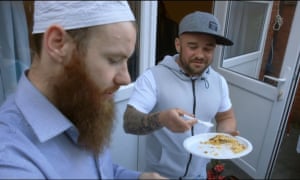
One converted to Islam, the other went to far-right rallies: a modern tale of two brothers

Abdul and Lee in C4’s Extremely British Muslims
Abdul converted to Islam seven years ago. “I never felt I was a bad boy. I was exposed to drugs and different elements, but I was never violent,” he said. He “stumbled across” Islam and was instantly attracted to the sense of structure and rules governing every aspect of his life.
“I thought, ‘wow, this is amazing’. But I also enjoyed all those things in my life, and I didn’t want to let them go. It was a slow process – it took about three or four years to realise I was living a lie,” he said. In the film, he talks of “drifting and wandering” until he became a Muslim. “It changed my life entirely. I was turning my back on my previous life.”
Lee was shocked at his brother’s decision. “I knew he had some sort of secret, but I thought he was gay or something. I wasn’t expecting this. If he was going to be religious, I’d have expected him to go into Christianity, not become a Muslim. It’s not something you’d expect a white man to do.”
Lee had taken part in several EDL rallies “against Muslims in general – the way they treat women, paedophilia, things like that. I didn’t really have a bad view of Muslims – it was something for me to do when I was bored”.
The brothers grew up in Dudley. For nine months after he converted on Christmas Day 2009, Abdul commuted from his home town to Birmingham before moving to the city. “I remember putting on my jubba [ankle-length robe] and literally shaking before I opened my front door, wondering what people would think. White people used to stare at me, sometimes with a look of betrayal. But I don’t take any notice.”
Soon Abdul met Hina, a Pakistani Muslim, on Facebook. A week or so later they met in person; seven days after that they were married. “It was a leap of faith, trusting in God,” he said. It was also instant fatherhood for Abdul, then still in his 20s; Hina had two teenage sons and a daughter from a previous marriage. Abdul’s relationship with the boys, and his insistence on them being strictly observant Muslims, has not been easy. The couple now have another two children, two-year-old Zahra and baby Mohammed.
In the film, after Mohammed’s birth Abdul hosts a celebratory barbecue, inviting members of the local Muslim community – and Lee. In an awkward scene in the back garden, Lee observes that all the other men, including Abdul, are eating with their hands. “It’s like you’re going backwards,” he says.
Afterwards, he says: “I wouldn’t say I was comfortable, to be honest, I just did it for Shaun. He’s chose this path, I’ve chose [another], but he’s still my brother. I miss the Shaun I grew up with.”
Speaking to the Observer, Abdul said: “We disagree but we have mutual respect. I still feel close to him – blood is thicker than water. But I don’t know if I’m deluded.”
Khan spend six months persuading and reassuring the mosque elders before filming began. “We had to establish a relationship. They were saying ‘we trust you but how do we know it won’t be changed down the line?’ It was a difficult project. But I think there’s a sense of relief at the outcome,” she said.
Lee said his decision to take part in the film was “purely for my brother”, but added that the process had made him more tolerant of Muslims.
Abdul’s motive was “wanting our own voice to be heard rather than other people creating news about us”. He added: “I want people to start a conversation, just break the ice, just talk to us. Even the skinhead white guy. But British people won’t ask, they prefer to let things build up under the skin. We just need to communicate with each other and break down the barriers.”
Source

Sunday, 21 February 2016

I'm a middle-aged, white Scottish man who converted to Islam without ever meeting a Muslim. This is how

 
How does a middle-aged, white Scottish man living in the Scottish Highlands end up becoming a Muslim - especially when he hasn't properly met a Muslim in his life?
For me, it all started when I heard the call to prayer from a local mosque while on a beach holiday in Turkey. It woke something up inside me, and inspired me to begin a spiritual quest.
Back home in Inverness, I went to the local bookshop, bought a Qur'an and started to read. While reading, I always asked God to guide me on the journey I had set out on.
A lot of praying. A lot of time on my knees.
The Qur'an really shook me. It's quite a scary book to read because it tells you so much about yourself. Some things that I found out about myself I didn’t like. So I decided to make some changes.
I knew that I could stop reading the Qur'an and halt the process at any time, but I also knew that would mean giving up something really important.
And I knew what the end result of this process would be: I would be a Muslim.
So I kept on reading. I read it three times, looking for the catch. But there was no catch; I was quite comfortable with everything.
The difficult part in all of this was wondering who I would become. Would I become strange, dress differently, speak differently in the eyes of others?
What would my family, friends and workmates think of me?