Showing posts with label Violence against women. Show all posts

Tuesday, 29 June 2021

Outrage after Pakistan PM Imran Khan blames rape crisis on women


 Pakistan’s prime minister, Imran Khan, is facing backlash after he blamed victims of rape for wearing “very few clothes”.

The former cricket captain was questioned by the Axios journalist Jonathan Swan about the ongoing “rape epidemic” in Pakistan and responded by saying: “If a woman is wearing very few clothes it will have an impact on the man unless they are robots. It’s common sense.”

He did not elaborate on what he meant by “few clothes”, in a country where the vast majority of women wear conservative national dress.

More than a dozen women’s rights groups, including the Human Rights Commission of Pakistan, released a statement demanding an apology. “This is dangerously simplistic and only reinforces the common public perception that women are ‘knowing’ victims and men ‘helpless’ aggressors,” they said.

The politician Maryam Nawaz, who is the vice-president of the Pakistan Muslim League-Nawaz and daughter of the former prime minister Nawaz Sharif, said Khan was a “rape apologist” and that people who validated rape had the same mindset as the perpetrators.

Kanwal Ahmed, a campaigner for women’s rights, tweeted: “Makes my heart shudder to think how many rapists feel validated today with the prime minister backing their crime.”

Weekend protests have been organised in the cities of Karachi and Lahore.

Earlier this year the prime minister was accused of “baffling ignorance” by one of the country’s top rights groups after he advised women to cover up to prevent rape.

His media team later insisted the comments in the national language of Urdu had been misinterpreted.

When questioned by Swan about his previous remarks about rape victims, Khan responded saying it was “nonsense” and he was instead referring to Islam’s “concept of purdah” which is to “avoid temptation of society”, often done through covering oneself.

Victims of sexual abuse are often viewed with suspicion and criminal complaints are rarely seriously investigated in Pakistan. Much of the country lives under a so-called “honour” code where women who bring “shame” on their families can be subjected to violence or murder.

The country regularly ranks among the worst places in the world for gender equality.

Nationwide protests erupted in 2020 when a police chief admonished a gang-rape victim for driving at night without a male companion. The French-Pakistani mother was assaulted in front of her children on the side of a motorway after her car ran out of fuel.

Link

Thursday, 20 September 2018

I lost my mum to domestic violence but I won't let fear or racists keep me silent


At Rookwood Cemetery in Sydney's west, Islamic Burial Section 8 is by the telegraph tower and the train line.

As I pull over, I notice other people conversing quietly with God by the graves of their loved ones. It looks like a funeral has recently taken place. I remind myself, inna lillah wa inna illayhi raji'un: we belong to God and it is to Him we return.

I'm here to visit the grave of my mum, Salwa Haydar, who was just 45 years old when she was murdered by my father in 2015. She was preparing her dinner in the kitchen after a long day's work when he attacked her with a knife.

My sister, who was 18 at the time, fought him with her bare hands and was injured in the attack. My father's actions were cowardly, merciless and unrelenting: my mum died at the scene from about 30 stab wounds.

Arriving at my mother's resting place, I empty the vases that flank her tombstone and fill them with fresh water and blooms — daisies and dahlias — before turning to her neighbours.

In an adjacent row, 16-year-old Mahmoud Hrouk is buried. I take my spare flowers to him.

Mahmoud was sexually assaulted and murdered in 2015 by Aymen Turkmani who left his body in an abandoned house in Villawood. Turkmani was subsequently found guilty and sentenced to a maximum of 45 years in prison.

Mahmoud's youthful face is never far from my thoughts — his funeral happened soon after my mum's and the sadness of their two stories seems to have fused in my mind.

I notice that the lilies by his tombstone are still in the bud. I think of his mum.

I then wander towards the back of Section 8, where, right by the fence line, lays baby Omaira: "Born without breath, but not without love".

Omaira died at 5 months' gestation when her pregnant mother was attacked by her abusive male partner. Omaira's tiny, humble grave has been decorated with pebbles and rainbow windmills. I remind myself to bring more flowers next time.

Children without parents, parents without children. Who else is here because of male violence? I ponder the question as I drive away with a heavy heart.

Why don't we talk more openly about the effects of male violence on our families? For Muslim women in particular, the answers are complex.

Recently, however, I've noticed a growing number of us are standing up to the forces that keep us quiet and I'm energised by the community's willingness to listen.

The double bind Muslim women find ourselves in
In its ongoing series, ABC News has been investigating the role of religion in influencing the behaviour of perpetrators and victims of domestic violence in different faith communities.

The most recent piece reported on the confusion and harm being caused by popular translations of verse 4:34 in the Quran, which some Islamic scholars argue permits men to beat "disobedient" wives.

Such interpretations hinder the work being done by Muslims to tackle gender-based violence. Meanwhile, contemporary, non-violent interpretations of the same verse have not yet gained consensus.


Full article

Wednesday, 22 November 2017

Kashmir 'mass rape' survivors fight for justice

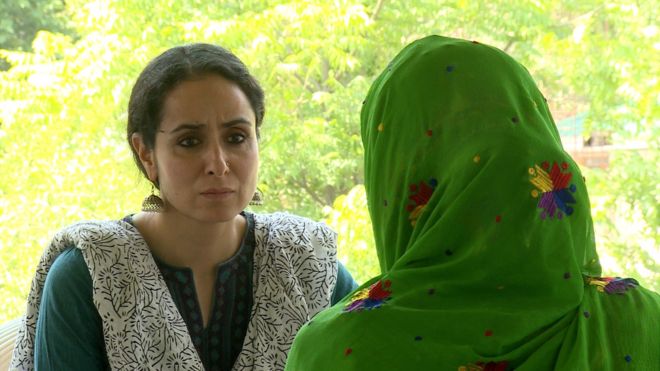
Aliya talking to victim
"We were getting ready for bed when the soldiers came. They took the men away. Some started drinking alcohol. I was holding my two-year-old daughter in my arms when they tried to grab me.
"I resisted, and in the scuffle she fell out of my arms, and out of the window. She was crippled for life.
"Three soldiers grabbed me, tore my pheran, my shirt - I don't even know what all happened after that. There were five of them. I still remember their faces."
Zareena was also in the same house. It had only been 11 days since her wedding.
"I had returned from my parents' house that very day.
"Some soldiers asked my mother-in-law about all the new clothes hanging in the room, so she told them, 'here, she is our new daughter-in-law, our new bride'.
"What happened after that, I cannot begin to describe it. We haven't just been wronged, what we have faced is an infinite injustice. Even today when we see soldiers we start shaking with fear."
The people of Kunan and neighbouring Poshpora accuse the Indian army of carrying out a planned mass rape of the women in these two far-flung villages. They also claim that while the women were gang-raped, the men were subjected to horrific torture, and that they have been fighting for justice these last 26 years.
In Srinagar when I spoke with a minister in the state government, Naeem Akhtar, about these allegations he said that in conflicts like Kashmir truth often gets obscured by the layer of dust that settles on it.
And now it seems a group of young Kashmiri women are determined to wipe this dust away.
http://www.bbc.co.uk/news/world-asia-41268906

Tuesday, 5 September 2017

Gang Rape and murder in Bangladesh


From Faceboook of @taqbirhuda
This woman, Rupa, was gang raped in a moving bus by 5 bus helpers near Mymensingh, Bangladesh. Because she had the audacity to scream the rapists broke her neck, killed her and threw her body out of the bus when passing a secluded area. She was on her way back home after giving a registration exam in a neighbouring city.
At one point when all passengers got down from the bus helper Shamim dragged Rupa to the back and attempted to rape her. In a state of utter helplessness, she offered Shamim all the money she had and her mobile phone and desperately pleaded to be let go. Shamim accepted her offerings but still went on to rape her. Then, two other helpers, Akram and Jahangir, also decided to join in and took turns raping her while the bus driver Habib kept on driving without a care as Rupa's horrendous ordeal unfolded.
This is almost identical to the notorious 2012 Delhi rape case which sent shockwaves around the world. Yet Rupa's horrific gang rape and murder incident is barely sending shockwaves in her own country. A few impersonal and perfunctory news-reports here and there, a few words of anger in response to them but nothing we won't eventually forget in a day or two because that's how desensitised we've become to the ever frequent phenomenon of violence against women.
She was an aspiring lawyer working for an MNC, with hopes and dreams she couldn't live to fulfil. Where is her story? Where is the nonstop coverage? Where is her photo in the leading English dailies? Where is her basic right to safety in something as ordinary and routine as bus travel? Most importantly, where is the outrage and impetus for change?

Friday, 28 April 2017

Ross Kemp Extreme World - India


This was hard to watch, because well it is India. The way women are dehumanized and murdered for the pleasure and profit of men, yet another side of the evil that is patriarchy. The trafficker admits he targets Advasi and Muslim girls, it made me think all the men that care so much about cows or are obsessed with hijab/purdah why does this not concern you? 

Wednesday, 26 April 2017

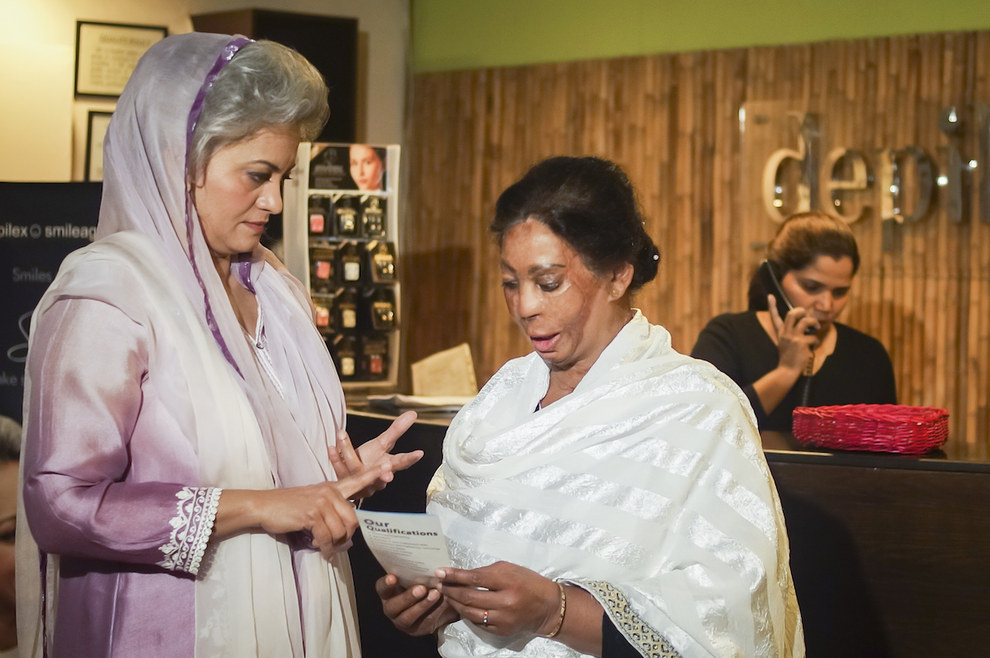
Masarrat Misbah: A messiah for acid burn victims

Image result for masarrat misbah depilex pictures

In conversation with Masarrat Misbah

“I still remember when a girl walked into my salon in a burqa. Thinking she was a beggar, I told her to come back the next day. It was only after she removed her veil, I saw that she had lost one eye and the nose. Her chin and neck were constricted together,” said Masarrat while talking to DNA.
Masarrat Misbah is Pakistan’s well-known beautician-turned-philanthropist who needs no introduction. She is one of the first beauty experts to introduce the trend of professional beauty salons in the country. She started Depilex Institute, which became one of the biggest beauty training institutes in Pakistan with internationally qualified staff.
With time she got inspired to incorporate the idea of ‘beauty with a cause’ with Depilex Smile Again Foundation after successfully running Depilex for years. She used this initiative to help acid attack victims and remove the stigma attached to it.
“I still remember when a girl walked into my salon in a burqa. Thinking she was a beggar, I told her to come back the next day. It was only after she removed her veil, I saw that she had lost one eye and the nose. Her chin and neck were constricted together,” said Masarrat while talking to DNA.
“I took that girl to the hospital and thought that if I could help one girl, maybe I could help more too. So an advertisement was placed in a few newspapers to report to a hospital on so and so date, for a free medical checkup. To my surprise, 42 girls showed up at Depilex.”


Thursday, 13 April 2017

FGM campaigner Fahma Mohamed to receive honorary doctorate

 Fahma Mohamed at the ‘Girl Summit 2014’.
The teenager who led the Guardian-backed campaign to end female genital mutilation (FGM) has been awarded a doctorate for her campaigning work.
Fahma Mohamed, 19, who will be a doctor of law, is one of the youngest people in the UK to receive the honorary degree, which will be presented by Bristol University on Friday.
Mohamed said she was ecstatic at being awarded the doctorate. “This has been seven years of hard work, we had so many obstacles to overcome and struggles at the beginning because it was so taboo,” she said. “It was fighting against something people were in denial about, it was hard for people to understand our point of view and for people in the community to be able to come out and say I am against this, too. 
“But now people have completely changed. Of course there are still people out there who might not agree. But there are many people who have said that our work has broken the cycle of abuse in their family. I am so glad and thankful to everyone I have met on this journey, [who] has been willing to listen to me and others doing this work and given me the opportunity to help young girls out there.”
Mohamed was 14 when, along with the Bristol-based charity Integrate, she started the campaign to end the practice of FGM in Britain.

Friday, 7 April 2017

Violent misogyny is a common trait among extremists

Violent misogyny is a common trait among extremists
The man who attacked Westminster shared a hatred for women with other mass murderers
We may never know what went through the mind of the perpetrator of last week’s attack in Westminster, London. That’s the opinion of the police who have been investigating why Khalid Masood, born Adrian Elms, drove a car into dozens of pedestrians, stormed into the Parliament and stabbed a policeman, leaving four people dead and at least 50 injured.

    I am struck by one thing we do know about him: a history of perpetrating domestic violence against his wives and partners.
    In the record of notorious attackers, he shares this feature with his heinous peers. Because if there is one thing that has become clear in their histories, it is that violence against women is an embedded feature of their lives long before they set out on their inglorious ends.

      A relative of one of Masood’s former wives said that he was "very violent towards her, controlling in every aspect of her life – what she wore, where she went, everything".
      Last year, Mohamed Lahouaiej-Bouhlel killed more than 80 people when he drove a lorry into a crowd in Nice, France. He had a history of domestic violence.
      The former wife of Omar Mateen, who killed 49 people in a Florida nightclub, last June reported that "he would just come home and start beating me up because the laundry wasn’t finished".

        Before anyone cries that this is about Muslims or Islamist ideologies, let’s be clear: this misogynistic world view cuts across all religions, backgrounds and classes. Whatever the background of such men, domestic violence abuse is a clear factor in their histories. In some cases, the atrocities they perpetrate are even announced as revenge on feminists.
        Full article

        Monday, 30 January 2017

        A Story That Will Terrify Every Man Who Abuses A Woman And Every Mother In Law Who Abuses Her Daughter In Law

        Image courtesy of Spreadit.com
        Must read blog post by brother Babar Ahmad.
        When I was in HM Prison Manchester I saw Rahan Arshad, a Pakistani taxi driver from Manchester who in 2006 battered his wife and three children, Adam (11), Abbas (8) and Henna (6), to death with a rounders bat.
        After killing their mother, one by one he brought the three sleeping children downstairs where he battered their heads with the bat until he killed them.
        At HM Prison Manchester I was on the high-security Category A unit but Arshad was on a separate unit, the VP (Vulnerable Prisoner) unit which houses rapists, paedophiles and rats (informers).
        Vulnerable?!
        The prison service considers them “vulnerable” to attack by other prisoners and so they are kept on separate units where they have no contact with mainstream prisoners. They only have contact with each other.
        When I was in HM Prison Long Lartin I saw Mahmod Mahmod, a Kurdish man from Mitcham, south London who, along with his brother in 2006, supervised the two-hour long rape, torture and slow death of his own 20-year old daughter Banaz Mahmod in a so-called “honour killing.”
        Mahmod was also held in a Vulnerable Prisoner unit but I used to see him in the corner of the prisoner-family visits hall.
        He would always be holding in his hand a “tasbeeh” rosary bead that the devout use to remember Allah. The shocking thing was that he just looked like an ordinary guy.

        Thursday, 13 October 2016

        Carer murdered by husband over her work with men

        Imran Khan
        A disgraceful munafiq murderer who orphaned his own children!
        A man who told his wife it was "not halal" for her to work with other men as a carer has been jailed for life after admitting her murder.
        Manchester Crown Court heard Imran Khan, 38, stabbed Nasreen Khan, also 38, at their home in Cheadle Hulme, Stockport on 18 April while five children were in the house.
        Khan was extremely controlling of his wife, the court heard.
        He was sentenced to life in prison with a minimum of 20 years.
        Khan had sent his wife angry text messages which said "leave the job" and "I don't give permission", the court heard.
        The court was told the couple had a volatile relationship and frequently split up.

        'Nothing to lose'

        Khan complained they had no physical intimacy and did not like that her job as a care assistant because it involved one-to-one contact with other men, even though she was not bathing them, the court heard.
        Judge Patrick Field said it was a "merciless attack" and described Khan as a "selfish and controlling man" who "did little to support" his wife and family.
        He told Khan there was "an element of jealousy of your wife's independence of mind".
        "She was a devoted mother. She worked hard to support her family and she was good at that job", he said.
        "Unless anyone should think there was a cultural clash, let it be said the evidence shows your parents and sister were entirely supportive of Nasreen's choice."

        Mrs Khan told a colleague she was going to confront him and stand up for herself, the court heard.
        On the night of her death, the court heard the couple had been arguing at their home on Cheadle Road.
        The court learned when Mrs Khan told her husband she wanted him to leave, he said: "I've got nothing to lose now have I?"
        He then phoned his father and the court heard he told him "I've got no choice. I'm going to kill her and kill myself."
        There were five children in the house who the court was told heard her screams as he repeatedly stabbed her in the kitchen. He then phoned his father again, saying "I did it" before hanging up.
        He discarded the knife on the driveway of their house before driving off.
        Mrs Khan died later in hospital.
        The court heard he told police: "I always loved her. I never meant to do nothing."
        His lawyer told the court Khan was "genuinely remorseful".

        Monday, 12 September 2016

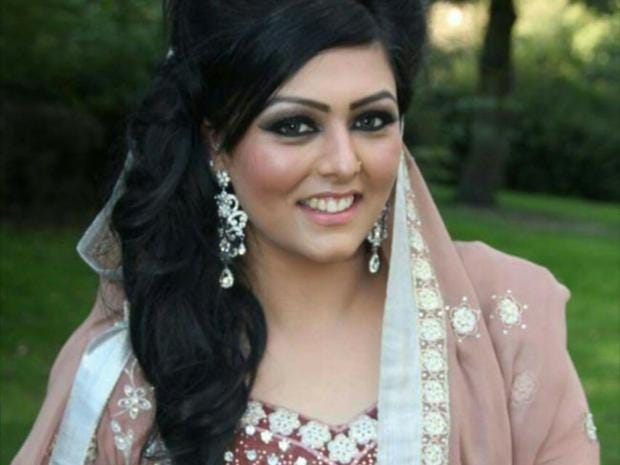
        Samia Shahid: British woman who died in alleged honour killing texted friend about fears she would not return alive

        samia-shahid.jpg
        Beyond horrifying this pathetic 'father' aided his own daughter's rape and murder. So much for being protectors...
        A 43-page police report, seen by the Mail Online, by an official connected with the case, concluded her father had held her down while Shakeel raped her. 
        In the report, it said the day before she was due to fly to Islamabadfor the week-long stay, she texted her friend with the message: “Pray I come bk alive on 21jul my psyco cuzzan u see” – referring to her former husband.
        But forensic and DNA tests confirmed Shakeel, who reportedly had never accepted the divorce, had raped Samia: “The result indicated a perfect match, thereby establishing that the victim was raped by accused Shakeel before she was murdered,” said the report. 
        The forensic report also showed a 19mm cut across her neck from where she had been strangled.
        The report claimed Shakeel was angry at the divorce and felt she had “dishonoured him and his family”. They had originally married in Pakistan in 2012 where she stayed for a short time before going back to the UK. She then divorced him ex-parte two years later and moved to Dubai to be with Mr Kazam. 

        Thursday, 4 August 2016

        It's not Muslims or people with mental health problems who are most likely to kill you in a terrorist attack – it's men

        Image result for male violent
        Toxic masculinity is what entitles a man to take a weapon and take other people's lives in the name of his values. 
        Toxic masculinity enforces the idea that being a “man” means not just being strong, but showing that strength through violence and fear. It means always being the one in control, having power and dominance over others at all times, by any means.
        If typical masculinity promotes emotional disconnection – something that men’s mental health charities are already trying to combat - toxic masculinity goes one step further and promotes the absence of empathy altogether. It also promotes the dismissal of anything deemed “feminine”, and the hatred of anything that contradicts heteronormative ideals around what it means to be a “man”. 
        The easiest way to think of it is to imagine the military. After all, soldiers are paid mass murderers. Different wars, same tactics.
        However, toxic masculinity has its roots in the everyday: to prove this, we should look no further than the fact a significant number of these killers were domestic violence perpetrators. Not just these killers, but the majority of mass murderers.

        The men who massacre the public are the same men who butcher women privately in their own homes. The same principles of power, control, fear and violence apply: instead of using violence to instil fear in one woman, they scale it up to instil fear across nations. These men walk among us, everywhere, but we only pay attention to their violence when it spills onto our streets.
        If we want this violence to stop, we need to address the root cause and its everyday manifestations before they escalate. These men were not extremists existing outside of society; they are products of it. They were men drunk on the entitlement that patriarchal cultures serve them. 
        They did not impulsively decide to go out and murder large numbers of people; they were fired by a deep, burning desire for control.
        Toxic masculinity hinges on having power over others; it demands inequality. As our world becomes more unequal, it becomes more violent. Toxic masculinity exists on political levels: in policing, prisons, immigration detention centres and controlling security measures.
        Full article:

        Monday, 9 May 2016

        Dozens of Syrians forced into sexual slavery in derelict Lebanese house

        A room used by trafficked women at Chez Maurice.
        No words, just horror.
        Police and judicial officials say the women were trafficked from war-torn Syria and Iraq, recruited by agents of the network for supposedly legitimate jobs such as restaurant workers, before being imprisoned at Chez Maurice.
        “They were perhaps looking for weaker families, where nobody is going to ask about the woman, such as if her father died in the war,” said Mousallam. “They are hunters. They did not for a moment treat them as humans.”
        Those who resisted working as prostitutes were raped and beaten, and then forced to have unprotected sex with customers. They were sometimes electrocuted or whipped, in an environment that judges described as “a journey to hell”.
        The indictment said the women were forced to have sex with customers more than 10 times a day, making between $30-70 per session, all of which was taken away by the guards, including any tips, in effect making them sex slaves.
        Jabbour said she hoped the Chez Maurice case would act as a model for similar situations in the future, with women treated as victims rather than being on par with those who run any network.
        But she said there would also have to be a cultural shift in the way Lebanese society looks at prostitution. Kafa is not in favour of legalising prostitution, saying it legitimises exploitation and the treatment of women as commodities. Instead, it advocates punishing human traffickers and sex buyers.
        Though Lebanon is one of the more liberal Middle Eastern societies, domestic violence and gender inequality are still pervasive. A one-of-a-kind survey carried out by Kafa, which interviewed sex buyers in Lebanon, found that many thought that if prostitution was completely prohibited, rates of rape would increase, and so it was necessary to have a sub-class of women who would shield the rest of society from male sexuality. Most of the interviewees felt entitled to have sex whenever they pleased, and also believed that the prostitutes enjoyed having sex with them, on top of being reimbursed.
        “Everything evolves around the sexuality of men,” she said. “We raise boys and men with the idea that it’s very normal to buy sex and to have sex whenever they want, not to control their sexuality.”


        Tuesday, 23 February 2016

        More than half of all teenage girls in Pakistan believe domestic violence is justified, report reveals


        A report carried out by the United Nations Population Fund (UNFPA) has revealed that troublingly, more than half of all teenage girls in Pakistan believe that domestic violence is justified for at least one reason. 
        Refusing sex was just one of the reasons girls aged between 15 and 19 believed a husband would be justified in beating his wife, while more than 30 per cent of girls of the same age had already experienced physical or sexual violence in Pakistan.
        The report, entitled  ‘Sexual and Reproductive Health of Young People in Asia and the Pacific’, also included data from Cambodia, India, Bangladesh and Nepal which revealed similar attitudes about violence against women among teenage boys, the Express Tribune reported
        Between 25 and 51 per cent said that wife beating was justified.
        It was discovered that factors such as low education, unemployment and family history of violence were linked to acceptance of violence in the home.