Showing posts with label Terrorist Attack. Show all posts

Friday, 13 July 2018

French Muslim families who lost loved ones in the Nice truck attack struggle with bereavement and Islamophobia.


One of Bouhlel's first victims was Fatima Charrihi, a Moroccan woman wearing a headscarf. In fact a third of the victims that day were Muslim men, women and children - including four year-old Kylan al-Majri who had come out to enjoy the fireworks with his family.
Truck Attack in Nice looks at the event through the eyes of three Muslim families who lost two young sons and a wife and mother. They re-tell their own versions of their ordeals on an evening that started with celebration and ended in violent tragedy, as they all struggle to come to terms with a loss that they simply cannot comprehend.
The relatively high numbers of Muslim victims in Nice and in the similar Barcelona attacks a year later, challenge the common perception that this type of violence is somehow an expression of Islamic teaching or values.
Lahouaiej-Bouhlel had been radicalised quickly through ISIL propaganda a few weeks before Bastille Day. He was known to French police for threatening behaviour, violence and petty theft but did not figure on the "Fiche S", or France's high-security watch list. He was a loner whose neighbours said smelled of alcohol and behaved strangely.
The 2016 attack in Nice followed those in 2015 on the Charlie Hebdo satirical magazine and Bataclan nightclub and neighbouring restaurants in Paris. Each incident turned up the heat in the debate about the relationship between Islam and violence in French politics and society.
In the months following Nice, politicians were campaigning for the French presidency.
Marine Le Pen seized the opportunity to make political capital out what she and her party call "the Islamisation of France", and former Prime Minister Francois Fillon spoke of what he called a new type of fear running through some parts of French society.
"This radical Islam is plaguing some of our fellow citizens. It challenges our common values. I won't allow this. I want strict administrative control of the Muslim religion before it takes root within the Republic," he said.
But the French Muslims families in this film see things quite differently. For them, it's not about Islam at all.
"Don't involve Islam in this issue," said Tahar al-Majri, who lost his ex-wife and four-year-old son Kylan in the Nice attack. "He ran down people aged four to 80. You can't kill people and say, 'God is Great'. God never tells us to kill people."
Link

Tuesday, 6 June 2017

#prayforLondon

Image result for pray for london

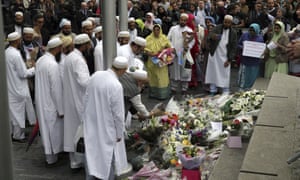
Imams refuse funeral prayers for 'indefensible' London Bridge attackers

People lay flowers after a vigil for victims of Saturday’s attack in London Bridge, at Potter’s Field Park in London,
More than 130 imams and Muslim religious leaders have said they will refuse to say funeral prayers for the perpetrators of Saturday’s attack in London.
In a highly unusual move, Muslim religious figures from across the country and from different schools of Islam said their pain at the suffering of the victims and their families led them to refuse to perform the traditional Islamic prayer – a ritual normally performed for every Muslim regardless of their actions. They called on others to do the same.
They expressed “shock and utter disgust at these cold-blooded murders”, adding: “We will not perform the traditional Islamic funeral prayer over the perpetrators and we also urge fellow imams and religious authorities to withdraw such a privilege. This is because such indefensible actions are completely at odds with the lofty teachings of Islam.”
Their move came as senior Muslims and community leaders said they would redouble efforts to root out extremism in their communities after the attack in London on Saturday.
The Metropolitan police commander for engagement, Mak Chishty, the highest-ranking officer of Muslim faith, called for “a step-change – a different direction and a different movement to counter the scourge of terrorism, extremism and hatred that we have in our communities at present”.
In a statement he read out on behalf of Muslim communities, Chishty said: “It is the Islamic duty of every Muslim to be loyal to the country in which they live. We are now asking questions to understand how extremism and hatred has taken hold within some elements of our own communities.”
Source

Tuesday, 15 October 2013

Why would anyone believe in the "Islamophobia industry"?


The Harlow Islamic Centre in Essex is an unassuming building. A former community centre, set back from the main road, it has seen various incidents of vandalism over the years; youngsters misbehaving, nothing out of the ordinary. That all changed on Sunday 25 August, when three young men visited the mosque in the middle of the night, prised open the shuttered doors and windows to spray insulation foam underneath, and set it alight. Only minor damage was caused, but there were no two ways about it: this was pre-meditated.
“It was a racist attack,” says Ajaib Hussain, chair of the centre. “They came to target the mosque.” Three young men have since been charged. The damage was reparable, but the impact of the incident can still be felt. Extra security cameras have been installed at the centre, and regular police patrols started. “Our community was shocked, sad, and afraid that it would happen again,” says Hussein. “But we are resilient. The support from Muslims and non-Muslims in Harlow after the attack has been overwhelming.”
What happened in Harlow was by no means unique. On 5 June, a mosque and Somali community centre in Muswell Hill, north London, was burnt to the ground by arsonists. On 18 June, the Masjid-e-Noor in Gloucester was set alight. On 23 May, the windows at Maidenhead’s mosque were broken. The list goes on.
Since the brutal murder of soldier Lee Rigby in Woolwich on 22 May, 30 mosques in the UK have been attacked. In the five weeks immediately following the attack, the monitoring organisation Tell Mama reported a further 250 anti-Muslim incidents against individuals.
This spike in incidents, coupled with the on-going political controversy over the niqab (face veil), has meant that the term “Islamophobia” has been hotly debated. High profile names such as the atheist Richard Dawkins have said that racism against a religion cannot exist (“It is not a race… Islam is a religion and you can choose to leave it or join it”). In June, journalist Andrew Gilligan wrote an article claiming that anti-Muslim hate crime was being exaggerated by “the Islamophobia industry”.
So what exactly is Islamophobia, and how useful is the term? The Runnymede Trust’s Commission on British Muslims gives eight components. These include seeing Islam as a monolithic bloc that is static and unresponsive to change; seeing it as the “other”, with no values in common with other cultures and inferior to the west; seeing Islam and Muslims as violent, primitive, and supportive of terrorism; seeing it as a political ideology; using hostility to Islam to justify discrimination against and exclusion of Muslims; and seeing such hostility towards individual Muslims as natural or normal. The definition was written back in 1997, and remains broadly in use today, used by organisations such as the European Monitoring Centre on Racism and Xenophobia. 
The Commission on British Muslims was set up in the mould of a similar group focusing on British Jews, formed in 1992. The aim was to take anti-Muslim prejudice as seriously as anti-Semitism, and to establish active policy steps to tackle it. Against this backdrop, arguing that one can’t be racist against a religion seems irrelevant.
Fiyaz Mughal is the director of Faith Matters, an organisation set up to promote inter-faith dialogue that also runs the Tell Mama project. Launched 18 months ago with funding from the Department for Communities and Local Government, this project is mapping and reporting incidents of anti-Muslim hate crime.
When we speak on the phone, he tells me that it is difficult to say whether there has been a general rise in Islamophobic incidents over the last few years because monitoring started relatively recently. The Metropolitan police force is currently the only one in the UK to keep a separate record of anti-Muslim crimes. Tell Mama receives about eight reports every single day (compared with around two or three when they launched in 2011).
“It’s very clear that a high number of incidents are taking place against Muslims in general,” says Mughal. “National or international incidents – like Woolwich – really spike the number of instances that get reported. This effect is cumulative over time. Post-Woolwich, the base line of incidents has not gone back down to what it was. Base line has reset itself to another level. That’s the concerning bit.”
The range of incidents recorded by Tell Mama and other monitoring groups range widely: from attacks on mosques, to violence against individuals, to verbal abuse, to online hatred. When Gilligan took issue with reports that anti-Muslim hate is on the rise, his main points were that many of the incidents were online only, and that others – such as hijab snatching – were “non-serious”.
“The police response to the online world is simply unacceptable,” says Mughal. “We are not talking about minor cases. In one incident, a man had knives on his Twitter picture, and suggested he wanted to go out and ‘slash Muslims’. The police did nothing. There is a laissez-faire approach to online abuse. The Crown Prosecution Service does not enforce and review the law consistently, due to the changing nature of what is happening. Not is there the political momentum behind fighting anti-Muslim prejudice.” It is worth noting that concerns about how online abuse is policed are not unique to anti-Muslim hate.
While arson attacks and petrol bombs at mosques are at the most extreme end of the spectrum, smaller incidents still create an atmosphere of fear and distress. “When I speak to people up north, they say that if there is something negative in their local press about Muslims, in the next few weeks there’ll be an attack or something happening in the street,” says Akeela Ahmed, a member of the government’s working group on Islamophobia. “Sometimes these things are at a low level – flour thrown at the mosque, or graffiti. I don’t think it was until Woolwich that people at a national level took notice.”
Around 70 per cent of incidents reported to Tell Mama involve women wearing headscarves: a visual marker of their religion. Equivalent monitoring groups in France and other European countries note the same trend.
Amina Malik is a 20 year old medical student who lives in London. She has worn a headscarf since she was 13, but has never experienced many problems – until mid-September. On 16 September, a judge ruled that a woman had to remove her niqab (full face veil) in court. This restarted a heated debate about whether such coverings have a place in a liberal society and whether a more far-reaching ban should be introduced. “I don’t cover my face, only my hair, but I felt uncomfortable seeing negative headlines about Muslims and Muslim women on the front pages every single day for a week,” says Malik.
On 20 September, as she was travelling to her home in west London, she sat in front of two men on the bus. “They were having a loud conversation about how Muslims shouldn’t be in this country if they wouldn’t live by British values. I felt edgy but I didn’t say anything and tried not to draw attention to myself.” The two men got off the bus at the same stop as her. “I didn’t think anything of it and tried to walk faster. One of them shouted ‘fucking Paki’ and I realised he was talking to me. They caught up with me and pulled off my headscarf from the back. I was so shaken that I just ran all the way home. I didn’t even stop to look at them.”
She did not report the crime. “There is a massive loss of confidence among Muslim communities,” says Mughal. Campaigners say that the police response to incidents against individuals falls far short, although at the most extreme end of the spectrum – where acts of terrorism are carried out against Muslims – it is far more efficient.
On 23 June, a group of worshippers arrived at the Aisha Mosque in Walsall to attend Friday prayers. They heard a loud bang, and thought that someone’s car engine may have exploded. One of the men looked underneath his car but didn’t see anything; they thought nothing of it. It was the next day that one of the men, back at the mosque, noticed a rucksack, and next to it, a device with wires attached to it. The imam called the police, who confirmed that it was an improvised bomb.
Pavlo Lapshyn, a 25 year old Ukrainian man, has subsequently been charged with planting the bomb at the Walsall mosque, as well as placing similar devices in Tipton and Wolverhampton. He was also charged with the murder of Mohamed Saleem, a 75 year old grandfather who was stabbed in Birmingham just weeks before the Woolwich attack
Zia ul-Haq, a representative of the mosque, is philosophical. “There was no damage, no people were hurt. This sort of thing has never happened before in our mosque. The community was concerned there could be a repeat, but we told them to be calm, vigilant, and watchful. Don’t overreact, and don’t point the finger towards any group or party. We don’t want to look at everyone suspiciously and have kept our open door policy at the mosque.”
However, just like the mosque at Harlow, extra security measures – such as an upgrade in the CCTV system – have been introduced.
“These incidents can cause polarisation,” says Ahmed. “At a local level – which is where these things play out – communities can be divided.”
The Walsall mosque chose not to point fingers, but the incident was not without repercussions. “After the attacks in Tipton and Walsall, there were people in Birmingham talking about the need for Muslims to defend themselves, to ‘man up’, to learn self-defence,” says Ahmed. “In addition to this very obvious, divisive impact of such attacks, there is a psychological impact on Muslim communities. Anxiety is increased. Every time there is an attack at a national level, like Woolwich, people automatically think ‘I hope it’s not a Muslim’. When you find out it is someone who calls themselves a Muslim, people – especially women – are wary about the repercussions. It does affect people’s confidence.”
Sunny Hasan is a 41 year old civil servant from Sheffield. She contrasts the simple racism of her childhood, when the refrain “Paki go home” was commonly heard, to more insidious forms today. “After 9/11 happened, people began to say ‘it’s you Muslims who are fundamentally responsible for the ills in society right now’.”
Like many British Muslims, she resents being held responsible for incidents of Islamic terrorism. “It becomes boring. You become this repeat mantra of formulaic responses. There is this nonsensical approach – ‘forgive us, it’s our fault, all Muslims apologise’. Actually, I don’t apologise for the acts of people who I don’t identify as Muslims, who have said very inappropriately that they are doing this in the name of Allah.”
It is difficult to say whether a rise in reported anti-Muslim incidents is because of increased awareness of the crime, or because of an actual increase in attacks. Campaigners point to the influence of far-right groups such as the English Defence League (EDL) in worsening anti-Muslim sentiment. A recent study by Teeside University found that EDL supporters were involved in 70 per cent of cases of online Islamophobic incidents. Certainly, the group provides a ready-made, if misinformed, narrative about Islam, with cherry-picked quotes and factoids for supporters to repeat.
But perhaps the most worrying fact is how mainstream some of these views have become. Back in January, former Conservative Party co-chair Sayeeda Warsi warned that there was a "misinformed suspicion of people who follow Islam … perpetuated by certain sections of the media.” Two years before that, she warned that anti-Muslim prejudice had “passed the dinner table test” and become socially acceptable.
Ahmed echoes this view: “There are things you can say about Muslims and Islam which you would not say about other communities, and other faiths.” A look at a selection of headlines and quotes bears evidence to this. “A quarter of young British people ‘do not trust Muslims’” (BBC News); “The real Islamist threat to Britain comes from mass immigration and multiculturalism” (Daily Mail). Many statements such as these, routinely seen in the media, would fall foul of the Runnymede Trust’s eight-point definition of Islamophobia.
It is not just the media that is at fault. “Politicians play political football,” says Mughal. “It is quite easy to turn to xenophobia in a time of austerity. Politicians say that the problem with cohesion is that the Muslims are not doing it right, and deflect from the very tough questions raised by the economic crisis, like a lack of investment in housing stock and jobs.”
According to the latest figures, there are more than 2.7 million Muslims in the UK, making up around 4.6 per cent of the overall population. The majority are settled, integrated, and proud to be British. Attacks on mosques or individuals may be relatively rare, but this is by no means a fringe issue. “My question is, where does the state actually want Muslim communities to go with these matters?” says Mughal. “Tell Mama was set up with funding from DCLG – if the police are not responding to us, what the heck! Who are they going to respond to?” When an entire community is routinely scapegoated in a supposedly tolerant society, it should be a concern for everyone.

Monday, 30 September 2013

The truly corrupt and manipulative: What does the Quran say?


Ustad Nouman Ali Khan gave the above lecture in response to the Boston bombings I revisit it now in the aftermath of the truly horrific attacks on Westgate Mall in Nairobi. Here we have murderous men claiming to be Muhajideen indiscriminately and cold-bloodedly killing unarmed, innocent, civilians many of them women and children. It has been reported that young children were found stabbed to death stuffed into fridges, women were shot after being questioned and found to be Muslim because they were not wearing hijab.  Very unfortunately some commentators on Facebook/Twitter have tried to justify this attack, or give explanations for it in light of Kenya’s actions in Somalia  and especially in light of what they think the Quran says.

After all the Quran says we have to fight our enemies it says it says “kill them wherever you find them.”


However , this attack is entirely unacceptable, there can be no justification for murdering innocents. These  self-styled ‘Mujahdeen’ have been defended by people (mis)quoting  the Quran just like Islamophobes who to paint us all as homicidal maniacs and justify their support of military action and drone bombings. 


SubhanAllah the Quran itself speaks of such people and their corruption as Ustad Nouman articulates the Quran says something unique about itself:
 

 “.......By it He misleads many, and many He guides thereby. And He misleads thereby only those who are Al-Fasiqun (the rebellious, disobedient to Allah).” Al-Baqarah:26. 


This means that Allah allows many people to be misguided by means of this very revelation, and He guides many by means of this revelation. When we first listen to this we ask: why would Allah send this revelation and then allow it to be used for misguidance? In fact, misguidance is mentioned first, and then the kind of people that will become misguided are mentioned. 


In fact Allah never misguides anybody at all, by means of revelation except those who are inherently corrupt. They have a deeply rooted corruption in themselves. There are psychological forms of corruption, people who don't even realize they're being manipulated, like young people are very gullible. There are people who are emotionally corrupt or traumatized, there are people who are actually outright evil and corrupt. Corruption takes many forms. It could be purposeful or not purposeful, it could be circumstantial. But you know what, when you come to this book with some kind of corruption – maybe you don't have complete information and you're rushing to conclusions – then the Quran has the option for someone to manipulate it. Someone to make the wrong conclusions.  Someone to use things in the Quran and say “oh this is what that means.”  But that can only happen when something is corrupt. If the intention and the approach and the emotions are corrupt. Something corrupt has to be there for the wrong conclusions to come out. So maybe it is the greatest of all of our true character.


And this is what has happened to the wanna-be Muhajideen and their corrupt supporters, these are people who will always justify violence and suffering.  They will insist “oh this is because of Islam”, or “this is a kind of jihad fee sabeelillah” or whatever else. This is nothing like jihad fee sabeelillah! This is nothing sanctioned by the Quran. It's a form of corruption. It's a form of manipulation of the sacred text. And we have to understand this first, that it's a violation of Allah's Word.

Saturday, 28 September 2013

The Muslim hero of Westgate Mall horror


There was an awkward wrinkle – Muslims too were among the dead. That was not supposed to happen, you know, how come “Islamist terrorists” were killing other Muslims? One of the survivors said he watched in horror when two terrorists asked some women to cite verses of the Quran to prove they were Muslim. They did…then the men shot them at point blank range. Some terrified people who were lying on the ground screamed; “why did you shoot them?”

One of the gunmen replied, “because they were not wearing the hijab”. So, it seems, misogyny and patriarchy trumped religion.


 Please read the entire blogpost @.

Sunday, 11 September 2011

A Call to Courage: Reclaiming Our Liberties Ten Years After 9/11


In the early days after the attacks, we were reminded that America is not only the land of the free, but also the home of the brave. On the evening of attacks, President Bush addressed the nation, and stated, “Our country is strong. Terrorist acts can shake the foundation of our biggest buildings, but they cannot touch the foundation of America.”

We could not have imagined that in the decade to follow, our country would engage in policies that directly defied American values and undermined our Constitution. We lost our way when, instead of addressing the challenge of terrorism consistent with our values, our government chose the path of torture and targeted killing, of Guantánamo and military commissions, of warrantless government spying and the entrenchment of a national surveillance state, all of which now define the post-9/11-era. That is not who we are, or who we want to be.

Ten years later, our nation still faces the challenge of remaining both safe and free.

The way forward lies in decisively turning our backs on the policies and practices that violate our greatest strength: our Constitution and the commitment it embodies to the rule of law. It is that strength which is the best rejoinder our nation has to violence and to those who advocate it. Liberty and security do not compete in a zero-sum game; our freedoms are the very foundation of our strength and security. Consistent application of the law is what ensures that practices don't change simply because of a change in the White House.

Our choice is not between safety and freedom; in fact it is our fundamental values that are the very foundation of our strength and security.

source

Tuesday, 2 August 2011

The rise and fall of Geert Wilders’ ideology


After years of capitalizing on the fear of Islam, Dutch right-wing politician Geert Wilders’ ideology has been severely dented by the Arab Spring and far-right terrorism in Norway.

The year 2011 looked bright for Dutch MP Geert Wilders, founder of the Party for Freedom, or PVV. In the fall of 2010 his party won 16 percent of the seats in parliament and obtained a decisive role in the new government coalition, with the Christian Democrats and Conservative Liberals. Opinion polls early this year indicated that his Freedom party would even overtake the Labor party as the second largest. Wilders has maneuvered himself into the driver seat, becoming the most important politician in Dutch politics and is slowly starting to become a household name on the international terrain as well.

Fear of Islam

Wilders’ party program has been based on what we could call the Vienna school of thought – referring to the year 1683 when the Ottomans tried to overtake Vienna. By referring to this historical event, cultural conservatives argue that Muslims have, and will, always strive to take over Europe and enforce on it its “barbarian” rule.

The accompanying discourse of cultural conservatives is very civilizational. Wilders and his counter-parts repeatedly stress the difference between Christian-Jewish and Islamic values: Enlightenment versus barbarianism, democracy versus dictatorship and freedom versus oppression. This difference, Wilders argues, is intrinsic and makes Europe incompatible with Islamic values – leaving no other option than to counter the influence of Islam.

By constantly linking Islam with issues such as immigration, public safety and terrorism, a paradigm is created in which Islam is the problem, and erasing it becomes the solution. This paradigm facilitates Wilders to argue that the Quran is similar to Hitler’s ‘Mein Kampf’ and should be banned, or describe over a million Muslims in the Netherlands as “Islamic voting cattle.”

The Arab Spring

The argument that Islam is incompatible with Western values, such as democracy, has in the past been defended by the number of Muslim majority states that harbor a dictatorial regime. Indeed, states in which Islam is the largest or sole religion, political freedom is often scarce.

As the Arab Spring erupted early this year in Tunisia, Egypt and many other states in the Middle East and North Africa, it exposed that not Muslims but merely Arab regimes are incompatible with democracy. The protest scene was very much secular in nature as the protesters called for more political freedom, not more religion.

In Syria, every Friday hundreds of thousands of Muslims continue to risk their life for freedom. Even though the regime employs death squads, tanks, snipers and torturers, ordinary men are bold enough to face death to fight for their ideals. The Arab Spring is their “Bastille”, knocking at the gates of dictatorship and oppression. The Arab age of enlightenment has started, which Wilders tends to ignore as it severely undermines his ideology.

Christian-fundamentalist terrorism

Norway’s Christian terrorist, Anders Breivik, also adhered to the Vienna school of thought and his views are shockingly similar to Wilders’. Breivik’s over 1,500 pages-long manifest encompasses the urge to purify Christian Europe from Islam and calls for support for Israel. In essence, the manifest reads as a violent adaptation of the Freedom Party’s program.

Breivik was unmistakably inspired by Wilders, labeling the PVV as the “only true conservative party” in Europe. Although it is unfair to stain Wilders’ “guilty by association”, it does raise the question of the (unintended) consequences of protracted hate speech directed at a race, religion or ethnicity.

Moreover, Breivik’s mass murder exposed the fallacy that merely Islamic fundamentalism is violent.

His terrorist act was inspired by the images of Medieval Christian Europe, just like the Muslim Caliphates inspired al-Qaeda. Breivik is as much a product of Christian fundamentalism as Bin Laden is from radical Islam.

2011, therefore, dawned as the year in which millions of Muslims peacefully marched for political freedom and a Christian, Islam-hating terrorist killed dozens of innocent children. Consequently, Wilders’ ideology is finally shattered to pieces.

source

*Anno Bunnik, a political commentator living in the Netherlands, is a graduate from King’s College London and interned at the Carnegie Middle East Center and the International Centre for Counter-Terrrorism.

Sunday, 31 July 2011

Pray for the innocents murdered in Norway


Because of that, We decreed upon the Children of Israel that whoever kills a soul unless for a soul or for corruption [done] in the land - it is as if he had slain mankind entirely. And whoever saves one - it is as if he had saved mankind entirely. And our messengers had certainly come to them with clear proofs. Then indeed many of them, [even] after that, throughout the land, were transgressors.

Quran 5:32

Monday, 7 March 2011

Facebook Jihad: The Radical Islamist Roots of the Frankfurt Attack


Arid U., who has confessed to the Wednesday shooting of two US airmen at the Frankfurt airport, was an unfriendly loner, say his neighbors. But his list of Facebook friends indicate that the 21-year-old had several contacts with radical Islamists.

Indications are mounting that the assault on a bus carrying US soldiers at the Frankfurt Airport on Wednesday afternoon was an Islamist terror attack.


The alleged perpetrator, Arid U., who admitted on Thursday to having carried out the attack, appears to have had extensive contact with radical Islamists via his Facebook page. SPIEGEL ONLINE has also learned that the shooting, which killed two American airmen and injured two others, possibly came after the gunman, identified as Arid U., was unable to leave Germany and travel to Afghanistan. Instead, the 21-year-old airport employee opted to attack US troops in Germany, according to a jihadist website. No proof for the assertion is offered, but the jihadists claim to have been in contact with acquaintances of Arid U.

SPIEGEL ONLINE has learned that Arid U., told police that he acted alone. He says that one day before the attack, he watched a video on YouTube which he says showed the rape of Muslim women. He says the film upset him so much that he decided to take action. Investigators consider his testimony to be credible, but are continuing to look into possible accomplices. Such films as that described by U., often propaganda videos, have circulated among jihadists for some time.

The attack is thought to be the first deadly, Islamist-motivated attack in Germany. And investigators doubt that it was as spontaneous as Arid U. makes it sound. On the one hand, he appeared to know when and where to find US soldiers at the airport. On the other, SPIEGEL ONLINE has learned that he told interrogators that he bought the weapon used in the attack months ago.

Arid U., who is originally from predominantly Muslim Kosovo, has left plenty of digital clues pointing to his adherence to radical Islamism. Two weeks prior to the shooting, he posted a link on his Facebook wall to a jihadist battle hymn. "I can no longer stand this life of humiliation among you," read the lyrics. "My weapon is ready at all times."

A fair number of his 125 Facebook friends would also seem to be sympathetic to radical Islamism. Anti-Semitic, anti-American and anti-Shiite comments are plentiful on both Arid U.'s Facebook page and those of his friends.

Some of the connections, however, are of particular interest to investigators, especially those with well-known figures in the Islamist scene. "He seems to have belonged to an unstructured militant-Salafist environment," said a source familiar with the investigation.

'Veritable Who's Who of German Salafism'

Salafists are pious Muslims who place particular emphasis in emulating as far as possible the life of the Prophet Muhammad and the first generation of his followers. It is a movement that has been growing for years. While most Salafists are more political than they are militant, there is a segment with significant crossover with the jihadist-terror scene. Several of Arid U.'s contacts appear to come from this gray area. In referring to U.'s contacts, one high-ranking security official spoke on Thursday morning of a "veritable who's who of German salafism."


Among others, U. appears to have a Facebook connection with Sheikh Abdellatif, a preacher originally from Morocco who now lives in Frankfurt. German security officials searched his home just last week on suspicion that he has encouraged his followers to take up arms. Sheikh Abdellatif was not arrested pending the completion of an analysis of his computer and other materials confiscated during the search.

"They will find nothing but animated films," Sheikh Abdellatif said in a recently released video, in which he also claims that he has never called on his followers to join the jihad. "In Europe, they hate us because we are Muslim," he says. He also claims that those who accuse preachers of speaking of the jihad receive "thousands of euros" from officials.

Sheikh Abdellatif, 39, is part of the Dawaffm network, a group which offers presentations on how to live a life which conforms to Islam on its website. Though there are no explicit calls for violence, the material on the website is clearly marked by Salafism. In one video, for example, Sheikh Abdellatif warns that prayers from women who do not obey their husbands are not heard by God.

Rapid Radicalization

For German investigators, the links are a clear indication that the Wednesday attack in Frankfurt could have an Islamist background. They also found that a large number of people, many of them well-known Islamists, became Facebook friends of Arid U. just in the two weeks immediately preceding Wednesday's attack. Investigators suspect that the wave of new contacts could have something to do with the airport assault. One theory holds that Arid U. radicalized extremely quickly and became part of a scene that urged him to act. Technicians are attempting to secure and evaluate all of Arid U.'s communications from recent weeks. His Facebook page was no longer accessible on Thursday morning.

In real life, such connections were not nearly as apparent. Arid U. lived with his parents and two brothers in a three-room apartment in a 1970s-era housing project in the Frankfurt quarter of Sossenheim. There are many immigrants who live in the buildings, most of them from Turkey but many from the former Yugoslavia as well.

Neighbors describe the family, which has lived in the first floor of one of the concrete blocs since the late 1990s but which has been in Germany for decades, as being unobtrusive. The father, a former roofer, periodically complained about loud children playing outside their apartment. And the family, one neighbor said, lived austerely. Whenever he visited, he said, the children and wife were forced to leave the living room. Arid U. lived in a single room with his older and younger brother.

Everyone in the complex was surprised when, on Wednesday evening, just hours after the attack, a large number of German police showed up and spent hours searching the family's apartment. Arid U.'s parents have stayed indoors since then and did not answer the doorbell.

'Seemed Like a Loner'

One neighbor said that her daughter went to school with Arid U. nearby. She never considered him to be a radical. She said that Arid U. never seemed to place great stock in symbols of Islam -- he didn't wear a beard or traditional clothes the woman, who wears a headscarf herself, said.

Another neighbor described Arid U. as "withdrawn." He almost never greeted neighbors and often just walked past wearing a large backpack, his eyes on the ground. In contrast to his brothers, who were always "very friendly," Arid U. "seemed like a loner," the neighbor said.

Investigators are unsure whether Arid U. may have been abetted or otherwise encouraged to carry out the shooting. Officials are also trying to determine whether anyone had prior knowledge of the attack and whether, as the jihadist website claims, he was indeed interested in traveling to Afghanistan. The FBI has also become involved in the investigation.

According to SPIEGEL ONLINE information, Arid U.'s parents have so far had little to contribute to the investigation. On Wednesday, they told police that they couldn't explain why their son did such a thing. They say that Arid was a believer but that he didn't have contacts to a radical milieu.

The parents first learned of the attack from the police. Up until that point, they had merely wondered why he hadn't returned as usual from his job at the Frankfurt Airport. The airport is Germany's main international hub and is used by a large number of US military personnel traveling between the United States and Europe.

source