Saturday, 25 November 2017

Just because I don’t wear hijab, doesn’t mean I need you to pray for my soul


As a Muslim, I have never thought that a hijabi Muslim sister is better than me, or more pious. And I have wished that these feelings be reciprocated. However, this has not always been the case. Many a time, during my childhood and teenage years, growing up with young Muslim girls, I was told what I was doing was wrong, and that they hope Allah yahdeek: loosely translated as may God guide you (to the right path). There was no discussion, debate or even room to allow me to defend myself. Instead, I was prayed for.

The most basic regulations within Islam lay in the main foundations of the five pillars: these are the testimony to the faith, to fast Ramadan, give to charity, pray five times a day and journey to Mecca at least once in one’s lifetime. Yet, the outer image of a Muslim has become more a concern than the inner intentions and acts of the Muslim woman. I think to myself often, if the headscarf instigates these women to pray, fast and genuinely help them in their path of faith, then I am all for it.

Yet what about those who feel the headscarf has done half their duty for them? It’s like having a padlock but no key: you may be wearing the headscarf, but it hasn’t unlocked your intention to follow Islam in its most basic form.

This sometimes harsh judgment shown towards Muslim women who do not wear hijab can lead to at least some Muslim women to become alienated from the Muslim community, and could lead to a loss of Islamic practice. A similar situation prevails regarding evaluation of the headscarf as a token of Islamic faith. The depiction of the hijab as a unifying element within the Muslim community is not well-founded, and breeds a seed of intolerance to those of us who don’t wear it. In addition, it has become a token political symbol, fuelling public debate by non-Muslims, never mind Muslims themselves.


Friday, 24 November 2017

Allahu Akbar - What does it mean?

Nice short video

Gaza Kids Live in Hell: A Psychologist Tells of Rampant Sexual Abuse, Drugs and Despair read more: https://www.haaretz.com/middle-east-news/palestinians/1.821771


Yes. In this visit I encountered a large number of cases of sexual abuse among the children. That’s a phenomenon that has always existed, but in this visit, and also in the previous visit, in August, it suddenly reached far larger dimensions. It’s become positively huge. More than one-third of the children I saw in the Jabalya [refugee] camp reported being sexually abused. Children from ages 5 to 13.

What do you mean by “sexual abuse”?
Everything from being touched to rape.
Who are the perpetrators?

Adults and other children of the same age or older, or someone in the family. Parents, brothers, uncles. In one case I saw, the mother of a mentally disabled 12-year-old girl told me that the girl was behaving very irritably. Every time I put my hand close to her face she flinched sharply, she looked really frightened. I asked the mother if she’d always been like this, and she said yes. I asked her to leave the room and I spoke to the girl. She told me that her father was abusing her. She didn’t say “abusing,” of course; she said he sleeps with her. It was utterly shocking, even for me, and I am used to such stories. My whole body trembled when she talked about it.
What did you say to her?
That a father is forbidden to touch his daughter. I tried to teach her how to defend herself. I know it won’t necessarily help.

And you can’t tell the mother.
No. That would only put the girl at even greater risk, if people know that she told. In general, when children are abused within the family, the mother knows and is silent. I believe that this mother also knew. By the way, that is the most severe trauma for the child: not the abuse, but the mother’s betrayal.

A conspiracy of silence. It’s even more complex in such a conservative society, where everything related to sex is taboo.
Conservatism is also found among mental health professionals. They don’t talk about sexuality, about sexual abuse. If one of my colleagues encounters children who have been sexually abused, he is silent.

Appalling.

read more: 

Thursday, 23 November 2017

Let’s be clear: Muslims are neither good nor bad. We’re just human

A Muslim woman at an Islamaphobia rally in 2006.
When I was 13 my school, a Muslim faith school, was advised by the police to close for three days after 9/11 because they feared the students would be at risk and that the school building might be attacked. The sharp increase in hate crimes and attacks in particular on visibly Muslim girls and women indicated that this was a very real risk. But as a child it was very difficult to understand why people would associate a group of schoolchildren with these far-removed global events.


Growing up I was painfully shy and keen to be seen as good. But all my years being a “good” kid seemed to conflict with the prevailing messages that Muslims were deviant and worthy of suspicion; and that Muslim women in particular lacked agency. How I saw myself was at odds with how I was “seen” by others. The past 16 years have involved a lot of questioning and reflecting, both in terms of what it means to be “good”, but also on the various racist myths about Muslims.
The main difficulty is that Islamophobia is so poorly understood. Instead of focusing on the harm experienced by British Muslims, Islamophobia is commonly dismissed by arguing that you can’t be racist against a set of ideas. Obviously there is space to criticise beliefs, and indeed much of this debate takes place between and within Muslim communities. But that is quite distinct from the characterisation of Muslims that denies people the opportunity to self-determine their own identities. It contradicts the very premise of the right to freedom from discrimination – that people should be judged on their individual attributes rather than based on the category to which they are perceived to belong.


Another difficulty is that the so-called “Muslim community” is positioned as homogeneous, outside of, and opposed to Britishness. Twenty years after the Runnymede Trust published groundbreaking research on Islamophobia in Britain, a new report seeks to further the debate by clearly identifying it, not as an abstract issue of culture, but for what it is: anti-Muslim racism. We do draw attention to the denial of dignity, rights and liberties across a range of political, economic, social and cultural institutions. The report examines and maps the impact of Islamophobia on individuals and communities across a range of issues, including employment, health, the Prevent strategy, hate crime and integration. It recentres the focus on individual people and sets out 10 specific recommendations on what needs to be done by government, media, civil society, local authorities – and, indeed, all people – to tackle Islamophobia.
But we also seek to emphasise the fact that this is a debate about people.
The drip-drip demonising of Muslim communities seeps into the everyday experiences of individuals. It manifests itself when they apply for jobs and their CV isn’t considered because of the assumption that they won’t “fit in”; when they visit a doctor and the health professional makes assumptions about their lifestyle and their “conservative” family; when no one will sit next to them on the tube or they are verbally or physically assaulted for looking Muslim. It’s there when a university student worries about being perceived as a terrorist if she badly phrases something in a discussion on Middle Eastern politics.
ll Muslims can recount examples of when Islamophobia has impacted them or someone they know. One incident that continues to disturb me concerns a former pupil, who at the time was not yet 12. On her way to school a man slapped her across the face while hurling Islamophobic abuse. A carriage full of adults watched on. It is difficult for an 11-year-old to process why that happened to her. But understanding that Islamophobia is a form of racism can equip her to cope in the face of prejudice and discrimination.
We should not attribute collective responsibility for crimes on the basis of shared group identity. But we should also stop trying to prove the worth of Muslim individuals by showing how fast they run, how well they bake or how much they give to charity. British Muslims are not exceptional in vice or virtue. We’re just human.

Wednesday, 22 November 2017

Kashmir 'mass rape' survivors fight for justice

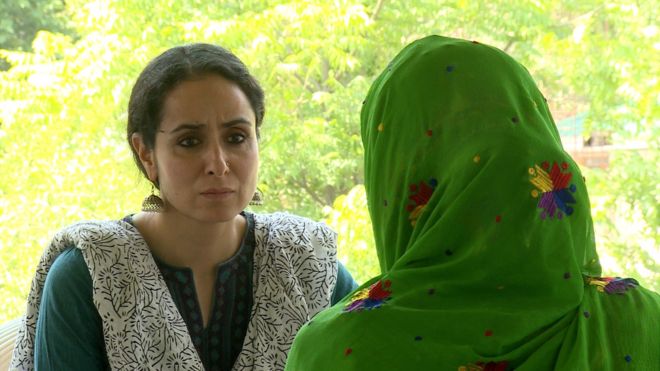
Aliya talking to victim
"We were getting ready for bed when the soldiers came. They took the men away. Some started drinking alcohol. I was holding my two-year-old daughter in my arms when they tried to grab me.
"I resisted, and in the scuffle she fell out of my arms, and out of the window. She was crippled for life.
"Three soldiers grabbed me, tore my pheran, my shirt - I don't even know what all happened after that. There were five of them. I still remember their faces."
Zareena was also in the same house. It had only been 11 days since her wedding.
"I had returned from my parents' house that very day.
"Some soldiers asked my mother-in-law about all the new clothes hanging in the room, so she told them, 'here, she is our new daughter-in-law, our new bride'.
"What happened after that, I cannot begin to describe it. We haven't just been wronged, what we have faced is an infinite injustice. Even today when we see soldiers we start shaking with fear."
The people of Kunan and neighbouring Poshpora accuse the Indian army of carrying out a planned mass rape of the women in these two far-flung villages. They also claim that while the women were gang-raped, the men were subjected to horrific torture, and that they have been fighting for justice these last 26 years.
In Srinagar when I spoke with a minister in the state government, Naeem Akhtar, about these allegations he said that in conflicts like Kashmir truth often gets obscured by the layer of dust that settles on it.
And now it seems a group of young Kashmiri women are determined to wipe this dust away.
http://www.bbc.co.uk/news/world-asia-41268906

Tuesday, 21 November 2017

On Insulting Islam: Does the Quran Ask Muslims to Respond with Patience or Violence?

Works in Progress3

Last Friday at least 30 Hindu homes were burned to the ground by thousands of enraged Muslim protesters after a local Hindu named Titu Chandra made a ‘blasphemous Facebook post’ insulting Islam and the Prophet (ï·º) in Rangpur, Bangladesh. After initially seeing the post, hundreds of Muslim locals began protesting and gave the authorities an ultimatum to arrest Chandra within twenty four hours. Since the police failed to do so, the protesters were joined by around 8,000 Muslims from surrounding villages and began torching homes in Chandra’s village named Thakubari, a predominantly Hindu neighbourhood. The resultant fires and destruction has left dozens of Hindu families totally homeless and penniless.

Similar atrocities have occurred in the past in other parts of the country. For instance, in November last year, a Muslim mob armed with locally-made weapons demolished at least 10 temples to the ground and vandalised hundreds of houses of the Hindu community in Brahmanbaria‘s Nasirnagar upazila, similarly in response to a Facebook post which allegedly insulted Islam.
Aside from the absurdity of attacking a whole community for the purported actions of single individuals within that community, it is important to note that these incidents are also utterly absurd and unacceptable from an Islamic point of view. Even if the miscreants had not opted for collective punishment and had simply gone after the specific individuals who had ‘insulted Islam’, that would also be condemnable since the Quran categorically prohibits violence in response to insults. For Muslims who are unsure about how to respond to insults about Islam or are even the slightest bit doubtful as to the unacceptability of the miscreants’ actions, I quote only two Quranic verses from the plethora of Islamic sources which preach patience and forgiveness in the face of insult and slander.
In chapter 73 (Al Muzammil – The Wrapped Up), verse 10, in relation to those who insult or mock the Prophet (ï·º) or Islam, the Quran instructs to ‘be patient over what they say and keep away from them in a graceful manner.’ Some may argue that the injunction of this verse is repealed by verses of jihad which were revealed later on. However, in Maariful Quran, one of the most comprehensive and authoritative Quran commentaries of all time, Pakistani Islamic scholar Mufti Muhammad Shafi argues that a careful analysis indicates that the injunction is not repealed. The above verse enjoins patience and steadfastness in the face of hurtful things the enemies say and cutting ties with them courteously. This is not in conflict with verses that deal with reproof, punishment and armed struggle that were revealed subsequently since the former is a verse of general application (which is applicable under normal circumstances), whereas the latter verses on jihad and armed struggle are of specific application (to be followed during times of war). He makes clear that Islamic jihad and armed struggle is not a matter of taking revenge or expression of anger, which would be totally in conflict with patience, fortitude and courteous severance which is generally required of Muslims. He further argues that in cases of slander and insult, true Muslims do not even entertain the thought of revenge.
In Chapter 3 (Al-i-Imraan – The Family of Imraan), verse 186, the Quran states ‘You will absolutely hear hurtful words from those who were given the book way before you and people who commit adultery and blasphemy with Allah. If you can be patient and you can maintain your consciousness of Allah then that is the most noble of deeds – the highest of accomplishments that you can accomplish’. This verse was revealed in the context of a specific incident. Abu Bakr had angrily slapped a Jew who had snidely remarked that ‘Allah is poor and we are rich’. The Jew then complained to the Prophet (ï·º) and thereafter this verse was revealed and again instructs Muslims to practice to be patient when faced with situations of insult and mockery. Mufti Shafi comments that these situations are nothing but a trial for Muslims. The best course for them is to observe restraint and remain calm and composed.
Thus from the study of the above two verses which deal with cases of ‘insulting Islam’ or ‘hurting religious sentiments’, it becomes clear just how unacceptable both the Rangpur and Brahmanbaria incidents are. By trying to use Islam as a cloak to legitimise their senseless violence, these miscreants end up insulting the religion they claim to follow a thousand times more than any single anti-Islam Facebook post by a non-Muslim ever could. Interestingly, in both cases the victims complained of how all their houses were looted prior to being burned by the perpetrators. It is unsurprising that in their collective fit of rage they conveniently had the composure to ransack the Hindu homes and pocket the valuables before setting them on fire, possibly showing ulterior motives as in the Brahmanbaria attacks.
We can no longer remain passive in the face of attacks against our minorities, that too in the name of Islam. We need to unite and eradicate the fanatics from within our own communities and expose the fallacy of their ways to show they are not serving the interests of anyone but themselves.
https://taqbirhuda.wordpress.com/2017/11/13/on-insulting-islam-does-the-quran-ask-muslims-to-respond-with-patience-or-violence/

Thursday, 16 November 2017

The grandfather of the European Enlightenment was Muslim


Image result for averroes


What is the Muslim philosopher Averroes doing in the famous fresco “The School of Athens” of the Italian Renaissance painter Raphael? The painter brought together all thinkers and scientists that influenced the West. So, it’s no surprise that Plato and Aristotle are in the centre of this 16th century painting. More surprising is that two ‘Eastern’ persons are made part of the school: Zoroaster and Averroes. A similar surprise might occur to the readers of the Divina Commedia of Dante Alighieri. In this 14th century Renaissance masterpiece Dante gave his description of Heaven, Purgatory and Hell, with a special chapter on Limbo where good non-Christians were allowed to have a decent afterlife. In Limbo we not only find ancient Greeks and Romans, but also three Muslims: Averroes, Avicenna and Saladin.


The fact that two Renaissance masterpieces dealing with the fundaments of Western civilization are putting a Muslim in the centre of it, is odd to say the least. We learn that the Renaissance, Humanism and the Enlightenment were a purely European accomplishment. In this view, humanists like Petrarchwould have found lost Greek and Roman manuscripts in old abbey libraries. This would have triggered the end of the Dark Middle Ages, the revaluation of men over the Church and critical thinking over dogmas.


This historical narrative is simply wrong. Even though Roman books were indeed rediscovered, this is not true for the Greek texts. The most important Greek philosophers and scientists came to Europe because they were translated from Arabic, a translation movement that was initiated by the Caliphs of Baghdad in the 8th century. At the epicentre were Ptolemy’s astronomy, Euclid’s geometrics, and Galen’s medicine. At the same time, Indian and Persian scientific texts were translated. In turn, Muslim scientists wove these ideas together, both elevating them and creating new fields of science, such as chemistry and algebra. Their calculations were the basis of the discoveries of Copernic and Newton.


No less important at the court of Baghdad was philosophy. Plato and Aristotle were very popular and were the subjects of much study, discussion, and debate. However, Islamic philosophers ran into the same problem that both preceding Christians and those that would follow faced: how to reconcile philosophy with theology and sacred texts. In Europe, Saint Augustine (died 430 AD) had halted this debate in favour of theology, with critical thinking being banned ever since. Those that attempted to reopen this debate were quickly silenced or even excommunicated by the Church. Not so in the Arab World, at least not until the end of the 12th century.