Saturday, 23 December 2017


Friday, 22 December 2017
Thursday, 21 December 2017
Wednesday, 20 December 2017
Why are Polish people so wrong about Muslims in their country?

The exaggeration of the size of the Muslim community in Poland is tied with political changes in the country in the last couple of years and increasingly divisive nationalistic rhetoric around the imagined presence of Muslims in the country. The 2015 elections won by the right-wing Law and Justice party opened up a space in Parliament to members of the far right National Movement.
Politicians have frequently invoked Islamophobic rhetoric, empowering far-right groups and contributing to a climate where not only Islamophobia, but also anti-Semitism, homophobia, sexism and other expressions of hate seem permissible. This in turn empowered far-right groups that organised several anti-refugee and anti-Muslim demonstrations in 2015 in cities that are home to Muslim minorities such as Białystok. Wrocław, Gdańsk and Kraków.
While Muslims were previously disliked as an ‘external enemy’ and usually mentioned in the context of terrorist attacks abroad or through the Polish involvement in military invasions in Iraq and Afghanistan, the figure of the Muslim as a dangerous Other slowly transformed to an ‘internal enemy’ who was supposedly posing a threat to Poland.
The refugee crisis helped in cementing views that Muslims were taking over Europe. It mattered less that this was predominantly an imaginary threat as the substantial inflow of migrants and refugees to Poland has not taken place. The new Polish government has been particularly reluctant in opening its borders to refugees and as such, Poland did not experience a ‘migration crisis’ and was never even a transit country for refugees.
And yet Poles believed in the divisive rhetoric of many of its leaders about an imagined inflow of Muslims. Why? The media bombardment of stories about a Muslim invasion certainly fueled some of the misconceptions. Several conservative mainstream Polish news outlets in Poland published front cover images depicting Poland being ‘flooded’ by Muslims, for example carrying bombs, and drawing parallels to a famous image of Nazi invasion of Poland in the 1930s, with Muslims now being portrayed as German soldiers.
In contrast to other European countries where Islamophobia is on the rise, Poland’s minorities are too small a group to challenge these false ideas. Instead, they have painfully felt the country’s’ increasing hostility towards all forms of Otherness. Our research on Islamophobia in Poland has confirmed that there has been an unprecedented rise in anti-Muslim sentiments resulting in attacks on individuals, mosques and places of business such as kebab shops(for a detailed chronological review of recent attacks see the European Islamophobia Report 2015 and the forthcoming 2016 report).
LinkTuesday, 19 December 2017
Britain First supporter drove van into curry house with aim of 'killing a Muslim'
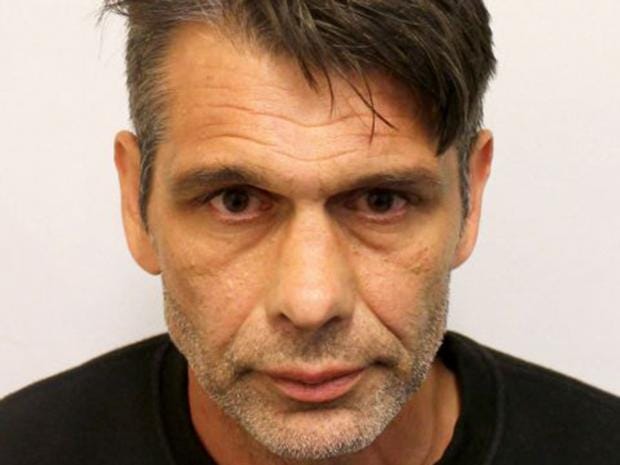
The court heard he had drunk two bottles of wine before grabbing his wife’s arm and threatening to “kill people” and himself.
During a racist rampage around Harrow, Zakrocki made a Nazi salute, pushed an unknown Asian man and repeatedly shouted “white power".
His concerned daughter called 999 after he left the family home making threats, and during a phone call with police, Zakrocki told them: “I'm going to kill a Muslim. I'm doing it for Britain.
"This is how I'm going to help the country. You people cannot do anything. I am going to do it my way because that is what I think is right."
He ended up outside Spicy Night restaurant, blocking the road with his white van.
Following an altercation in the street, he started the engine and aimed the vehicle at restaurant owner Kamal Ahmed.
Zakrocki mounted the pavement as he twice drove at his intended victim, who was forced to jump out of the way.
After he was arrested by armed police, the defendant was found to be in possession of a kitchen knife and baton-torch.
Police found a Nazi coin in Zakrocki's pocket and a stash of Britain First flyers and newspapers at his home in Harrow.
Monday, 18 December 2017
Meet Ozlem Sara Cekic, Denmark's first female Muslim MP who meets neo-Nazis for tea and cake
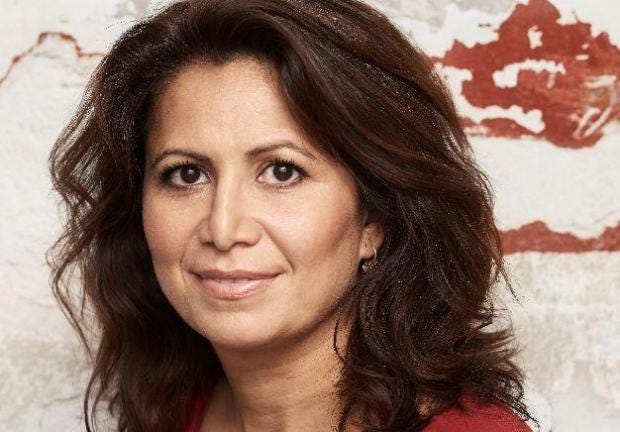
“I met him because he said he had a very good solution for all of these problems,” she tells The Independent. “I did not trust him. He said: ‘I don’t think we should deport people out the country: the black race is much more violent than the white race, and the best solution is to stop you having children.’
I said: ‘But I want children.’ He said: ‘I’ve found a solution, we can inseminate you with the white genes, so you can get the white children’.”
The campaigner has had a number of instances where she has been overwhelmed with emotion, and admits it can be difficult to engage with people with such angry and hateful views.
“I am a human – of course I get upset. I wish I did not cry,” she says. “It is very hard to talk with these people but someone has to do it. I no longer think that the right strategy is to ignore them.”
Saturday, 16 December 2017
'Tis That Time Of The Year Again
Its mid-December and for Muslims living in the western society, it's generally difficult times. Its the Christmas parties that can't be avoided that contains drinks and oppotunities to fall in Satan's traps.
Whenever I need to go to any of these unavoidable parties, my intention is to educate atleast 3 people on how Christmas has got nothing to do with Christianity and how bad Alcohol is for health. Follow these links if you want to get up to speed on Christmas and Alcohol.
There is a good article in Al-Jazeera about how Victorian Muslims celebrated Christmas. For those of you who may not know, Victorian era was the period of Queen Victoria's reign, from 20 June 1837 until her death on 22 January 1901.

While it is common for some "very religious" Muslims to say how Un-Islamic wishing your neighbour, friends or family who may not be Muslims are, I would point out to Fatawa on Islam Awareness Homepage that say otherwise.
Whenever I need to go to any of these unavoidable parties, my intention is to educate atleast 3 people on how Christmas has got nothing to do with Christianity and how bad Alcohol is for health. Follow these links if you want to get up to speed on Christmas and Alcohol.
There is a good article in Al-Jazeera about how Victorian Muslims celebrated Christmas. For those of you who may not know, Victorian era was the period of Queen Victoria's reign, from 20 June 1837 until her death on 22 January 1901.

The Liverpool Muslim Institute was founded by the Liverpudlian William 'Abdullah' Quilliam [Courtesy: Abdullah Quilliam Society]
At 6am on December 25, 1888, the winter sun was yet to rise over the English city of Liverpool.
A Victorian terrace house was feverish with activity.
The soft glow of candlelight emanating from 8 Brougham Terrace revealed men and women busily putting up decorations and preparing food for the big celebration ahead, Christmas Day.
In one corner, a familiar Victorian scene of a woman playing the piano and directing hymn rehearsals, the singers' voices muted by the howling of a bitter northeasterly wind as it rattled the thin panes of glass.
This was Britain's first mosque and Muslim community preparing for their very first Christmas Day.
At 8am, having led the tiny congregation in the early morning prayer, the Imam finally opened the mosque doors.
Imam William Henry "Abdullah" Quilliam founded the mosque after embracing Islam in 1887, aged 31 years old.
He was greeted by more than 100 of the city's poor, who had been invited to enjoy a charitable Christmas breakfast inside what locals called "Islam Church".
As the group of recent converts served the paupers a hearty meal of "sandwiches, bread and meat, seedloaf, bunloaf, bread and butter, tea and coffee," the music began.
Hymns praising the birth of the Prophet Isa, or Jesus, rung out through the venue. By evening, numbers swelled. Word had got around, and the Muslims offered a "substantial tea" and small musical concert to the visitors.
The entertainment began with "mesmeric performances" by two young Muslims before "some delightful airs upon the zither, the fairy bells and the mandolin" by one Miss Warren.
The finale was a "magic lantern" show and photo series from the imam's recent tour across distant Muslim lands.
These descriptions of Victorian Muslims at Christmas were taken from the pages of The Crescent, the country's first Muslim newspaper.
It was published by the Liverpool Moslem Institute between 1893 and 1907 and was recently made available online by the Abdullah Quilliam Society - which is based at the historic mosque - in partnership with the British Library.
"This reminds us there was an earlier generation of Muslims, looking to spread the word of Islam through finding points in common rather than things to argue about," said Timothy Winter, a prominent British Muslim scholar.
Winter, the dean of Cambridge Muslim College and lecturer in Islamic Studies at the Faculty of Divinity, University of Cambridge, converted to Islam in 1979. He has worked extensively with the archives.
Britain's first Muslim community mostly comprised English converts.
The Christmas scenes, described in every January issue of The Crescent, may come as a surprise.
Winter said the festivities demonstrated a willingness to appropriate local traditions, something that was easier because the group had grown up with them.
"They possessed a spirit of openness and hospitality and were more concerned with God and truth and conveying the word [as opposed to] boundary issues and questions of identity and difference," Winter told Al Jazeera.
Quilliam's role and influence were such that he was given the title of Sheikh Ul Islam of Britain by the Ottomans, and when he left Liverpool in 1908, it seems his community disbanded too.
Today, there are more than 2.5 million Muslims in Britain and, unlike Quilliam's community, they hail from a multitude of ethnic and cultural backgrounds and observe Islam differently.
"The Victorian Muslims were a small community, almost exclusively white English," said Sadiya Ahmed, founder of Everyday Muslim - an organisation which preserves Britain's Muslim heritage.
"Today, we have Muslims in Britain whose families have come from all over the world as well as those who are ethnically English, and this inevitably means they approach Christmas in a number of ways," she told Al Jazeera.
While it is common for some "very religious" Muslims to say how Un-Islamic wishing your neighbour, friends or family who may not be Muslims are, I would point out to Fatawa on Islam Awareness Homepage that say otherwise.
Muslims, however, are most respectful of what others believe and wish to live on friendly terms with all their neighbors, whether they are Muslim or not. In this context, returning the Christmas greetings of non-Muslim friends does not present us with a problem.ALLAHU ALAM الله اعلم
Obviously, if we sent a card, it would not be a religious card with Christian symbols, but rather some other symbol of the festive season. If the people we are responding to are devout believers in the Christmas message, we might send a greeting that says something like, "May God bless you all as you celebrate your feast," out of respect for their religious belief.
If they are, like the vast majority, simply celebrating what has become an important social occasion, we can respond to a well-intentioned greeting with a card that says something like "Compliments of the season" or "Greetings," since neither they nor we are celebrating the religious festival.
In such a context, even a card with a picture of a tree or some mistletoe or a robin red-breast, and the greeting "Merry Christmas" is not really a problem for either of us.
Going for drinks in the pub to celebrate is clearly out of the question. Going to parties where alcohol is being consumed is not how Muslims behave. However, if our non-Muslim neighbors invite us into their house for a piece of Christmas cake or a mince pie, we can accept their invitation.
Christmas should not be allowed to become a time where Muslims are being singled out as being unfriendly or not a part of the community. Indeed, we should be seen by our neighbors as full of fun and quite comfortable living with them. Let us not forget, though, to invite those same people to join us in our own homes at the time of the `Eid or to join us for iftar during Ramadan.
Showing our non-Muslim friends that Islam is a religion of peace and that we are peaceful and kind people is, indeed, at the heart of how we should behave. Peaceful and kind does not, of course, mean weak. We are not offering Christmas greetings out of weakness because we are in a minority. No, our greetings to our neighbors come from a strong and proud faith that we are called to be Muslim.
Our actions throughout the year, not just at Christmas time, should show how good Muslims behave and how we are faithful to prayer and dedicate all things to the Mercy of Almighty Allah. Indeed, Christmas time is actually a time for da`wah.
In a world which has lost all sense of God and which turns to alcohol and consumerism to drown its sorrows, we can show that there is a better way and that the way for all mankind to experience peace is not by kissing under the mistletoe or visiting Santa Claus in his Grotto, but by embracing Islam. In sha' Allah, even Christmas is a time for us to tell others about Islam.
Friday, 15 December 2017
Jerusalem
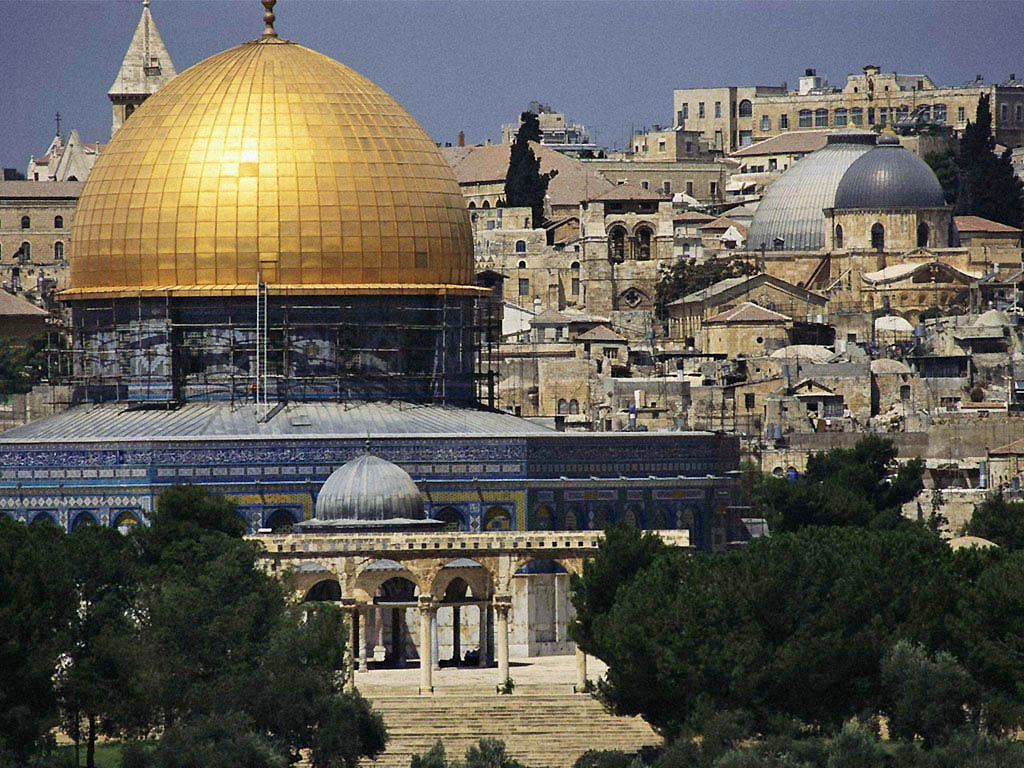
Jerusalem: One of the Prophet’s companions reported: "Once I asked Prophet Muhammad (peace be upon him) what was the first mosque established on earth; he said Al-Masjid (the mosque) Al-Haram (in Mecca). Then I asked him: Then which mosque? He replied: Al-Masjid Al-Aqsa."
Chapter 17, verse 1, of the Quran states: "Glorified be He (God) who took his servant (Muhammad) for a journey by night from al-Masjid al-Haram (in Mecca) to al-Masjid al-Aqsa (in Jerusalem), whose precincts we have blessed."
Thursday, 14 December 2017
Advice of the Prophet

Companion of Prophet Muhammad  , Khalid ibn El Waleed narrated the following:
, Khalid ibn El Waleed narrated the following:
A Bedouin came one day to the Prophet and said to him, "O, Messenger of God! I've come to ask you a few questions about the affairs of this life and the Hereafter. "
and said to him, "O, Messenger of God! I've come to ask you a few questions about the affairs of this life and the Hereafter. "
The Prophet responded Ask what you wish.
responded Ask what you wish.
Bedouin: I'd like to be the most learned of men.
Prophet: Fear God, and you will be the most learned of men.
Prophet: Fear God, and you will be the most learned of men.
Bedouin: I wish to be the richest man in the world.
Prophet: Be contented, and you will be the richest man in the world.
Prophet: Be contented, and you will be the richest man in the world.
Bedouin: I'd like to be the most just man.
Prophet: Desire for others what you desire for yourself, and you will be the most just of men.
Prophet: Desire for others what you desire for yourself, and you will be the most just of men.
Bedouin: I want to be the best of men.
Prophet: Do good to others and you will be the best of men.
Prophet: Do good to others and you will be the best of men.
Bedouin: I wish to be the most favored by God.
Prophet: Engage much in God's praise, and you will be most favored by Him.
Prophet: Engage much in God's praise, and you will be most favored by Him.
Bedouin: I'd like to complete my faith.
Prophet: If you have good manners you will complete your faith.
Prophet: If you have good manners you will complete your faith.
Bedouin: I wish to be among those who do good.
Prophet: Adore God as if you see Him. If you don't see Him, Know that He sees you. In this way you will be among those who do good.
Prophet: Adore God as if you see Him. If you don't see Him, Know that He sees you. In this way you will be among those who do good.
Bedouin: I wish to be obedient to God.
Prophet: If you observe God's commands you will be obedient.
Prophet: If you observe God's commands you will be obedient.
Bedouin: I'd like to be free from all sins.
Prophet: Bathe yourself from impurity and you will be free from all sins.
Prophet: Bathe yourself from impurity and you will be free from all sins.
Bedouin: I'd like to be raised on the Day of Judgment in the light.
Prophet: Don't wrong yourself or any other creature, and you will be raised on the Day of Judgment in the light.
Prophet: Don't wrong yourself or any other creature, and you will be raised on the Day of Judgment in the light.
Bedouin: I'd like God to bestow His mercy on me.
Prophet: If you have mercy on yourself and on others, God will grant you mercy on the Day of Judgment.
Prophet: If you have mercy on yourself and on others, God will grant you mercy on the Day of Judgment.
Bedouin: I'd like my sins to be very few.
Prophet: If you seek the forgiveness of God as much as you can, your sins will be very few.
Prophet: If you seek the forgiveness of God as much as you can, your sins will be very few.
Bedouin: I'd like to be the most honorable man.
Prophet: If you do not complain to any fellow creature, you will be the most honorable of men.
Prophet: If you do not complain to any fellow creature, you will be the most honorable of men.
Bedouin: I'd like to be the strongest of men.
Prophet: If you put your trust in God, you will be the strongest of men.
Prophet: If you put your trust in God, you will be the strongest of men.
Bedouin: I'd like to enlarge my provision.
Prophet: If you keep yourself pure, God will enlarge your provision.
Prophet: If you keep yourself pure, God will enlarge your provision.
Bedouin: I'd like to be loved by God and His messenger.
Prophet: If you love what God and His messenger love, you will be among their beloved ones.
Prophet: If you love what God and His messenger love, you will be among their beloved ones.
Bedouin: I wish to be safe from God's wrath on the Day of Judgment.
Prophet: If you do not lose your temper with any of your fellow creatures, you will be safe from the wrath of God on the Day of Judgment.
Prophet: If you do not lose your temper with any of your fellow creatures, you will be safe from the wrath of God on the Day of Judgment.
Bedouin: I'd like my prayers to be responded.
Prophet: If you avoid forbidden actions your prayers will be responded.
Prophet: If you avoid forbidden actions your prayers will be responded.
Bedouin: I'd like God not to disgrace me on the Day of Judgment.
Prophet: If you guard your chastity, God will not disgrace you on the Day of Judgment.
Prophet: If you guard your chastity, God will not disgrace you on the Day of Judgment.
Bedouin: I'd like God to provide me with a protective covering on the Day of Judgment.
Prophet: Do not uncover your fellow peoples faults, and God will provide you with a covering protection on the Day of Judgment.
Prophet: Do not uncover your fellow peoples faults, and God will provide you with a covering protection on the Day of Judgment.
Bedouin: What will save me from sins?
Prophet: Tears, humility and illness.
Prophet: Tears, humility and illness.
Bedouin: What are the best deeds in the eyes of God?
Prophet: Gentle manners, modesty and patience.
Prophet: Gentle manners, modesty and patience.
Bedouin: What are the worst evils in the eyes of God?
Prophet: Hot temper and miserliness.
Prophet: Hot temper and miserliness.
Bedouin: What alleviates the wrath of God in this life and in the Hereafter?
Prophet: Concealed charity and kindness to relatives.
Prophet: Concealed charity and kindness to relatives.
Bedouin: What extinguishes hell's fires on the Day of Judgment?
Prophet: Patience in adversity and misfortunes.
Prophet: Patience in adversity and misfortunes.
Imam El Mustaghfiri said: "I have never heard a tradition more comprehensive of the beauties of religion, and more beneficial than this hadith. It collects all the good things of Islam but not put to use." (Related by Imam Ibn Hambal)
NOTE: This is a widely quoted narration but according to some sources it does not have an "Isnad" (chain of narrators). Hadith scholars note that this is possibly a collection and compilation of the meanings of several well-known hadiths and reports.
LinkWednesday, 13 December 2017
Subscribe to:
Posts (Atom)