Tuesday, 1 June 2010

Robert Fisk: Western leaders are too cowardly to help save lives


It is a fact that it is ordinary people, activists, call them what you will, who now take decisions to change events

Has Israel lost it? Can the Gaza War of 2008-09 (1,300 dead) and the Lebanon War of 2006 (1,006 dead) and all the other wars and now yesterday's killings mean that the world will no longer accept Israel's rule?

Don't hold your breath.

You only have to read the gutless White House statement – that the Obama administration was "working to understand the circumstances surrounding the tragedy". Not a single word of condemnation. And that's it. Nine dead. Just another statistic to add to the Middle East's toll.

But it's not.

In 1948, our politicians – the Americans and the British – staged an airlift into Berlin. A starving population (our enemies only three years before) were surrounded by a brutal army, the Russians, who had erected a fence around the city. The Berlin airlift was one of the great moments in the Cold War. Our soldiers and our airmen risked and gave their lives for these starving Germans.

Incredible, isn't it? In those days, our politicians took decisions; our leaders took decisions to save lives. Messrs Attlee and Truman knew that Berlin was important in moral and human as well as political terms.

And today? It was people – ordinary people, Europeans, Americans, Holocaust survivors – yes, for heaven's sake, survivors of the Nazis – who took the decision to go to Gaza because their politicians and their statesmen had failed them.

Where were our politicians yesterday? Well, we had the ridiculous Ban Ki-moon, the White House's pathetic statement, and dear Mr Blair's expression of "deep regret and shock at the tragic loss of life". Where was Mr Cameron? Where was Mr Clegg?

Back in 1948, they would have ignored the Palestinians, of course. It is, after all, a terrible irony that the Berlin airlift coincided with the destruction of Arab Palestine.

But it is a fact that it is ordinary people, activists, call them what you will, who now take decisions to change events. Our politicians are too spineless, too cowardly, to take decisions to save lives. Why is this? Why didn't we hear courageous words from Messrs Cameron and Clegg yesterday?

For it is a fact, is it not, that had Europeans (and yes, the Turks are Europeans, are they not?) been gunned down by any other Middle Eastern army (which the Israeli army is, is it not?) there would have been waves of outrage.

And what does this say about Israel? Isn't Turkey a close ally of Israel? Is this what the Turks can expect? Now Israel's only ally in the Muslim world is saying this is a massacre – and Israel doesn't seem to care.

But then Israel didn't care when London and Canberra expelled Israeli diplomats after British and Australian passports were forged and then provided to the assassins of Hamas commander Mahmoud al-Mabhouh. It didn't care when it announced new Jewish settlements on occupied land in East Jerusalem while Joe Biden, the Vice-President of its erstwhile ally, the United States, was in town. Why should Israel care now?
How did we get to this point? Maybe because we all grew used to seeing the Israelis kill Arabs, maybe the Israelis grew used to killing Arabs. Now they kill Turks. Or Europeans. Something has changed in the Middle East these past 24 hours – and the Israelis (given their extraordinarily stupid political response to the slaughter) don't seem to have grasped what has happened. The world is tired of these outrages. Only the politicians are silent.

Diplomatic storms

*Goldstone report, November 2009

Israel launched Operation Cast Lead in December 2008 with the declared aim of halting rocket fire from Gaza into Israel. More than 1,400 Palestinians were killed in the three-week conflict along with 13 Israelis. The South African jurist Richard Goldstone's report into the conflict found both Israel and the Hamas movement that controls the Strip guilty of war crimes, but focused more on Israel. Israel refused to co-operate with Goldstone and described his report as distorted and biased.

* The al-Mabhouh assassination, January-May 2010

Britain and Australia expelled Israeli diplomats after concluding that Israel had forged British and Australian passports used by assassins to kill a Hamas commander in Dubai. Israel has neither confirmed or denied a role in the killing of Mahmoud al-Mabhouh in his hotel room in January. Britain said such misuse of British passports was "intolerable". Australia said it was not the behaviour of "a nation with whom we have had such a close, friendly and supportive relationship".

*Settlements row, March 2010

Israel announces plans, during visit by US Vice-President Joe Biden, to build 1,600 homes for Jews in an area of the West Bank annexed by Israel. The announcement triggers unusually harsh criticism from the United States. Washington said it damaged its efforts to revive the Middle East peace process. US Secretary of State Hillary Clinton said the project was an insult. Netanyahu said he was blindsided by planning bureaucrats and apologised to Biden. Today's meeting with Barack Obama at the White House, called off by Mr Netanyahu so he could return home to deal with the flotilla crisis, was supposed to be another part of the fence-mending between the two allies.

*Nuclear secrecy, May 2010

Israel, widely assumed to have the Middle East's only nuclear arsenal, has faced renewed calls to sign a global treaty barring the spread of atomic weapons. Signatories of the Non-Proliferation Treaty (NPT) last week called for a conference in 2012 to discuss banning weapons of mass destruction throughout the Middle East. The declaration was adopted by all 189 parties to the NPT, including the US. It urged Israel to sign the NPT and put its nuclear facilities under UN safeguards.

source

Dissent is a dirty word in Israel


JERUSALEM: When an 81-year-old scholar is deemed threatening and the majority thinks human rights organisations enjoy too much freedom of expression , it is time to grab your worry beads. When the leader of the opposition has a warrant against her in Britain for ‘war crimes’ , it is time to wonder what is happening inside the storied and spunky country called Israel. When former supporters begin to whisper the word ‘apartheid’ to describe Israeli policies in the occupied territories, it is time to hold your head.

Recently, Noam Chomsky, the world renowned American academic, was barred from entering Israel to deliver a lecture at a Palestinian university in the occupied West Bank. After a two-hour grilling that was Kafkaesque and demeaning, he was told, “Israel does not like what you say.” Chomsky recalled he had been turned away once before “in another age, another time” by the Soviets in 1968 when he tried to visit Alexander Dubcek in Czechoslovakia, father of the crushed Prague Spring.

The fear of Chomsky that Israeli officials displayed is a fear of ideas and in what is becoming fairly typical in a country as it careens rightward. Chomsky has been a consistent and blistering critic of Israel as he has been of his own government, the United States. Unforgiving in his analysis, he stands apart from the army of US supporters who easily rationalise any and many policies of Israel. He is seen as a traitor to the cause, more so because he is Jewish . And he is sympathetic to the Palestinian struggle — his ultimate sin. “Israel looks like a bully who has been insulted by a superior intellect and is now trying to fight it, arrest it and expel it,” said an editorial in the liberal newspaper Haaretz.

Dissent is increasingly a dirty word in Israel and the right to be different under threat. Israel prides itself as the only democracy in the Middle East and was recently admitted to the exclusive club called the Organization for Economic Cooperation and Development.

While front pages celebrated this acknowledgment from Western powers, they also reported on the case of Dan Goldberg, who is forced to wait in a Mumbai hotel with his newborn twins because of a judge’s decidedly illiberal stance. Goldberg is gay and like many others went to India in search of a surrogate mother. But a family court judge raised questions he could be “a pedophile or a serial killer” . The judge won’t order a paternity test required before the infants can come home to Israel.

The gay community is justifiably outraged both at the judge’s innuendos and at the interior minister Eli Yishai’s foot dragging, who is also the deputy prime minister. Yishai has said this in the past: “Gays and lesbians are sick people. It’s definitely a disease. They haven’t invented a cure for it yet but I hope they will.” Tolerance is not his strong suit but someone like him would never have made it to the cabinet in most advanced democratic countries.
Yishai and his ultra orthodox Shas Party are sending a signal to gays to think hard before they decide to become parents. This, when Goldberg is a law-abiding citizen who did his mandatory army service and is listed as a reserve. Incidentally, members of the Jewish Orthodox groups like Yishai’s are exempt from the army under an old deal made by Israel’s first prime minister, David Ben-Gurion . What seemed like political accommodation at the time has become political extortionism in today’s Israel as religious parties push the country away from its democratic ideals and into right-wing oblivion because they are members of the ruling coalition.

The superstructure constructed with the twin pillars of religion and security has seeped well into the population. Surveys repeatedly find Israelis accepting and adapting readily to this ‘we-are-under-constant-threat’ official mindset . They support gag orders, indefinite detentions and harsh punishment for those who blow the whistle on government misconduct. A survey by the Tami Steinmetz Center for Peace Research at Tel Aviv University published in February showed more than 57 per cent support for curbing human rights organisations , which expose immoral behavior by Israel. A majority felt that there was “too much freedom of expression” and a whopping 82 per cent backed stiff penalties for people who leak information to expose misconduct by the defence forces.

This siege mentality has been more in evidence after the Gaza War (Dec 2008-Jan 2009) for which Israel came under heavy criticism. European governments and NGOs took the lead in talking about “Israeli war crimes” but Israel’s response was to term them anti-Semitic and move on. It has become a reflex action to denounce any and all critics as anti-Semitic and if they are Jewish, as self-hating Jews. Richard Goldstone, who prepared a 547-page report on the Gaza War for the United Nations after interviewing hundreds of witnesses, was denounced and discredited. Every detail from his past was dug up while his detailing of Israeli excesses was not deemed worthy of an answer.

The Goldstone report cited Yishai, the aforementioned interior minister, as saying, “We should bombard thousands of houses in Gaza, destroy Gaza. As simple as that.” There was no call for his resignation, no outrage that a minister of a democratic country can utter those words while his country is supposedly working to find a solution to the conflict.

And finally the official treatment meted out to the Arab minority living in Israel — not those in the occupied territories but the 1.37 million Arab citizens who pay taxes and vote here but suffer institutionalised discrimination. Allocation of resources for education and housing for them is abysmally low compared to the figures for the Jewish majority . Arab villages lack basic amenities and municipal support and permits are rarely given to expand housing. They are second-class citizens in a country officially at war with their fellow Palestinians in the West Bank and Gaza.

To be sure, the embrace of democracy is real but there is a double standard, which finds an explanation for the distortions. And the distortions appear to be growing.
source

Monday, 31 May 2010

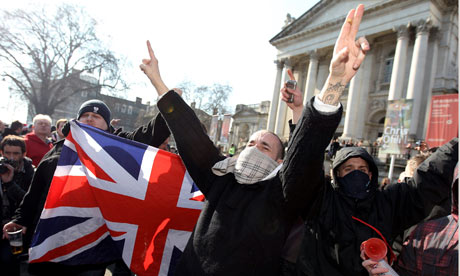
English Defence League: new wave of extremists plotting summer of unrest


In the back room of a sparsely decorated pub in Bolton a man with a shaved head and a tattoo poking out above his shirt collar hands out what look like wraps of cocaine to his friends. It is just after 11am but behind him the pub is already packed with young, mainly white, men. Suddenly it erupts.

"We want our country back. We want our country back … Muslim bombers off our streets." The chants ring out as tables are thumped and plastic pint glasses are thrust into the air.

"It is going to be a good 'un today," says the shaven-headed man, leaning across the table towards me to make himself heard. "We're going to get to twat some Pakis – I can feel it."

The pub, a few hundred yards from Bolton railway station, is the latest gathering point for the most significant rightwing street movement the UK has seen since the heyday of the National Front in the 1970s.

For the past four months the Guardian has joined English Defence League demonstrations, witnessing its growing popularity, from protests attracting just a few hundred hardcore activists at the end of last year to rallies and marches which are bringing thousands of people on to the street – and into direct conflict with the police and local Muslim communities.

The EDL plans to step up its campaign in coming weeks, culminating in marches through some of the UK's most high-profile Muslim communities, raising the spectre of widespread unrest.

With the British National party beset by infighting and recriminations after its poor showing in last month's local and national elections, the UK is facing the prospect of rightwing activists turning away from the ballot box and back to the street for the first time in three decades.

The English Defence League sprang up in Luton last year in reaction to a demonstration by a small extreme Islamist group during a homecoming parade by the Royal Anglian Regiment.

Since then this chaotic organisation – based largely around existing football groups and hooligan networks – has mobilised thousands of people against what it terms "Islamic extremism".

In telephone conversations and face-to-face meetings, members of the EDL's secretive leadership team repeatedly told the Guardian that the group is not racist and just wants to "peacefully protest against militant Islam".

But at each demonstration I attended while making an undercover film for the Guardian's investigative film unit, Guardian Films, I was confronted by casual – often brutal – racism, a widespread hatred of Muslims and often the threat of violence.

It was only possible to film some of the most alarming scenes with a hidden camera. Inside a pub in Stoke in January about 3,000 EDL supporters gathered for the first demonstration of the year. They had spent the past four hours drinking. The balcony around the top of the cavernous pub was draped in flags bearing the names of different football clubs – Wolves, Newcastle, Aston Villa – and the chants "We all hate Muslims" and "Muslim bombers off our streets" filled the air. The atmosphere was tense, and not just because of the growing anti-Islamic rhetoric. The pub was packed with rival football gangs from across the Midlands and the north of England. Twice, fighting broke out as old rivalries failed to be subdued by the new enemy – Islam. "They're just kids," said one man. "That is not what we are here for today."

As we moved outside for the EDL protest – during which supporters became involved in violent clashes with the police – a woman asked me for a donation to support the "heroes coming back injured from Afghanistan". I put a pound in the bucket. "Thanks love," she said. "They go over there and fight for this country and then come back to be faced with these Pakis everywhere." She paused, before adding: "But to be honest it is the niggers I can't stand."

This kind of casual racism is not hard to find on EDL demonstrations. The Guardian has also identified a number of known rightwing extremists who are taking an interest the movement – from convicted football hooligans to members of violent rightwing splinter groups. The EDL says it is doing what it can to keep them away but acknowledged their influence.

"At previous events, we have had far-right groups like Combat 18 turning up," the EDL's self-proclaimed leader, who uses the pseudonym Tommy Robinson, said in a local newspaper interview. "It's naive to guarantee no violence."

Nick Lowles, of the anti-fascist group Searchlight, says these groups have a growing – and dangerous – influence.

"What we are seeing is more organised fringe elements – the National Front, old networks of Combat 18 people and members of the BNP – who are getting involved specifically to try and use the EDL to spark serious disorder," says Lowles. "This is a serious development; we just need one of these demonstrations to go wrong – for there to be a serious incident – and it won't just lead to disorder in Dudley, Bolton or wherever, it will spread to towns and cities across the country."

Strange coalition

But the EDL is not a simple rerun of previous far-right street groups. On each demonstration there is a smattering of non–white faces and one of the group's leaders is Guramit Singh, a British-born Sikh. The organisation's core support appears to be young white men who are often fuelled by drink and sometimes drugs. But its Islamophobic message seems to have acted as a lightning rod for a strange coalition – from rightwing Christians who see it as being on the frontline in the "global fight against Islam" to gay rights activists.

At the front of the EDL demonstration in Bolton in March, among the banners decrying Islam, was a man holding up a pink triangle. He looked nervous when I asked him what he was doing there. "This is the symbol gay people were made to wear under Hitler," he said. "Islam poses the same threat and we are here to express our opposition to that." It turns out he is a member of the EDL's lesbian, gay, bisexual and transgender division, which has 115 members.

Many of the people I met said they had never been involved in rightwing politics before. "I finished my night shift at 5am and we got on a coach down from Wigan about six," says Steve as the Victoria line tube train rattles along towards Pimlico and the EDL's London demonstration a few weeks later. "Reckon I should be back in time for it to start again at 10."

The carriage is packed with around 50 EDL supporters who set off from the north-west that morning. They launch into one of the EDL's favourite songs: "There were 10 Muslim bombers in the air." Steve explains over the din how his factory is being "overrun by immigrants". Like others on EDL demonstrations, he exudes a sense of excitement that "something is happening". "We have had enough, no one is taking us seriously … about anything – but they are going to have to listen now."

But the EDL is not only attracting disaffected working-class men. On a chilly evening in early March, Alan Lake settles into his seat in a cafe in central London. This smartly dressed man in his mid-40s has emerged as a key figure in the organisation and is quickly into his stride – warning that the UK will have Sharia law in the next 40 years "unless something is done".

A London-based IT consultant, Lake has spoken at several EDL rallies and sees himself as one of the organisation's thinkers. "The middle-class intellectuals are coming forward and also American speakers – some of them quite famous, although I can't give you names yet … they love the fact that we can have people that can go on the streets."

Addressing a far-right anti-Islam conference in Sweden last year, Lake told delegates it was necessary to build a united "anti-Jihad movement" and spoke of the need for "people that are ready to go out in the street", boasting that he and his friends had begun to build alliances with "more physical groups like football fans". Lake says he is opposed to violence or confrontation but regularly returns to the importance of the EDL's physical presence.

"The EDL has a lot of support and is growing quickly and crucially what it has done is deliver an activist movement on the streets," he tells me subsequently. Pressed on the levels of violence at the demonstrations, he replies: "These people are not middle-class female teachers … if they continue to be suppressed it will turn nasty in one way or another … We have put bodies on the street, writing letters to the Times does not work … if we are going to have a mess that is so much grist to the mill."

Lake says he is exploring a political future for the EDL – and argues it should consider throwing its weight behind the UK Independence party. He later introduces me to Magnus Nielsen – a Ukip candidate in the general election – who has agreed to speak at forthcoming EDL rallies. Nielsen describes Muhammad as a "criminal psychopath", "the first cult leader" and "psychiatrically deranged". Lake says there is "some synergy" between the two groups.

A few weeks later Lake tells me that he is no longer an EDL spokesman. "I am really working on the Ukip thing so we can offer people an alternative," he says.

A spokesman for Ukip said it would not form any alliance with the EDL or any other "extremist" group.

However, these efforts appear to be part of tentative steps by the EDL to expand its reach beyond its street demonstrations. In March a delegation of activists travelled to Berlin to take part in an anti-Islam rally in support of far-right anti-immigrant Dutch politician Geert Wilders. It is also forging tentative links with the US anti-Islam group Stop the Islamification of America, whose New York demonstration was advertised on the EDL website in April.

Growing unrest

The upshot appears to be a movement that, although chaotic and beset by infighting, seems to be growing in scope and sometimes violence. At a protest in Dudley last month, demonstrators threw missiles at the police before ripping down barriers and rampaging through the town in an attempt to confront anti-racist protesters and local Asian youths. In Aylesbury a few weeks later they again clashed with police.

And despite the group's protestations to the contrary, the prospect of serious unrest is growing. The list of towns the EDL plans to hit this summer is lengthening – Newcastletomorrow, Cardiff, Dudley and Bradford over the next few weeks. According to Lowles the stakes are high. "What we are seeing now is the most serious, most dangerous political phenomenon that we have had in Britain for a number of years," he says. "With EDL protests that are growing week in, week out there is a chance for major disorder and a political shift to the right."

But the appeal of the EDL is not just down to the extreme opinions expressed by people such as Lake and Nielsen. In Stoke a group of teenagers who were on their first EDL demonstration said they had come after reading reports that "the Muslims" were planning to march through Wootton Bassett with 500 coffins. The proposed march was called by Anjem Choudary and his small extremist group Islam4UK. The group is reviled by the majority of Muslims and the demonstration did not go ahead. But this was lost on the outraged teenagers who turned up in Stoke and subsequently travelled to two of the next three EDL events.

Outside the Morpeth Arms on the banks of the Thames in March supporters gathered for the EDL's London demonstration. One who had travelled down from Blackburn was eager to know who had seen a television documentary that he thought showed how a Muslim group were taking over politics in east London. The EDL had carried a link to the film on the front of its website and most of the supporters drinking in the sunshine knew about it.

For Matthew Goodwin, an academic who specialises in far-right politics at Manchester University, this is a crucial difference between the EDL and previous far-right street movements.

"The reason why the EDL's adoption of Islamophobia is particularly significant is that unlike the 1970s, when the National Front was embracing antisemitism, there are now sections of the media and the British establishment that are relatively sympathetic towards Islamophobia," says Goodwin. "It is not difficult to look through the media and find quite hostile views towards Islam and Muslims. That is fundamentally different to the 1970s, when very few newspapers or politicians were endorsing the NF's antisemitic message."

"The point for your average voter is that if they see the EDL marching through their streets shouting about how the neighbourhood is about to be swamped by Muslims or how the UK is going to be Islamified by 2040, they are also receiving these cues from other sections of British society … the message of the EDL may well be legitimised if that continues."

The people on the sharp end of the EDL's message echo this view. Mujibul Islam, chair of the youth committee of the Muslim Council of Britain, says the foundations for the growth of the EDL have been laid not just by extremists but by countless political speeches and newspaper articles. "It simply would not be acceptable to say the things that are being said on these demonstrations about any other group – black people, Jewish people. But we are now in a position where it seems almost acceptable to say these things about Muslims."

He said the growth of the EDL was having a real impact on the way ordinary Muslims were being treated. "A woman I know got on to a tube train which had a lot of EDL supporters on recently and was really badly abused; another man was attacked as he made his way home on the train. These are the consequences of what we are seeing now. It is not just a theoretical debate about freedom of speech."
source

Saturday, 29 May 2010

Young. British. Female. Muslim.


It’s a controversial time for British women to be wearing the hijab, the basic Muslim headscarf. Last month, Belgium became the first European country to pass legislation to ban the burka (the most concealing of Islamic veils), calling it a “threat” to female dignity, while France looks poised to follow suit. In Italy earlier this month, a Muslim woman was fined €500 (£430) for wearing the Islamic veil outside a post office.

And yet, while less than 2 per cent of the population now attends a Church of England service every week, the number of female converts to Islam is on the rise. At the London Central Mosque in Regent’s Park, women account for roughly two thirds of the “New Muslims” who make their official declarations of faith there – and most of them are under the age of 30.

Conversion statistics are frustratingly patchy, but at the time of the 2001 Census, there were at least 30,000 British Muslim converts in the UK. According to Kevin Brice, of the Centre for Migration Policy Research, Swansea University, this number may now be closer to 50,000 – and the majority are women. “Basic analysis shows that increasing numbers of young, university-educated women in their twenties and thirties are converting to Islam,” confirms Brice.

“Our liberal, pluralistic 21st-century society means we can choose our careers, our politics – and we can pick and choose who we want to be spiritually,” explains Dr Mohammad S. Seddon, lecturer in Islamic Studies at the University of Chester. We’re in an era of the “religious supermarket”, he says.

Joanne Bailey
Solicitor, 30, Bradford

“The first time I wore my hijab into the office, I was so nervous, I stood outside on the phone to my friend for ages going, ‘What on earth is everyone going to say?’ When I walked in, a couple of people asked, ‘Why are you wearing that scarf? I didn’t know you were a Muslim.’

“I’m the last person you’d expect to convert to Islam: I had a very sheltered, working-class upbringing in South Yorkshire. I’d hardly even seen a Muslim before I went to university.

“In my first job at a solicitor’s firm in Barnsley, I remember desperately trying to play the role of the young, single, career woman: obsessively dieting, shopping and going to bars – but I never felt truly comfortable.

“Then one afternoon in 2004 everything changed: I was chatting to a Muslim friend over coffee, when he noticed the little gold crucifix around my neck. He said, ‘Do you believe in God, then?’ I wore it more for fashion than religion and said, ‘No, I don’t think so,’ and he started talking about his faith.

“I brushed him off at first, but his words stuck in my mind. A few days later, I found myself ordering a copy of the Koran on the internet.

“It took me a while to work up the courage to go to a women’s social event run by the Leeds New Muslims group. I remember hovering outside the door thinking, ‘What the hell am I doing here?’ I imagined they would be dressed head-to-toe in black robes: what could I, a 25-year-old, blonde English girl, possibly have in common with them?

“But when I walked in, none of them fitted the stereotype of the oppressed Muslim housewife; they were all doctors, teachers and psychiatrists. I was struck by how content and secure they seemed. It was meeting these women, more than any of the books I read, that convinced me that I wanted to become a Muslim.

“After four years, in March 2008, I made the declaration of faith at a friend’s house. At first, I was anxious that I hadn’t done the right thing, but I soon relaxed into it – a bit like starting a new job.

“A few months later, I sat my parents down and said, ‘I’ve got something to tell you.’ There was a silence and my mum said, ‘You’re going to become Muslim, aren’t you?’ She burst into tears and kept asking things like, ‘What happens when you get married? Do you have to cover up? What about your job?’ I tried to reassure her that I’d still be me, but she was concerned for my welfare.

“Contrary to what most people think, Islam doesn’t oppress me; it lets me be the person that I was all along. Now I’m so much more content and grateful for the things I’ve got. A few months ago, I got engaged to a Muslim solicitor I met on a training course. He has absolutely no problem with my career, but I do agree with the Islamic perspective on the traditional roles for men and women. I want to look after my husband and children, but I also want my independence. I’m proud to be British and I’m proud to be Muslim – and I don’t see them as conflicting in any way.”

Aqeela Lindsay Wheeler
Housewife and mother, 26, Leicester

“As a teenager I thought all religion was pathetic. I used to spend every weekend getting drunk outside the leisure centre, in high-heeled sandals and miniskirts. My view was: what’s the point in putting restrictions on yourself? You only live once.

“At university, I lived the typical student existence, drinking and going clubbing, but I’d always wake up the next morning with a hangover and think, what’s the point?

“It wasn’t until my second year that I met Hussein. I knew he was a Muslim, but we were falling in love, so I brushed the whole issue of religion under the carpet. But six months into our relationship, he told me that being with me was ‘against his faith’.

“I was so confused. That night I sat up all night reading two books on Islam that Hussein had given me. I remember bursting into tears because I was so overwhelmed. I thought, ‘This could be the whole meaning of life.’ But I had a lot of questions: why should I cover my head? Why can’t I eat what I like?

“I started talking to Muslim women at university and they completely changed my view. They were educated, successful – and actually found the headscarf liberating. I was convinced, and three weeks later officially converted to Islam.

“When I told my mum a few weeks later, I don’t think she took it seriously. She made a few comments like, ‘Why would you wear that scarf? You’ve got lovely hair,’ but she didn’t seem to understand what it meant.

“My best friend at university completely turned on me: she couldn’t understand how one week I was out clubbing, and the next I’d given everything up and converted to Islam. She was too close to my old life, so I don’t regret losing her as a friend.

“I chose the name Aqeela because it means ‘sensible and intelligent’ – and that’s what I was aspiring to become when I converted to Islam six years ago. I became a whole new person: everything to do with Lindsay, I’ve erased from my memory.

“The most difficult thing was changing the way I dressed, because I was always so fashion-conscious. The first time I tried on the hijab, I remember sitting in front of the mirror, thinking, ‘What am I doing putting a piece of cloth over my head? I look crazy!’ Now I’d feel naked without it and only occasionally daydream about feeling the wind blow through my hair. Once or twice, I’ve come home and burst into tears because of how frumpy I feel – but that’s just vanity.

“It’s a relief not to feel that pressure any more. Wearing the hijab reminds me that all I need to do is serve God and be humble. I’ve even gone through phases of wearing the niqab [face veil] because I felt it was more appropriate – but it can cause problems, too.

“When people see a white girl wearing a niqab they assume I’ve stuck my fingers up at my own culture to ‘follow a bunch of Asians’. I’ve even had teenage boys shout at me in the street, ‘Get that s*** off your head, you white bastard.’ After the London bombings, I was scared to walk about in the streets for fear of retaliation.

“For the most part, I have a very happy life. I married Hussein and now we have a one-year-old son, Zakir. We try to follow the traditional Muslim roles: I’m foremost a housewife and mother, while he goes out to work. I used to dream of having a successful career as a psychologist, but now it’s not something I desire.

“Becoming a Muslim certainly wasn’t an easy way out. This life can sometimes feel like a prison, with so many rules and restrictions, but we believe that we will be rewarded in the afterlife.”

Catherine Heseltine
Nursery school teacher, 31, North London

“If you’d asked me at the age of 16 if I’d like to become a Muslim, I would have said, ‘No thanks.’ I was quite happy drinking, partying and fitting in with my friends.

“Growing up in North London, we never practised religion at home; I always thought it was slightly old-fashioned and irrelevant. But when I met my future husband, Syed, in the sixth form, he challenged all my preconceptions. He was young, Muslim, believed in God – and yet he was normal. The only difference was that, unlike most teenage boys, he never drank.

“A year later, we were head over heels in love, but we quickly realised: how could we be together if he was a Muslim and I wasn’t?

“Before meeting Syed, I’d never actually questioned what I believed in; I’d just picked up my casual agnosticism through osmosis. So I started reading a few books on Islam out of curiosity.

“In the beginning, the Koran appealed to me on an intellectual level; the emotional and spiritual side didn’t come until later. I loved its explanations of the natural world and discovered that 1,500 years ago, Islam gave women rights that they didn’t have here in the West until relatively recently. It was a revelation.

“Religion wasn’t exactly a ‘cool’ thing to talk about, so for three years I kept my interest in Islam to myself. But in my first year at university, Syed and I decided to get married – and I knew it was time to tell my parents. My mum’s initial reaction was, ‘Couldn’t you just live together first?’ She had concerns about me rushing into marriage and the role of women in Muslim households – but no one realised how seriously I was taking my religious conversion. I remember going out for dinner with my dad and him saying, ‘Go on, have a glass of wine. I won’t tell Syed!’ A lot of people assumed I was only converting to Islam to keep his family happy, not because I believed in it.

“Later that year, we had an enormous Bengali wedding, and moved into a flat together – but I certainly wasn’t chained to the kitchen sink. I didn’t even wear the hijab at all to start with, and wore a bandana or a hat instead.

“I was used to getting a certain amount of attention from guys when I went out to clubs and bars, but I had to let that go. I gradually adopted the Islamic way of thinking: I wanted people to judge me for my intelligence and my character – not for the way I looked. It was empowering.

“I’d never been part of a religious minority before, so that was a big adjustment, but my friends were very accepting. Some of them were a bit shocked: ‘What, no drink, no drugs, no men? I couldn’t do that!’ And it took a while for my male friends at university to remember things like not kissing me hello on the cheek any more. I’d have to say, ‘Sorry, it’s a Muslim thing.’

“Over time, I actually became more religious than my husband. We started growing apart in other ways, too. In the end, I think the responsibility of marriage was too much for him; he became distant and disengaged. After seven years together, I decided to get a divorce.

“When I moved back in with my parents, people were surprised I was still wandering around in a headscarf. But if anything, being on my own strengthened my faith: I began to gain a sense of myself as a Muslim, independent of him.

“Islam has given me a sense of direction and purpose. I’m involved with the Muslim Public Affairs Committee, and lead campaigns against Islamophobia, discrimination against women in mosques, poverty and the situation in Palestine. When people call us ‘extremists’ or ‘the dark underbelly of British politics’, I just think it’s ridiculous. There are a lot of problems in the Muslim community, but when people feel under siege it makes progress even more difficult.

“I still feel very much part of white British society, but I am also a Muslim. It has taken a while to fit those two identities together, but now I feel very confident being who I am. I’m part of both worlds and no one can take that away from me.”

Sukina Douglas
Spoken-word poet, 28, London

“Before I found Islam, my gaze was firmly fixed on Africa. I was raised a Rastafarian and used to have crazy-long dreadlocks: one half blonde and the other half black.

“Then, in 2005, my ex-boyfriend came back from a trip to Africa and announced that he’d converted to Islam. I was furious and told him he was ‘losing his African roots’. Why was he trying to be an Arab? It was so foreign to how I lived my life. Every time I saw a Muslim woman in the street I thought, ‘Why do they have to cover up like that? Aren’t they hot?’ It looked oppressive to me.

“Islam was already in my consciousness, but when I started reading the autobiography of Malcolm X at university, something opened up inside me. One day I said to my best friend, Muneera, ‘I’m falling in love with Islam.’ She laughed and said, ‘Be quiet, Sukina!’ She only started exploring Islam to prove me wrong, but soon enough she started believing it, too.

“I was always passionate about women’s rights; there was no way I would have entered a religion that sought to degrade me. So when I came across a book by a Moroccan feminist, it unravelled all my negative opinions: Islam didn’t oppress women; people did.

“Before I converted, I conducted an experiment. I covered up in a long gypsy skirt and headscarf and went out. But I didn’t feel frumpy; I felt beautiful. I realised, I’m not a sexual commodity for men to lust after; I want to be judged for what I contribute mentally.

“Muneera and I took our shahada [declaration of faith] together a few months later, and I cut my dreadlocks off to represent renewal: it was the beginning of a new life.

“Just three weeks after our conversion, the 7/7 bombings happened; suddenly we were public enemy No 1. I’d never experienced racism in London before, but in the weeks after the bombs, people would throw eggs at me and say, ‘Go back to your own country,’ even though this was my country.

“I’m not trying to shy away from any aspect of who I am. Some people dress in Arabian or Pakistani styles, but I’m British and Caribbean, so my national dress is Primark and Topshop, layered with colourful charity-shop scarves.

“Six months after I converted, I got back together with my ex-boyfriend, and now we’re married. Our roles in the home are different, because we are different people, but he would never try to order me around; that’s not how I was raised.

“Before I found Islam, I was a rebel without a cause, but now I have a purpose in life: I can identify my flaws and work towards becoming a better person. To me, being a Muslim means contributing to your society, no matter where you come from.”

Catherine Huntley
Retail assistant, 21, Bournemouth

“My parents always thought I was abnormal, even before I became a Muslim. In my early teens, they’d find me watching TV on a Friday night and say, ‘What are you doing at home? Haven’t you got any friends to go out with?’

“The truth was: I didn’t like alcohol, I’ve never tried smoking and I wasn’t interested in boys. You’d think they’d have been pleased.

“I’ve always been quite a spiritual person, so when I started studying Islam in my first year of GCSEs, something just clicked. I would spend every lunchtime reading about Islam on the computer. I had peace in my heart and nothing else mattered any more. It was a weird experience – I’d found myself, but the person I found wasn’t like anyone else I knew.

“I’d hardly ever seen a Muslim before, so I didn’t have any preconceptions, but my parents weren’t so open-minded. I hid all my Muslim books and headscarves in a drawer, because I was so scared they’d find out.

“When I told my parents, they were horrified and said, ‘We’ll talk about it when you’re 18.’ But my passion for Islam just grew stronger. I started dressing more modestly and would secretly fast during Ramadan. I got very good at leading a double life until one day, when I was 17, I couldn’t wait any longer.

“I sneaked out of the house, put my hijab in a carrier bag and got on the train to Bournemouth. I must have looked completely crazy putting it on in the train carriage, using a wastebin lid as a mirror. When a couple of old people gave me dirty looks, I didn’t care. For the first time in my life, I felt like myself.

“A week after my conversion, my mum came marching into my room and said, ‘Have you got something to tell me?’ She pulled my certificate of conversion out of her pocket. I think they’d rather have found anything else at that point – drugs, cigarettes, condoms – because at least they could have put it down to teenage rebellion.

“I could see the fear in her eyes. She couldn’t comprehend why I’d want to give up my freedom for the sake of a foreign religion. Why would I want to join all those terrorists and suicide bombers?

“It was hard being a Muslim in my parents’ house. I’ll never forget one evening, there were two women in burkas on the front page of the newspaper, and they started joking, ‘That’ll be Catherine soon.’

“They didn’t like me praying five times a day either; they thought it was ‘obsessive’. I’d pray right in front of my bedroom door so my mum couldn’t walk in, but she would always call upstairs, ‘Catherine, do you want a cup of tea?’ just so I’d have to stop.

“Four years on, my grandad still says things like, ‘Muslim women have to walk three steps behind their husbands.’ It gets me really angry, because that’s the culture, not the religion. My fiancé, whom I met eight months ago, is from Afghanistan and he believes that a Muslim woman is a pearl and her husband is the shell that protects her. I value that old-fashioned way of life: I’m glad that when we get married he’ll take care of paying the bills. I always wanted to be a housewife anyway.

“Marrying an Afghan man was the cherry on the cake for my parents. They think I’m completely crazy now. He’s an accountant and actually speaks better English than I do, but they don’t care. The wedding will be in a mosque, so I don’t think they’ll come. It hurts to think I’ll never have that fairytale wedding, surrounded by my family. But I hope my new life with my husband will be a lot happier. I’ll create the home I’ve always wanted, without having to feel the pain of people judging me.”
source

Wednesday, 26 May 2010

Is Miss USA an inspiration, or an embarrassment?

VERSE OF THE DAY: CHOOSE GOD’S PROTECTION


The parable of those who choose protectors other than God is that of the spider that builds (itself) a dwelling. But truly, the flimsiest of dwellings is that of the spider. The Holy Quran, 29:41

Tuesday, 25 May 2010

How Western journalists reported the ban on burqa


Two weeks ago I was interviewed on an Australian television news program about the wave of proposed burqa bans in Europe, Canada, and now, apparently, in Australia. No one should be surprised about my opinion of the whole thing: It’s dumb.

My argument to George Negus, the interviewer at SBS, was simply that someone in a position of authority should have the wherewithal to ask a woman who wears the burqa whether she is forced to wear it and if she feels oppressed. If she is forced to do something that she doesn’t want to do, then it’s a symptom of possible domestic violence and there are existing laws to deal with that.

I also noted I didn’t see much difference between the Taliban forcing women to wear the burqa and some old white guys passing laws forcing women not to wear it. It’s all the same to me.

Mr. Negus, much to my surprise, had a good grasp of the burqa issue. Except for the briefest of moments when his staff asked me to if it is possible to wear the abaya and niqab for my appearance – as if it were some sort of costume I put on and take off when it suits my mood – I must say they didn’t have hint of Western bias in the way the interview was conducted.

This made an impression because the following week I attended a journalism workshop sponsored by the United Nations’ Alliance of Civilizations and Search for Common Ground in Beirut. Search for Common Ground is a group that’s been around for nearly 30 years with the goal of dealing with global conflict though collaborative problem-solving instead of taking an adversarial approach. The group uses the media, specifically print, television and radio, to resolve conflict in a constructive manner.

Many of the attendees at the workshop were journalists from Lebanon, Morocco, Yemen, Kuwait, Iraq, Syria, Egypt, Oman and Saudi Arabia. Although the burqa ban was not discussed specifically at the workshop, the SBS interview could have been held up as an example for Western media of intelligent reporting. The engine that drives the issue of the burqa is the Western press.

European and North American journalists, mostly white males with a sprinkling of their non-hijabi Muslim sycophants, are shaping the public debate surrounding the issue of whether the burqa is an oppressive symbol of Islam.

Commenting and reporting based solely on the Western concept of freedom (and forgetting the basics, such as freedom of choice), pundits and columnists have molded the issue into a battle between civilizations, Christian versus Muslim values, and modern ideals versus culture and tradition. Who’s going to win this argument?

Western media, of course. The West has the resources to use as a sledgehammer to make their point, while the Arab media shrink from the thought of confrontation.

But here’s a thought: The only journalist lazier than an Arab is a Westerner. I can’t think of a single reported instance of a Western newsperson asking a burqa-clad woman her opinion until someone bothered to ask Afghan lawmaker Shinkai Karokhail for a comment. Not surprisingly, she said the only thing she finds more “appalling” at being forced to wear a burqa is a law banning it.

All of this brings me back to the Beirut journalism workshop, which was filled with young, university-educated Muslim women. Many of these ladies wore hijabs and many wore the burqa, or abaya, in their native countries.

These women are visible and have an opinion worth considering. Yet they are virtually ignored by the media. These women simply don’t exist when lawmakers consider punitive laws affecting them and the cultural traditions they hold close to their heart.
The nature of journalism is to tell a story of conflict. No better example can be served than the burqa ban. Yet journalists can serve the international community better if it employed just a few of the goals of Search for Common Ground by seeking collaborative solutions to issues, and at the same time hold lawmakers and the Taliban accountable for the oppressive measures they force on Muslim women.

source

Monday, 24 May 2010

Muslim leader: find wives in Britain not Pakistan and India


Muslim men have been told to marry women born in Scotland rather than import wives from Pakistan and India.

Shaykh Amer Jamil, a Glasgow-born Islamic scholar, warned that Asian women who have grown up in Scotland are being left on the shelf in favour of wives from outside the country.

Parents often prefer their sons to have arranged marriages with women who grew up in the Indian sub-continent, as they are seen as better partners. But this means there are increasing numbers of British women unable to find a husband.

Islamic dating events have been set up to try and address the situation, but the balance is so heavily weighted towards women that few marriages result from these events.

Shaykh Jamil, an Islamic scholar who set up a family counselling service called Unity Family Services, said: “I would say the situation is at a critical level. There are many well-educated women up and down the country who want to get married but are not finding the right match. There is an acute shortage of suitable male options and the ones who are available are getting married from back home.

“Consequently, this leads to many women reluctantly having to bring someone over from south Asia and that can lead to problems. The men coming over have a different mentality and are not used to seeing a female working or having a life outside of the home. It makes sense to marry from within the UK as both partners will speak English and will be familiar with British culture. This will also make raising children much easier.”

There are also community cohesion implications to the trend, as women come over from Pakistan who cannot speak English and are unused to the culture.

Arranged marriages are often facilitated by an informal matchmaking network of women called Aunty Gees. Shaaista Yousaf is one of these women and she has been arranging marriages for more than a decade. Currently, she knows 30 eligible males and 80 females.

She explained: “There are mothers who insist their daughters only marry within a specific caste. They don’t like them getting married outside of the biraderi [extended clan affiliation]. Such an issue automatically narrows their choice.

“There are also girls who are not prepared to stay with the in-laws. They want their own home, their own privacy. Girls brought over from Pakistan know how to live with the extended families and the family politics that come as a result of that. Girls from here are not used to that.”

Naseem Khan ran Muslim marriage events in Glasgow for five years. She said that attitudes are changing amongst the younger generation, who want different things from a relationship.

She said: “Our mothers came here and brought with them some cultural baggage that led them to get their daughters married within the family, within the same caste or someone who they had given their word to back in Pakistan. Such attitudes are not prevalent amongst me or my friends. We are more flexible.”

Figures from the Home Office show that 12,700 husbands or fiances were admitted in 2008, a 16% reduction from 2007. Almost twice the number of wives or fiancees were admitted, with 24,100 in 2008, although this still represents a 14% decrease from 2007. A high proportion of these partners were from Asia.

CASE STUDY

Amina is a 38-year-old single woman from Glasgow. She is currently unemployed, but worked in accounts before retraining with a degree in music. Amina (not her real name) then worked in London’s music industry for five years before returning to Glasgow.

“People ask questions if you don’t have a partner by my age,” she says. “They realise I’ve had a career and done other things, rather than brought up children.

“Parents want men to marry from back home – it is one of the biggest problems in the Asian community. Mothers think the girls [here] are not good enough; they don’t have the attributes of girls back home, who will be better wives. They think girls here are too independent.”

source

Love it!


Islam is a way of life, try it. Islam is a gift, accept it. Islam is a journey, complete it. Islam is a goal, achieve it. Islam is an opportunity, take it. Islam is not a mystery, behold it. Islam is a promise, fulfill it. Islam is a duty, perform it. Islam is a treasure (the prayer), pray it. Islam is a beautiful way of life, see it. Islam has a message for you, hear it. Islam is Love, LOVE IT.