Friday, 30 December 2016


Wednesday, 28 December 2016
Black, British & Muslim; We’re not just a “Complication”
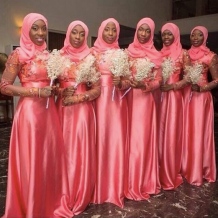
The last UK census undertaken in 2011 showed that Black Muslims made up 10.1% of the British Muslim population, not counting Muslims of mixed Black heritage. The British Black Muslim reality is whispered in hushed tones: it is the Jamaican converts frequenting inner-city mosques, the Nigerian doctors administering your prescriptions, Somali working mothers who nurse the aged in recession-hit care homes. We navigate a precipice few would want to tiptoe in 21st century Britain: the two-pronged realities of unbridled Islamophobia and established racism.
Black British Muslims possess our own distinctive heritage spanning centuries of blood, nobility and disenfranchisement. When Elizabeth I wrote of the need to control the number of ‘blackmoores’ brought into her realm, she was speaking of the many Black interpreters, musicians, servants and sailors who inhabited major English cities in the 1600s. This was a multi-ethnic and certainly multi-faith populace, hailing from what we now know as Ghana, Guinea and North Africa’s much-debated Moors who entertained King James IV’s Scottish court. Somali seamen could even be found serving in the Royal Navy or clustered in 19th century Cardiff and Liverpool. I was born in London to parents who had previously sought education and employment in Saudi Arabia, Lebanon, Egypt and India.
Full article Monday, 26 December 2016
Europeans greatly overestimate Muslim population, poll shows
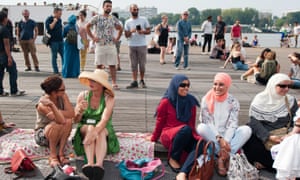
Members of the public in European states including France, Belgium, Germany and the UK greatly overestimate their country’s Muslim population and the rate at which it is growing.
An Ipsos Mori survey that measured the gap between public perception and reality in 40 countries in 2016 found French respondents were by far the most likely to overstate their country’s current and projected Muslim population.
The average French estimate was that 31% of the population was Muslim – almost one in three residents. According to Pew Research, France’s Muslim population actually stood at 7.5% in 2010, or one in 13 people.
French respondents were also widest of the mark when it came to the projected Muslim population in 2020. The average prediction was that Muslims would make up 40% of the French population in four years’ time, almost five times the 8.3% Pew Research projection.
The French were not the only ones to hold such misconceptions: Italian, German and Belgian respondents all guessed that more than a fifth of the resident population was Muslim, while in reality the figure ranges from 3.7% in Italy to 7% in Belgium. All three countries also greatly overstated the expected proportion of Muslim residents in 2020.
Friday, 23 December 2016
Wednesday, 21 December 2016
Tuesday, 20 December 2016
The Prophet Muhammad’s Birthday: Are We Able to Rejoice?

The Quran advises: “‘Let them rejoice at God’s bounty and mercy; it is better than all they accumulate.’” It also mentions in regards to the Prophet Muhammad: “It was only as a mercy that We sent you [Prophet] to all people”.
As Muslims around the world celebrate the birth of the Prophet Muhammad, I find myself asking: how can people whose hearts are filled with deep sadness truly rejoice? From Palestine, Syria, Iraq, Yemen, Egypt, Libya, Somalia, Burma, Afghanistan, Sudan—the list goes on—people are suffering; many mothers are weeping bitterly over children they have lost.
Is there any room left in people’s hearts for joy after all this tragedy?
I’ve found that there is some light in the darkness that engulfs us. The Prophet was born into a world that was witness to great persecution and maltreatment. His birth signalled an end to that era with a message relevant for all human beings. In this there is hope for us today.
The internal change he brought about in the human soul is what strikes me most about the Prophet. He altered the perception that people had about fellow human beings. In a society like pre-Islamic Arabia this was a phenomenal undertaking. One event in his life sticks out in particular as a demonstration of this mission.
The Prophet was once walking along the road with a group of his companions when a woman with a mental condition stopped him and asked to speak to him alone. He responded by saying: “I am at your service, O mother of so and so” which was an affectionate way to address someone in that culture. He then requested that she choose a street in which they could converse. She was overjoyed and rushed to a nearby street. The Prophet followed her while the Companions stood watching this whole episode. He sat on the ground in front of the woman while she explained her problems, making hand gestures to clarify her point. He spoke to her with gentleness and compassion, answered her questions and then returned to his Companions and they continued on their way.
The Prophet looked at this world through the eye of mercy. His mercy was harmonious with the correct etiquette in mixing and living among people and interacting with them. These are universal human qualities that we, and others, should strive to attain.
One of the Prophet’s customs was to stand outside the mosque after the dawn prayer and meet the poor and destitute. They would bring water containers with them to the mosque in the hope of having the Prophet bless their water. To please them, he would still bless the water by placing his fingers in it, despite the severe winter cold of Madina.
If a slave-girl of Madina came to him and took him by the hand to accompany her while she ran her errands he would go along with her without taking his hand away. If he met a man and spoke to him, he would not be the first to turn his face away. If they shook hands he would not be the first to take his hand away. If he was sitting with a group of people he was never once seen putting his knees in front of the person he was sitting with.”
We know this about the Prophet because his actions were witnessed by his companion and assistant, Anas. In the ten years that Anas served the Prophet, he described his experience with these words: “I was in the service of the Prophet for ten years and he never once insulted me, struck me, scolded me or frowned at me. He never once commanded me to do something and then rebuked me if I was slow to do it. If one of the members of his household rebuked me, he would say: “Leave him, for had something been destined to happen, it would have happened.” He added: “He never once rebuked me for doing something wrong.”
The Prophet’s wife Aisha said of him: “There was no one better in character than the Prophet; whenever one of his Companions or one of the members of his household called him, he would answer by saying: ‘At your service.’”
The Quran described him as having “a tremendous character”.
The absolute failure of our communicating, mixing and interacting with each other is a common factor in the upheavals sweeping societies in the east and west. Perfecting our dealings with each other is a remedy for the tumultuous circumstances, turmoil and calamity that we see present around us. This is the universal lesson that the Prophet taught.
Monday, 19 December 2016
Sunday, 18 December 2016
Aleppo is about the sanctity and dignity of each and every human life

As a Muslim, I find my community in selective outrage. The same desire for moral consistency applies to us as Americans. Today I watched with admiration the powerful words of Ambassador Samantha Powers speaking at the United Nations, addressing Russia and Iran:
“Are you truly incapable of shame? …
Is there no act of barbarism against civilians,
no execution of a child,
that gets under your skin, that just creeps you out,
just a little bit?”
Yes, these are powerful words. I found myself nodding in agreement. Yet I wonder where the same moral outrage was in our own country’s use of drones against Pakistan, Afghanistan, Yemen, Somalia, Libya, Iraq and Syria. Where was the same outrage when we bombed wedding parties and blew grandmothers to smithereens? Where was this moral display in Abu Ghraib and the forced feeding of prisoners at Guantanamo Bay, Cuba? Where is the moral speaking to power when we destroyed Iraq and Afghanistan, enable the Israeli occupation of Palestine by providing both military and political cover for Israel, and expedited shipment of weapons to Saudi Arabia to wreak havoc upon Yemen?
SourceFriday, 16 December 2016
Thursday, 15 December 2016
Crossing the Styx: Conversion Story

Love this brother alhamdulilah his blog his well worth reading.
I moved on from Christianity and studied many other religions. Based on the above, all religions of cyclical time were immediately eliminated from consideration. All religions of a polytheistic nature were also eliminated. Christianity was eliminated from consideration and all I had left was – Judaism. Islam was never on the list. I did not like the ‘Islam’ portrayed by the Muslims. Judaism seemed the perfect initial fit. After all, Christianity developed as a Jewish sect. And yet, after much study, Judaism itself was found wanting.
One day, the clerk at the finance office asked me, why I never thought of becoming a Muslim. I replied quite indignantly that I would never, ever convert. But surely Allah (s.w.t.) has a sense of humour. One day, I passed by a bookshop in Arab street and on a whim, I bought an English translation of the Qur’an. I read it on the bus on the way back. And I could not put it down. I read it over days afterward and I looked up the exegesis of the passages. I bought a copy of the story of Muhammad (s.a.w.). The first sirah book was Shaykh Martin Ling’s (q.s.) ‘Life of Muhammad’. Now, this Muhammad (s.a.w.), this was a man I could follow.
It was a shock to the system and I remember that I had a very high fever for days. I went back to Novena church almost every evening and sat in the pew outside long after the rest of the church was closed. Only these days, I stayed until well into the morning and I had the King James’ Version of the Bible in one and the ‘Abdullah Yusuf ‘Ali (r.a.) translation in the other. This went on for several nights. This ummah that I read about; that was what I wanted to be part of. And Jesus (a.s.) was no longer a Pharisee wandering rabbi; he was a prophet of God. And Muhammad (s.a.w.) was indeed the final Messenger and the evidence of everything, I found in the Bible. It was in the beginning that I found the end of the search. Most importantly, the Qur’an is about tawhid. And the exercise that I had done to find out that God is One was done, perhaps more than 5,000 years earlier by Abraham (a.s.).
Then I read the story of Pharaoh, when the seas closed in, he said, “I believe in the God of Moses.”
And God Replied; “Now you believe? It is too late. You had every chance before this.” I remembered that storm in 1994 that began this journey. But I was given that chance. I believed in the God of Moses (a.s.), the God of Jesus (a.s.) and finally, the God of Muhammad (s.a.w.). It was there, alone in the dark, at three in the morning, 06th December, 1999 that I said the shahadah. I did the sujud in the church, near the altar. It was not most conventional thing to do. But that was how my voyage as a Muslim began.
Subscribe to:
Posts (Atom)