
Friday, 13 August 2010


Thursday, 12 August 2010
A Secret History

For Muslims and non-Muslims alike, the stock image of an Islamic scholar is a gray-bearded man. Women tend to be seen as the subjects of Islamic law rather than its shapers. And while some opportunities for religious education do exist for women — the prestigious Al-Azhar University in Cairo has a women’s college, for example, and there are girls’ madrasas and female study groups in mosques and private homes — cultural barriers prevent most women in the Islamic world from pursuing such studies. Recent findings by a scholar at the Oxford Center for Islamic Studies in Britain, however, may help lower those barriers and challenge prevalent notions of women’s roles within Islamic society. Mohammad Akram Nadwi, a 43-year-old Sunni alim, or religious scholar, has rediscovered a long-lost tradition of Muslim women teaching the Koran, transmitting hadith (deeds and sayings of the Prophet Muhammad) and even making Islamic law as jurists.
Akram embarked eight years ago on a single-volume biographical dictionary of female hadith scholars, a project that took him trawling through biographical dictionaries, classical texts, madrasa chronicles and letters for relevant citations. “I thought I’d find maybe 20 or 30 women,” he says. To date, he has found 8,000 of them, dating back 1,400 years, and his dictionary now fills 40 volumes. It’s so long that his usual publishers, in Damascus and Beirut, have balked at the project, though an English translation of his preface — itself almost 400 pages long — will come out in England this summer. (Akram has talked with Prince Turki al-Faisal, Saudi Arabia’s former ambassador to the United States, about the possibility of publishing the entire work through his Riyadh-based foundation.)
The dictionary’s diverse entries include a 10th-century Baghdad-born jurist who traveled through Syria and Egypt, teaching other women; a female scholar — or muhaddithat — in 12th-century Egypt whose male students marveled at her mastery of a “camel load” of texts; and a 15th-century woman who taught hadith at the Prophet’s grave in Medina, one of the most important spots in Islam. One seventh-century Medina woman who reached the academic rank of jurist issued key fatwas on hajj rituals and commerce; another female jurist living in medieval Aleppo not only issued fatwas but also advised her far more famous husband on how to issue his.
Not all of these women scholars were previously unknown. Many Muslims acknowledge that Islam has its learned women, particularly in the field of hadith, starting with the Prophet’s wife Aisha. And several Western academics have written on women’s religious education. About a century ago, the Hungarian Orientalist Ignaz Goldziher estimated that about 15 percent of medieval hadith scholars were women. But Akram’s dictionary is groundbreaking in its scope.
Indeed, read today, when many Muslim women still don’t dare pray in mosques, let alone lecture leaders in them, Akram’s entry for someone like Umm al-Darda, a prominent jurist in seventh-century Damascus, is startling. As a young woman, Umm al-Darda used to sit with male scholars in the mosque, talking shop. “I’ve tried to worship Allah in every way,” she wrote, “but I’ve never found a better one than sitting around, debating other scholars.” She went on to teach hadith and fiqh, or law, at the mosque, and even lectured in the men’s section; her students included the caliph of Damascus. She shocked her contemporaries by praying shoulder to shoulder with men — a nearly unknown practice, even now — and issuing a fatwa, still cited by modern scholars, that allowed women to pray in the same position as men.
It’s after the 16th century that citations of women scholars dwindle. Some historians venture that this is because Islamic education grew more formal, excluding women as it became increasingly oriented toward establishing careers in the courts and mosques. (Strangely enough, Akram found that this kind of exclusion also helped women become better scholars. Because they didn’t hold official posts, they had little reason to invent or embellish prophetic traditions.)
Akram’s work has led to accusations that he is championing free mixing between men and women, but he says that is not so. He maintains that women students should sit at a discreet distance from their male classmates or co-worshipers, or be separated by a curtain. (The practice has parallels in Orthodox Judaism.) The Muslim women who taught men “are part of our history,” he says. “It doesn’t mean you have to follow them. It’s up to people to decide.”
Neverthless, Akram says he hopes that uncovering past hadith scholars could help reform present-day Islamic culture. Many Muslims see historical precedents — particularly when they date back to the golden age of Muhammad — as blueprints for sound modern societies and look to scholars to evaluate and interpret those precedents. Muslim feminists like the Moroccan writer Fatima Mernissi and Kecia Ali, a professor at Boston University, have cast fresh light on women’s roles in Islamic law and history, but their worldview — and their audiences — are largely Western or Westernized. Akram is a working alim, lecturing in mosques and universities and dispensing fatwas on issues like inheritance and divorce. “Here you’ve got a guy who’s coming from the tradition, who knows the stuff and who’s able to give us that level of detail which is missing in the self-proclaimed progressive Muslim writers,” says James Piscatori, a professor of Islamic Studies at Oxford University.
The erosion of women’s religious education in recent times, Akram says, reflects “decline in every aspect of Islam.” Flabby leadership and a focus on politics rather than scholarship has left Muslims ignorant of their own history. Islam’s current cultural insecurity has been bad for both its scholarship and its women, Akram says. “Our traditions have grown weak, and when people are weak, they grow cautious. When they’re cautious, they don’t give their women freedoms.”
When Akram lectures, he dryly notes, women are more excited by this history than men. To persuade reluctant Muslims to educate their girls, Akram employs a potent debating strategy: he compares the status quo to the age of al jahiliya, the Arabic term for the barbaric state of pre-Islamic Arabia. (Osama Bin Laden and Sayyid Qutb, the godfather of modern Islamic extremism, have employed the comparison to very different effect.) Barring Muslim women from education and religious authority, Akram argues, is akin to the pre-Islamic custom of burying girls alive. “I tell people, ‘God has given girls qualities and potential,’ ” he says. “If they aren’t allowed to develop them, if they aren’t provided with opportunities to study and learn, it’s basically a live burial.”
When I spoke with him, Akram invoked a favorite poem, “Elegy Written in a Country Churchyard,” Thomas Gray’s 18th-century lament for dead English farmers. “Gray said that villagers could have been like Milton,” if only they’d had the chance, Akram observes. “Muslim women are in the same situation. There could have been so many Miltons.”
Dont Be Sad: Patience is most fitting

Those who meet hardship with a strong bearing and a patient countenance are in the minority. But we must consider this, though it may seem obvious: if you or I will not be patient, then what else is there for us to do? Do you have an alternative solution? Do you know of any provision that is better than patience?
Those that achieve greatness have to surmount an ocean of difficulties and hardships before finally achieving success. Know that each time you escape a difficulty you will have to face another. Through this constant conflict, you must arm yourself with patience and a strong trust in Allah.
This is the way of the noble-minded: they face difficulties with firm resolution, and they wrestle hardship to the ground.
Therefore be patient and know that your patience is only through Allah. Have the patience of one who is confident of forthcoming ease, of one who knows that there will be a good ending, and of one who seeks reward from his Lord, hoping, that by facing difficulties, he will find expiation for his sins. Have patience, no matter what the difficulty and no matter how dark the road ahead seems. For truly, with patience comes victory, and with difficulty relief follows close behind.
After having read biographies of some successful people from the past, I became amazed at the amount of patience they displayed, at their ability to bear heavy burdens only to emerge as stronger human beings. Hardship fell upon their heads like the lashing of freezing rain and yet they were as firm as mountains. And then, after a short time had passed, they were rewarded for their patience with success.
Source: Don't Be Sad - By Aaidh ibn Abdullah al-Qarni
Wednesday, 11 August 2010
Saudi man with 58 wives stirs polygamy debate

In 50 years, he says, he has married 58 women and has forgotten the names of most of them. He knows he has had 10 sons, but ask about daughters and he counts on his fingers: 22. No, no, 28. No, that's too many. He settles on 25.
Saleh al-Sayeri, a 64-year-old shepherd-turned-businessman, says his marital adventures have cost him more than $1.6 million in wedding expenses and settlements for divorced wives. But the man who remembers being forced into his first marriage at age 14 says he'd do it a million times over.
"Marriage doesn't bore me," he said, relaxing on cushions at a carpeted, open-air reception area in his 22-horse stable in Usfan, in the desert 500 miles west of Riyadh. "I'm the happiest man in the world."
Al-Sayeri's story might seem a bizarre curiosity, but it touches a nerve in Saudi Arabia, the status of whose women is a matter of international controversy.
When it surfaced in Saudi media in March, some readers reacted angrily.
A woman who identified herself as Maryam, a convert to Islam, wrote to the Arab News, an English-language daily, that al-Sayeri's story "really sent me over the edge."
"What kind of a family structure is this? What is divorce doing to the psychologies of the ex-wives and children? How can this man devote any quality time to his children — teaching them about Islam and being a constant role model?" She wrote.
Sayyidaty magazine, which interviewed al-Sayeri, also spoke to psychiatrist Mona al-Sawwaf who said al-Sayeri does not treat a wife as a human being "but as a piece of clothing he can change whenever he pleases or an object."
"The biggest blame lies with the parents" who let their daughters enter such marriages, she said.
Al-Sayeri dismisses such critics as "crazy," insisting he is not breaching Islamic laws, which permit a man to have four wives at a time.
"I have a clear conscience," he said.
None of Al-Sayeri's ex-wives could be reached. He said many have remarried, but to reveal their identity would be a gross violation of Saudi custom. One of his sons said his mother has remarried, but refused to give details.
Divorce has become quite common in the kingdom, with press reports saying half of all marriages break up. But the fate of a divorced woman depends on her parents' frame of mind. If they oppose the divorce, they likely will confine her to the house and monitor her movements. She will be barred from dating or working without family permission.
The notion of a single career woman barely exists here. Women cannot even drive. They cannot get an education, travel or check into a hotel without a male guardian's permission.
Some parents, on the other hand, are modern-minded enough to let their daughters finish their schooling or go out to work. And although Islamic laws permit a man to have four wives at a time, most Muslim men today take one wife, because it has become the cultural norm and polygamy is costly.
Money is not an issue for al-Sayeri, who says he has made a fortune trading in cars and property. He is a dark, medium-built man with black mustache and goatee who heads the Sayer, a southern Bedouin tribe. He also raises camels and horses.
He has had 10 sons, one of whom died. Two sons who were at the stable while their father was being interviewed rolled their eyes whenever the subject of marriages came up. They said they had come to accept that their dad is "mizwaj," a man who likes to marry often.
Fahd al-Sayeri, who inherited his father's passion for horses, recalled a desert hunting trip some 15 years ago in the remote Empty Quarter. He and his friends had gone in search of gasoline when they heard celebratory gunshots coming from a tent. They had come across a wedding.
"Out of politeness, we asked who's wedding it was," Fahd said.
"The guests responded with my father's name. I was shocked," he added.
It's not that the elder al-Sayeri hides his marriages. He just doesn't always bother to spread the word. He said two of his daughters learned they were sisters and two sons they were brothers at school.
Some wives even attend his weddings and bring the bride gifts. But he said he keeps each wife in a separate villa and sometimes even in a different town to keep the peace, and assures each that she's his favorite.
Son Fahd, a 32-year-old bachelor, is adamant he won't follow in his father's footsteps. "No, no, no," he said. "One will be enough for me."
Al-Sayeri said he has married first cousins and women from about 30 tribes all over the kingdom. "As a leader of a tribe, I can't marry just anybody," he said.
He said three of his four current wives have been with him 18 to 40 years. The fourth seems to be the one who usually gets replaced.
"It's the one for renewal," said al-Sayeri, sipping cardamom-flavored coffee after a dinner of spicy lamb and rice. "I like to change my fourth wife every year."
His latest marriage — and at 10,000 guests his most sumptuous — was to a 14-year-old girl nine months ago. She was the perfect age, he said.
When he heard about her, he sent his niece to check her out. She came back with a favorable report.
Then he visited her family. When the girl came into the living room to offer him refreshments — an excuse for him to see her face — he asked her if she would marry him.
"She was shy at first and didn't answer but then she said yes," al-Sayeri recalled. "Now, we're such good friends it feels we've known each other 40 years."
A Saudi woman will usually marry whomever her family chooses, and marriage is considered acceptable from the onset of puberty.
Al-Sayeri claims he has never forced a woman to marry him, and has never been turned down. His ex-wives get a divorce settlement set out in a prenuptial agreement and he supports the children, he said. He said all his divorces are documented with court-issued papers that usually follow this declaration to his wife: "You are divorced."
He said today's women are "more pleasant to have around."
"They take better care of themselves, use makeup and do not run away every time I want to touch them," he said.
Al-Sayeri said he will keep on marrying until the number of wives he has acquired equals the number of years he has lived.
Hadith: Ramadan

Narrated by Abu Huraira (RA): I heard Allah’s Apostle (peace be upon him) saying regarding Ramadan, “Whoever prayed at night in it (the month of Ramadan) out of sincere Faith and hoping for a reward from Allah, then all his previous sins will be forgiven.”[Bukhari Volume 3, Book 32, Number 226]
Friday, 6 August 2010
Israeli rabbis clamp down on burka

At the insistence of the husbands of some burka-wearing women, a leading rabbinical authority is to issue an edict declaring burka wearing a sexual fetish that is as promiscuous as wearing too little.
A small group of ultra-orthodox Jews in the town of Beit Shemesh chose to don the burka, usually associated with women in repressive Islamist regimes, three years ago in a bid to protect their modesty.
Since then, the habit has spread to five other Israeli towns causing alarm among ultra-orthodox religious leaders who once saw it as a relatively harmless eccentricity – even though the number of Jewish burka wearers is not thought to be more than a few hundred.
“There is a real danger that by exaggerating, you are doing the opposite of what is intended [resulting in] severe transgressions in sexual matters,” Shlomo Pappenheim, a member of the rabbinical authority preparing to make the edict, was quoted as saying.
Ultra-Orthodox women are required to dress conservatively and keep their heads covered with a scarf, hat or wig when in public.
But even that was not enough for some, who insisted that only by covering their faces and wearing multiple layers of clothes to hide the shape of their bodies can they really be chaste.
"At first, I just wore a wig," one burka-wearing woman told the Haaretz newspaper. "Now when I see a woman with a wig, I pray to God to forgive her for wearing that thing on her head."
Since donning the burka, the woman said she had been taunted by neighbours who called her a "smelly Arab" and that Israeli soldiers had asked to see her identification papers to prove she was not a Muslim. They backed down, she said, when she showed them that her children were clearly Jewish.
The trend has also caused tensions in family life. One man went to a rabbinical court in an attempt to get a ruling to force his wife to stop wearing the burka.
The plan backfired, however. The court ruled that that woman's behaviour was so "extreme" that it ordered the couple to undergo an immediate religious divorce.
Thursday, 5 August 2010
Church plans Quran-burning event

(CNN) -- In protest of what it calls a religion "of the devil," a nondenominational church in Gainesville, Florida, plans to host an "International Burn a Quran Day" on the ninth anniversary of the September 11, 2001, attacks.
The Dove World Outreach Center says it is hosting the event to remember 9/11 victims and take a stand against Islam. With promotions on its website and Facebook page, it invites Christians to burn the Muslim holy book at the church from 6 p.m. to 9 p.m.
"We believe that Islam is of the devil, that it's causing billions of people to go to hell, it is a deceptive religion, it is a violent religion and that is proven many, many times," Pastor Terry Jones told CNN's Rick Sanchez earlier this week.
Jones wrote a book titled "Islam is of the Devil," and the church sells coffee mugs and shirts featuring the phrase.
Muslims and many other Christians -- including some evangelicals -- are fighting the initiative.
The church launched a YouTube channel to disseminate its messages.
"I mean ask yourself, have you ever really seen a really happy Muslim? As they're on the way to Mecca? As they gather together in the mosque on the floor? Does it look like a real religion of joy?" Jones asks in one of his YouTube posts.
"No, to me it looks like a religion of the devil."
The Islamic advocacy group Council on American-Islamic Relations called on Muslims and others to host "Share the Quran" dinners to educate the public during the monthlong fast of Ramadan beginning in August. In a news release, the group announced a campaign to give out 100,000 copies of the Quran to local, state and national leaders.
"American Muslims and other people of conscience should support positive educational efforts to prevent the spread of Islamophobia," said CAIR spokesman Ibrahim Hooper in the release.
The National Association of Evangelicals, the nation's largest umbrella evangelical group, issued a statement urging the church to cancel the event, warning it could cause worldwide tension between the two religions.
"The NAE calls on its members to cultivate relationships of trust and respect with our neighbors of other faiths. God created human beings in his image, and therefore all should be treated with dignity and respect," it said in the statement.
Dove's Facebook page, set up for the September event, has more than 1,600 fans.
"Eternal fire is the only destination the Quran can lead people to, so we want to put the Quran in it's [sic] place -- the fire!" the page says.
But another Facebook group with more than 3,100 fans says it stands "against the disrespect and intolerance that these people have for the Muslim people" and encourages people to report Dove's page to Facebook.
Targeting another group it calls "godless," the Dove center is also hosting a protest against Gainesville Mayor Craig Lowe, who is openly gay, on Monday at Gainesville's City Hall. The group previously fought -- unsuccessfully -- to derail Lowe's election campaign.
"We protest sexual perversion because the Bible protests it. ... What is acceptable to today's leadership becomes acceptable to tomorrow's society," the church says in its blog entry about the event.
Lowe and other government figures and media outlets received e-mails from the church about the event, The Gainesville Sun reported. Lowe isn't concerned with Monday's event.
"I've got other things to do," he said, The Sun reports.
On the outreach center's front lawn, alongside a sign reading "Aug. 2 Protest, No Homo Mayor, City Hall," stands not just one, but three signs bearing the slogan "Islam is of the Devil."
One of the signs -- one reading "Islam" on one side, "Devil" on the other -- was vandalized. On its blog last week, the church said the sign will be replaced.
"This is private property and vandalism is a crime here in America," the blog says. "In Islam, many actions that we consider to be crimes are encouraged, condoned or sheltered under Islamic teaching and practice, though. Another reason to burn a Quran."
source
Wednesday, 4 August 2010
Fury as Israel president claims English are 'anti-semitic'

Shimon Peres said England was "deeply pro-Arab ... and anti-Israeli", adding: "They always worked against us."
He added: "There is in England a saying that an anti-Semite is someone who hates the Jews more than is necessary."
His remarks, made in an interview on a Jewish website, provoked anger from senior MPs and Jewish leaders who said the 87-year-old president had "got it wrong".
But other groups backed the former Israeli prime minister and said the number of anti-semitic incidents had risen dramatically in the UK in recent years.
The controversy follows the furore last week over David Cameron's remark that Gaza was a "prison camp", as he urged Israel to allow aid and people to move freely in and out of the Palestinian territory.
Mr Peres, a Nobel Peace Prize winner who is three years into his seven-year term as president and was awarded an honorary knighthood by the Queen in 2008, said that England's attitude towards Jews was Israel's "next big problem".
"There are several million Muslim voters, and for many members of parliament, that's the difference between getting elected and not getting elected," he said.
"And in England there has always been something deeply pro-Arab, of course, not among all Englishmen, and anti-Israeli, in the establishment.
"They abstained in the [pro-Zionist] 1947 UN partition resolution ... They maintained an arms embargo against us in the 1950s ... They always worked against us. They think the Arabs are the underdogs."
By contrast, relations with Germany, France and Italy were "pretty good", he added.
He made the comments in an interview with the historian Professor Benny Morris of Ben-Gurion University of the Negev published last week in Tablet, a Jewish news website.
The wide-ranging interview covered Mr Peres' role as one of Israel's longest-serving political leaders – an MP for 48 years, twice prime minister, and holder of other ministerial posts over the decades. He is firmly on the Israeli Left.
He was awarded Nobel Peace Prize in 1994 jointly with Yitzhak Rabin and Yasser Arafat for his part as foreign minister in the peace talks which produced the landmark Oslo Accords.
But following his comments, James Clappison, the Conservative MP for Hertsmere and vice-chairman of Conservative Friends of Israel, said: "Mr Peres has got this wrong.
"There are pro- and anti-Israel views in all European countries. Things are certainly no worse, as far as Israel is concerned, in this country than other European countries."
The MP added that he could "understand the frustration" that people in Israel felt with "certain elements of the British broadcast media" which present an unbalanced view of Israel.
He said: "I can understand Mr Peres' concerns, but I don't recognise what he is saying about England."
Yet in Israel, Mr Peres is far from alone in holding such views, which have gained a wider following, particularly on the Right, since the expulsion of an Israeli diplomat over accusations that Mossad sent agents using British passports to assassinate a Hamas commander in Dubai.
Aryeh Eldad, a right-wing member of the Israeli parliament, the Knesset, accused Britain of working against Israeli interests for decades – ever since it "betrayed" its promises to build a Jewish homeland when it governed Palestine under a League of Nations mandate.
"Both governments from the right and the left prefer Arab interests over Israeli interests," said Mr Eldad, whose father Israel was a leading figure in the Stern Gang, the most radical of the Jewish terror groups that fought British mandatory rule.
"The other layer is an ongoing, subtle form of anti-semitism. It is not as overt as it was in Germany, it is a quiet, polite form."
Some leading Jewish commentators in Britain disagreed. Rabbi Dr Jonathan Romain, minister of Maidenhead synagogue and a writer and broadcaster, said: "I am surprised at Peres. It is a sweeping statement that is far too one-sided.
"Britain has supported both Israel and Arab causes at different periods over the last 50 years. There are elements of anti-semitism but it is not endemic to British society.
"The tolerance and pluralism here make Britain one of the best countries in the world in which to live."
Mr Peres found support, however, from other pro-Israeli groups. Jacob Vince, the director of Christian Friends of Israel, said there was anti-semitism in the UK although many people had a positive view of Israel but were unwilling to express it publicly.
Mr Vince said it was "difficult to see how many MPs would not be influenced by the number of Muslim voters in their constituencies".
The Government was not treating Arabs as the underdogs but rather was trying to appease them, he said. "The question is how well they understand those with whom they are seeking conciliation."
Mr Peres is "measured and moderate," he added.
He said: "His comments have serious connotations and I am sure would not be said lightly."
One Israeli politician expressed disbelief that the doveish Mr Peres had launched such a broadside against the British.
Benny Begin, a cabinet minister whose father Menachem was prime minister and before that leader of Irgun, the group that killed 91 people in an attack on Jerusalem's King David Hotel in 1946, said: "Peres? I simply can't believe he said that."
The latest figures show that the number of anti-semitic incidents in Britain is rising, according to the Community Security Trust (CST), a charity set up in 1984 to monitor such incidents.
The situation in Britain had worsened "significantly" in the past decade, a spokesman said.
In 2009 there were 924 anti-semitic incidents, the highest figure since CST began keeping records in 1984, and 55 per cent higher than the previous record in 2006.
The figures include reports, accepted only when backed by evidence, of physical assaults, verbal abuse and racist graffiti.
The monthly figure has soared from 10-20 incidents in the 1990s to 40-50 now.
Last year nearly half of the 924 anti-semitic race attacks recorded by the CST showed a political motivation, with 66 per cent of those including some reference to Israel and the Middle East.
A 2009 report by the US-based Anti-Defamation League found one in five Britons admitted Israel influences their opinion of British Jews, and the majority of those said that they felt "worse" about Jews than they used to. It found, however, that Britain was less anti-semitic than other European countries.
Tuesday, 3 August 2010
Sayeeda Warsi: 'What I find amazing is the media's obsession with having to define me'
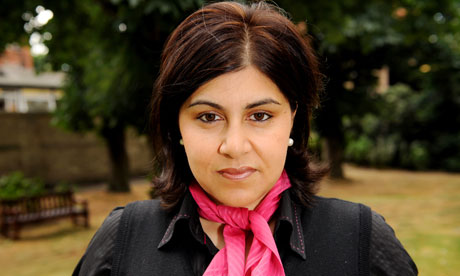
In all the fuss preceding Nick Griffin's appearance on Question Time last October, the great debate was about whether the programme would – as Griffin was gleefully predicting – promote the BNP to "the big time". As usual, Griffin turned out to be wrong. On the night, the star performance came from Baroness Sayeeda Warsi – a little known Tory peer, and relative newcomer to national politics, whose consummate demolition of the BNP leader made Jack Straw and Chris Huhne look like amateurs. If anyone joined the big time that night, it was Warsi.
To give Griffin his due, he was right about one thing. The show was indeed a golden opportunity to transform public perceptions of a party widely regarded as racist, anti-immigrant and resoundingly white. But it was the Conservatives who seized it – for there on our screens was a confident, likable, modern Muslim woman, the antithesis of a stereotypical Tory and apparently proof that David Cameron's Conservatives were no longer the nasty party.
Eight months on – and only eight years into her political career – at 39 Warsi is now one of the most powerful women in the country. Chair of her party, with a seat in cabinet as minister without portfolio, Warsi has been given a wide-ranging brief to work across government. As the former shadow minister for community cohesion and social action, she will be expected to focus foremost on social cohesion, and on the elusive matter of mending "broken Britain".
Her admirers make much of her down-to-earth appeal – her lack of airs and graces, her common touch, her common sense – all of which are apparent as soon as we meet. Over a KitKat and a cup of tea, she chats about motherhood, reapplies a quick dab of her daughter's Boots No 17 lip gloss, and poses for photos with a businesslike air of let's-get-on-with-it.
Warsi's brisk manner is that peculiarly Yorkshire blend of cheerful and grumpy – and she certainly wants you to know that's where she's from, for she references her Yorkshire roots with somewhat tiresome frequency. "There are parts of West Yorkshire," she points out proudly, "that I can reach, which maybe if you were from a different part of the country with a different accent it would be harder to reach."
She does indeed have a Yorkshire accent – but then, so do William Hague and Eric Pickles, so this could hardly be described as her USP. In terms of perspective and personal identity, surely what she brings to the cabinet table is gender, faith and ethnicity; Cameron has said as much himself, as have other colleagues, so you'd think this was pretty self-evident. Yet strangely, the only person who doesn't seem to agree is Warsi. In fact, she gets quite angry with me for suggesting such a thing – and by the time I leave, the interview has more or less descended into a row.
Warsi wouldn't disagree that her views are an interesting mixture of traditional and modern. An outspoken opponent of the Iraq war, she has called for dialogue with hardline Muslim groups, argued for asylum seekers to be granted the right to work, and criticised anti-terror legislation for radicalising Muslim youths. She would definitely, she has joked, fail Norman Tebbit's cricket test; when England play Pakistan, her loyalty lies firmly with with the latter. When Cameron made her a peer in 2007, Conservative Home ran an article by officials from the Margaret Thatcher Centre For Freedom, condemning her appointment as "the wrong signal at a time when Britain is fighting a global war against Islamic terrorism and extremism".
Warsi has also, however, said that BNP supporters have "some very legitimate views", described immigration as "out of control", and criticised the Archbishop of Canterbury for suggesting that sharia law in parts of Britain could foster social cohesion. In Luton last year she was pelted with eggs by Muslim protestors, who accused her of not being "a proper Muslim". Warsi had an arranged marriage at 19, but divorced in her early 30s, and was a single mum (her daughter, 13, goes to a convent school) before recently remarrying, to a Muslim divorcee. The extremist preacher Anjem Choudary has warned that "she is in danger", for "betraying Allah" and becoming "a 'coconut' – brown on the outside but white on the inside".
Exactly where Warsi sits in the whole debate about multiculturalism versus integration is not obvious, so I ask her to define her position. "Well I think there's a difference between multiculturalism per se, and state multiculturalism, where the state intervenes and says, 'You will do this, you will do that.'" For example, she offers, "When the state says 'We'll have winterfest instead of Christmas, so everyone feels included.' That's wrong."
But surely it's the state's decision either way? Whether schools call it winterfest or Christmas, it's still the state's decision. She disagrees: "A school should have the freedom to decide. If you have a school in the middle of a diverse society with lots of ethnic communities, then the head teacher in their professional judgment should know the best way to make everyone feel included. It's not for the state to say. 'You will teach A, B and C.'" That sounds like an objection to state centralisation rather than an argument specifically about multiculturalism. "Yes but it's also to do with state multiculturalism. For example, there was a county court that didn't put tinsel on its public desk because they thought it would offend! You see, that's the state intervening, saying you can't have tinsel there."
If she disapproves of state intervention so much, presumably she doesn't support the government's recent decision to make it a condition of entry for immigrants coming to join their spouses in Britain that they must learn to speak English first.
"No, not at all, I do support it. If you're saying, are you a multiculturalist or an integrationist, I'm an absolute believer in multiculturalism per se, where people have the right in their private lives to do what they want – as long as when it comes to the public sphere there is an acceptance of what the mainstream culture is, and our values and principles are. And our values and principles are about giving everyone an equal opportunity to improve their lives through economic involvement. They will not be able to do that if they don't speak the language of the land. We have to be quite clear about what people are joining here, and that includes having to join the language."
For Warsi, however, it doesn't include having to show your face in public, and she is vehemently opposed to a ban on the burka. "Why should we tell women what to wear? What it boils down to is choice. If women don't have a choice over what to wear then they are oppressed. But if a woman has a choice, and she chooses to wear whatever she chooses to wear, then she's not oppressed, is she? She's choosing what she wants."
I'm not sure why a woman can choose to wear what she wants, but not choose to speak what she wants. "Well just because a woman wears the burka, it doesn't mean she can't engage in everyday life." Some would argue, on the contrary, that in this country it does; that the burka alienates and disturbs to an extent that it creates a barrier between the wearer and the western world around her. "But there are women who wear the burka who run extremely successful businesses – internet businesses, which don't actually require you to be there face to face," she retorts. Which may well be true – but would only support Warsi's argument if what she really objects to is immigrants not earning money, rather than being ghettoised.
I'm sure Warsi does care about more than money. I'm just trying, I say, to identify your consistent principle which says no to banning the burka, but yes to making immigrants speak English. "The principle," she says, looking increasingly exasperated, "is one of equality and opportunity!"
Warsi talks passionately about the isolation and abuse of immigrant women without English, unable to understand their rights in this country or ask for help. It's unfortunate that the Pakistani ex-wife of Warsi's new husband recently claimed that she cannot speak or read English, so didn't understand he was divorcing her, and mistook the decree nisi for a utilities bill. The family row has been played out in the pages of a Sunday tabloid paper, and Warsi understandably refuses to discuss it.
But she must understand better than most the difficulty for many poor women in remote rural countries to access education and learn English. Far from giving them an equal opportunity, the government is arguably denying them the opportunity to come here at all – where it could ensure that they learned English – by making them stay in a country where it has no influence at all over their access to education. And what about spouses who have no intention of working in this country, but legitimately wish to lead a quiet and private domestic life?
"No, but coming to Britain is a privilege," she says flatly. "It's not an automatic right."
Warsi's own father arrived in Yorkshire from Pakistan in 1960, with £2.50 to his name, and she credits his work ethic – "the belief that if you work hard you can achieve anything" – as the guiding political philosophy of her life. The second of five sisters, she grew up in a working class, Labour-voting household – until her father started his own furniture business, became rich and joined the Conservative party. Educated at comprehensive school and Leeds University, Warsi became a lawyer and set up her own practice in Dewsbury. It was only in 2002 that she became involved in politics – and when Oliver Letwin heard her speak at a party conference fringe meeting the following year he suggested she stand for parliament in Dewsbury in 2005. She lost, but was made a peer two years later, and appointed to the shadow cabinet.
Her core political values, she has often said, are belief in the free market and individual liberty. But she also said in the past that what made her at Tory, more than anything else, was Labour's attitude to ethnic minorities. She said once that when she heard Alan Johnson refer to "leaders of the Muslim community", she thought, "I couldn't sit in a cabinet of people who still think like that; that somehow there are these alien groups in our nation, each of them represented by a leader who talked to the government on their behalf. It's almost the kind of approach of 'we know what's best for you brown people.' I find that patronising."
When I suggest that Johnson was perhaps just describing pluralism, she snaps: "That's not pluralism! You can't divide people on that basis." But it sounds as if her real anger was towards the "self-appointed religious leaders – men, you know, in beards" claiming to speak on her behalf – and she tells me she got involved in politics because, "I just felt, post 9/11, that the national voices weren't necessarily the voices of what ordinary people thought. That wasn't what the majority of British Muslims were feeling. I've always been confident in my identity, and I thought the whole debate needed to be had from the perspective of someone who was confident."
That sounds like a reasonable desire to offer herself as an alternative representative – a role not unlike the one she got so angry with Johnson for describing. Now she starts to look really annoyed.
"When I'm here at Central Office I'm identified by the fact that I'm part of the Conservative family. Why should I be identified on the grounds of my race or religion? What I find amazing is the media's obsession with having to define me."
But it's not the media, I point out – it's her leader. "She is the first Muslim in a cabinet or shadow cabinet," was Cameron's proud boast on The Andrew Marr Show within days of her appointment in 2007 – a view echoed by her colleague Andrew Mitchell, who declared, "She clearly has a reach within and outside the party which others of us don't have." Another hailed her as "a bridge builder – a thoroughly modern British Muslim woman."
If she doesn't like these labels, I ask, why did she accept an award last year from the Equality and Human Rights Commission as Britain's most powerful Muslim woman? "You should listen to the acceptance speech I made," she huffs. I did, I say, and quote it: "I hope in five years we don't have this award, because actually we should be taking it for granted that British Muslim woman are powerful."
It sounded like a sensible acknowledgement that we're not there yet, and a hope that her success might help us in that direction. To have a female Muslim cabinet minister is so clearly a cause for celebration that her reluctance now to acknowledge it makes little sense. It makes a bit more sense when she adds, "For someone like me, from 2005 to now, there have always been people on the sidelines who wondered if I'm a token appointment, if I'm being used. Am I going to spend the rest of my life trying to convince them otherwise? No of course not. I can't be bothered."
But it's hard to escape the impression of Warsi wanting to have her cake and eat it. If she's happy for her party to present her as the poster girl for the newly inclusive Conservatives, it seems a bit rich to object when anyone else talks about her in such terms. "I'm actually bored of these interviews, with all due respect," she says crossly. "And with this constant obsession with who are you, what's your identity, what is it that you stand for?"
Then, for a moment, the mood seems to lighten. "It's about," she says, "bringing additional value to the table. Your race, your ethnicity, your origin, your background – they all bring additional value." Finally, we seem to have arrived at a point of agreement. So when she says, "Did David want me to do Question Time because I was a brown woman? Or did David think she was a bloody solid media performer?" The answer seems obvious. Doesn't she think it was both?
"No, I don't!" she snaps. "I absolutely think it's the second one."
source
Monday, 2 August 2010
Subscribe to:
Posts (Atom)