Wednesday, 6 December 2017

Distinguished New York City imam preaches tolerance, unity

Executive Director of the New York University Islamic Center and New York City Police Department Chaplain Khalid Latif delivered the annual MacVittie Theology Lecture on Tuesday Nov. 14. Latif  foregrounded intercultural dialogue and understanding between dissimilar peoples. (Keith Walters/campus photographer)
Religion has a galvanizing force that can catalyze both prejudice and social change. Geneseo highlights this power with the annual MacVittie Theology Lecture: “Racialized Religion.” 
Executive Director of the New York University Islamic Center and Chaplain for the New York Police Department Khalid Latif spoke on Tuesday Nov. 14 for the Robert MacVittie lecture series. 
“The reality that numerous minority populations in this country face … are things that we have to be acutely aware of,” Latif said. “Foundationally, in my opinion, we can understand the country to be rooted in anti-blackness.”
Latif clarified the insidious ways that prejudice can even affect people like him, despite his privileged position as a leader in the New York City Muslim community. 
“I’ve shared stages with the Dalai Lama, been interviewed by Stephen Colbert and Katie Couric, been on the cover of Newsweek,” Latif said. “I’ve still had the FBI up in my house … despite all that though, I can’t tell you what it’s like to be black in America.”
Latif further wove his own experiences, his theology and the perspectives of others into a series of interconnected stories. One of the main memories focused on the different ways people treated him and other Muslims who lived in New York City during and after the World Trade Center attack on Sept. 11, 2001. 
As a Muslim student at NYU on 9/11, Latif was often shoved into the spotlight as people profiled and either verbally or physically attacked people they thought looked Muslim. Following 9/11, Latif experienced Islamophobia in the form of questioning at the ninth anniversary 9/11 ninth anniversary ceremony. 
“I was at the ceremony in my police uniform—an Inspector’s uniform—talking and mingling, but I still had my beard and my head cover,” Latif said. “Three men approached me wearing suits and said that Secret Service had spotted me from the top of a building and wanted to check my credentials ‘just in case.’” 
Latif urged the audience to use the tenets of love and religiosity when approaching injustice in the United States and the world.  Latif—who recently accompanied international aid organizations on a relief trip for Rohingya Muslims refugees in Bangladesh—emphasized the apparent Western disregard toward the ongoing genocide in Myanmar of Rohingya Muslims.
Above all, Latif implored the audience to really listen and try to understand other people, especially those who are unlike themselves. The only way to approach the crises and injustices that pervade the country and the world today is through a real love and devotion for other people, according to Latif.
“You are at a university—a space that embraces and appreciates dialogue and diversity,” Latif said. “You can sit down and become informed and then you think of yourselves as potential partners.”
https://www.thelamron.com/posts/2017/11/16/distinguished-new-york-city-imam-preaches-tolerance-unity

Tuesday, 5 December 2017

Mohammed’s Law: when in doubt, blame the Muslims

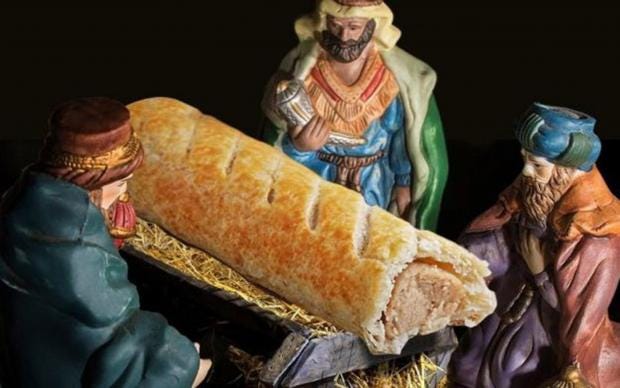
In a genius marketing move or a brainfart, Greggs the Great British High Street bakery did a sausage-of-Nazareth nativity scene for its Advent calendar that went viral. As a form of self-flagellation, I listened to the backlash about this unexpected pork-based blasphemy on a radio phone-in. It was pretty early on into the festivities that the phrase “They wouldn’t do this to the Muslims” was proffered as reasoned, un-seasoned and a very seasonal form of analysis by callers to the aforementioned radio show.
This religiously incorrect “they wouldn’t do this to the Muslims” straw man could have been dispelled by the host of the show – Jesus (Isa AS) is a revered prophet for Muslims, and as any self-respecting patriot knows, pork-based products are kryptonite for Muslims and especially Mosques, yet it was treated as Informed Comment and echoed by many callers during the show.
Now, I’m not privy to the private machinations of Greggs HQ, but I am willing to bet my steak bake that this bangers and nativity scene probably wasn’t an actual unholy trinity between ISIS, Iran and the bakery’s PR team, to make Dave with the crusader knight profile picture incandescent with rage. So why mention Muslims and Islam at all, and more importantly, why no pushback from those who should know better?
In trying to explain the phenomenon of linking Muslims with something as innocuous and non-Muslim related as a pasty-based marketing ploy, you have to name it, so I did. I call it Mohammed’s Law, named after my favourite uncle who is always complaining “what’s that got to do with Islam?” upon reading something in the papers that had nothing to do with Islam or Muslims but nonetheless mentions either or both.
Mohammed’s Law asserts that as an online discussion grows longer or a radio phone-in on LBC gets to its third caller, the probability of a comparison involving Muslims/Islam approaches; that is, if an online or radio discussion (regardless of topic or scope) goes on long enough, sooner or later someone will compare something non-Muslim related (sausage rolls) to something Muslim related (Ramadan).
Mohammed’s Law is an offshoot of blaming British Muslims for everything that 1.6 billion Muslims around the world might do, to just blaming Muslims for everything because it just feels right. It’s the jumping of the figurative gun in relation to the Oxford Circus panic, whereby the Daily Mail and an assortment of far-right agitators started to speculate/salivate that it was terror-related and/or most probably Muslim related, or at the very least something to do with gangs of rampaging immigrants – when the vast majority of publications and responsible tweeters (apart from Olly Murs) rightly held back on speculation.
So what is the genesis of Mohammed’s Law? You can trace its baby-in-the-manger birth to the comment section of any number of “there’s halal in our water!” stories in national papers and far-right publications. It gained further traction on social media championed by far-right celebrities their figurative hats upturned for donations and glory. For a while, Mohammed’s Law was underground: a punky, edgy take. Then it gained respectability and has in the past few years gone mainstream.
But in 2017 it’s reaching a dangerous tipping-point now we’re talking about a ‘Muslim Problem’, a term straight out of the Nazi playbook used to demonise Jews in the 30’s.
This obsession with commenting about Muslims and anything Islam-related is not just confined to British Muslims as some amorphous and foreign “other” to be scrutinised and linked to something on a Greggs menu at Christmas. Attacks on visible Muslims are also the norm. If you follow the likes of Mehdi Hasan on Twitter and read the comments left for him when tweeting something mundane; within a couple of minutes you’ll see responses like “Your Prophet is a paedo.”
But it goes further than Islamophobic comments on social media; Muslims are increasingly being questioned for being Muslim and doing a job, even if it has nothing to do with their religion, as witnessed in an op-ed piece by Kelvin McKenzie on Fatima Manji that asserted that because she was a visible Muslim in a headscarf this was offensive and she shouldn’t be doing her job and reporting on the Nice ISIS-inspired terror attack.
Islamophobia has, as Baroness Warsi once suggested, passed the dinner table test and is now prevalent in every comment section or radio phone-in, even if recipient or subject matter has no connection to Islam. It’s in the non-threatening actions of Nadiya Begum sharing Christmas recipes and getting backlash for being Muslim and appropriating Christmas from the same vocal sectors of society who for the preceding months and days share stories about Muslims from Birmingham – and its always Muslims from Birmingham – trying to cancel Christmas and not integrating enough.
The Muslim community in the UK has become a recognised measure of how bad or good a certain topic is, or whether or not it deserves prominence in the news cycle of the day depending on whether it has a Muslim protagonist. “We wouldn’t do that to the Muslims” and its bedfellow “But what about the Muslims?” has become a lazy trope, a yardstick for how all society is now judged.
Full article

Friday, 1 December 2017

Exclusive: The Crusader Sub-Culture in the US Military

USMC Marine with "Kafir"/Infidel Tattoo
The US military’s “Islam problem” captured news headlines even before Wired.com ‘s 2012 breaking story about a military course teaching soldiers that the USA was at “war with Islam.” Since 2007 the Military Religious Freedom Foundation (MRFF) and its founder Mikey Weinstein have diligently documented violations of religious freedom within the military. During that time many of MRFF’s documentation of violations have included cases of anti-Islam/Muslim propaganda and activities.
In addition to these very troubling stories reported in the mainstream press and by rights organizations, Islamophobia Today has uncovered facts indicating that the pervasive “Crusader” sub-culture within the ranks of Islamophobes isn’t limited to internet forums and blogs but also exists within the US Military.
Anti-Muslim/Islam and pro-Crusader themes tied to military-use paraphernalia, including: T-Shirts, insignias, bullet coating, rifle scope cases as well as tattoos inscribed “Kafir,” and “Infidel” have become common within a sub-set of the US military.
Full article

Thursday, 30 November 2017

Gender violence in India: 'Daughters are not a burden'

Parveen Khan as a child. She was savagely bitten by her husband after she gave birth to a second daughter [Al Jazeera]
Three years into her marriage, Khan got pregnant with her first child. Hameed was not very excited about it and expressed his wish for a son.
"Nine months passed and I gave birth to a baby girl. Hameed stormed out of the hospital when he looked at our daughter," Khan recalled.
When she was expecting for the second time, Hameed insisted the baby should be aborted if it was a girl.
"Three months into my pregnancy, Hameed took me to the hospital to find out the gender of my baby. I screamed and cried, but he pulled me from my hair and dragged me to the hospital to find out," Khan said.
"Without asking me, he forced me inside the hospital to get the baby girl aborted."
Her husband forced her to abort for the third time after finding out that it was a baby girl.
"I was shattered, heartbroken and could not recover from the trauma of two innocent babies being murdered just because of their gender."
Two back-to-back abortions in one year weakened Khan and a year later she suffered a miscarriage. In the course of two years, she had lost three children and the mental trauma and physical exhaustion took a toll on her.
"I hated myself for a very long time, could not be happy and kept mourning for my lost children."
Link

Wednesday, 29 November 2017

Thanksgiving and Muslim Heritage

As American Muslims, should we stand with the Pilgrims or the Indians?
Since Abraham Lincoln issued a proclamation in 1863 in the midst of the Civil War, Americans have celebrated a November Thursday as a day of Thanksgiving and Praise. Since 1970, a Native American group in New England has observed this same day as a National Day of Mourning. They are descendents of the indigenous Wampanoag Indians who encountered the Pilgrims that landed at Plymouth Rock. Each year at Plymouth Rock itself, the group - along with hundreds of allies - mourn the theft of their lands and food by the Pilgrims, and the enslavement and subjugation of their ancestors. At the same time, they also look forward to an America filled with justice and freed of brutality.
So, should American Muslims give thanks and praise the Creator, or should we mourn on this day? We should both give thanks and remember the past. We should stand in earnest compassion with the Pilgrims and in genuine solidarity with the Indians, helping each in their needs. As the Prophet Muhammad, peace and blessings be upon him, said: "A person should help his brother whether he is the oppressor or the oppressed. If he is the oppressor he should prevent him from doing so, for that is his help; and if he is the oppressed he should be helped against oppression."
As Muslims, we should always be thankful and truly grateful for all that we have. Although things could be better, things could also always be much, much worse. We should be mindful of the distance we need to go ? as individuals, as a community and as a country. As America marks a Day of Thanksgiving, let American Muslims also commit ourselves to both an unfailing gratitude and to the struggles for racial and economic justice and peace.
Let's make this a day of thanksgiving and remembrance of our heritage as American Muslims. Let's recount the good and the bad, so we can better understand our role in America in these remarkable times.
This Thanksgiving, let's remember the Muslims who arrived in America in the hulls of slave ships after crossing the Middle Passage. After all, Malcolm X did say, "We didn't land on Plymouth Rock; Plymouth Rock landed on us!" Historians estimate that a quarter of African slaves brought to America were Muslim. When Alex Haley traced his Roots, he traced them through Kunte Kinte to a Muslim village in West Africa. Historian Sylviane Diouf has eloquently described this experience in her book "African Muslims Enslaved in the Americas". Let's give thanks for those lifted out of slavery, and for the dignity in struggle of the late Rosa Parks and her generation.
Let's remember the vision of religious pluralism of our Founding Fathers. According to James Hutson, chief of the Library of Congress' Manuscript division, the Founding Fathers - especially Thomas Jefferson & George Washington - "explicitly included Islam in their vision of the future of the republic". Thomas Jefferson was more proud of his effort to pass Virginia's landmark Statute for Establishing Religious Freedom in 1786 than he was of his presidency. (Some say a future president would be similarly more proud of his stint as the manager of baseball team in Texas.) In his Autobiography, Jefferson praised the Virginia Statute's "mantle of protection," which included "the Jew and the Gentile, the Christian and Mahometan, the Hindoo and the Infidel." Let's give thanks for the religious freedoms we enjoy.
Let's remember the hand of friendship extended by the Sultan of Morocco, who made Morocco the first country to recognize the independence of the United States. Isn't it amazing that it is a Muslim land that has that honor? The 1787 Treaty of Friendship and Cooperation between Morocco and the United States stands as the basis for the longest unbroken treaty relationship between the US and any foreign country in the history of the Republic. Let's give thanks for those sincere efforts at peacemaking and bridge building in our time.
Let's remember the great American landmark, the Washington Monument on the Capitol Mall in Washington, DC. It was completed in the 1880s in part with the gift of funds from the Ottoman sultan in Istanbul, who as Caliph was also the figurehead leader of all Muslims. The Sultan's subjects included the populations of today's Middle East hotspots: Iraq, Israel, Jordan, Lebanon, Palestine, Syria, and Saudi Arabia. If you go to the Washington Monument, you can see the Sultan's commemorative plaque inside the Monument, which features a specially commissioned calligraphed poem in the Arabic script for the American people. Let's give thanks for wisdom, foresight, and small kindnesses in our leaders, communities, and families.
Let's remember the first American colonial conquest and occupation in the Muslim world which occurred during the Philippines-American War in the early 20th century, a war in which about 1.4 million Filipinos died. General Pershing accomplished in 10 or so years what the Spanish couldn't in 400 years. Fresh from fighting the Sioux at Wounded Knee, Pershing helped conquer the Muslim Moro peoples of the southern Philippines. The Colt .45 Gun, which was the standard issue handgun of the US Armed Forces until 1985, was invented specifically for the conquest of the Muslim Moro peoples. In one fateful siege, the Battle of Bud Bagsak, American troops killed 2000-3000 Muslim men, women, and children. Let's give thanks for those Muslims and Christians in the Philippines and around the world who are today breaking barriers and working for a new dawn free of oppression, exploitation and hate.
Let's all remember our own shortcomings, and give thanks for the infinite mercy, forgiveness, and love of our Creator.
Let's give thanks. Let's pray and work for a future of peace, justice, and nonviolence.
Link

Tuesday, 28 November 2017

How Israel is 'cleansing' Palestinians from Greater Jewish Jerusalem


 Israel is putting in place the final pieces of a Greater Jewish Jerusalem that will require “ethnically cleansing” tens of thousands of Palestinians from a city their families have lived and worked in for generations, human rights groups have warned.
The pace of physical and demographic changes in the city has accelerated dramatically since Israel began building a steel and concrete barrier through the city’s Palestinian neighbourhoods more than decade ago, according to the rights groups and Palestinian researchers.
Israel is preparing to cement these changes in law, they note. Two parliamentary bills with widespread backing among government ministers indicate the contours of Jerusalem’s future.
One bill intends to annex to Jerusalem some 150,000 Jews in illegal West Bank settlements surrounding the city. As well as bolstering the city’s Jewish population, the move will give these additional settlers a vote in Jerusalem’s municipal elections, pushing it politically even further to the right.
Full article

Monday, 27 November 2017

Why Quran calls woman a tilth for man?

Image result for tilth

Q-Is it not a fact that "ISLAM CONSIDERS WOMEN TILTH FOR MEN" and thus degrades them?
ANS: The verse they refer to is as under;
"Your wives are as a tilth unto you; so approach your tilth when or how ye will; but do some good act for your souls beforehand; and fear Allah. And know that ye are to meet Him (in the Hereafter), and give (these) good tidings to those who believe." (Al-Quran 2:223)
Yes, woman is called the tilth for man, but it is not that a parallel is being drawn between her and tilth. Actually it is a simile, that it is man whose seed a woman carries in her womb. It is in this context that this simile is given for understanding. For those who really understand the Quran, this verse asks for better attitude towards women. you see, a farmer looks after his tilth, waters it, protects it against all climate conditions. In the same way man is supposed to take every care of woman, for he has been given more physical strength and has been made her protector and manager of her affairs.
INDEED ALLAH KNOWS THE BEST!

Sunday, 26 November 2017

Islamic schools in Pakistan plagued by sex abuse of children

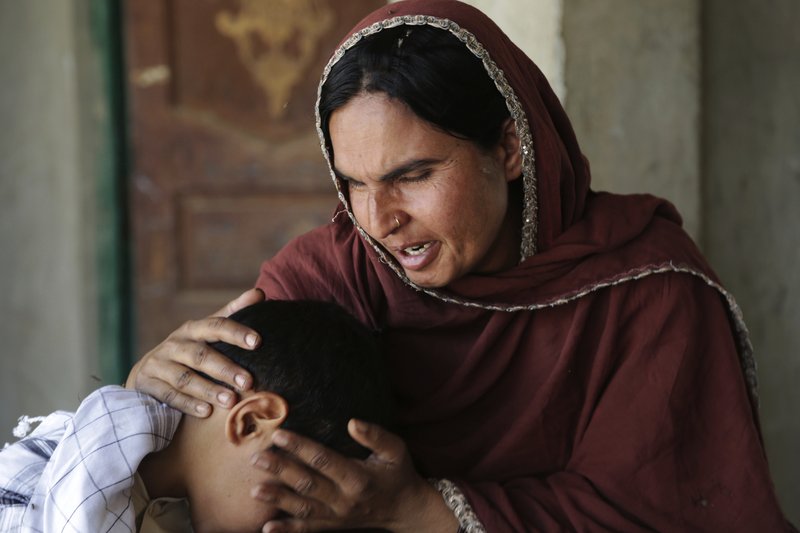
Kausar Parveen struggles through tears as she remembers the blood-soaked pants of her 9-year-old son, raped by a religious cleric. Each time she begins to speak, she stops, swallows hard, wipes her tears and begins again.

The boy had studied for a year at a nearby Islamic school in the town of Kehrore Pakka. In the blistering heat of late April, in the grimy two-room Islamic madrassa, he awoke one night to find his teacher lying beside him.
“I didn’t move. I was afraid,” he says.
The cleric lifted the boy’s long tunic-style shirt over his head, and then pulled down his baggy pants.

“I was crying. He was hurting me. He shoved my shirt in my mouth,” the boy says, using his scarf to show how the cleric tried to stifle his cries. He looks over at his mother.
“Did he touch you?’” He nods. “Did he hurt you when he touched you?” ″Yes,” he whispers.
“Did he rape you?” He buries his face in his scarf and nods yes.
Parveen reaches over and grabs her son, pulling him toward her, cradling his head in her lap.

Sexual abuse is a pervasive and longstanding problem at madrassas in Pakistan, an AP investigation has found, from the sunbaked mud villages deep in its rural areas to the heart of its teeming cities. But in a culture where clerics are powerful and sexual abuse is a taboo subject, it is seldom discussed or even acknowledged in public.
It is even more seldom prosecuted. Police are often paid off not to pursue justice against clerics, victims’ families say. And cases rarely make it past the courts, because Pakistan’s legal system allows the victim’s family to “forgive” the offender and accept what is often referred to as “blood money.”

The AP found hundreds of cases of sexual abuse by clerics reported in the past decade, and officials suspect there are many more within a far-reaching system that teaches at least 2 million children in Pakistan. The investigation was based on police documents and dozens of interviews with victims, relatives, former and current ministers, aid groups and religious officials.

The fear of clerics and the militant religious organizations that sometimes support them came through clearly. One senior official in a ministry tasked with registering these cases says many madrassas are “infested” with sexual abuse. The official asked to remain anonymous for fear of retribution; he has been a target of suicide attacks because of his hard position against militant groups.